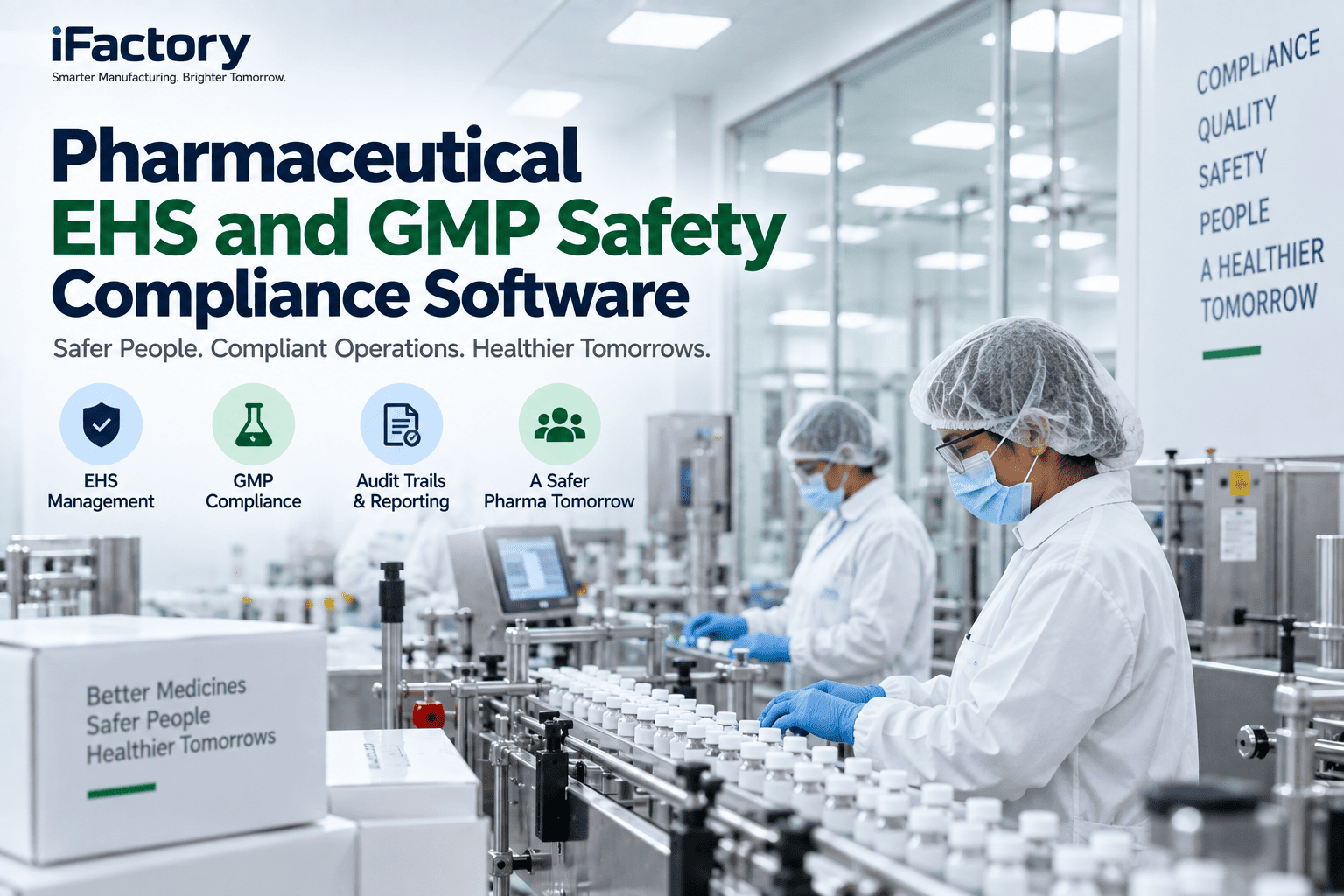
Pharmaceutical safety operates in a regulated space no other industry has: GMP requirements under 21 CFR 210/211 for product integrity sit alongside OSHA 29 CFR 1910 for worker safety, and the two frequently touch the same activities. Cleanroom gowning is both a product-contamination control and a worker-exposure control. Solvent handling in API synthesis is both a process-safety and a fume-exposure question. Change control under 21 CFR 211.100 has to satisfy both the QA reviewer and the safety reviewer. When these run in separate systems, gaps open at the seams — and both FDA inspection and OSHA enforcement find them. Software that bridges GMP and EHS discipline in one system is not a nice-to-have; it is validation-ready EHS.
iFactory / Pharmaceutical EHS + GMP safety
Bridge GMP and EHS Discipline — In One Validation-Ready System
Manage chemical safety, cleanroom compliance, solvent handling, containment, and change control with the audit trail 21 CFR Part 11 requires and the risk assessment ICH Q9 expects — while satisfying OSHA and EPA obligations at the same site.
GMP
Product integrity
21 CFR 210/211
ICH Q7 · Q9 · Q10
SHARED
Cleanroom · solvents
containment · training
change control
EHS
Worker safety
29 CFR 1910
EPA · state regs
Part 11
21 CFR audit trail
ICH Q9
quality risk management
OSHA + FDA
dual-regulator ready
The Problem in Pharma Safety
A pharma manufacturing site operates two parallel systems that touch the same activities. The QA function runs deviations, change controls, and CAPAs in a validated quality system per 21 CFR Part 11 with electronic-signature discipline. The EHS function runs incidents, JSAs, industrial-hygiene monitoring, and chemical inventory in a separate platform that was never validated because it was never seen as GxP. When a solvent-handling incident occurs, the same event needs a QA deviation, an EHS incident, and a change-control if the fix modifies a validated procedure. Three systems, three records, three review cycles — and every seam is where FDA inspection finds evidence of poor integration.
Where the Pharma EHS Chain Actually Breaks
Pharma safety compliance fails at the GMP/EHS seam in specific ways at almost every regulated site. Each is a finding category on both FDA 483s and OSHA citations.
Split incident records
Solvent spill in production. QA logs product-impact deviation. EHS logs worker-exposure incident. Change control on procedure fix runs separately. Three systems, three timelines, no unified view.
Cleanroom dual control
Gowning procedure serves both product-contamination and worker-exposure controls. Change to the procedure needs QA and EHS review. Runs through QA only; EHS finding at OSHA audit.
Chemical inventory drift
EHS chemical inventory maintained for OSHA HazCom. QA maintains a separate raw-materials list for GMP. New API-adjacent solvent added; only one system catches it. Reconciliation gap widens.
Training system split
GMP training in the validated LMS. EHS training in a separate system. Worker in cleanroom passes GMP training but is not current on the solvent-exposure training — and no cross-check exists.
What Good Looks Like in Pharma EHS
A working pharma EHS system holds four disciplines together — unified incident and event capture across GMP and EHS lenses, integrated chemical and material control, cross-functional change management, and validated audit trail per 21 CFR Part 11.
Unified Event Record
Every incident captured once with both GMP (product impact, batch quarantine) and EHS (worker exposure, environmental release) attributes. One record, one timeline, one closure.
One record, two lenses
Chemical + Material Control
One inventory that serves EHS HazCom and GMP raw-materials tracking. SDS management, exposure-band classification, and API/API-intermediate profile in one system.
One inventory, one truth
Integrated Change
Change control routing that includes QA, EHS, and validation reviewers where the change touches their scope. No procedure change goes live without the required review from every regulated function.
No seam gaps
Part 11 Audit Trail
Every record with e-signature per 21 CFR Part 11, time-stamped audit trail per action, version control on every SOP reference — validation-ready for FDA inspection and OSHA record request.
Validation-ready
How iFactory AI Fits
iFactory AI overlays your validated QMS (Veeva Vault, MasterControl, TrackWise), LMS (ComplianceWire, Veeva Quality), and existing EHS platform — adding the integrated GMP/EHS event, chemical, and change-control workflow with 21 CFR Part 11 compliant audit trail.
Unified Event
EHS + QMS
Every incident, near miss, and observation captured once with GMP and EHS attributes. Routing to QA deviation, EHS incident, and change-control workflows from one record.
Material Ledger
EHS + QMS
Chemicals, APIs, intermediates, and consumables in one ledger with SDS, exposure profile, GMP category, and inventory location. Serves both HazCom and raw-material control.
Integrated Change
EHS + QMS + LMS
Change control that routes to QA, EHS, and validation reviewers as required by the change scope. Training assignments in the validated LMS triggered on approval.
Part 11 Trail
Compliance Layer
21 CFR Part 11 compliant e-signature, time-stamped audit trail, and version control on every record. IQ/OQ/PQ validation package included.
Ask your QA head and your EHS manager to independently produce the record of the last solvent-related incident on the site — deviation, worker report, change control. If the three records don't reconcile, the FDA and OSHA are each looking at half a picture. Book a pharma EHS review.
16-Week Rollout on One Manufacturing Suite
One manufacturing suite (or one production line) in a regulated pharma site, sixteen weeks. The pilot deploys the integrated event, chemical, and change workflow with 21 CFR Part 11 validation for the suite scope.
Weeks 1–4
URS + Validation Plan
User requirements specification and validation plan drafted. IQ/OQ/PQ scope defined. QA and EHS jointly review and approve. Configuration decisions locked before build.
Weeks 5–8
Configure + IQ/OQ
System configured for the pilot suite. Chemical ledger loaded from combined EHS and GMP sources. Event workflow configured. IQ and OQ executed and approved.
Weeks 9–13
PQ + Go-Live
PQ executed against real workflows. Pilot suite go-live. First real incidents, chemical changes, and procedure changes flow through the integrated workflow. Deviations logged and closed.
Weeks 14–16
Audit Simulation
Simulated FDA and OSHA audit runs. Records produced on demand. Full-site rollout scoped based on record-completeness and cross-functional review coverage.
Who Owns the KPI
Pharma EHS crosses QA, EHS, validation, and site operations. Each function owns a specific KPI or the integration collapses back into two systems.
EHS Manager
Incidents with dual-lens capture
Owns the safety completeness — every incident captured with both GMP and EHS attributes at first record. Post-hoc reconciliation is where the picture breaks.
QA Head
Change controls with cross-function review
Owns the QMS integrity — every change control with the correct reviewer set for the scope of change. Missing an EHS review on a solvent-handling change is a 483 finding waiting.
Validation Lead
System state per 21 CFR Part 11
Owns the validation posture — the system's Part 11 compliance state, IQ/OQ/PQ currency, and change-control on the system itself. GxP-ready is the requirement, not the target.
Site Head
Regulator findings across GMP and EHS
Owns the outcome — count and severity of findings from FDA inspections and OSHA visits. Integrated system posture is what makes both defensible.
FAQ
Does this replace our existing QMS — Veeva Vault, MasterControl, TrackWise?
No. The QMS remains the source of truth for GMP deviations, CAPAs, complaint handling, and batch record review. This layer sits alongside — adding the EHS attributes to events, the integrated chemical/material control, and the cross-functional routing for changes that touch both functions. Veeva Vault, MasterControl, TrackWise, and Sparta Systems all integrate through their standard APIs. What you gain is the GMP/EHS bridge that no dedicated QMS covers well; what you keep is your validated quality system.
What is required to validate this per 21 CFR Part 11 — will it slow our compliance schedule?
The validation package (URS, functional specification, IQ/OQ/PQ protocols, validation summary report) is delivered as part of the pilot. Your QA validation team reviews and approves per your existing SOP for computerized system validation. A typical pilot to validated go-live runs 16 weeks for one manufacturing suite; full-site rollout depends on scope. Where you already have a validated QMS and LMS, we integrate at the API level rather than replacing — which limits the validation scope to the new workflow and its interfaces, not the systems it connects to.
Book a demo to see the validation package structure.
How does this handle the FDA data integrity expectations — ALCOA+?
ALCOA+ (Attributable, Legible, Contemporaneous, Original, Accurate, plus Complete, Consistent, Enduring, Available) is met through the 21 CFR Part 11 architecture: every record with attributable user ID and role, e-signature at approval, time-stamped audit trail per action, versioned SOP references, and retention per your site's validated retention policy. Data-integrity findings on FDA 483s (Warning Letters increasingly cite ALCOA+ specifically) center on undocumented changes, back-dated entries, and shared credentials — all of which the workflow explicitly prevents.
Stop running GMP and EHS in parallel systems that never reconcile.
Walk One Incident Through the Integrated Workflow — Live
Bring one recent solvent-handling or chemical incident from your site and the current deviation, EHS incident, and change-control records for it. We'll walk the integrated workflow that would have produced one unified record and demonstrate the Part 11 audit trail structure.