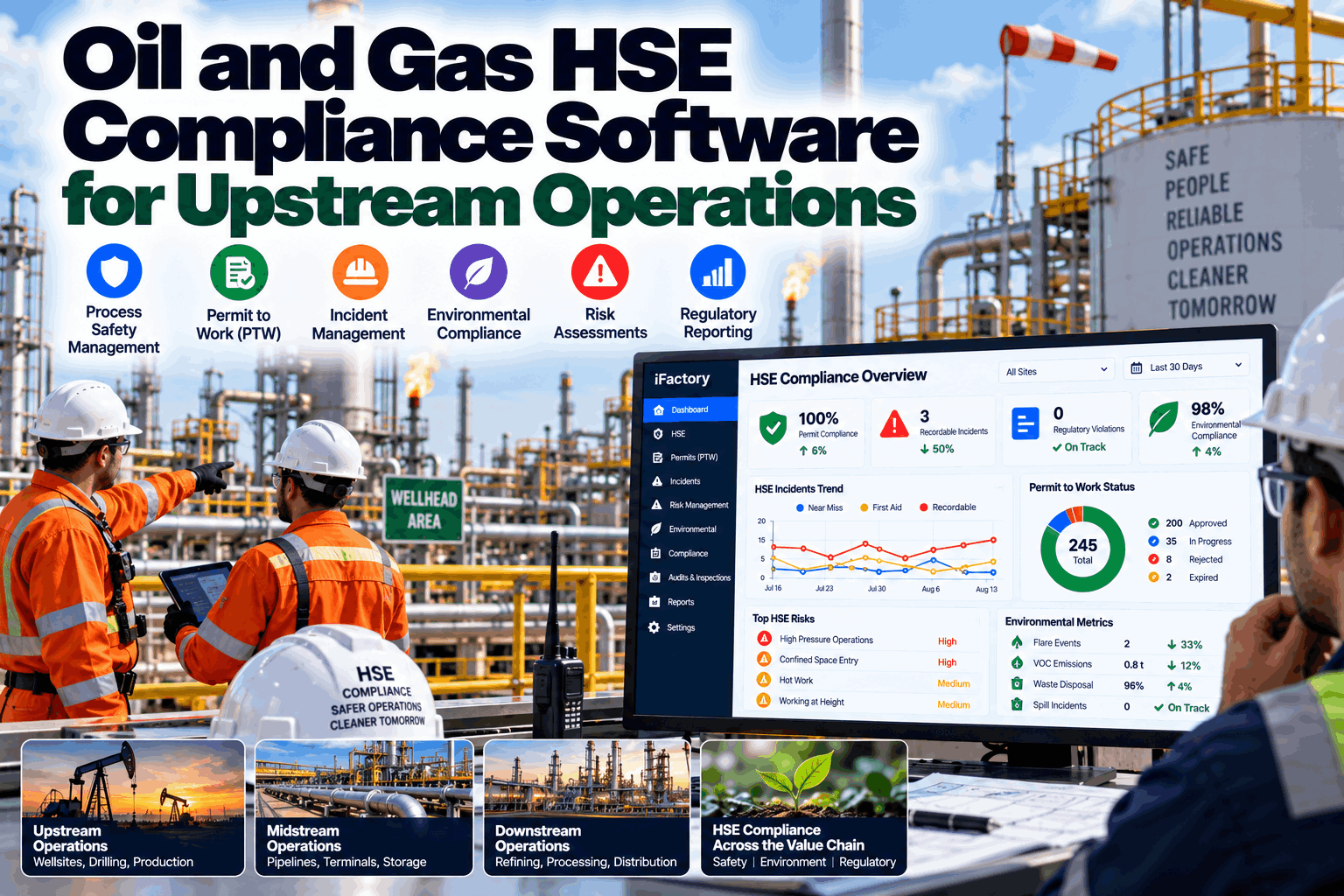
Oil and gas HSE teams manage some of the highest-consequence work in industry across sites that are remote, spread out and heavily staffed by contractors, under rules that differ by segment and keep changing. A well pad, a compressor station and a refinery unit answer to different regulators, but the same HSE manager is expected to prove all of them are under control. iFactory brings permits, isolations, process safety events, emissions records and contractor compliance into one HSE system for upstream operations, extending into midstream and downstream sites, with vision AI where fixed cameras cover the work. Book a 30-minute review of HSE compliance across your oil and gas operations.
Permits, process safety, emissions and contractors, managed in one HSE record across well pads, compressor stations and plants, whatever each segment’s regulator asks for.
At a Glance
Why Oil and Gas HSE Is Harder Than Plant EHS
The Bureau of Labor Statistics’ 2024 census of fatal injuries puts the extraction sector at roughly four times the all-worker fatality rate. Transportation incidents, the leading fatal event across all industries, weigh heavily on field operations, where crews drive long distances between sites. Add dispersed locations with minimal on-site supervision, a workforce that is often majority contractor, and high-energy work such as well intervention, hot tapping and confined-space entry, and the HSE challenge looks very different from a single manufacturing plant.
The regulatory picture is just as fragmented. A single operator may answer to OSHA, EPA, PHMSA, BSEE and several state agencies at once, and the rules that apply depend on segment, location and even the quantity of hazardous material in a process.
The Regulatory Map, Segment by Segment
| Segment | Primary regimes | What the HSE record must show |
|---|---|---|
| Upstream onshore | OSHA general industry standards; OSHA PSM applies to some production and separation facilities by quantity, while well drilling and servicing and normally unoccupied remote facilities are excluded; EPA NSPS OOOOb and EG OOOOc for methane and VOC; state programs | Permits and isolations, leak detection and repair, flare and control-device records, vehicle and journey management |
| Upstream offshore | BSEE Safety and Environmental Management Systems (SEMS), 30 CFR 250 Subpart S, built on API RP 75 | SEMS elements, audits, management of change, stop-work authority records |
| Midstream | PHMSA pipeline safety at 49 CFR 192 (gas) and 195 (hazardous liquids), including integrity management and operator qualification; EPA OOOOb/c at compressor stations | Integrity activities, operator qualification, station permits, emissions and leak repair |
| Downstream | OSHA Process Safety Management (1910.119); EPA Risk Management Program (40 CFR 68); API RP 754 process safety indicators | PSM elements, management of change, mechanical integrity, Tier 1–4 event trends |
| All segments | EPA Greenhouse Gas Reporting Program Subpart W for petroleum and natural gas systems; OSHA recordkeeping | Emissions source data, OSHA 300 logs, incident investigations |
PSM applicability in upstream depends on facility type and hazardous chemical quantities, and OSHA has issued interpretations on specific scenarios. Your HSE and legal teams make the applicability call; iFactory records it and manages the resulting program.
Rules in Motion: What Changed in 2025–2026
An interim final rule published July 28, 2025, and finalized in November 2025, extended certain NSPS OOOOb and EG OOOOc compliance deadlines, covering control devices, equipment leaks, storage vessels, process controllers and closed vent systems.
EPA proposed to end reporting for most Greenhouse Gas Reporting Program source categories, with changes for Subpart W. EPA has said it will address the proposal in later actions, so the program still applies for now.
A February 2026 rule moved the reporting-year 2025 deadline from March 31 to October 30, 2026. Operators still need complete Subpart W source data.
When federal timelines move, the safest HSE posture is to keep collecting the underlying records at the level of the strictest requirement that could apply, including state methane programs such as those in Colorado and New Mexico. Deferred federal deadlines do not remove the evidence an operator may need later, and rebuilding months of leak surveys or control-device records after the fact is far harder than keeping them current.
Permit to Work, Isolation and SIMOPS in One Flow
Most serious oil and gas incidents involve work that was permitted, but not on the conditions that actually existed on site. A digital permit to work only helps if it is connected to the isolations, gas tests and other activities happening around it.
Scope, location, crew and equipment, with the job safety analysis attached.
Other open permits and SIMOPS in the same area are shown before approval.
Isolation points linked to the permit and verified before work starts.
Readings recorded with time and tester; the permit authority signs.
Re-tests, shift handovers and camera alerts where fixed cameras cover the area.
Isolations removed in order, site restored and the permit closed with evidence.
Bring one field area or facility. We map your permits, isolations, API RP 754 events and emissions records into one view and outline a pilot for your highest-risk operations.
Process Safety Events on the API RP 754 Tiers
API Recommended Practice 754 gives the industry a common language for process safety performance. Classifying every event consistently across sites is what turns a list of incidents into a trend that leadership can act on.
iFactory records each event once, applies the tier your process safety team confirms, and trends Tier 3 and 4 indicators by facility. That is where the warning signs of the next Tier 1 event usually show first.
Contractors and Remote Crews
In many operations, contractors perform most of the field hours. HSE performance then depends on how well the operator qualifies, orients and supervises people it does not employ directly. iFactory tracks contractor prequalification status, site orientation, required training and short-service employees, the workers newest to the industry who need closer supervision, by site and by crew. Permit authorities see who is qualified for which work before they sign, and journey-management records support the driving exposure that dominates field risk.
What iFactory Delivers for Oil and Gas HSE
Upstream first, with the same records extending to midstream stations and downstream plants, each mapped to its own regulator.
Linked to isolations, gas tests and SIMOPS conflict checks.
API RP 754 tier classification and facility trends.
Leak surveys, repair clocks and control-device records kept current.
Prequalification, orientation, training and short-service employees.
Zone entry, PPE and vehicle-pedestrian alerts where cameras cover the work.
Obligations tagged by segment so changes such as deadline extensions are reflected quickly.
How Deployment Works
The pre-configured NVIDIA AI server arrives racked with software loaded. We connect cameras and systems, confirm data access and agree the first zones and rules.
Models are tuned to your site, lighting and layouts, then piloted on one area with supervisors reviewing every alert and marking false positives.
Rollout to the agreed zones, operator and supervisor training, and handover to 24×7 remote monitoring of the system itself.
For dispersed upstream assets, the AI server is typically installed at a field office, gas plant or central facility, with field records captured on mobile devices and synced as connectivity allows. Vision AI is used where fixed cameras already cover the work, such as plants, compressor stations and terminals.
Frequently Asked Questions
Partly. PSM (1910.119) excludes oil and gas well drilling and servicing and normally unoccupied remote facilities, but some production and separation facilities can be covered depending on the hazardous chemicals and quantities present. Your HSE and legal teams confirm applicability site by site.
Yes. The records are common, including permits, isolations, incidents, training and emissions data, while each site is mapped to its own regulatory regime, such as OSHA and EPA upstream, PHMSA for pipelines, and PSM and RMP at refineries.
Tiers 1 and 2 are losses of primary containment by consequence severity. Tier 3 covers challenges to safety systems, and Tier 4 covers operating discipline and management system performance. Tiers 3 and 4 are the leading indicators.
EPA extended certain NSPS OOOOb and EG OOOOc compliance deadlines in 2025. Many operators keep collecting leak, control-device and storage-vessel records anyway, both for state programs and to avoid rebuilding evidence later. iFactory keeps those records current whichever deadline applies.
A February 2026 EPA rule moved the GHGRP reporting-year 2025 deadline to October 30, 2026. EPA’s broader 2025 proposal to end most reporting has not been finalized, so check the current status with EPA before you file.
Field records are captured on mobile devices and synced when a connection is available, while the AI server runs at a central facility. Vision AI is used where fixed cameras and network already exist.
iFactory brings permits, process safety, emissions and contractor compliance together across upstream, midstream and downstream operations, so your HSE team can show control everywhere.