AI Asset Performance Management with Predictive Maintenance in EAM
By Josh Brook on April 15, 2026
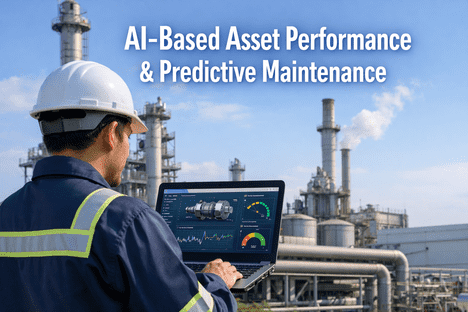
A chemical plant in Texas ran its cooling tower fans on a fixed 90-day maintenance schedule for eleven years. The maintenance team was disciplined, the logs were immaculate, and the bearings got replaced like clockwork every quarter — whether they needed it or not. Then they installed vibration sensors on four critical fans and connected them to an AI-powered asset performance management platform. Within six weeks, the system flagged a bearing on Fan 3 that was degrading far faster than schedule predicted — it would have failed 23 days before the next planned replacement, taking down a $180,000-per-hour production line. Simultaneously, the AI showed that bearings on Fans 1, 2, and 4 were running well within tolerance and did not need replacement for another 40-60 days beyond schedule. The plant saved $340,000 in avoided downtime, eliminated $28,000 in unnecessary parts replacements, and discovered that their "best practice" maintenance schedule had been both too late for some assets and too early for others — for over a decade.
iFactory Predictive Intelligence
AI Asset Performance Management with Predictive Maintenance in EAM
How AI-driven condition monitoring, failure prediction, and real-time asset analytics are replacing calendar-based maintenance with intelligence-based interventions
Fewer labour hours in planned vs emergency repairs
Why Calendar-Based Maintenance Is Failing Modern Plants
The maintenance strategy most manufacturers still rely on was designed for an era when equipment was simpler, production tolerances were wider, and downtime costs were a fraction of what they are today. Time-based schedules assume every asset degrades at the same rate under every condition. That assumption is wrong — and the cost of being wrong has never been higher.
Calendar-Based Maintenance
Replaces parts on fixed schedules regardless of actual condition
30% of scheduled maintenance is performed unnecessarily
Cannot detect failures between scheduled intervals
Only 10% of equipment actually fails from age-related wear-out
Reactive repairs cost 3-5x more than planned interventions
AI Predictive Maintenance
Intervenes based on real-time asset condition and degradation curves
Eliminates unnecessary replacements, saving 15-30% on parts
Detects anomalies 14-21 days before failure with 94%+ accuracy
Addresses all failure modes — random, infant mortality, and wear-out
Planned work requires 3.2x fewer labour hours than emergencies
The Four Layers of AI Asset Performance Management
Effective asset performance management is not a single technology — it is a layered intelligence stack where each capability builds on the one below it. Most legacy systems only deliver the first layer. AI-powered APM platforms deliver all four simultaneously, creating a closed loop from data collection to autonomous optimisation.
Layer 4
Prescriptive Optimisation
AI recommends specific actions — which technician, which parts, which sequence — and auto-generates work orders with optimal timing. Generative AI assistants let teams query asset health in natural language and receive actionable guidance instantly.
Layer 3
Predictive Analytics
Machine learning models — LSTM networks, gradient boosting, anomaly detection algorithms — analyse degradation curves to predict Remaining Useful Life. LSTM models achieve 94.3% failure prediction accuracy, providing 14-21 day early warning windows.
Layer 2
Condition Monitoring
Continuous sensor data streams — vibration, temperature, pressure, acoustics, current, oil particle counts — feed into real-time health dashboards. Edge computing processes critical signals in sub-millisecond response times for immediate alerting.
Layer 1
Data Acquisition
IoT sensors, SCADA feeds, historian databases, and maintenance logs create the foundational data layer. With industrial vibration sensors now costing $50-100 (down from $200-500), the barrier to comprehensive instrumentation has collapsed.
What AI Actually Monitors — and How It Predicts Failure
AI-powered asset performance management does not rely on a single data source. It correlates multiple condition indicators simultaneously, building a multidimensional health profile for each asset that no human analyst could maintain manually across hundreds or thousands of machines.
Vibration Analysis
Accelerometers detect bearing wear, imbalance, misalignment, and looseness. AI identifies spectral pattern shifts weeks before mechanical failure. The most mature and widely deployed condition monitoring technique.
Thermal Monitoring
Infrared sensors and embedded thermocouples track temperature gradients across windings, bearings, and process surfaces. AI correlates thermal drift with load changes to separate normal variation from genuine degradation signals.
Current Signature
Motor current analysis detects rotor bar cracks, stator faults, and electrical imbalances without requiring physical access. AI models baseline current profiles against real operating loads, flagging deviations invisible to traditional power monitoring.
Acoustic Emission
Ultrasonic microphones capture high-frequency sounds from friction, cavitation, and micro-fractures. AI filters ambient noise to isolate fault-specific acoustic signatures, detecting problems in valves, steam traps, and pressure vessels.
Oil and Fluid Analysis
Inline particle counters and moisture sensors continuously assess lubricant condition. AI tracks metallic particle trends, viscosity changes, and contamination levels to predict bearing and gear failures in hydraulic, gearbox, and turbine systems.
Multi-Signal Fusion
The real power of AI — correlating all signal types simultaneously. A bearing fault that shows subtle vibration shifts also produces thermal anomalies and particle count increases. AI fuses these weak signals into high-confidence failure predictions no single sensor could provide alone.
From Detection to Action — The Predictive Maintenance Workflow
Detecting an anomaly is only valuable if it triggers the right response at the right time. AI-powered APM platforms close the loop from sensor signal to completed repair, automating every step that traditionally required manual coordination between operators, planners, and technicians.
1
Anomaly Detected
AI identifies a vibration pattern shift on a pump bearing that deviates from the learned baseline by more than two standard deviations. The system classifies the anomaly type and estimates severity.
2
RUL Calculated
Remaining Useful Life algorithms project that the bearing will reach critical failure threshold in 18 days under current operating conditions. Confidence interval and risk score are assigned.
3
Work Order Auto-Generated
The system creates a prioritised work order with the correct spare part, recommended procedure, and optimal scheduling window that minimises production impact. Parts availability is verified automatically.
4
Technician Dispatched
The right technician — based on skill match, location, and availability — receives a mobile notification with AI-generated troubleshooting guidance, historical context, and step-by-step repair instructions.
5
Effectiveness Verified
Post-repair sensor data confirms the anomaly is resolved. The AI model retrains on the new data point, improving future prediction accuracy. The feedback loop makes every repair an investment in better intelligence.
The Numbers That Make the Business Case
The financial impact of AI-powered asset performance management is consistent across industries and plant sizes. These are not projections — they are documented results from manufacturers who have made the shift from reactive and calendar-based maintenance to condition-driven intelligence.
$260K
Average manufacturing downtime cost per hour
95%
Of predictive maintenance adopters report positive ROI
10-30x
ROI ratio achieved within 12-18 months of deployment
20%
Improvement in first-time fix rates with AI guidance
25-50%
Reduction in serial and repeat failures
12%
Average energy savings from optimised asset operation
How much sensor instrumentation do we need to start with AI predictive maintenance?
You do not need to instrument every asset on day one. Most deployments start with 10-20 critical assets — the equipment where unplanned failure causes the highest production and financial impact. With industrial vibration sensors now costing $50-100 each, the initial investment is modest and scales incrementally as the platform proves value.
How long does it take for AI models to learn our equipment behaviour?
AI models begin generating useful anomaly alerts within 4-6 weeks of data collection. Prediction accuracy improves steadily over 3-6 months as the system learns normal operating patterns, seasonal variations, and load-dependent behaviours. Historical maintenance data accelerates this learning significantly when available.
Does AI predictive maintenance replace our maintenance team?
No — it amplifies them. AI handles the data analysis, pattern recognition, and scheduling optimisation that no human team can perform at scale across hundreds of assets simultaneously. Your technicians focus on skilled repair work instead of routine inspections and emergency firefighting. The result is higher job satisfaction and lower burnout alongside better outcomes.
Can AI APM integrate with our existing SCADA, ERP, and CMMS systems?
Yes. AI-powered APM platforms connect via standard industrial protocols including OPC-UA, MQTT, Modbus, and REST APIs. Data flows bi-directionally — sensor data comes in, work orders and alerts go out to your existing systems. No rip-and-replace is required, and most integrations complete within 2-4 weeks.
What if we have limited historical failure data for our equipment?
AI models can work with limited historical data by leveraging transfer learning — applying failure patterns learned from similar equipment types across other installations. Additionally, unsupervised anomaly detection algorithms do not require labelled failure examples at all. They learn normal behaviour and flag deviations, becoming more accurate as they accumulate operational data from your specific assets.
Predict. Prevent. Perform.
Stop Reacting to Breakdowns Your Data Already Saw Coming
iFactory's AI-powered asset performance management platform monitors condition signals, predicts failures weeks in advance, and auto-generates the work orders your team needs to intervene at exactly the right moment. Every repair becomes an investment in better intelligence.