A pharmaceutical manufacturer in New Jersey passed every internal audit for three consecutive years. Their documentation looked impeccable on paper. Then the FDA arrived for an unannounced inspection. Within 48 hours, inspectors issued a Form 483 with nine observations — three of them repeat findings the internal audits had somehow missed. The root cause was not negligence. It was a compliance system built on spreadsheets, shared drives, and manual checklists that could not keep pace with what regulators actually expected. The CAPA backlog alone contained 47 overdue actions that no one had escalated. Six months and $2.8 million in remediation costs later, the plant was back in compliance. A competitor across the state had deployed an AI-driven compliance platform eighteen months earlier. Same FDA scrutiny — zero 483 observations. Same products, same standards, radically different outcomes. The difference was not better people. It was better systems.
iFactory Compliance Intelligence
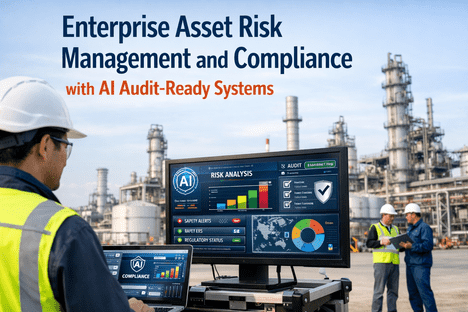
Enterprise Asset Risk Management and Compliance with AI Audit-Ready Systems
How AI-powered risk and compliance platforms are replacing manual audit preparation with continuous assurance — turning regulatory readiness from a fire drill into a permanent state
$165K
Maximum OSHA penalty per willful violation in 2026
85%
Audit preparation time reduced with AI compliance
64%
Increase in OT ransomware targeting industrial firms
25%
Reduction in regulatory fines with AI-driven systems
The Compliance Landscape Is Getting Harder, Not Easier
Manufacturers today face a compounding regulatory burden. Standards are becoming more interconnected, audits more data-intensive, penalties more severe, and the consequences of non-compliance more existential. Yet most quality and EHS teams still manage compliance on a patchwork of spreadsheets, paper forms, and disconnected software that was never designed for the speed or complexity of modern regulatory environments.
OSHA Penalties Escalating
Willful violation penalties now reach $165,514 each. Over $150 million in total penalties assessed in 2026. Manufacturers pay $29,100 per employee to comply with federal regulations — nearly double the cross-industry average.
Standards Expanding Scope
ISO 55000 added three new standards in 2024, including ISO 55013 for data asset management. FDA QMSR replaced QSR in February 2026, incorporating ISO 13485 by reference. ISO 9001:2026 revision adds AI governance and climate action requirements.
Cyber Threats Multiplying
Ransomware targeting industrial organisations increased 64% in 2025. Manufacturing accounts for two-thirds of OT ransomware victims. Average dwell time in OT environments is 42 days. The EU Cyber Resilience Act now requires security-by-design.
The Risk-Compliance Matrix: What Needs Managing
Asset risk management is not a single category. It spans safety, regulatory, financial, operational, and environmental domains — each with its own standards, inspection cadences, and penalty structures. The challenge is that these domains overlap: a single asset failure can trigger safety violations, regulatory fines, environmental penalties, and operational losses simultaneously.
Risk Domain
Key Standards
Failure Consequence
AI Mitigation
OSHA, ISO 45001, ATEX, NFPA
Injuries, fatalities, facility shutdowns, criminal liability
Predictive hazard alerts, automated safety inspection scheduling, real-time compliance scoring
FDA 21 CFR, ISO 9001, IATF 16949, ISO 13485
Form 483s, warning letters, consent decrees, import bans
Continuous audit readiness, auto-generated evidence packages, CAPA escalation automation
ISO 55000, SOX, IFRS 16
Overspend, stranded assets, inaccurate depreciation, audit qualifications
TCO modelling, lifecycle cost analytics, replacement timing optimisation
OEE benchmarks, SLA commitments, ISO 22000
Unplanned downtime, missed deliveries, customer penalties, contract losses
Predictive maintenance, condition monitoring, AI-optimised scheduling
EPA, CSRD, ISO 14001, EU ETS
Emissions violations, remediation costs, ESG downgrades, reputational damage
Energy monitoring per asset, emissions tracking, sustainability reporting automation
IEC 62443, NIST CSF, EU CRA, ISO 21434
Production shutdowns, data breaches, IP theft, ransom payments
OT network segmentation monitoring, vulnerability scanning, access control audit trails
Need to understand your compliance gaps across all risk domains? Book a free multi-domain risk assessment.
How AI Transforms Compliance from Reactive to Continuous
Traditional compliance works in cycles — prepare for the audit, pass the audit, relax until the next one. AI-powered compliance works continuously, monitoring every asset and every process in real time and maintaining audit readiness as a permanent state rather than a periodic achievement.
The Compliance Maturity Journey
Most manufacturers overestimate their compliance readiness. This five-level framework helps you honestly assess where your risk management capability sits today — and what it takes to reach continuous, AI-driven assurance.
Level 5 — Predictive Assurance
AI predicts compliance risks before they materialise. Audits become confirmations, not discoveries. Risk management is continuous, automated, and self-improving. This is the target state for iFactory customers.
Level 4 — Automated Compliance
Digital systems with automated workflows, real-time dashboards, and one-click audit reports. CAPA auto-triggered by threshold breaches. Evidence packages auto-generated. Audit preparation measured in minutes, not days.
Level 3 — Digital but Disconnected
Some digital tools in place but not integrated. Document control is electronic but CAPA tracking is still a spreadsheet. Compliance evidence exists in multiple systems that do not talk to each other.
Level 2 — Reactive Compliance
Paper-based with some digital elements. Compliance is addressed only before audits. CAPA backlogs grow between audit cycles. Documentation gaps are common and discovered during audits rather than before them.
Level 1 — Ad Hoc Quality
No formal compliance structure. Quality depends on individual knowledge. Tribal memory replaces documentation. Audits are existential threats that consume the entire team for weeks beforehand.
Measurable Impact of AI-Driven Compliance
The business case for AI-powered risk management is built on both cost avoidance — penalties, fines, remediation — and productivity recovery. Quality managers currently spend 30-40% of their time gathering evidence instead of improving processes. AI gives that time back.
85%
Audit preparation time reduced
25%
Reduction in regulatory fines
75%
CAPA cycle time improvement
100%
Audit trail coverage
Want to see how AI closes the compliance gaps your current systems are missing? Get a customised compliance readiness report from our engineers.
Frequently Asked Questions
Can a single AI platform handle compliance across ISO 55000, OSHA, FDA, and environmental regulations simultaneously?
Yes. AI-powered compliance platforms manage multiple regulatory frameworks in a single installation with pre-configured templates and cross-standard mapping. Each procedure and record is linked to every applicable clause across all relevant standards, eliminating the duplication and inconsistency that comes from running separate systems for each certification.
How does AI help with unannounced regulatory inspections?
Because AI maintains continuous audit readiness — not cyclical preparation — unannounced inspections become non-events. Every audit trail is current, every evidence package is pre-assembled, every CAPA is tracked with live status. When an inspector arrives, the system generates the required documentation in minutes rather than the days or weeks that manual preparation requires.
What happens with our existing compliance documentation and records?
Historical compliance records migrate during implementation and serve as the foundation for AI pattern recognition. The platform identifies gaps in existing documentation, flags expired certifications, and maps current procedures to applicable standard clauses. Most migrations complete within 4-6 weeks without disrupting ongoing compliance activities.
Does AI replace human judgement in compliance decisions?
No. AI provides decision support — risk scoring, pattern recognition, predictive alerts, and automated evidence assembly — but final compliance decisions remain with authorised personnel. Under both FDA and ISO frameworks, human oversight of quality and compliance decisions is required. AI ensures those decisions are informed by complete, current, and accurate data rather than incomplete manual records.
How does AI address the new ISO 55013 data management requirements?
ISO 55013 specifically addresses data asset and asset data management — requiring organisations to treat their operational data with the same governance rigour as physical assets. AI platforms inherently satisfy these requirements through structured data architectures, automated data quality monitoring, version-controlled records, and complete audit trails for every data point used in asset management decisions.
Always Audit-Ready. Never Scrambling.
Stop Preparing for Audits. Start Being Continuously Compliant.
iFactory's AI-powered compliance platform automates audit trails, predicts regulatory risks, manages CAPAs, and generates evidence packages across every standard your facility needs to meet. Compliance becomes a permanent state, not a periodic achievement.
100%
Audit trail coverage
4-6wk
Deployment to value