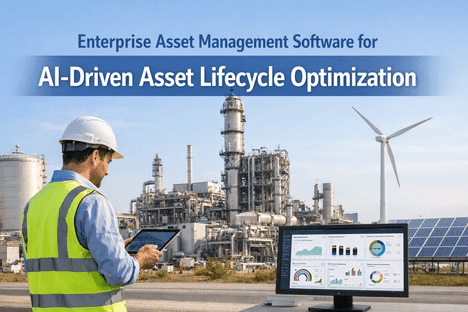
Enterprise Asset Management is no longer just about tracking what you own and fixing what breaks. In 2026, EAM has become a strategic intelligence platform — and the organizations that understand the trends reshaping it will outperform those that don't. The global EAM market is growing from $7.27 billion in 2025 to $16.42 billion by 2034, driven by a convergence of AI, IoT, cloud computing, and predictive analytics that is rewriting the rules of asset performance, reliability, and maintenance. Here are the seven defining trends every asset-intensive organization needs to understand — and act on — in 2026.
Trend 01 — AI & Machine Learning: From Reactive to Prescriptive
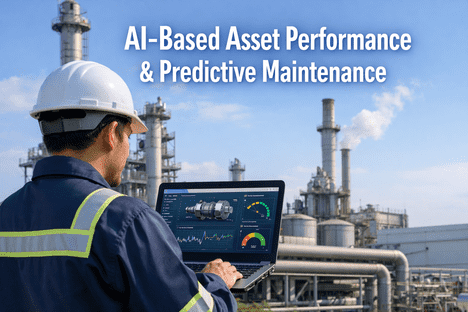
Artificial intelligence is no longer a future-facing feature in EAM — it is rapidly becoming table stakes. In 2026, AI in EAM extends far beyond simple anomaly alerts. Machine learning models now analyze historical data, live sensor feeds, and operational patterns to forecast equipment failures 6–12 months in advance with accuracy rates exceeding 85%. More significantly, AI has graduated from predictive to prescriptive — not just flagging what will fail, but recommending exactly what to do, when, with which parts, and by which technician.
AI & Machine Learning
Trend 02 — IoT-Enabled Asset Monitoring: Every Asset, Every Second
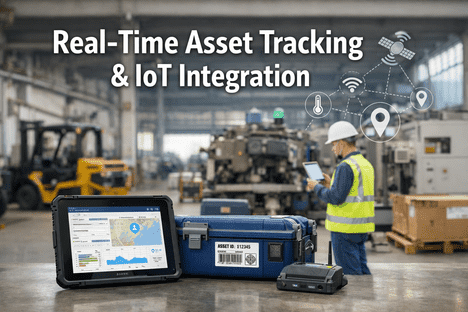
IoT-enabled asset monitoring is now the data backbone of every advanced EAM platform. Wireless vibration, thermal, pressure, and power sensors stream real-time data into cloud analytics that flag anomalies hours or days before failures develop. The US IoT integration market is growing at 27% CAGR through 2032 — and EAM is one of the primary beneficiaries. In 2026, IoT doesn't just collect data: it feeds AI models that turn raw signals into maintenance intelligence.
Trend 03 — Cloud EAM: The Infrastructure Revolution
Cloud deployment has become the dominant model in EAM — holding 62.15% of 2025 revenue and growing at a 13.05% CAGR through 2031. The shift is structural: cloud EAM eliminates capital infrastructure costs, enables real-time analytics at scale, and makes enterprise-grade asset intelligence accessible to mid-sized organizations that would never have considered it two years ago. In 2026, cloud isn't an option — it's the fast lane to predictive workflows.
See iFactory's Cloud EAM Platform in 30 Minutes
AI predictions, IoT sensor feeds, multi-site dashboards, and automated work orders — all cloud-native, all live in your free demo. No infrastructure needed. No sales pitch.
Trend 04 — Digital Twins: Your Equipment's Virtual Intelligence Layer
Digital twins are ranked among the top three factory digitization levers by the World Economic Forum — and for good reason. A digital twin is a continuously updated virtual replica of a physical asset that combines real-time sensor data with physics-based simulation. It enables engineers to test failure scenarios, simulate maintenance interventions, and optimize performance without ever touching the real machine. Unilever, IBM, and Siemens have all documented significant savings from digital twin implementations. Organizations report ROI within 18–36 months, with initial investments of $200K–$600K generating $1.2–3.5 million in annual savings.
Trend 05 — Edge AI + 5G: Real-Time Intelligence Where It Matters
The convergence of edge computing and 5G connectivity is eliminating the last barrier to true real-time predictive maintenance. Edge AI processes data directly at or near the asset — removing cloud round-trip latency and enabling decisions in milliseconds. Paired with 5G's ultra-low latency, operations like rerouting work, throttling production, or shutting down equipment to prevent damage can happen before damage begins. In high-precision manufacturing, this millisecond advantage can prevent millions in losses.
Why it matters: Cloud-only EAM waits for data to travel to a server and back. Edge AI decides at the source. In a $1 million-per-hour downtime scenario, that delay is the difference between preventing a failure and recording one. See iFactory's real-time architecture →
Trend 06 — ESG & Sustainability Tracking: Compliance Becomes Competitive
Environmental, Social, and Governance (ESG) considerations are no longer optional in asset management. ESG-focused institutional investment is reaching $33.9 trillion in 2026 — representing 21.5% of all assets under management. This capital shift is forcing asset-intensive organizations to prove their environmental performance at the asset level. In 2026, leading EAM platforms track carbon footprint, energy efficiency, and emission metrics in real time per asset — turning compliance from a cost into a competitive signal.
Carbon Tracking Per Asset
Real-time energy consumption and carbon footprint tracked at individual asset level — not just site-wide. ESG reports generated automatically from maintenance data.
Energy Efficiency Monitoring
AI identifies assets consuming disproportionate energy — often a leading indicator of mechanical degradation. Fix the asset, reduce energy waste, and lower emissions simultaneously.
Circular Economy Lifecycle
Asset lifecycle data supports repair-vs-replace decisions that favor extending useful life — reducing material waste and aligning with circular economy mandates across EU and US markets.
Audit-Ready ESG Records
Every maintenance action auto-generates timestamped, digitally tagged ESG documentation — meeting the 2026 regulatory requirement for comparable, accessible sustainability data.
Trend 07 — Integrated Digital Ecosystems: EAM as the Operations Hub
The era of siloed EAM systems is ending. In 2026, leading organizations are integrating their EAM platforms with ERP, supply chain, MES, financial systems, and SCADA into a unified digital ecosystem. Asset health data no longer lives in the maintenance department — it flows across the organization, informing procurement strategies, production scheduling, capital expenditure planning, and financial forecasting in real time. Services now command 35.2% of the EAM market as organizations seek integration expertise alongside software.
iFactory Connects All 7 Trends in One Platform
AI predictions, IoT sensors, cloud deployment, digital twin support, edge-ready architecture, ESG tracking, and full ERP integration — all in a single platform your team can use from week one.
2026 EAM Trend Readiness: Where Does Your Organization Stand?
Every trend above delivers compounding value — but only to organizations that act. Here's how to score your current readiness across all seven dimensions:
How iFactory Delivers Every 2026 EAM Trend — Today
iFactory is built to operationalize all seven trends in a single, cloud-native platform. Not a roadmap. Not a future feature list. A live platform your team can deploy in weeks:
Predictive Failure Engine
Machine learning forecasts failures 30–90 days out from vibration, thermal, and current data. Prescriptive recommendations tell your team exactly what to do, when, and with which parts.
Sensor Integration Hub
Connect any IoT sensor — vibration, thermal, pressure, acoustic — directly to iFactory's AI engine. Real-time feeds, edge processing, cloud analytics, all unified in one data layer.
Live in Weeks
Zero infrastructure. Automatic updates. Multi-site dashboards accessible from any device. iFactory's cloud architecture eliminates the deployment barriers that stalled traditional EAM.
Integrated Ecosystem
ERP, SCADA, supply chain, financial systems — iFactory connects to your existing stack to create the enterprise-wide asset intelligence hub that 2026 demands.
Ready to Lead Every 2026 EAM Trend?
30 minutes. Zero obligation. We'll show you exactly how iFactory positions your organization ahead of every trend in this report — with an implementation timeline and ROI estimate you can take to your leadership team today.