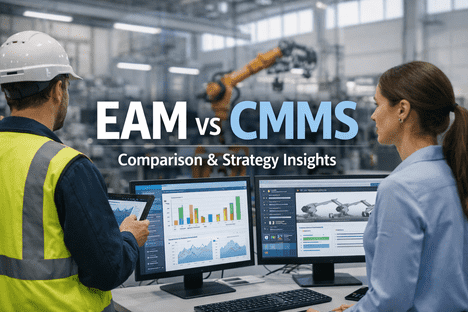
A mid-sized auto parts manufacturer in Michigan spent $180,000 on a CMMS platform in 2021. It handled work orders, tracked PM schedules, and kept spare parts inventories in order. The maintenance team was satisfied — until leadership asked a question the system could not answer: what is the total cost of ownership for the stamping press in Line 4 across its 12-year lifespan, and should we refurbish it or replace it? The CMMS had maintenance records but no acquisition costs, no depreciation data, no energy consumption trends, no residual value projections. The question required pulling data from five different systems, three spreadsheets, and two people who had since retired. Six weeks later, they had an answer — but it was already outdated. Their competitor had deployed an AI-powered enterprise asset management platform that answered the same question in 90 seconds, with a recommendation backed by predictive analytics and live condition data. Same industry, same question, radically different decision speed.
iFactory Strategic Intelligence
Enterprise Asset Management vs CMMS: Key Differences and Benefits Explained
Why the distinction between EAM and CMMS matters more than ever — and how AI is making the gap between them a strategic liability for manufacturers still running maintenance-only systems
$6.5B+
Global EAM market size in 2025
80%
Of CMMS implementations fail to achieve full adoption
30-50%
Downtime reduction with AI-powered EAM
3-5x
Cost multiplier for reactive vs planned maintenance
The Core Difference in One Sentence
A CMMS manages maintenance activities. An EAM manages the entire asset lifecycle. That single distinction drives every difference in capability, scope, and strategic value between the two systems — and it determines whether your organisation is optimising repairs or optimising outcomes.
CMMS
Computerised Maintenance Management System
Manages the maintenance function
Work orders, PM schedules, spare parts, labour tracking, maintenance history
EAM
Enterprise Asset Management
Manages the entire asset lifecycle
Planning, acquisition, commissioning, operation, maintenance, performance, compliance, decommissioning
Where They Overlap — and Where They Diverge
CMMS and EAM share a common foundation in maintenance management. Every EAM platform includes CMMS functionality. But EAM extends far beyond maintenance into territory that CMMS was never designed to cover. Understanding where the two systems diverge is the key to choosing the right platform for your operational maturity.
| Capability |
CMMS |
EAM |
AI-Powered EAM |
| Work Order Management |
Full |
Full |
AI auto-generates and prioritises |
| Preventive Maintenance |
Calendar-based scheduling |
Calendar + usage-based |
Condition-based, AI-optimised |
| Predictive Maintenance |
Not available |
Basic threshold alerts |
ML models, 94%+ accuracy, 14-21 day warnings |
| Asset Lifecycle Tracking |
Maintenance history only |
Full lifecycle from acquisition to disposal |
AI-driven TCO and RUL projections |
| Financial Integration |
Maintenance costs only |
Depreciation, TCO, capital planning |
Predictive cost modelling, ROI analytics |
| Compliance and Audit |
Basic record keeping |
ISO 55000, regulatory documentation |
Auto-generated audit trails and evidence |
| Supplier Management |
Parts vendor tracking |
Supplier performance scoring |
AI risk scoring with early-warning alerts |
| IoT and Sensor Integration |
Limited or none |
Supported |
Native with edge computing and digital twins |
| Cross-Site Visibility |
Single facility typically |
Multi-site, multi-region |
Enterprise-wide with benchmarking |
| Decision Support |
Historical reports |
Dashboards and KPIs |
Prescriptive recommendations, NLP queries |
Not sure which system your operation actually needs? Book a free assessment with our engineers.
Five Questions That Reveal Which System You Need
The choice between CMMS and EAM is not about software features — it is about what questions your operation needs to answer. If your most important questions are about maintenance execution, a CMMS may suffice. If they are about asset strategy, financial optimisation, or predictive intelligence, you need EAM.
01
Do you need to know only when an asset was last repaired — or what it will cost to own over its entire lifespan?
CMMS answers
Last repair date, cost, and technician
EAM answers
Full TCO with acquisition, maintenance, energy, depreciation, and projected residual value
02
Do you manage assets at one site — or across multiple facilities, regions, or business units?
CMMS handles
Single-site maintenance operations effectively
EAM handles
Multi-site with cross-facility benchmarking, standardised KPIs, and consolidated reporting
03
Is your maintenance strategy calendar-based — or do you need condition-based and predictive capabilities?
CMMS provides
Scheduled PM with fixed intervals and manual triggers
EAM provides
IoT sensor integration, ML failure prediction, automated condition-based work orders
04
Do you face regulatory audits that require documented asset lifecycle evidence?
CMMS offers
Maintenance logs and work order histories for audit reference
EAM offers
ISO 55000 compliance mapping, auto-generated audit trails, risk documentation, and evidence packages
05
Does your leadership ask strategic questions about asset performance, capital allocation, and ROI?
CMMS reports
Maintenance cost summaries, backlog status, and completion rates
EAM reports
Asset ROI, lifecycle cost projections, refurbish-vs-replace analysis, and strategic performance dashboards
Why 80% of CMMS Implementations Fail — and What EAM Does Differently
The industry statistic is sobering: up to 80% of CMMS implementations fail to achieve full adoption. The failure is rarely about the software itself. It is about the gap between what maintenance teams need from a system and what the organisation actually needs from its assets. Understanding why CMMS deployments stall reveals exactly why the shift to EAM is accelerating.
Scope Too Narrow
CMMS digitises maintenance workflows but does not connect them to financial, procurement, or strategic planning systems. Maintenance stays siloed.
EAM approach
Integrates maintenance with finance, procurement, compliance, and operations from day one — breaking silos by design.
Data Without Intelligence
CMMS collects maintenance records but cannot analyse them. Teams drown in data without insights. Reports require manual extraction and interpretation.
EAM approach
AI analytics transform raw data into actionable intelligence — predictive alerts, performance trends, and prescriptive recommendations delivered automatically.
No Strategic Visibility
Leadership cannot answer capital allocation questions using maintenance data alone. CMMS serves technicians but not executives.
EAM approach
Lifecycle dashboards give executives TCO visibility, replacement timing projections, and cross-site performance benchmarking.
Reactive Architecture
CMMS is built to manage work after it is identified. It cannot anticipate failures, optimise schedules dynamically, or adapt to changing conditions.
EAM approach
IoT integration and ML models shift the platform from recording history to predicting the future — 14-21 day failure warnings at 94%+ accuracy.
The Migration Path: CMMS to AI-Powered EAM
Moving from CMMS to EAM does not require a rip-and-replace. The most successful migrations follow a phased approach that preserves existing workflows while progressively adding lifecycle, analytics, and predictive capabilities. Here is the path most manufacturers follow.
Foundation and Data Migration
Existing CMMS data — work orders, asset registers, maintenance histories, parts inventories — migrates into the EAM platform. Integrations with ERP, SCADA, and MES systems are established via OPC-UA, MQTT, and REST APIs. No workflow disruption for maintenance teams.
Lifecycle and Financial Integration
Asset lifecycle data — acquisition costs, depreciation schedules, warranty terms, compliance records — connects to maintenance histories. Total Cost of Ownership calculations become available for every asset. Real-time dashboards and KPIs go live.
IoT and Predictive Intelligence
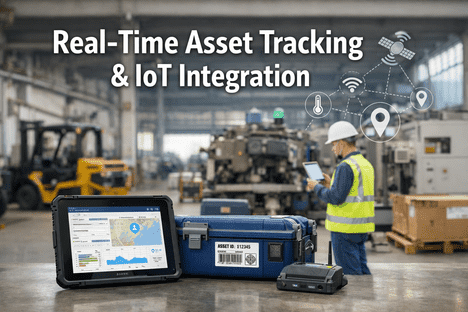
IoT sensors deploy on critical assets. AI models begin learning baseline performance patterns. Condition monitoring dashboards activate. By month 6, predictive failure alerts are operational with increasing accuracy as models mature on your specific equipment data.
Autonomous Optimisation
AI auto-generates work orders from condition triggers, optimises maintenance schedules dynamically, and provides prescriptive recommendations for refurbish-vs-replace decisions. Generative AI assistants enable natural language queries. Full ROI is typically realised by month 12-18.
Ready to plan your migration from CMMS to AI-powered EAM? Book a free migration assessment.
Frequently Asked Questions
Is EAM just a more expensive version of CMMS?
No. EAM and CMMS serve fundamentally different purposes. CMMS manages maintenance execution — work orders, schedules, and parts. EAM manages the entire asset lifecycle — from capital planning and acquisition through operation, compliance, and disposal. Every EAM includes CMMS functionality, but adds financial integration, lifecycle analytics, predictive intelligence, and strategic decision support that CMMS architecturally cannot provide.
Can we keep our existing CMMS and add EAM capabilities on top?
Yes, many manufacturers take this approach initially. AI-powered EAM platforms integrate with existing CMMS systems via standard APIs, pulling work order and maintenance history data while adding lifecycle tracking, predictive analytics, and financial integration layers. Over time, most organisations consolidate into the EAM platform as it becomes the single source of truth.
At what company size does EAM become necessary over CMMS?
Size matters less than complexity. A single-site manufacturer with a few hundred assets and straightforward maintenance needs may operate well with CMMS. But if you manage assets across multiple sites, face regulatory compliance requirements, need lifecycle cost visibility, or want predictive maintenance capabilities, EAM becomes necessary regardless of company size. The complexity threshold, not the headcount, drives the decision.
How long does migration from CMMS to EAM typically take?
Data migration and core functionality go live in 4-6 weeks. Lifecycle and financial integration completes in weeks 5-12. IoT and predictive capabilities mature over months 3-6. Full autonomous optimisation is typically operational by month 12. The phased approach means maintenance teams experience no workflow disruption — they gain capabilities progressively without losing existing processes.
What ROI should we expect from upgrading to AI-powered EAM?
Manufacturers deploying AI-powered EAM consistently report 30-50% reduction in unplanned downtime, 18-25% maintenance cost savings, 20-40% asset lifespan extension, and 15-30% spare parts inventory reduction. 95% of predictive maintenance adopters report positive ROI, with 27% achieving full payback within 12 months. The typical ROI ratio is 10-30x within 12-18 months of deployment.
Beyond Maintenance. Into Intelligence.
Your Assets Deserve More Than a Maintenance Log. They Need a Lifecycle Strategy.
iFactory's AI-powered EAM platform gives you everything your CMMS does — plus lifecycle analytics, predictive intelligence, compliance automation, and strategic decision support that turns asset data into competitive advantage.
90 sec
TCO answers vs weeks manually
50%
Less unplanned downtime
4-6 wk
Migration without disruption
10-30x
ROI within 12-18 months