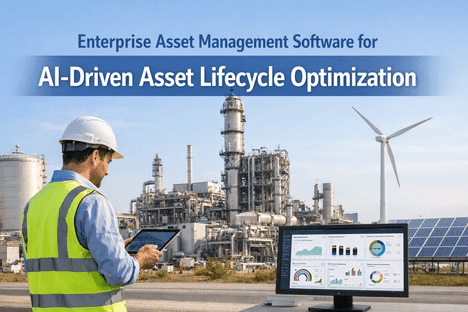
Enterprise Asset Management Software for AI-Driven Asset Lifecycle Optimization
By Larry Eilson on April 15, 2026
Every industrial asset tells a story — from the day it arrives on the plant floor to the moment it is decommissioned. The problem is that most manufacturers cannot read that story. A turbine that could run for 25 years gets replaced at 18 because nobody tracked its degradation pattern. A $400,000 compressor fails on a Tuesday night because the vibration anomaly that started three weeks earlier was buried in a spreadsheet nobody opened. Across the Fortune Global 500, these blind spots add up to $1.4 trillion in annual unplanned downtime losses — 11% of total revenues, vanishing into breakdowns that AI could have predicted weeks in advance. Enterprise asset management is no longer about tracking serial numbers. It is about giving every asset a digital voice — and building the intelligence layer that listens.
iFactory Asset Intelligence
Enterprise Asset Management Software for AI-Driven Asset Lifecycle Optimization
How AI-powered EAM platforms are turning reactive maintenance into predictive intelligence, extending asset lifespans by 20-40%, and delivering measurable ROI within 12 months
Annual unplanned downtime losses across Fortune 500
30-50%
Reduction in unplanned downtime with AI-powered EAM
20-40%
Asset lifespan extension through predictive maintenance
12-18mo
Typical ROI payback period for AI EAM deployments
The Real Cost of Managing Assets Without Intelligence
Most manufacturers believe they manage their assets well. The data tells a different story. The average plant operates at just 55-65% OEE, meaning more than a third of productive capacity evaporates every shift. Nearly half of all maintenance budgets flow into reactive emergency repairs that cost 3-5x more than planned work. And with the average age of U.S. industrial fixed assets now at 24 years — the oldest in nearly seven decades — the gap between what assets need and what maintenance teams can deliver is widening every quarter.
$260K
Average cost per hour of unplanned downtime in manufacturing
38-52%
Of maintenance budgets wasted on reactive emergency repairs
55-65%
Average OEE — far below the 85% world-class benchmark
1.9M
Manufacturing jobs projected unfilled by 2033 due to skills gap
AI Across the Complete Asset Lifecycle
Traditional EAM software tracks assets. AI-powered EAM software understands them. The difference shows up at every stage of the lifecycle — from the moment you evaluate a capital purchase to the day you decommission the equipment. Here is what changes when intelligence replaces guesswork at each phase.
Phase 1
Planning and Acquisition
AI-powered Total Cost of Ownership engines simulate asset performance across the full lifecycle before you commit capital. Digital twins model energy consumption, failure probabilities, and maintenance costs under different operating scenarios. Vendor benchmarking uses anonymized cross-project data to identify which equipment suppliers deliver the best long-term reliability — not just the lowest sticker price.
Phase 2
Commissioning
Virtual commissioning using digital twins combined with PLC simulation identifies integration issues before physical installation, reducing commissioning time by up to 40%. AI establishes baseline performance models from day one — vibration signatures, thermal profiles, current draws — creating the reference framework for all future anomaly detection. 75% of companies using digital twins during commissioning report lower subsequent maintenance costs.
Phase 3
Operation and Monitoring
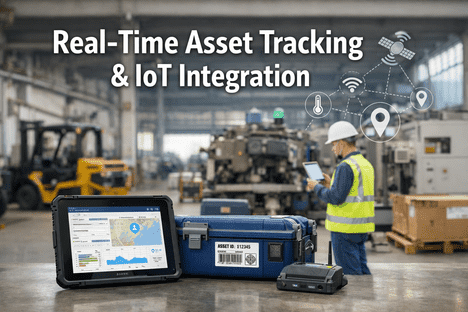
IoT sensors feed continuous condition data — vibration, temperature, pressure, acoustics — into machine learning models that detect degradation patterns 14-21 days before failure with over 94% accuracy. Real-time dashboards surface anomalies the moment they emerge, not after they cause breakdowns. Manufacturers typically see a 5-15 point OEE improvement within months of deployment.
Phase 4
Predictive Maintenance
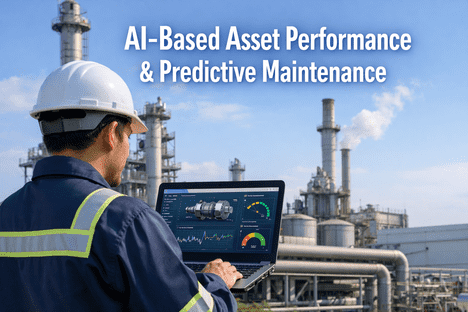
AI-driven LSTM models achieve 94.3% accuracy in predicting failures, shifting your team from calendar-based schedules to condition-based interventions. Planned maintenance requires 3.2x fewer labour hours than emergency repairs. Generative AI assistants let technicians create work orders, query asset histories, and access troubleshooting guidance using natural language — reducing first-time fix failures by 20%.
Phase 5
Decommissioning and Renewal
Remaining Useful Life algorithms continuously update disposal timing recommendations based on actual operating conditions — not arbitrary age thresholds. AI-driven residual value forecasting maximises recovery: assets processed within 45 days of decommissioning can recover 35-50% of original purchase value. Material recovery AI identifies circular economy opportunities, aligning disposal with sustainability mandates and ESG reporting requirements.
The distance between how most manufacturers manage assets and what is actually achievable represents the single largest operational improvement opportunity in industrial manufacturing today. AI-powered EAM closes this gap systematically.
Performance Metric
Industry Average
World-Class Target
AI EAM Impact
Overall Equipment Effectiveness
55-65%
85%+
+5 to 15 points
Reactive Maintenance Share
38-52% of budget
Less than 20%
Reduced by 30-50%
Maintenance Cost (% RAV)
4-6%
1.5-2.5%
18-25% cost reduction
Planned Maintenance Rate
Less than 50%
85%+
Automated scheduling
Asset Utilisation
60-70%
85%+
20-40% lifespan extension
Spare Parts Inventory Excess
12-18% excess stock
Under 5% excess
15-30% inventory reduction
Scroll to see full table
What Is Driving the Shift to AI-Powered EAM in 2026
The enterprise asset management market — valued at approximately $6.5 billion in 2025 and growing at 9-11% CAGR — is being reshaped by four converging forces that are making AI-powered asset management not just advantageous but operationally necessary.
01
Digital Twins at Scale
The digital twin market is projected to reach $150 billion by 2030 at a 48% CAGR. Manufacturing adoption has risen from 20% in 2020 to roughly 48% in 2024, with 72% of manufacturers planning deployment by 2026. These virtual replicas of physical assets enable what-if scenario testing, virtual commissioning, and continuous performance optimisation without interrupting production.
02
IoT and Edge Intelligence
With 21 billion connected IoT devices globally and industrial vibration sensors dropping from $200-500 to $50-100 each, the barrier to continuous condition monitoring has collapsed. Edge computing — growing at 16% CAGR to $45 billion by 2030 — processes sensor data locally in sub-millisecond response times, enabling real-time factory-floor decisions that cloud-only architectures cannot match.
03
Generative AI for Maintenance
Natural language interfaces now let technicians query asset data conversationally, auto-generate work orders, and access troubleshooting guidance without navigating complex software menus. 73% of asset management executives say AI is critical to their future, and 71% plan to adopt generative AI within three years — driven partly by the need to capture institutional knowledge before 40% of the manufacturing workforce retires by 2030.
04
Regulatory and ESG Pressure
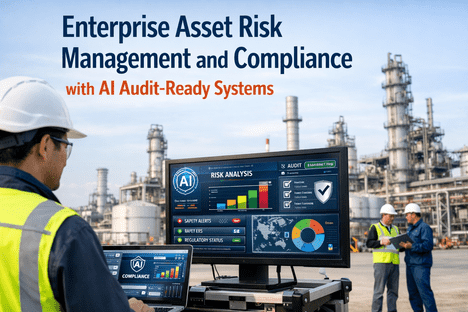
ISO 55000 received major updates in 2024 adding data asset management standards. OSHA penalties now reach $165,514 per willful violation. The EU's CSRD mandates asset-level environmental disclosures. AI-powered EAM systems automatically generate the audit trails, compliance dashboards, and sustainability metrics these regulations demand — converting maintenance data into compliance documentation.
Measurable ROI from AI-Powered Asset Management
The business case for AI-driven EAM has moved well beyond theory. Manufacturers deploying intelligent asset management platforms are reporting consistent, measurable financial returns — with 95% of predictive maintenance adopters reporting positive ROI and 27% achieving full payback within the first 12 months.
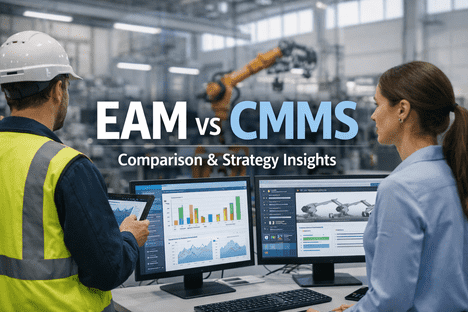
How is AI-powered EAM different from traditional CMMS or EAM software?
Traditional systems record what has already happened — work orders, repair histories, asset registers. AI-powered EAM predicts what will happen next by analysing sensor data, maintenance patterns, and operational context in real time. It shifts your team from reactive firefighting to proactive optimisation across the entire asset lifecycle.
What kind of ROI can we expect and how quickly?
95% of manufacturers deploying AI-powered predictive maintenance report positive ROI, with 27% achieving full payback within 12 months. Typical returns include 30-50% reduction in unplanned downtime, 18-25% maintenance cost savings, and 20-40% asset lifespan extension. Time to first measurable value is typically 4-6 weeks for modular deployments.
Does deploying AI EAM require replacing our existing systems?
No. AI-powered EAM platforms integrate with existing ERP, MES, SCADA, and legacy CMMS systems via standard protocols including OPC-UA, MQTT, and REST APIs. Historical asset data is migrated during implementation and serves as the training foundation for AI models. No rip-and-replace is required.
How does AI EAM help with ISO 55000 compliance?
ISO 55000's 2024 updates now explicitly address data asset management through the new ISO 55013 standard. AI-powered EAM automatically generates the evidence-based decision trails, risk documentation, lifecycle cost analyses, and performance metrics that auditors require — eliminating the manual evidence-gathering that consumes quality teams.
What happens with our existing maintenance data and institutional knowledge?
AI models use your historical maintenance records, failure logs, and operational data as a training foundation — the more data, the more accurate the predictions. Generative AI features also capture institutional knowledge from experienced technicians through natural language documentation, addressing the critical knowledge loss as 40% of the manufacturing workforce approaches retirement by 2030.
From Reactive to Predictive
Give Every Asset a Digital Voice. Build the Intelligence Layer That Listens.
iFactory's AI-powered enterprise asset management platform monitors, predicts, and optimises every stage of the asset lifecycle — from acquisition through decommissioning. Stop losing capacity to breakdowns your data already saw coming.