Enterprise Asset Management is undergoing the biggest transformation in its history. The global EAM market — valued at $7.65 billion in 2024 — is racing toward $27 billion by 2032, and the engine driving that growth isn't better spreadsheets or faster technicians. It's AI. When artificial intelligence meets predictive maintenance inside a modern EAM platform, something fundamental changes: organizations stop reacting to broken equipment and start preventing breakdowns entirely. This guide explores exactly how that transformation works, what it delivers, and how iFactory makes it happen — from day one.
The Gap Between Traditional EAM and AI-Powered EAM
For decades, Enterprise Asset Management meant one thing: track what you own, log what broke, schedule the next service. That model worked when equipment was simple, labor was plentiful, and downtime costs were manageable. In 2026, none of those conditions exist. AI doesn't just improve traditional EAM — it replaces its most expensive limitation: operating in the dark about what will fail next.
The core shift: Traditional EAM tells you what happened to your assets. AI-powered EAM tells you what will happen — days or weeks before it does — so every maintenance decision becomes proactive, not reactive. See iFactory's AI EAM live →
6 Ways AI Is Transforming Enterprise Asset Management
AI doesn't just make one part of EAM smarter — it upgrades every layer. Here are the six dimensions where AI transforms how organizations manage, maintain, and optimize their physical assets:
Failure Prediction
AI analyzes sensor streams — vibration, heat, current — to forecast failures 30–90 days in advance with up to 97% accuracy. No more calendar guesses. Every repair is purposeful.
Smart Scheduling
AI balances production demands, technician availability, and asset condition to schedule maintenance at the optimal moment — minimizing disruption while maximizing equipment health.
Inventory Optimization
AI predicts which spare parts will be needed, and when — automatically triggering reorders before stockouts. Organizations reduce parts spend by up to 35% while eliminating costly emergency procurement.
Asset Lifecycle Intelligence
AI tracks total cost of ownership in real time — automatically flagging the moment an asset's maintenance costs exceed its replacement value, so capital decisions are always data-driven.
Automated Compliance
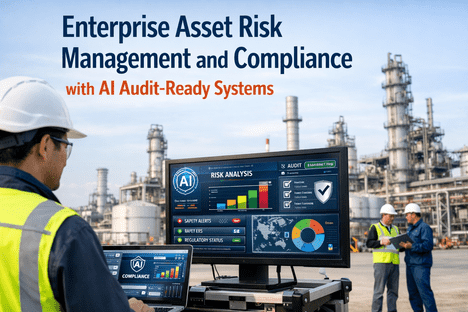
Every predictive maintenance action auto-generates timestamped, audit-ready records for OSHA, FDA, and ISO 55001 — compliance documentation produced as a byproduct of normal operations.
Knowledge Capture
Generative AI converts technician observations into structured work orders, captures veteran knowledge before it walks out the door, and surfaces troubleshooting steps at the exact moment of need.
Want to See All 6 AI Capabilities Live?
In 30 minutes, iFactory will walk you through every one of these AI layers working together — on real asset data, customized for your industry. Zero sales pitch. Just answers.
The AI + EAM Technology Stack: What's Actually Inside
AI-powered EAM isn't a single technology — it's a layered stack where each component feeds the next. Understanding the architecture helps you understand why platforms that integrate all layers outperform point solutions by a wide margin:
iFactory delivers all four layers in one cloud-native platform. No stitching together point solutions. No data silos. See the full stack in your free demo →
Proven Results: What AI-Powered EAM Delivers in Numbers
Every statistic below comes from documented industry research — Deloitte, McKinsey, the U.S. Department of Energy, and enterprise case studies. These are real outcomes from organizations that made the shift to AI-driven asset management:
What Would These Numbers Mean for Your Operation?
In 30 minutes, iFactory will calculate your projected savings based on your actual asset count, current maintenance spend, and downtime history — and give you a roadmap to get there.
The AI-Powered EAM Asset Lifecycle: How Intelligence Compounds
AI doesn't just improve one stage of asset management — it adds intelligence at every phase of the lifecycle. Value compounds from the moment you acquire an asset until the moment you replace it:
AI Baselines from Day One
When a new asset is registered in iFactory, AI immediately establishes performance baselines from sensor data — so the system knows what "normal" looks like before the first shift ends. Procurement decisions are also informed by historical performance data from similar assets already in your fleet.
Continuous Health Monitoring
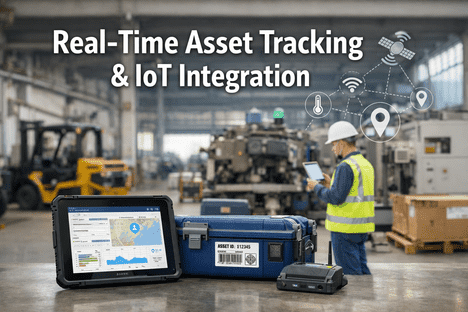
IoT sensors feed real-time data into iFactory's AI engine around the clock. When readings deviate from baseline — even subtly — the system flags the anomaly, calculates severity and time to failure, and auto-generates a work order with parts and instructions attached. Your team acts on intelligence, not instinct.
AI Learns, Accuracy Improves
Every repair, every sensor reading, every failure outcome trains iFactory's models to become more accurate over time. Condition-based maintenance replaces calendar-based schedules — so parts are serviced when they actually need it, not when a calendar says so. Asset lifespan extends 20–40% compared to reactive approaches.
Data-Driven End-of-Life Decisions
iFactory's lifecycle analytics show exactly when an asset's maintenance cost trajectory exceeds its productive value — so replacement decisions are proactive, budgeted, and defensible. Disposal is auto-documented for compliance. And the replacement decision is informed by years of real performance data from your own fleet.
AI + EAM in Action: Real-World Industry Outcomes
Production Line Uptime Optimization
A steel manufacturer reduced MRO spending by 10% and cut transaction volume by 25% by combining AI-powered inventory optimization with predictive maintenance — eliminating both emergency procurement and excess safety stock simultaneously.
Turbine & Grid Asset Health Management
AI-driven EAM platforms deployed across energy infrastructure track thousands of rotating equipment assets in real time — detecting thermal and vibration anomalies weeks before failure. Critical grid assets that cannot afford unplanned outages now operate on fully predictable maintenance cycles.
Critical Infrastructure & Medical Equipment
Hospitals and commercial facilities use AI EAM to manage thousands of assets — from HVAC and elevators to life-critical medical equipment. Every maintenance action is auto-documented against regulatory standards, keeping facilities perpetually audit-ready without any manual compliance effort.
Fleet & Rail Asset Lifecycle Management
The fastest-growing EAM sector at 11.5% CAGR. AI monitors vehicle health, brake wear, engine performance, and fuel consumption in real time — scheduling maintenance during natural route gaps rather than pulling assets from service during peak demand periods.
What iFactory's AI-Powered EAM Platform Delivers
iFactory brings all of this together in one cloud-native platform — combining CMMS simplicity with enterprise AI intelligence, built for multi-site manufacturers and asset-intensive operations of any scale:
AI Failure Engine
Sensor-fed machine learning predicts failures 30–90 days out with up to 97% accuracy. No more calendar guesswork — every maintenance event is purposeful and planned.
Smart Work Orders
AI predictions auto-generate work orders with repair steps, required parts, and priority already attached. Your team executes. iFactory routes and tracks everything.
Inventory Intelligence
AI predicts parts demand, automates reorder triggers, and links every spare to the assets and work orders that need them — cutting inventory costs by up to 35%.
Multi-Site Cloud Platform
Manage every plant, warehouse, and facility from one cloud-native platform — with cross-site benchmarking, best-practice replication, and real-time leadership dashboards built in.
AI + EAM: The Transformation Is Happening Now
Only 32% of maintenance teams have fully adopted AI — which means the majority of your competitors are still operating reactively. That gap is narrowing fast: 65% of maintenance organizations plan to implement AI within the next 12 months. The organizations that move now don't just reduce downtime today — they compound an intelligence advantage that becomes harder to close with every passing month. iFactory is built to get you there — in weeks, not years.
Your First Step Into AI-Powered EAM
30 minutes. Zero obligation. We'll show you how iFactory's AI works on real asset data, walk through your specific industry use case, calculate your projected ROI, and give you an implementation plan you can act on today.