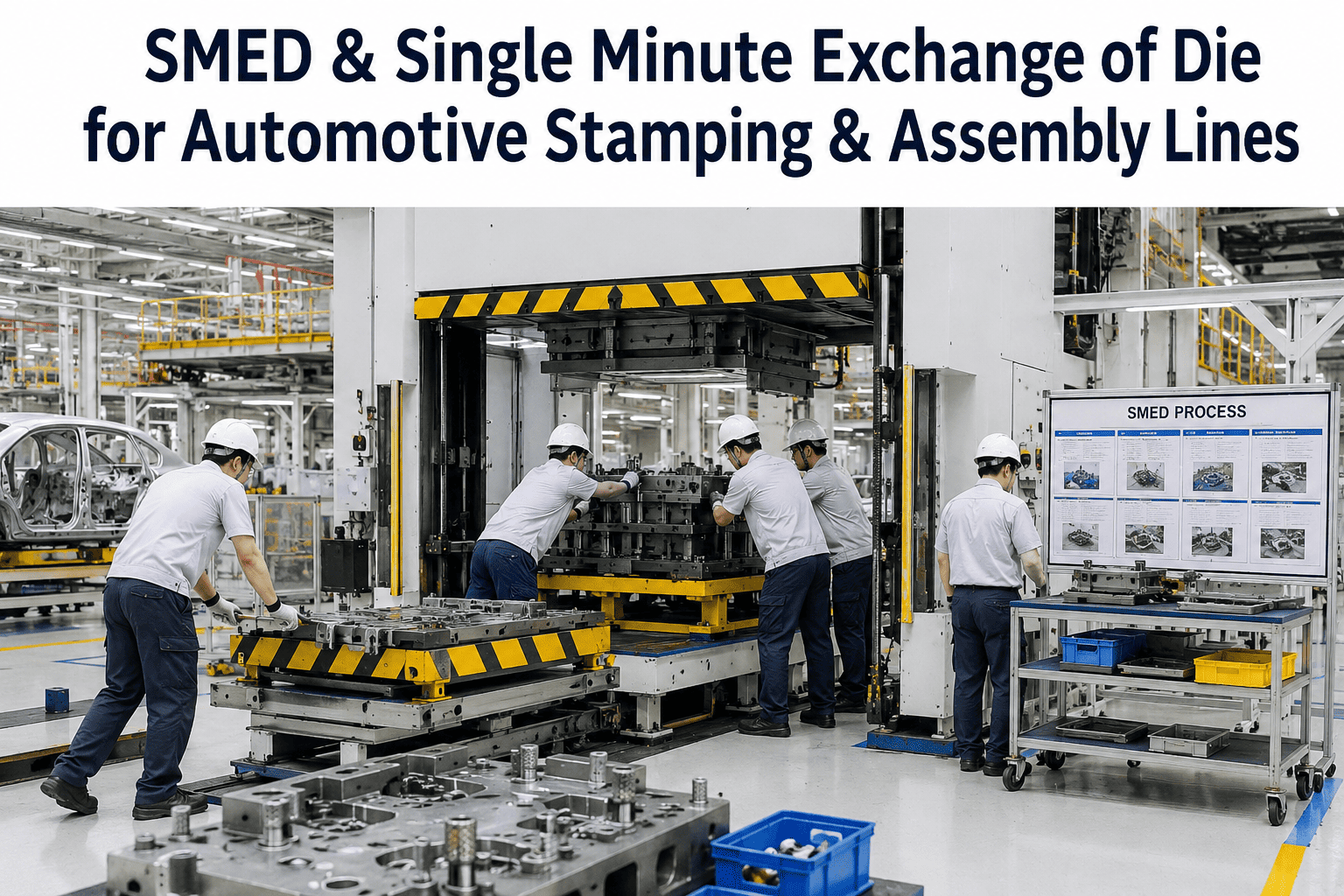
A stamping press that sits idle during a die change is not resting, it is bleeding capacity that the rest of the plant is counting on. SMED, or Single-Minute Exchange of Die, has been the standard answer to this problem since Shigeo Shingo first formalized it decades ago, yet most automotive stamping and assembly operations still run changeovers that take two to three times longer than they should, simply because nobody has measured where the minutes are actually going. Process engineers who want a precise answer to that question, rather than a rough estimate from the floor, usually start with Book a Demo to see exactly where a live changeover loses time.
Turn Every Die Change Into Data You Can Actually Reduce
ifactoryApp times every step of your changeover automatically, separates internal from external work, and shows process engineers exactly which minutes are worth attacking first.
Why Most Plants Get SMED Half Right and Stop There
The core insight behind SMED is deceptively simple: every changeover task is either internal, meaning the press must be stopped for it to happen, or external, meaning it could be done while the press is still running the previous job. Most process engineers know this distinction. Far fewer plants have actually gone through the disciplined work of timing every single task in a real changeover, tagging each one correctly, and then systematically converting internal tasks to external ones wherever physically possible.
The result is that changeover times get treated as a fixed cost of doing business rather than a variable one engineers can actively shrink. A die swap that takes forty minutes is accepted as "just how long it takes," when a properly analyzed changeover on comparable equipment routinely runs under fifteen. The gap between those two numbers is rarely a hardware problem. It is almost always a sequencing and preparation problem that nobody measured precisely enough to fix.
What a Measured Changeover Timeline Actually Looks Like
The timeline below reflects a real pattern seen across stamping operations before and after tasks are correctly separated into internal and external work and resequenced accordingly.
How ifactoryApp Applies AI to Classic SMED Methodology
AI does not replace the SMED framework, it removes the manual timing burden that keeps most plants from applying it rigorously across every press and every changeover, not just the one time a consultant ran a study years ago.
Automatic Task Timing
Video and sensor data from the press area automatically time each changeover task without requiring an engineer standing at the line with a stopwatch for every single swap.
Internal vs. External Classification
Each timed task is automatically classified as internal or external work, immediately surfacing which tasks are candidates to move before or after the press actually stops.
Variance Detection Across Crews
The same changeover performed by different crews or shifts is compared automatically, surfacing best-practice sequences that can be standardized plant-wide.
Continuous Trend Tracking
Every changeover after the first becomes another data point, so process engineers can track whether a converted task is actually holding its time reduction over months, not just in a one-time study.
Time Your Next Changeover Without a Stopwatch
See how ifactoryApp automatically times, classifies, and analyzes a real die change on your equipment during a live walkthrough with our team.
Press Utilization Gains From Structured Changeover Reduction
Process engineers running structured, data-backed SMED programs across stamping and assembly changeovers report consistent gains in the metrics below within two to three production quarters.
Average changeover duration reduction
Net press utilization across the shift
Variance between crews on identical changeovers
More die changes possible per shift on the same press
Traditional SMED Studies vs. Continuous AI-Assisted Changeover Analysis
A traditional SMED study is a one-time snapshot, usually run by an outside consultant on one changeover, on one press, one time. The comparison below shows why that snapshot loses value quickly compared to a continuous approach.
| Aspect | Traditional SMED Study | Continuous AI Analysis |
|---|---|---|
| Coverage | One changeover, one time | Every changeover, every press, ongoing |
| Data source | Manual stopwatch and observation | Automated sensor and video timing |
| Crew comparison | Rarely captured | Standard output of every analysis |
| Drift detection | Not visible until the next study | Flagged automatically as it happens |
SMED & Changeover Reduction — Process Engineer Questions
Do we need cameras installed at every press for this to work?
Video timing improves task-level granularity, but it is not the only data source. ifactoryApp can begin with existing press cycle and PLC signals to establish a baseline changeover timeline, then layer in video analysis at specific presses where task-level detail matters most, based on where our support team identifies the biggest opportunity during onboarding.
How is this different from a one-time SMED consulting engagement?
A consulting engagement gives you a snapshot of one changeover, analyzed once, which is valuable but decays quickly as crews, tooling, and press conditions change. Continuous analysis keeps measuring every changeover after that, so drift back toward slower times gets caught immediately instead of discovered a year later during the next scheduled study.
Can this identify which internal tasks are actually convertible to external work?
Yes, this is one of the most direct outputs of the analysis. Each task is timed and classified, and the system flags internal tasks that show characteristics of external candidates, such as tooling that could be staged in advance, so your engineering team can prioritize which conversions to attempt first based on time impact.
Will this work across different die sizes and press types in our plant?
Yes, the analysis adapts to the specific changeover pattern of each press and die combination rather than applying one fixed template. Large transfer presses and smaller progressive die stations are each analyzed against their own historical baseline, so comparisons stay meaningful within each equipment category.
How quickly can we expect to see changeover times actually drop?
Most plants see the first measurable improvement within four to six weeks, once baseline timing data identifies the highest-impact task conversions and crews adopt the standardized sequence. Full utilization gains across a shift typically stabilize over one to two production quarters as the practice becomes routine across all crews rather than just the pilot team.
Find the Minutes Your Changeover Is Losing
Talk to ifactoryApp about applying continuous, automated SMED analysis across your stamping and assembly changeovers instead of relying on a study that goes stale the day it's finished.

.png)

.png)