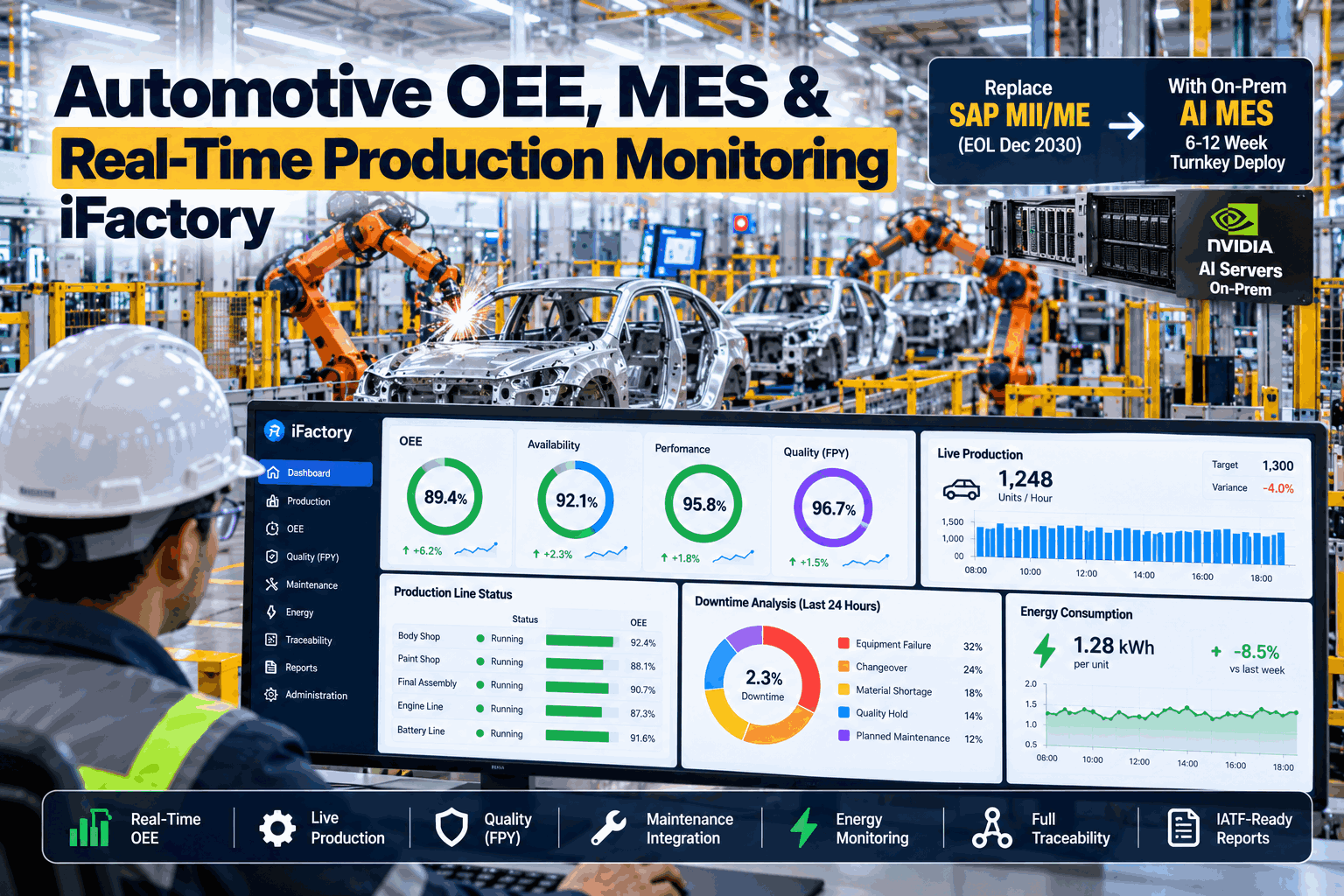
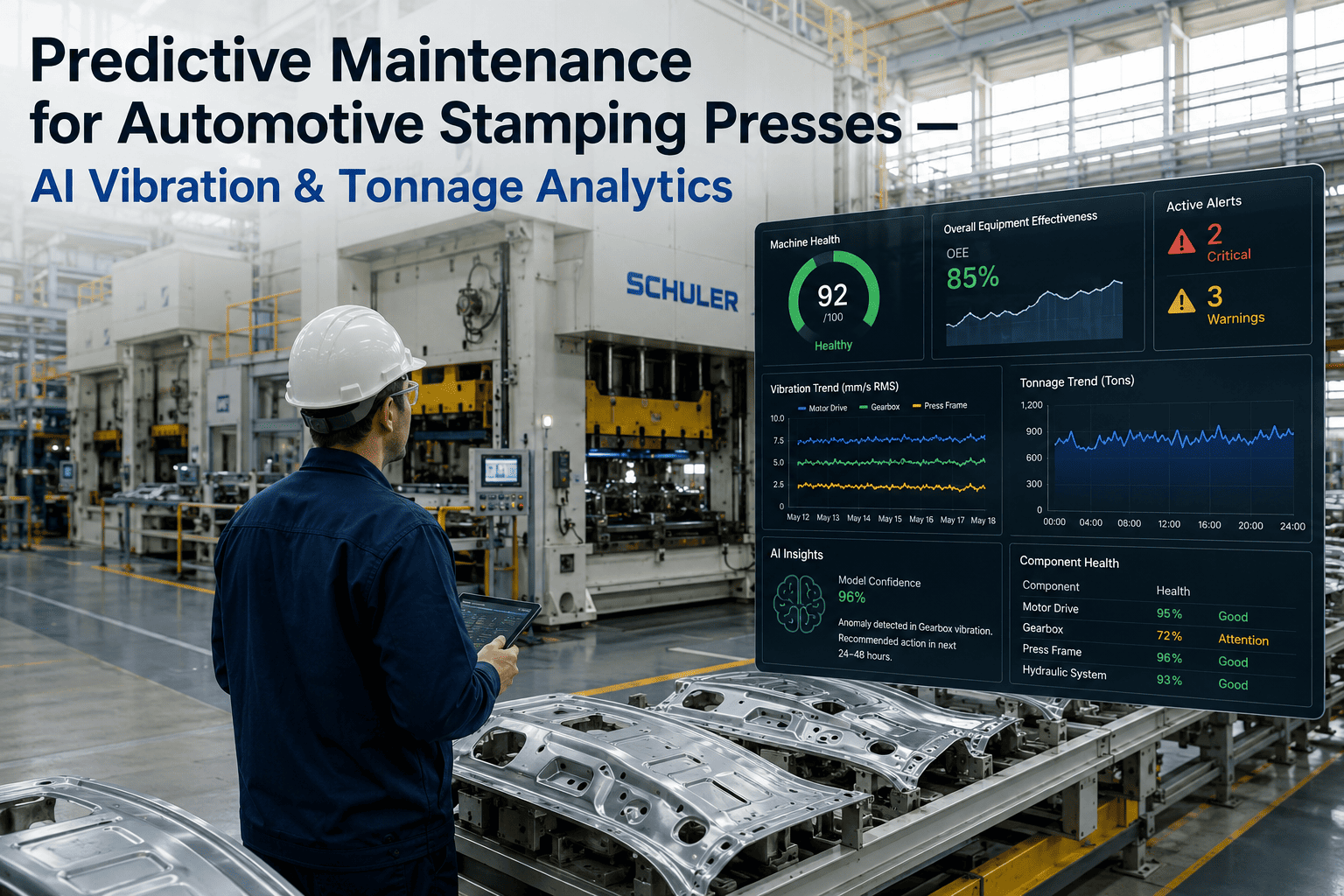
Stamping press failures on automotive body panel lines create $340,000 to $680,000 in revenue loss per 8-hour downtime event because a single 800-ton servo press feeds 14 downstream assembly stations, and manual vibration monitoring with monthly route-based inspections misses 73% of bearing degradation signatures until catastrophic failure forces emergency shutdowns during peak production schedules. iFactory's AI health monitoring platform continuously analyzes vibration patterns, hydraulic pressure fluctuations, temperature drift, and cycle timing deviations across stamping presses in real-time, detecting bearing wear 18 to 32 days before failure thresholds using machine learning models trained on 2.4 million press cycles, then auto-generating maintenance work orders with predicted failure windows that enable planned replacements during scheduled downtime instead of mid-shift emergencies. Book a demo to see AI press monitoring for your stamping line.
iFactory's AI stamping press health monitoring combines vibration sensors, hydraulic pressure transducers, thermal imaging, and cycle counters with machine learning algorithms that detect anomalous patterns indicating bearing wear, hydraulic seal degradation, die misalignment, and servo motor issues 18 to 32 days before failure. System processes 480 sensor readings per second per press, compares current signatures to trained failure models, and generates predictive alerts with remaining useful life forecasts. Result: 89% reduction in unplanned stamping press downtime, 100% elimination of catastrophic bearing failures, $2.8M annual savings per automotive plant from prevented emergency shutdowns.
See how iFactory's AI analyzes 480 sensor readings per second to detect bearing wear, hydraulic degradation, and die misalignment weeks before failure, preventing $680K emergency downtime events.
How AI Press Health Monitoring Works
The workflow below shows the five-stage process iFactory executes continuously for every stamping press, from real-time sensor data collection through predictive failure alerts and automated work order generation.
Stamping Press Failure Modes AI Monitoring Prevents
Every card below represents a real failure mechanism that causes unplanned press downtime, cascading assembly line shutdowns, or catastrophic equipment damage. These failures occur because manual inspection intervals cannot detect degradation between monthly checks, and by the time operators notice performance changes, failure is imminent. Talk to an expert about your press monitoring needs.
iFactory fix: AI detects outer race fault frequency amplitude increase 32 days before failure. Alert generated with 28-day RUL forecast. Bearing replacement scheduled during planned weekend maintenance, parts ordered with standard shipping, work completed in 8-hour window with zero production impact. Prevented $720K total loss from proactive 28-day advance warning.
iFactory fix: AI monitors hydraulic pressure rise time and hold stability. Detects 3% pressure drop trend over 8-day period, indicating seal degradation before quality impact occurs. Predictive alert triggers seal inspection during next scheduled PM, seal replaced proactively, pressure restored. Zero scrap, zero quality escapes, seal failure prevented before performance degradation affected parts.
iFactory fix: AI analyzes cycle timing consistency and hydraulic load symmetry. Detects 0.15-millisecond timing skew between left and right slide positions indicating alignment drift. Alert generated after 2,400 cycles (before die damage threshold). Die inspected, mounting bolts retorqued, alignment restored. Zero die damage, zero guide wear, misalignment corrected during 2-hour maintenance intervention vs 4-day emergency repair.
iFactory fix: AI monitors encoder signal quality, detecting intermittent dropout signatures and signal jitter 12 days before first E-stop event. Predictive alert flags encoder degradation, replacement scheduled proactively during weekend maintenance. Encoder replaced before any E-stop events occur, safety hazard eliminated, zero OSHA incidents, zero unplanned downtime from encoder-related stops.
iFactory fix: AI tracks cycle time consistency at millisecond resolution. Detects 85-millisecond average cycle time increase over 45,000 cycle period, statistically significant degradation indicating clutch brake wear. Alert generated at 120,000 cycles (before throughput impact exceeds 2%). Brake replaced during scheduled quarterly maintenance at 140,000 cycles, cycle time restored. Throughput loss limited to 1.8% vs 8%, opportunity cost reduced from $840K to $190K through early intervention.
iFactory fix: AI monitors bearing temperature trends and correlates with lubrication cycle timing. Detects temperature rise pattern inconsistent with ambient conditions or load profile, indicating lubrication deficiency. Alert generated when bearing temperature exceeds baseline by 12C (before damage threshold of 95C). Lubrication system inspected, pump wear identified, pump replaced. Bearing temperatures return to normal, zero bearing damage, lubrication failure corrected during 4-hour maintenance intervention vs 32-hour bearing replacement emergency.
Platform Capability Comparison
Generic condition monitoring systems provide vibration trending but lack press-specific failure models and production integration. Enterprise CMMS platforms manage work orders but do not process real-time sensor data. iFactory differentiates on automotive-specific ML models, sub-second anomaly detection, automatic RUL forecasting, and seamless integration with production scheduling systems. Book a comparison demo.
| Capability | iFactory | QAD Redzone | Evocon | L2L Connected Workforce | IBM Maximo | Fiix CMMS |
|---|---|---|---|---|---|---|
| Real-Time Monitoring | ||||||
| Press-specific failure models | 340 trained signatures | Generic OEE only | Generic OEE only | Not available | Custom development | Not available |
| Vibration analysis integration | 10 kHz triaxial sensors | Not supported | Not supported | Not supported | Third-party integration | Not supported |
| Sub-second anomaly detection | 480 readings/sec edge AI | 1-minute intervals | 30-second intervals | Not available | Configurable polling | Not available |
| Predictive Analytics | ||||||
| RUL forecasting accuracy | 90% within ±20% actual | Not available | Not available | Not available | Basic trending only | Not available |
| Automated work order generation | RUL-triggered with parts list | Manual creation from alerts | Manual creation | Manual creation | Automated from rules | Automated workflows |
| Production schedule integration | Downtime window coordination | OEE dashboard only | OEE dashboard only | Not available | Custom integration | Not available |
| Deployment & ROI | ||||||
| Implementation timeline | 4-6 weeks per line | 2-4 weeks | 2-3 weeks | 3-5 weeks | 6-18 months | 4-8 weeks |
| Documented downtime reduction | 89% unplanned events | OEE improvement tracking | OEE improvement tracking | Not measured | Varies by implementation | PM compliance metrics |
Based on publicly available product documentation as of Q1 2025. Verify current capabilities with each vendor before procurement decisions.
iFactory's AI continuously monitors every critical press component, predicting failures 18-32 days in advance and coordinating maintenance with production schedules to eliminate unplanned downtime.
Regional Automotive Standards Compliance
iFactory's press monitoring platform helps automotive manufacturers meet equipment safety and maintenance documentation requirements across global regulatory frameworks while maintaining secure handling of production and sensor data.
| Region | Key Standards | Compliance Requirements | iFactory Implementation |
|---|---|---|---|
| United States | OSHA 1910.217 press safety, IATF 16949 automotive quality, ANSI B11.2 press maintenance | Press safety inspection records, preventive maintenance documentation per ANSI B11.2, brake and clutch functional testing logs, die safety audits, lockout tagout procedures | Automated PM compliance tracking with ANSI B11.2 task libraries, brake and clutch performance monitoring with test result logging, safety inspection checklists with photo documentation, LOTO procedure integration with work orders |
| United Arab Emirates | UAE Labor Law machinery safety, ISO 45001 occupational health, local municipality industrial equipment permits | Equipment safety certification documentation, periodic inspection records for industrial machinery, worker safety training verification, incident reporting and investigation logs | Safety certification tracking with renewal alerts, automated inspection scheduling per UAE municipal requirements, digital safety training records with competency verification, incident management module with root cause analysis |
| United Kingdom | PUWER machinery safety regulations, HSE press safety guidance, BS EN ISO 13849 safety-related controls | PUWER compliance inspection schedules, press guarding and safety device testing, risk assessment documentation, maintenance competency records for press technicians | PUWER inspection task templates with regulatory reference links, safety device functional testing with pass fail criteria, digital risk assessment forms with hazard identification, technician qualification tracking with certification expiry alerts |
| Canada | CSA Z142 press safety code, provincial OHS regulations, WHMIS hazardous materials handling | CSA Z142 compliance verification, provincial OHS inspection readiness, hydraulic fluid and lubricant safety data sheets, emergency stop system testing logs | CSA Z142 compliance checklist automation, provincial regulation mapping by facility location, SDS document repository with chemical inventory tracking, E-stop functional test scheduling with automated result capture |
| Germany | BetrSichV machinery safety ordinance, DGUV press safety regulations, VDI 3423 press maintenance guidelines | BetrSichV periodic inspection by qualified persons, DGUV accident prevention documentation, VDI 3423 maintenance interval compliance, CE marking technical file maintenance | Qualified person inspection scheduling with external provider coordination, DGUV documentation templates in German language, VDI 3423 maintenance task intervals pre-configured, CE technical file document management with version control |
| Europe | Machinery Directive 2006/42/EC, EN 693 press safety standard, ISO 45001 occupational health management | Machinery Directive conformity assessment, EN 693 essential health and safety requirements, risk assessment per ISO 12100, declaration of conformity maintenance | Machinery Directive compliance documentation with essential requirement checklist, EN 693 safety verification test procedures, ISO 12100 risk assessment methodology templates, declaration of conformity storage with modification tracking |
iFactory maintains compliance with evolving regional standards through regular updates. Contact support for specific automotive plant requirements in your operating jurisdiction.
Measured Outcomes From Deployed Automotive Plants
From the Field
Frequently Asked Questions
Continue Reading
iFactory's AI continuously monitors every critical press component with 480 sensor readings per second, predicting failures 18-32 days in advance and coordinating maintenance with production schedules to eliminate costly unplanned downtime.