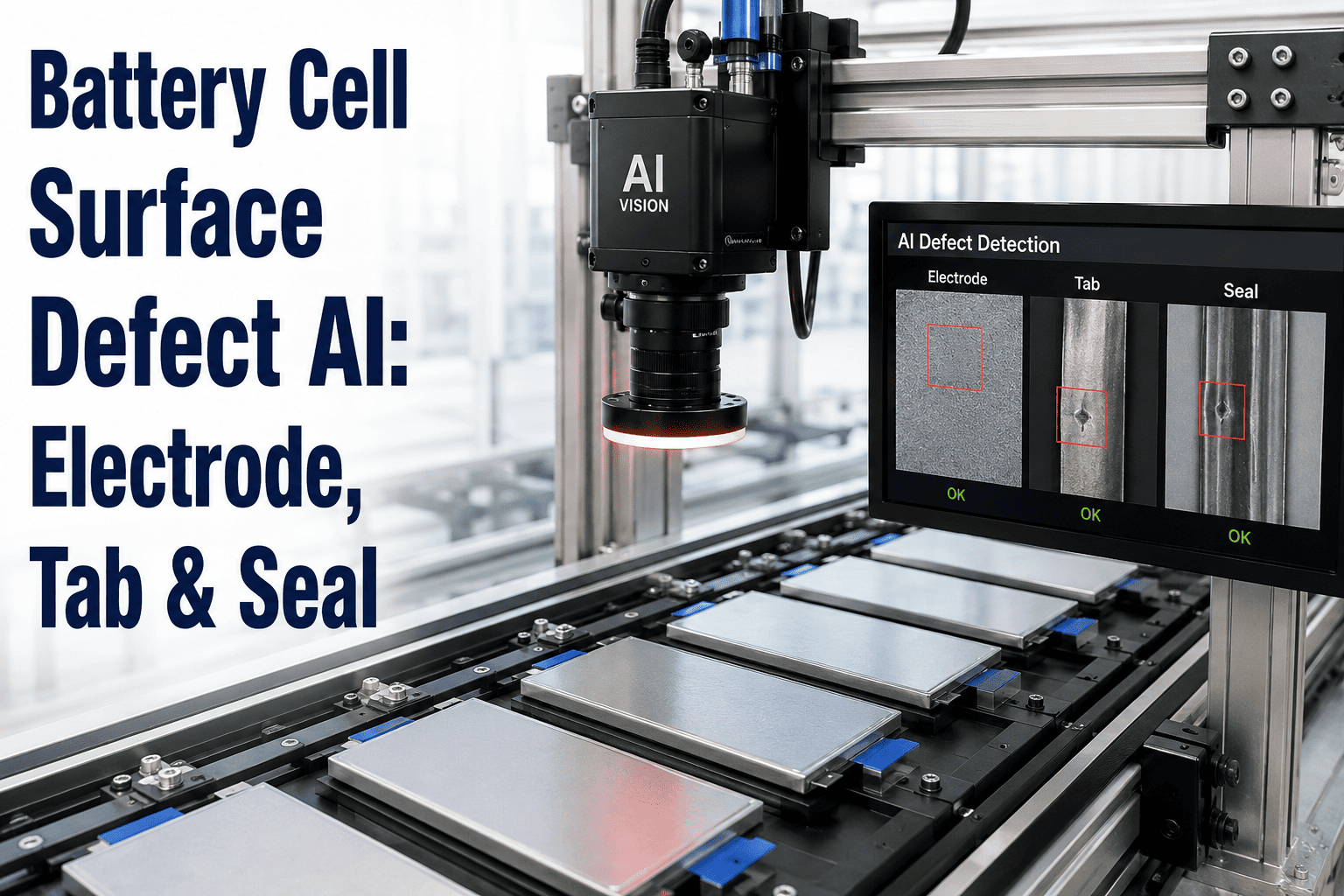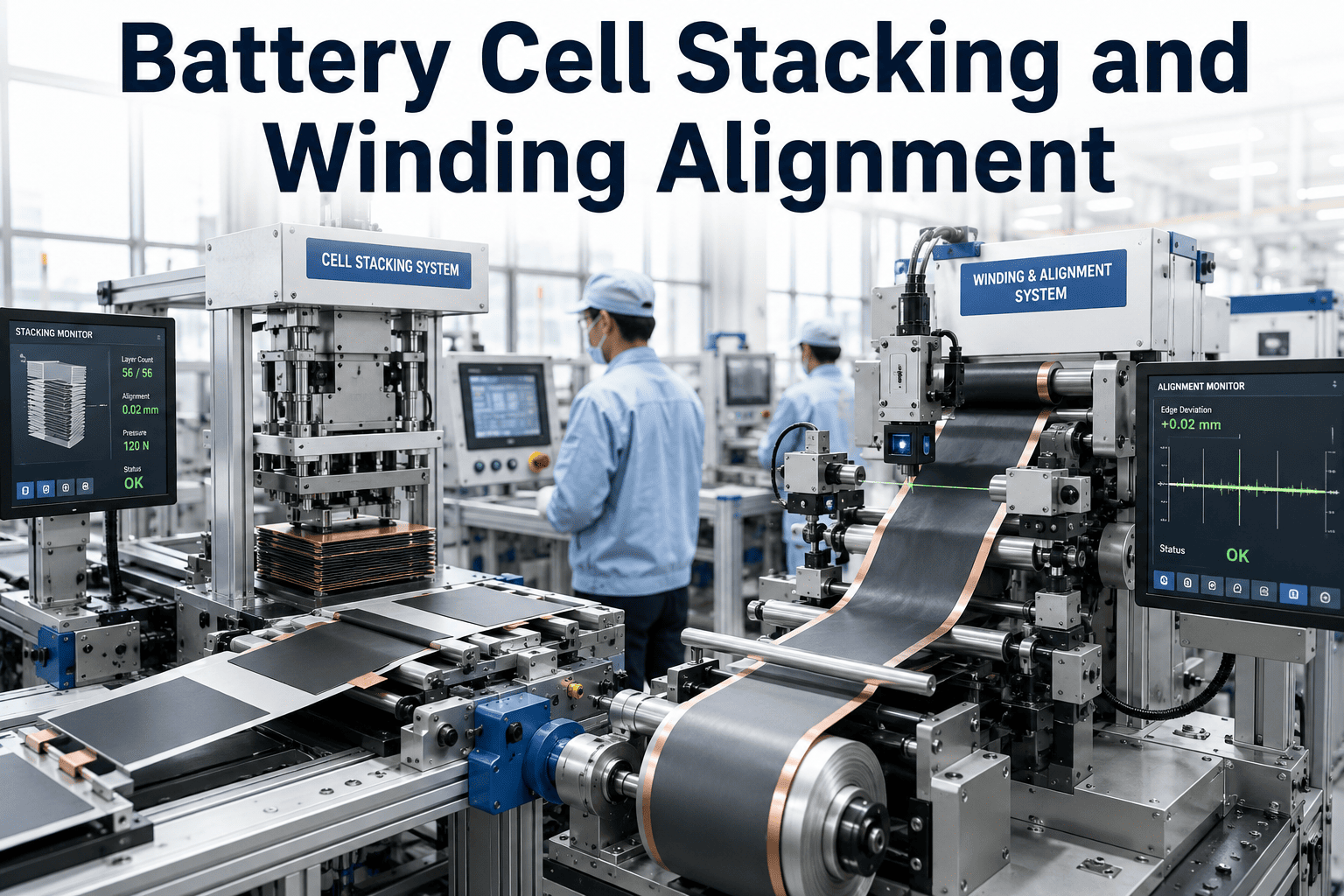
Misaligned electrode stacking and winding accounts for more than half of all cell defects across the industry, and unlike a coating pinhole, a misalignment issue is not always visible from the outside once a cell is sealed. Cathode, anode, and separator layers that drift out of position can create shorting risk or capacity loss that only shows up during formation testing or, worse, months later in the field. Vision-based alignment checks catch this at the exact moment each layer is placed. See the inspection point in action by booking a demo for your cell assembly line.
Why Stacking Misalignment Is the Leading Defect Category
Prismatic and pouch cells depend on precise layer registration. A cathode, anode, or separator that shifts even slightly can compromise safety and performance long before any electrical test would catch it.
A Layer-by-Layer View of the Stack
Vision inspection does not check the finished stack once — it verifies every layer as it is placed, comparing each cathode, separator, and anode position against the design tolerance in real time.
What a Cell Assembly Lead Actually Sees Change
The value of layer-by-layer inspection is easiest to see in what stops happening once it is running, rather than in what gets added to a dashboard.
Formation-stage rejects tied to internal shorting or capacity shortfall typically decline first, since these are the failure modes most directly connected to stacking and winding misalignment. That decline shows up before any broader safety metric moves, simply because misalignment is a leading cause of exactly the defects formation testing is designed to catch. A cell assembly lead reviewing weekly scrap data usually notices this category shrink within the first few weeks of full-coverage inspection, well before the system has been tuned to its final accuracy targets.
The second, less immediately visible change is in root-cause investigation time. When a defect pattern emerges, the automatic per-cell record means an engineer can pull up the exact alignment measurement for that cell rather than relying on a nearby manual sample that may not reflect the actual cell in question. What used to take a shift or more of manual cross-referencing between logbooks and defect reports often becomes a query that returns an answer in minutes, which shortens the entire corrective action cycle considerably.
What Vision AI Checks at Every Cycle
Stacking and winding inspection covers more than a single alignment number — it verifies the full geometry that determines whether a cell will perform and behave safely.
Manual Sampling vs Vision AI on the Stacking Line
Manual spot checks sample a fraction of cells per shift. Vision inspection checks every layer of every cell, at the speed the stacking or winding machine already runs.
| Dimension | Manual Spot Checks | Vision AI Inspection |
|---|---|---|
| Coverage | Sampled fraction of cells per shift | Every layer of every cell |
| Detection timing | After stacking is complete | As each layer is placed |
| Overhang measurement precision | Manual gauge, operator-dependent | Sub-millimeter, consistent across shifts |
| Traceability | Manual log per sample | Automatic record per cell |
| Cylindrical, prismatic, pouch coverage | Format-specific manual procedures | Single platform across all formats |
The Scrap and Safety Impact
Stacking defects that go undetected do not just create scrap — they carry the highest safety-cost asymmetry of any defect category in cell manufacturing.
Why Alignment Drift Is Hard to Catch Manually
Stacking and winding equipment is mechanically precise when it is new, but every moving part wears, and wear does not announce itself with a sudden failure.
A robotic gripper placing electrode layers hundreds of times per minute develops microscopic wear patterns over weeks of continuous operation, and that wear shows up as a slow, cumulative drift in placement accuracy rather than a single dramatic miss. A periodic manual dimensional check, taken once per shift or once per batch, is structurally unlikely to catch this kind of gradual drift while it is still within tolerance but trending in the wrong direction. By the time a manual sample flags a problem, a meaningful number of cells have often already been produced with a degree of misalignment that a continuous system would have flagged days earlier.
Humidity and material feed variance compound this further. Separator material behaves slightly differently as ambient humidity shifts across a shift or a season, and slight variations in electrode feed tension interact with gripper wear in ways that are difficult to predict from a single variable in isolation. Continuous vision monitoring does not need to predict this interaction in advance — it simply measures the actual result on every cycle, which is precisely why it catches combined-cause drift that single-variable manual checks are not designed to detect.