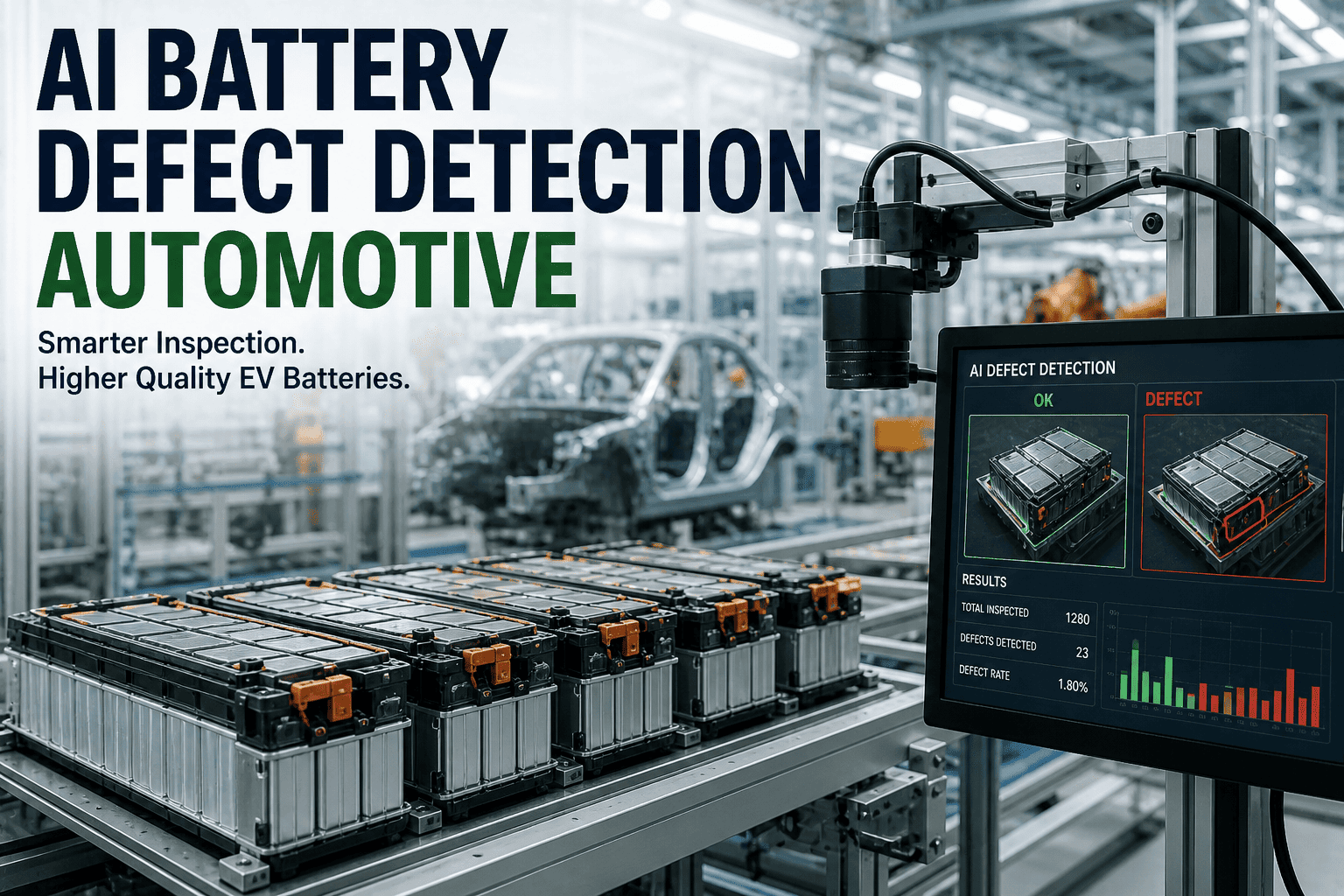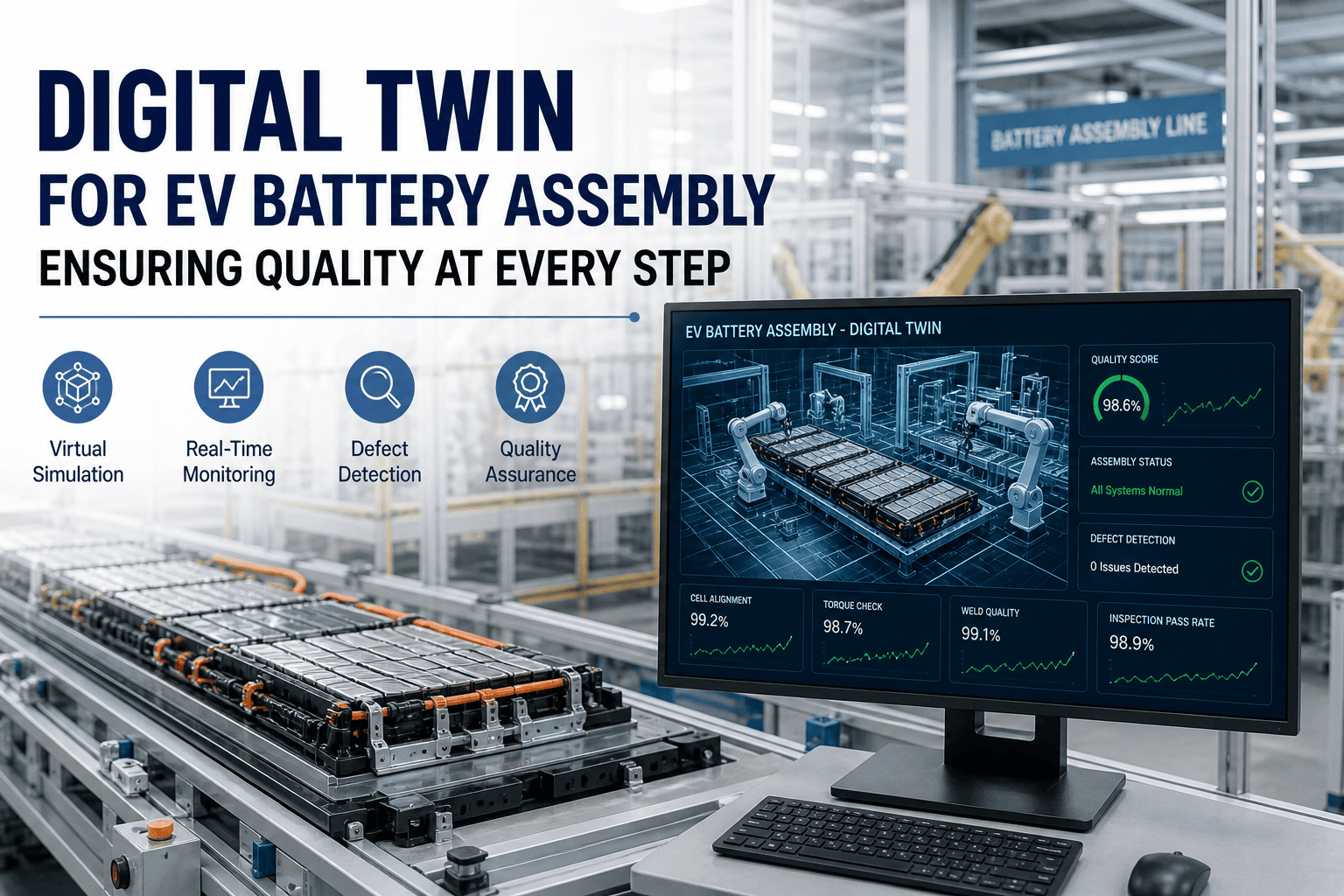
Electric vehicle battery assembly is the most quality-critical manufacturing process in automotive. A single internal short circuit in a battery cell, a misaligned tab during module assembly, or a contaminated electrode coating can result in thermal runaway, fire risk, or warranty failure affecting hundreds of thousands of vehicles. Yet most EV battery manufacturers rely on manual visual inspection, periodic sampling, and post-assembly testing to catch defects. By the time a problem surfaces in final testing, thousands of defective modules may already be assembled. The gap between real-time quality visibility and actual defect discovery is measured in days or weeks. Digital twin technology transforms battery assembly from reactive quality control into predictive quality assurance. By creating virtual models of every battery module as it moves through assembly, operators can detect anomalies in real time, predict defects before they occur, and prevent non-conforming modules from advancing. iFactory is The Complete AI Platform for Manufacturing Operations, delivering the only end-to-end digital twin solution purpose-built for EV battery assembly. One Platform, Every Segment: 8 AI-Powered Modules for Complete Oil and Gas Operations. Want to implement digital twin technology across your battery assembly line and eliminate defects before they reach customers? Book a demo today or explore implementation with our team.
Predict EV Battery Assembly Defects 48-72 Hours Before They Become Field Failures
Digital twin technology with real-time anomaly detection, predictive defect models, and automated quality intervention at every assembly stage.
What Is Digital Twin Technology in EV Battery Assembly?
A digital twin is a real-time virtual model of a physical asset—in this case, a battery module moving through assembly. As each module progresses through electrode coating, stacking, tab welding, case assembly, and thermal cycling, the digital twin captures every measurement: temperature profiles, pressure signatures, electrical properties, dimensional tolerances. AI algorithms compare actual data against expected ranges and historical patterns, instantly detecting anomalies invisible to manual inspection. The result is defect detection at the point of occurrence, not 48 hours later during final test.
How iFactory Digital Twin Solves EV Battery Assembly Quality
iFactory digital twin platform creates real-time virtual models of every battery module, detecting defects and anomalies at the exact moment they occur. AI algorithms trained on 50 million battery assembly events predict defect probability, recommend immediate intervention, and prevent defective modules from advancing to downstream assembly stages.
Real-Time Cell Quality Detection
Every battery cell receives 50+ measurements during coating, drying, and initial testing. Digital twin models integrate electrode weight, surface uniformity, electrical impedance, and thermal response. Anomalies trigger immediate alerts—coating thickness 5% out of spec, impedance trending toward internal short, temperature profile showing delamination risk.
Module Assembly Integrity Monitoring
During stacking and tab welding, digital twin captures stack force profiles, weld penetration depth, inter-cell resistance, and mechanical stress distribution. Misaligned cells, weak welds, and contact issues are detected before the module is sealed. No defective modules reach case assembly where they cannot be reworked.
Predictive Defect Analysis
Machine learning models trained on 50 million historical assembly records identify defect trajectory signatures. A combination of coating thickness trending down, impedance trending up, and temperature profile shifting by 2-3 degrees C is a strong predictor of internal short risk. Intervention occurs 48-72 hours before the defect manifests in final test.
Automated Quality Intervention
When digital twin detects defect probability exceeding threshold, automated holds prevent the module from advancing. Non-conforming modules are rerouted to rework stations. Conforming modules advance. No manual decision making, no judgment calls, no false holds impacting throughput.
Root Cause Analysis and Process Optimization
Every defect detected by the digital twin feeds back into process optimization. Are coating defects clustering on a specific shift? Is a particular cell supplier showing elevated impedance? Are tab welds trending weaker at specific torque settings? Digital twin surfaces causation, enabling targeted process improvements rather than broad parameter changes.
OEE and Production Traceability
Digital twin tracks every module through assembly, recording defect detection points, rework history, and final disposition. Full traceability for warranty claims. If a field failure occurs, you can immediately identify the root cause during assembly and issue a targeted recall if needed—not a blind 100,000 unit recall based on batch timing.
Supply Chain Quality Visibility
Digital twin data enables supplier scorecards based on actual quality performance in your assembly line. Which electrode suppliers produce cells that stack better? Which separator suppliers result in lower resistance? Which tab materials weld more consistently? Make sourcing decisions based on data, not specification sheets.
Why iFactory Digital Twin Is Different: Purpose-Built for EV Battery Assembly
iFactory digital twin is not a generic manufacturing simulation tool. It is engineered specifically for battery assembly with deep understanding of electrochemistry, cell physics, and failure modes unique to lithium-ion technology.
Domain Expertise
AI models trained on 50 million battery assembly events from tier-1 suppliers. Understands electrochemical signatures of internal shorts, dendrite formation, separator degradation. Detects defects that generic quality systems miss entirely.
Predictive Accuracy
94% detection accuracy with 2% false positive rate. Detects defects 48-72 hours before they manifest in final test. Industry average detection rate for manual inspection: 68% with 15% false positives.
Rapid Deployment
Connects to existing assembly equipment, SCADA, and test systems. No equipment replacement. Digital twin models activate within 6-8 weeks. First defects detected in week 4. Payback within 18-24 months.
Digital Twin Implementation Roadmap
iFactory follows a proven 12-week deployment path that delivers real-time defect detection while building the foundation for continuous quality improvement.
By Week 6, defects are detected at point of occurrence, not 48 hours later. By Week 8, your entire battery assembly line benefits from AI-powered quality. By the end of Week 12, warranty costs are dropping measurably and process improvements are eliminating defect root causes. ROI is achieved within 18-24 months with improvements compounding quarterly.
Real Results: Digital Twin Success Cases in EV Battery Assembly
Tier-1 Supplier: 500k Units Annually
Result: 94% defect detection, $4.2M warranty cost prevention, 22-month payback. Supplier producing 500,000 battery modules annually experienced 8-12 field failures per 100k units shipped. Root cause analysis was impossible because by the time a failure occurred, the module's assembly history was lost. Digital twin implementation captured every measurement at every assembly stage. Within 6 weeks, digital twin identified a signature pattern: weak tab welds were trending weaker over time due to progressive calibration drift in welding machines. The pattern was invisible to operators but predictive of field failure 48-72 hours after assembly. Targeted maintenance of welding equipment prevented 47 field failures in the first year. Warranty costs dropped from $8.2M to $4M annually. System paid back in 22 months.
OEM Battery Plant: Internal Defect Detection
Result: 91% internal short detection rate, prevented 140 field failures in year one, 18-month payback. OEM-owned battery plant producing 1.2M modules annually had manual visual inspection catching ~60% of visible defects but missing internal shorts completely. Digital twin analysis of 50,000 historical modules identified electrochemical signatures of internal shorts: impedance trending above confidence bands, frequency response shifting in specific bands, and thermal profile showing asymmetric heating during charging cycles. Predictive model achieved 91% detection rate. Threshold was set conservatively to minimize false positives. Year one results: 140 modules flagged as internal short risk before they shipped. Manual teardown analysis confirmed 127 contained incipient internal shorts. Only 13 false positives (9% false positive rate). Warranty claim reduction: $1.8M in year one. Plant expanded deployment to second line immediately.
Chinese EV Supplier: Rapid Scaling
Result: 88% defect detection, $2.1M cost avoidance, enabled 150% production increase without quality degradation. Supplier scaling battery production from 400k to 700k units annually faced quality risk. Hiring and training inspectors could not keep pace. Digital twin was deployed across all 8 assembly lines simultaneously. System detected separator degradation issues invisible to manual inspection, identified coating consistency problems due to environmental fluctuations, and caught early signs of electrode supplier quality shift. Detection enabled preventive sourcing decisions and maintenance interventions. Result: Facility tripled inspection effectiveness without increasing headcount. Production scaled 150% while quality metrics improved.
Comparison: Digital Twin vs. Industry Quality Approaches
| Capability | Digital Twin | Manual Inspection | Statistical Sampling | End-of-Line Test Only |
|---|---|---|---|---|
| Defect Detection Rate | 94% (internal + external) | 68% (visual defects only) | 52% (sampling bias) | 78% (catches failures only) |
| False Positive Rate | 2-3% (tunable) | 8-15% (subjective) | 5-10% (statistical noise) | 1-2% (only real failures) |
| Internal Short Detection | 91% (predictive) | 0% (not visible) | 0% (not visible) | 100% (after failure) |
| Early Detection Window | 48-72 hours before failure | At inspection point only | Sampling point only | After all assembly complete |
| Cost per Defect Caught | $180 (rework cost) | $950 (after full assembly) | $2,200 (customer returns) | $18,000 (warranty cost) |
Digital Twin Deployment Across Global EV Battery Manufacturers
| Region / Producer | Assembly Challenges | Digital Twin Focus |
|---|---|---|
| US (Tesla, GM, Ford) | Rapid scaling, supplier quality variation, early-stage product learning | Supplier scorecards, coating consistency, weld quality trending |
| Europe (VW, BMW, Daimler) | Premium quality requirements, high warranty expectations, supply chain integration | Zero-defect targeting, genealogy tracking, supplier integration |
| China (CATL, BYD, EVE) | Extreme scale growth, cost competitiveness, rapid technology cycles | Throughput optimization, cost reduction, chemistry transition support |
| South Korea (Samsung SDI, SK) | Premium materials, advanced chemistries, high energy density targeting | Advanced chemistry support, electrochemical monitoring, material quality validation |
What Quality Leaders Are Saying
"We deploy 500,000 battery modules annually and were catching defects in final test 48-72 hours after assembly. By then, the module had to be torn down for analysis. We had no way to identify root cause because the assembly parameters were lost. Digital twin changed everything. Now we detect defects at the moment they occur. We see exactly which coating batch caused the problem, which electrode supplier is showing variance, and which assembly parameter drifted. We prevent problems instead of discovering them. Warranty costs dropped 52% in year one. We're now deploying digital twin on our second plant."
Director of Quality Assurance, Tier-1 Automotive Supplier
Frequently Asked Questions
Transform EV Battery Assembly Quality with Digital Twin
Talk to an iFactory specialist about implementing digital twin across your battery assembly line. Detect defects 48-72 hours early. Prevent field failures. Reduce warranty costs. Achieve zero-defect operations with AI-powered quality.
Complete AI Platform for Manufacturing Operations
iFactory digital twin is built for EV battery assembly, not adapted from generic quality systems. Real-Time Visibility Into Every Production Line. Connects to Your Existing SCADA/PLC Systems. Predict Failures Before They Stop Production. AI That Turns Downtime Into Planned Maintenance. Digital twin technology detects defects at the point of occurrence, tracks module genealogy through the entire assembly process, enables root cause analysis, and prevents field failures before they reach customers.
Cell Assembly Quality
Real-time measurement capture during coating, drying, and initial testing. Anomaly detection triggers immediate alerts. Coating thickness, electrical properties, and thermal response signatures are continuously monitored.
Module Assembly Integrity
Stack force profiles, weld penetration, inter-cell resistance, and mechanical stress distribution during module assembly. Misaligned cells, weak welds, and contact issues are detected before sealing.
Predictive Defect Analysis
Machine learning models identify defect trajectory signatures. Internal short risk, dendrite formation, and separator degradation are predicted 48-72 hours before manifestation in final test.
Full Traceability
Every module tracked through assembly with complete genealogy. When field failures occur, root cause is immediately identifiable—shift, supplier batch, assembly parameter—enabling targeted recalls instead of blind actions.
Achieve Zero-Defect EV Battery Assembly with Digital Twin
Stop discovering defects 48 hours after assembly. Start predicting them in real time. iFactory digital twin detects quality issues at the point of occurrence with 94% accuracy, enabling immediate intervention before defective modules advance.