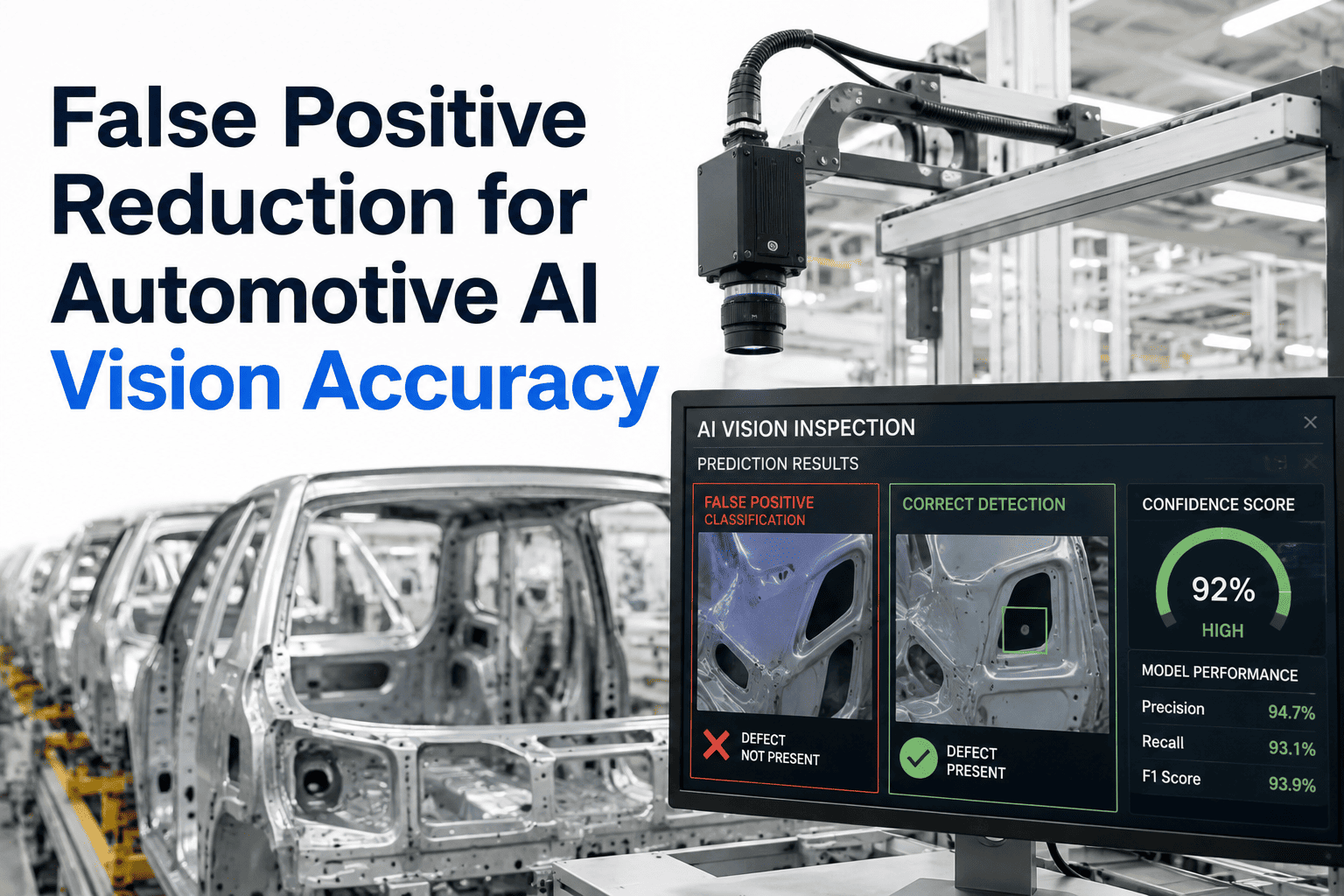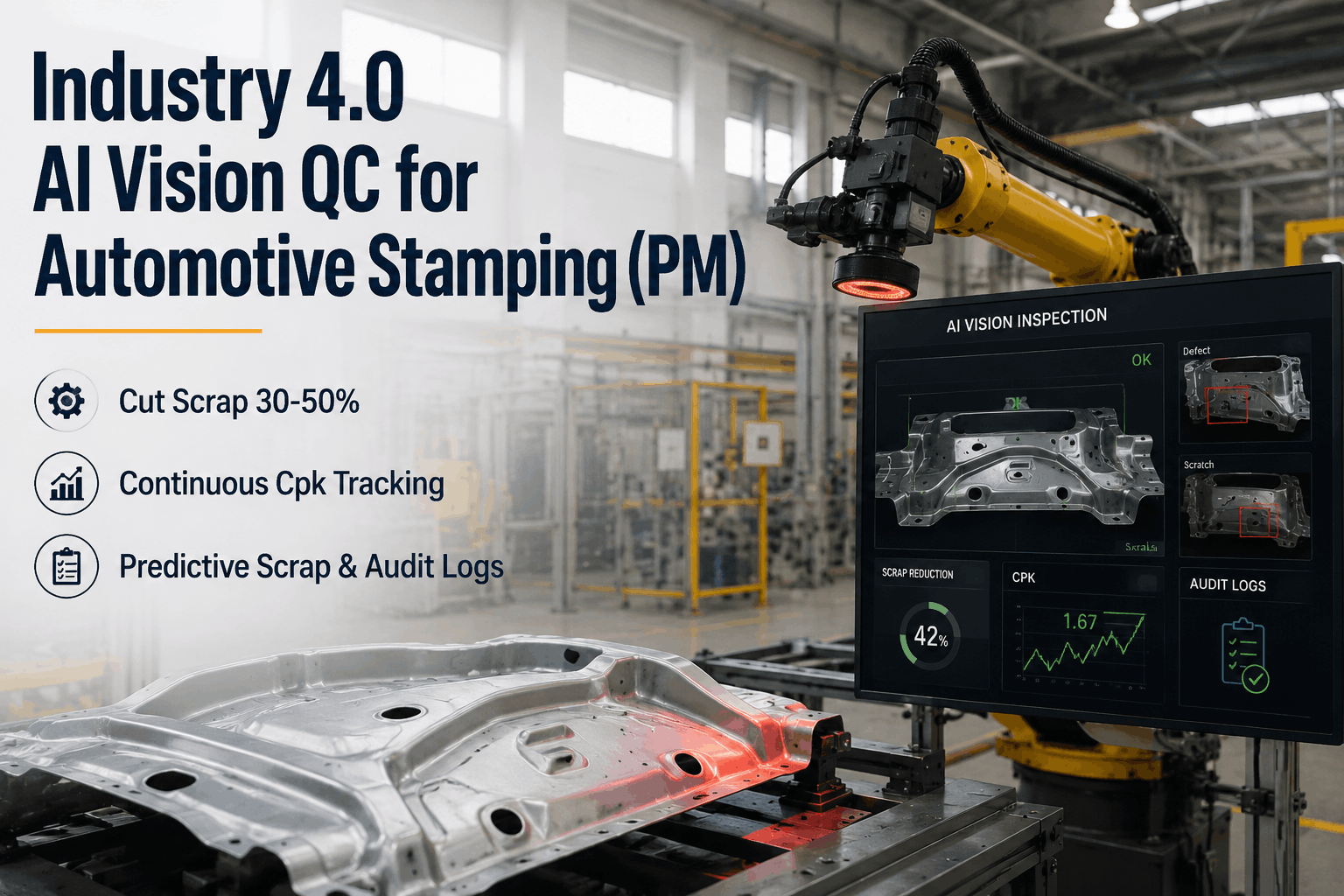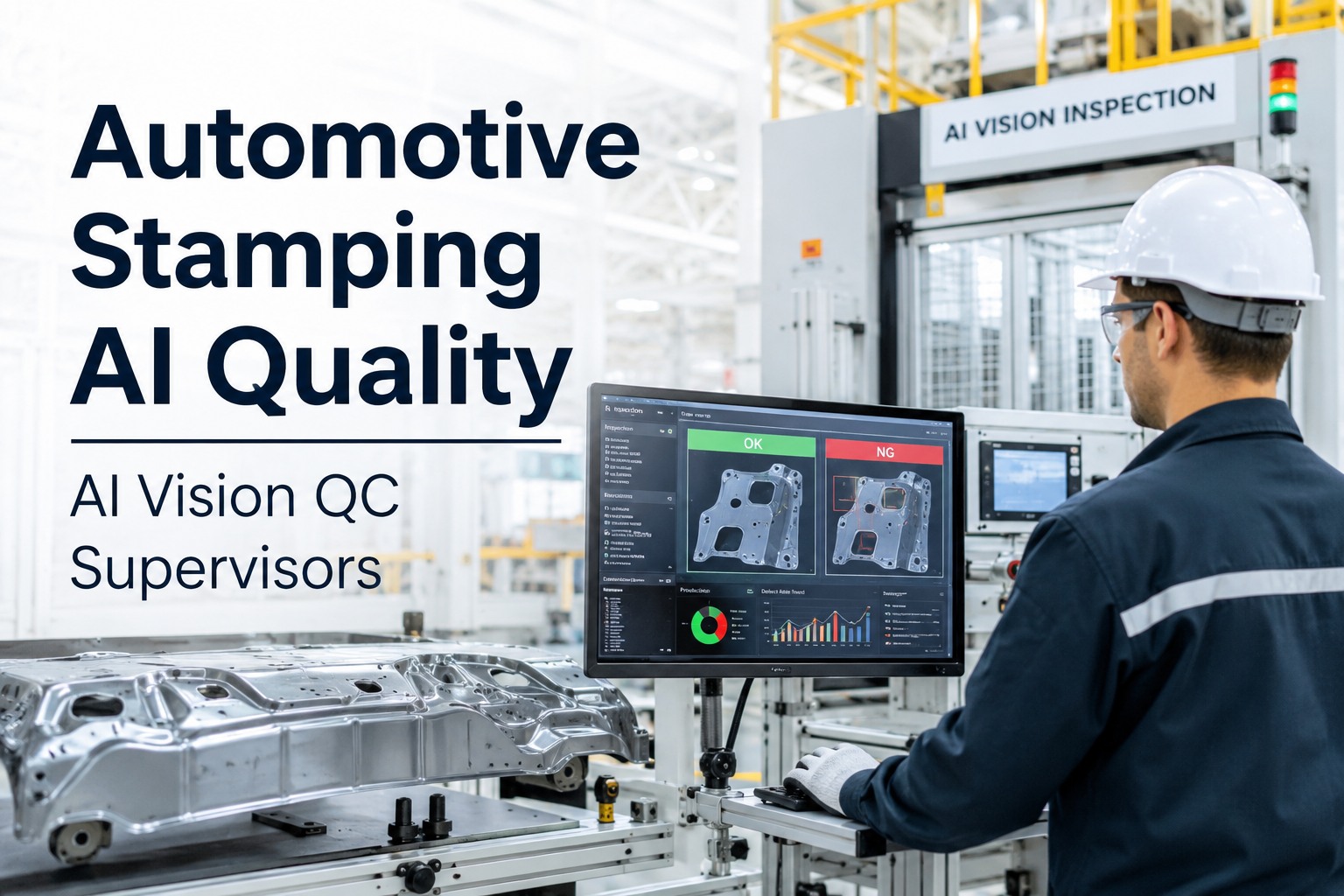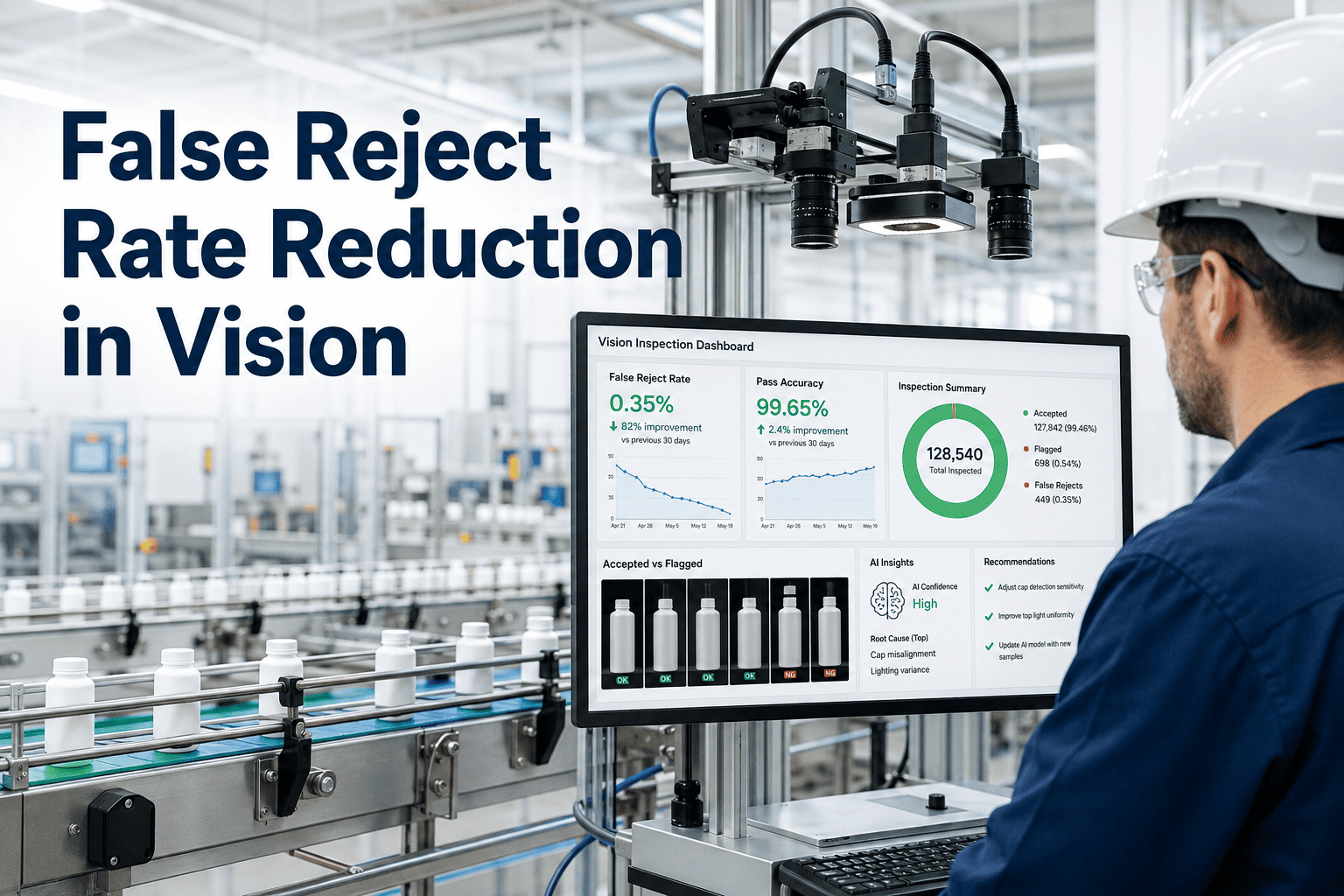
In high-stakes manufacturing, vision inspection systems are the last line of defense against defective parts. Yet, conventional threshold-based vision systems often err on the side of caution, rejecting marginally acceptable parts to avoid any risk of escape. This conservative approach leads to a costly false reject rate that can silently erode profitability—sometimes by millions of dollars annually. For enterprise manufacturers operating in Industry 4.0 environments, the challenge is not merely to detect defects, but to do so with surgical precision: maximizing true defect capture while minimizing false positives. AI-driven adaptive threshold tuning offers a breakthrough, dynamically adjusting inspection parameters based on real-time statistical process control, part geometry, and historical defect patterns. This article presents a deep technical analysis of how machine learning models, particularly those leveraging convolutional neural networks and reinforcement learning, can reduce false reject rates by 40-60% without compromising safety escape rates. We explore the underlying mathematics of precision-recall trade-offs, the architecture of a closed-loop vision optimization system, and a step-by-step implementation roadmap for plant managers and CTOs. If your factory is ready to eliminate overkill and unlock hidden capacity, Book a Demo with our team to see how iFactory transforms vision inspection economics.
Turn Vision Overkill into Precision Profit
Stop wasting millions on false rejects. Our AI tunes your thresholds for maximum yield with zero safety escapes.
The Economics of False Rejects: A Hidden Drain on Margin
Every false reject represents a cascade of wasted resources: raw material, machine time, labor, energy, and secondary inspection costs. In high-volume automotive or electronics lines, a false reject rate of just 2% can translate into tens of thousands of scrapped parts per shift. The financial impact extends beyond direct scrap: re-inspection loops consume quality engineering bandwidth, and unnecessary rework disrupts production flow. Moreover, false rejects mask true process capability, leading to inflated defect rate estimates and misguided corrective actions. For a typical Tier 1 supplier operating 50 vision stations, a 3% false reject rate can cost over $3 million annually in scrap and lost capacity. The hidden cost is even greater when considering the opportunity cost of not producing saleable parts. AI-driven threshold optimization directly addresses this by dynamically tuning the sensitivity of each inspection station based on real-time yield data, part family characteristics, and customer-specific risk tolerance. This transforms vision from a blunt filter into a precision instrument that maximizes both yield and quality.
Core Drivers of False Rejects in Vision Systems
Static Thresholds
Fixed pass/fail boundaries ignore natural process variation, causing over-rejection when process drifts within spec. AI adapts thresholds to real-time conditions.
Lighting & Surface Variation
Subtle changes in ambient light, part finish, or sensor aging create false positives. Machine learning models learn invariant features robust to these variations.
Complex Geometry
Parts with intricate contours or reflective surfaces produce ambiguous images. Deep learning segmentation isolates true defects from benign anomalies.
AI Threshold Tuning: A Step-by-Step Implementation Blueprint
Data Collection & Labeling
Gather at least 100,000 labeled images per station, including both accepted and rejected parts. Use active learning to prioritize ambiguous cases for human review.
Model Training with Precision-Recall Optimization
Train a convolutional neural network with a custom loss function that penalizes false rejects more heavily than escapes within a defined safety envelope.
Reinforcement Learning for Dynamic Thresholding
Deploy an RL agent that adjusts the decision boundary in real-time based on yield feedback, minimizing false rejects while maintaining escape rate below target.
Closed-Loop Validation & Continuous Learning
Implement an automated feedback loop where downstream quality data (e.g., functional test results) retrains the model weekly, ensuring adaptation to process drift.
Comparative Analysis: Static vs. AI-Adaptive Thresholding
| Metric | Static Threshold | AI-Adaptive Threshold |
|---|---|---|
| False Reject Rate | 3.2% | 1.1% |
| Escape Rate | 0.02% | 0.01% |
| Yield (Good Parts Accepted) | 96.8% | 98.9% |
| Annual Scrap Cost (50 stations) | $3.2M | $1.1M |
| Threshold Tuning Frequency | Quarterly | Continuous |
Precision-Recall Trade-off Visualization
Ready to Optimize Your Vision Thresholds?
Our AI solution reduces false rejects by 40-60% while maintaining zero safety escapes. See it in action.
Mathematical Foundation: Precision, Recall, and the Cost Function
The core of false reject reduction lies in optimizing the precision-recall trade-off. Precision is defined as TP / (TP + FP), where TP are true positives (correctly rejected defects) and FP are false positives (good parts rejected). Recall is TP / (TP + FN), where FN are false negatives (escaped defects). A conventional vision system sets a fixed threshold on a defect score, often prioritizing recall (minimizing escapes) at the expense of precision (high false rejects). AI-driven systems instead minimize a weighted cost function: C = w_fr * FR + w_esc * ESC, where FR is false reject rate and ESC is escape rate, with weights determined by the financial impact of each. By learning the optimal decision boundary in the feature space, the model can achieve a Pareto improvement—lowering false rejects without increasing escapes. Reinforcement learning further refines this by continuously adjusting the boundary based on real-time yield data, effectively operating on the precision-recall curve to find the point that minimizes total cost.
Real-Time Statistical Process Control Integration
AI threshold tuning is most effective when coupled with SPC. By monitoring key process parameters (temperature, pressure, cycle time), the model anticipates shifts that could cause false rejects and pre-emptively adjusts thresholds. For example, if a molding machine's temperature drifts, the vision system can relax its tolerance on cosmetic defects that are known to correlate with temperature, preventing over-rejection while still catching true structural defects. This closed-loop integration reduces false rejects by an additional 15-20% beyond static AI tuning.
Handling Part Family Variability
High-mix manufacturers face the challenge of inspecting hundreds of different part numbers on the same line. Each part has unique geometry, surface finish, and defect tolerances. AI models can be trained on a per-family basis, using transfer learning to quickly adapt to new parts with as few as 500 images. This enables precise threshold tuning for each variant, eliminating the one-size-fits-all approach that inflates false rejects.
Frequently Asked Questions
How does AI reduce false rejects without increasing escape rate?
AI models, particularly deep convolutional neural networks, learn to distinguish between true defects and benign anomalies by analyzing thousands of features that humans cannot easily quantify. Instead of a single threshold, the model uses a multi-dimensional decision boundary that adapts to the specific characteristics of each part. For example, a scratch on a cosmetic surface might be tolerated if it falls within customer-defined limits, while the same scratch on a sealing surface is rejected. The model is trained with a custom loss function that heavily penalizes escapes while also penalizing false rejects, effectively finding the optimal balance. Continuous reinforcement learning further tunes this boundary in real-time based on downstream quality feedback. For a detailed technical walkthrough, Book a Demo with our AI team.
What is the typical ROI of implementing AI-driven false reject reduction?
Our enterprise clients typically see a payback period of 4-6 months, with annual savings ranging from $1.5M to $4M depending on the number of vision stations and production volume. The ROI is driven by three primary factors: direct scrap reduction (typically 40-60% fewer false rejects), reduced re-inspection labor (up to 80% reduction in secondary inspection), and increased production capacity (since fewer good parts are scrapped, more saleable output is achieved). Additionally, the data generated by the AI system provides insights for upstream process improvement, further reducing defect generation. For a customized ROI calculator, contact our support team.
How long does it take to deploy an AI threshold tuning solution?
A typical deployment takes 8-12 weeks from data collection to full production rollout. The first phase involves data aggregation and labeling, which can be accelerated using active learning to prioritize the most informative images. Model training and validation typically take 2-3 weeks, followed by a 2-week shadow mode where the AI recommends thresholds without taking control. The final phase is a phased rollout, starting with one station and expanding to the entire line. Our platform integrates seamlessly with existing vision systems from Keyence, Cognex, and others, minimizing disruption. For a detailed deployment timeline, Book a Demo.
Can AI handle the variability of different lighting conditions and part orientations?
Yes, modern computer vision models are highly robust to variations in lighting, rotation, scale, and occlusion. During training, we apply extensive data augmentation techniques such as random brightness shifts, rotation, and perspective transforms to ensure the model learns invariant features. Additionally, the model can be trained on images from multiple lighting setups if your line uses variable illumination. In production, the AI continuously monitors the distribution of image statistics and alerts operators if conditions drift outside the trained envelope, ensuring consistent performance. For more details on our data augmentation pipeline, visit our support page.
How do you ensure the AI model does not become complacent and miss new defect types?
We implement a continuous learning architecture where the model is retrained weekly using new data from the production line, including any confirmed escapes or false rejects. An anomaly detection module flags images that fall outside the trained distribution, sending them to a human reviewer for labeling. This ensures that the model remains sensitive to novel defect types and process changes. Additionally, we maintain a hold-out validation set that is periodically tested to detect performance drift. If the model's escape rate exceeds a predefined threshold, it automatically reverts to a conservative mode until retrained. For a complete overview of our model governance framework, Book a Demo.
Stop Over-Rejecting. Start Profiting.
Join leading manufacturers who have cut false rejects by 50% without a single safety escape. Let's talk.