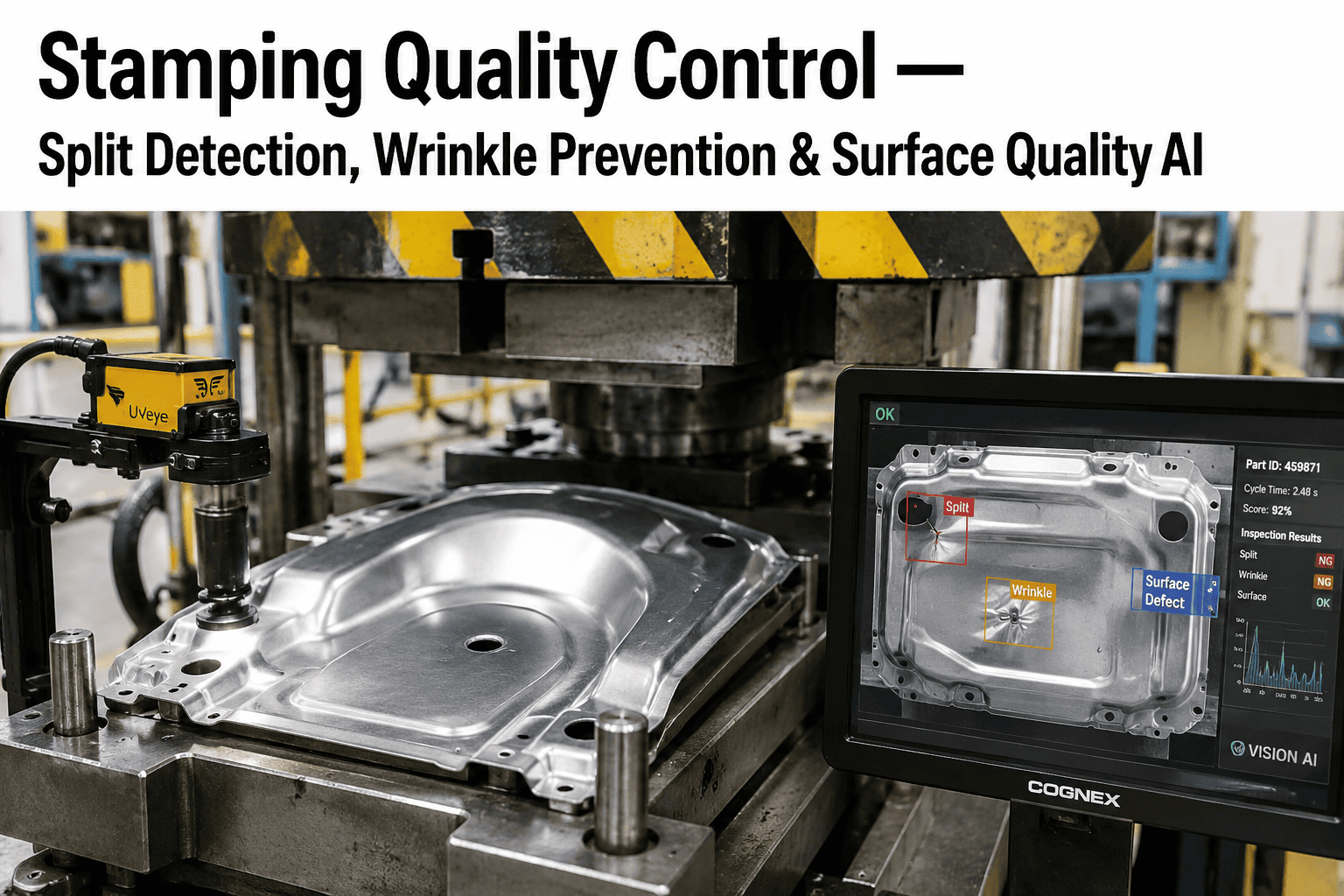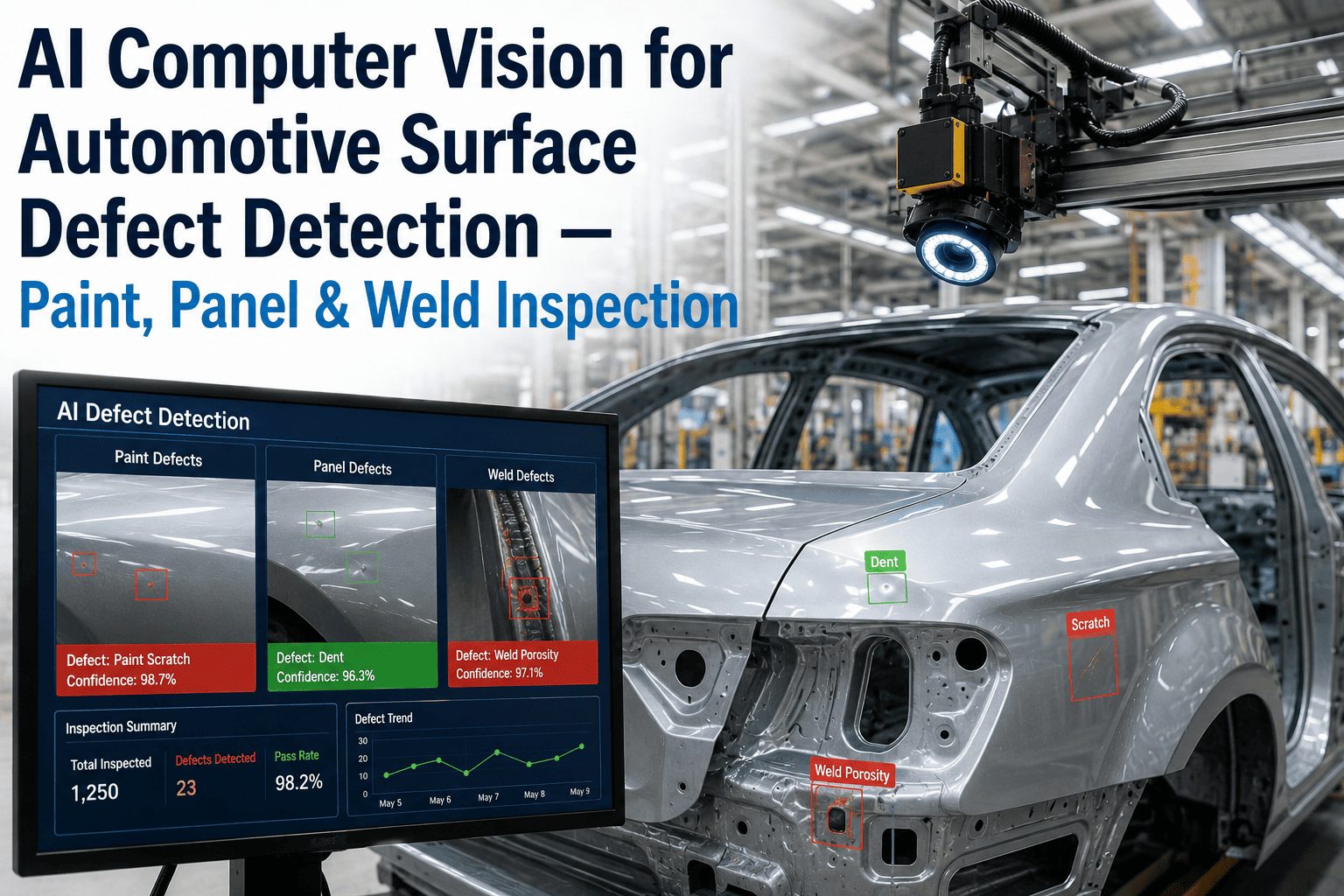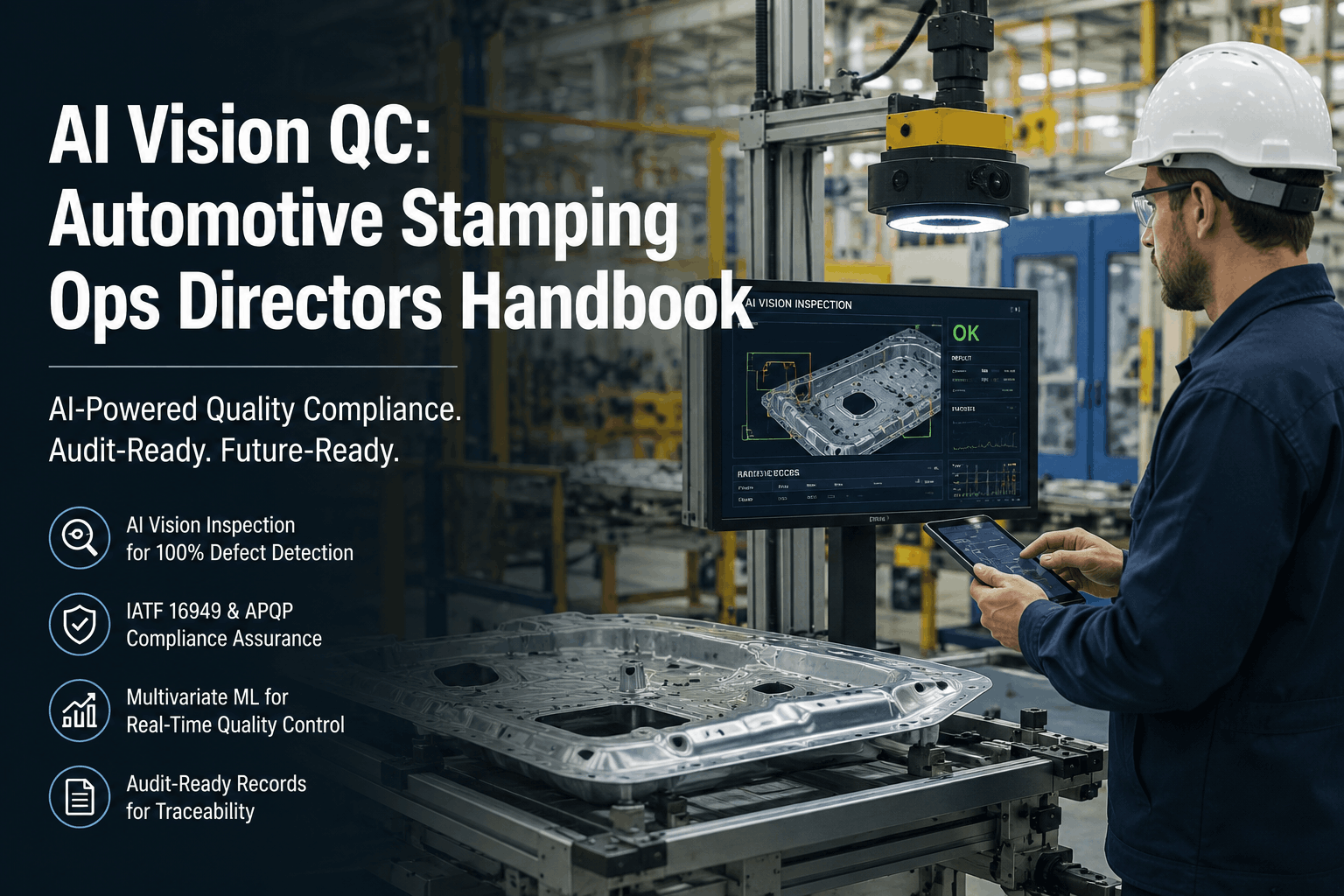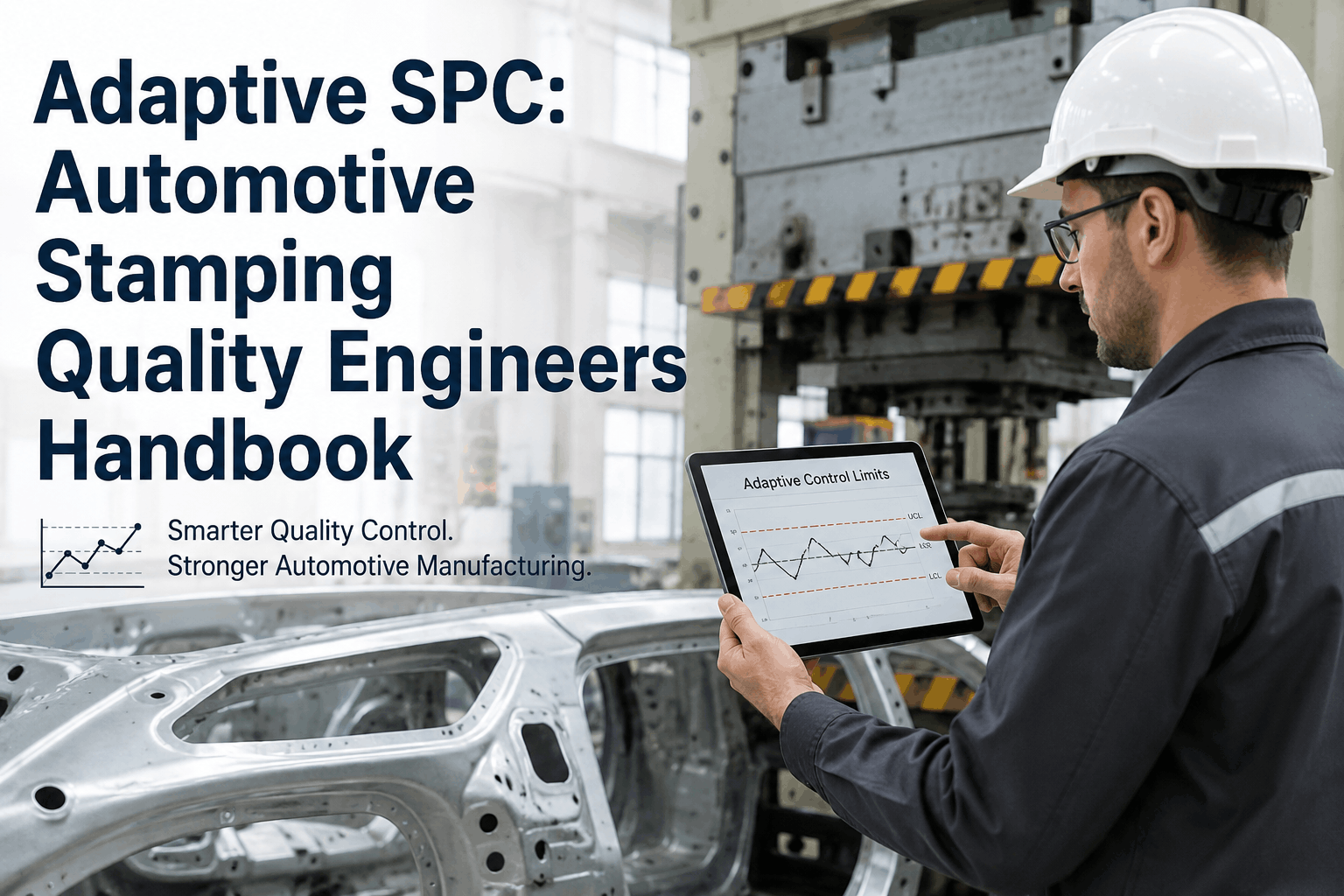
If you supervise a stamping shift, OEE is the number that lands on your scorecard every morning. Availability times Performance times Quality — three multipliers, each one with its own ways of falling short. Quality losses in particular are punishing because they cascade — a defect at the press becomes rework downstream, becomes a quarantine call, becomes a customer complaint, becomes a Q1 or BIQS scorecard hit, becomes a meeting with the plant manager. Traditional QC inspection samples one in N parts, finds problems hours after they started, and rarely tells you exactly which press, which die, which shift produced the bad parts. AI vision inspection changes that math. Cameras at the press exit, CNN models running on edge hardware, every part inspected in real time, defects caught at the source with the press, die, and shift attributed automatically. The OEE lift is typically 10–20 points across an 18-month deployment — quality contribution improves, micro-stops drop, faster fault recovery boosts availability. This is the supervisor's guide to AI vision inspection in automotive stamping — what it actually does, what defects it catches, how it shows up on your shift report, and how to deploy it on your line. iFactory delivers this on a turnkey on-premise NVIDIA appliance or fully managed cloud — same vision AI stack, your deployment choice.
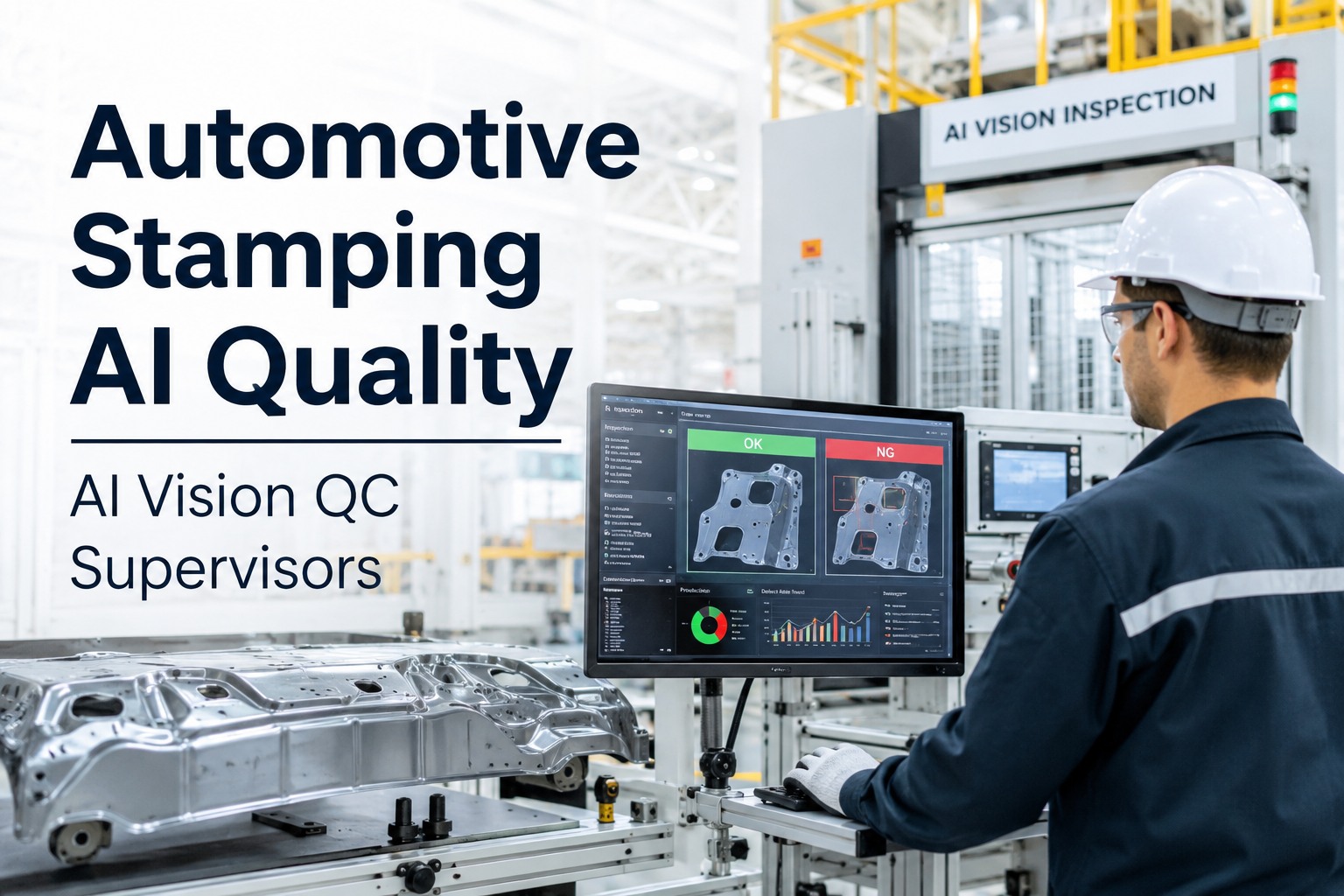
Automotive Stamping AI Quality | AI Vision QC for Supervisors
How shift supervisors lift OEE 10–20 points with AI vision inspection on the stamping line — six common defects caught inline, real-time scorecard reporting, IATF 16949 audit trail built automatically.
Where AI Vision Moves the OEE Needle
OEE = Availability × Performance × Quality. Most stamping supervisors know which of the three is hurting them — but they may not know that AI vision inspection contributes to all three, not just the obvious Quality factor. Catching defects inline cuts quality losses directly. Faster fault attribution (this press, this die, this shift) accelerates recovery and improves availability. Eliminating downstream rework lines reduces micro-stops and lifts performance. The combined OEE lift is typically 10–20 points across 12–18 months, with the bulk of it landing in the first 6 months.
Want this OEE lift breakdown applied to your actual shift numbers? Request a Shift-Floor Demo — bring your last quarter's OEE breakdown and the iFactory automotive team will project the AI vision contribution to each OEE factor, with a sized 12–18 month uplift estimate. Sessions available this week.
How AI Vision Inspection Actually Works on the Press Line
The architecture is simpler than most supervisors expect. A high-speed industrial camera mounted at the press exit captures every part. The image streams to an edge AI inference engine running locally on the NVIDIA appliance (or in cloud if that's your deployment choice). A CNN model — pre-trained on automotive defect taxonomies, fine-tuned on your specific parts — classifies the image in under 50 milliseconds. Good parts continue. Suspect parts are routed to a divert station or operator review. Every inspection event logs to the audit trail with press ID, die ID, shift, operator, and the classified outcome.
Six Stamping Defects AI Vision Catches Inline
These are the six highest-value visual defect categories where AI vision delivers measurable scorecard impact for supervisors. Each has a specific detection method and typical accuracy range.
Surface Scratches & Scuffs
Catches the hairline scratches and tool-mark scuffs human inspection misses under poor lighting, especially on door outers, hoods, and fenders.
Burrs & Edge Defects
Catches micro-burrs along trim edges before assembly downstream causes fitment issues. Tracks burr growth rate as a predictive die-wear indicator.
Dimensional Variance
Inline dimensional measurement against CAD reference — flags overall dimension, feature position, and hole-to-hole distance drift before CMM finds it.
Missing / Incorrect Features
Verifies presence and correctness of all features — holes, embosses, perforations, weld nuts. Catches die-pin breakage and mis-piercing as it happens.
Oil Canning & Distortion
Detects panel snap-through and visible distortion on outer panels — runs structured-light overlay to find low-amplitude waviness invisible to the naked eye.
Coating & Contamination
Catches galvanizing scale, weld spatter, oil stains, foreign-material contamination, and surface coating inconsistencies before they reach paint.
Want to see which of these six defect categories deliver the biggest OEE lift on your specific stamping line? Request a defect-pattern audit from iFactory support — we'll analyze 30 days of your scrap log against the six AI vision capabilities and rank the OEE-impact opportunities, returned within 5 business days.
Inline AI Vision vs Sampling Inspection — The Coverage Difference
Traditional QC inspection samples one part in N — typically every 50th to 500th part depending on tier and customer requirements. That works for slow processes and stable production. It doesn't work for a 30-stroke-per-minute press producing 1,800 parts an hour, where a die issue at stroke 50 might not surface in inspection until stroke 350. AI vision inspects every part, every cycle, with full attribution to press, die, shift, and operator.
One in N parts, after-the-fact
- Coverage — 0.2–2% of parts produced
- Detection delay — hours to discover trending defects
- Attribution — usually not part-specific
- Cost basis — dedicated QC headcount per shift
- Defect escape rate — typically 200–1,500 PPM
- Audit data — manual entry into inspection log
Every part, real-time
- Coverage — 100% of parts produced
- Detection delay — sub-50ms per part
- Attribution — press, die, shift, operator captured per part
- Cost basis — CapEx appliance or OpEx cloud subscription
- Defect escape rate — typically 10–50 PPM
- Audit data — automatic tamper-evident log
What Changes on Your Shift Report — Before and After
For the supervisor, the biggest change is what happens at end of shift. Instead of assembling the scorecard from scrap log entries, inspection sheets, and operator handover notes, the AI vision system has been compiling the data continuously — and the shift report assembles itself with full attribution.
Real-time dashboard
OEE trend by press, defect heat-map, AI-flagged trends from previous shift highlighted with recommended actions.
Live defect alerts
If a die starts producing rising burr counts, alert fires immediately with press / die / part ID. No waiting for sampling.
Auto-generated handover
OEE breakdown, defect counts by category, die health summary, AI-flagged items for next shift — all assembled automatically.
Scorecard input
CSR-specific reporting (Q1, BIQS, PIST, SQA) generates from the same data — no manual data assembly for customer submissions.
Want to see what your specific shift report looks like with AI vision running? Request a Shift-Floor Demo — iFactory's team will mock up the dashboard with your part numbers, defect categories, and KPI structure, then walk through end-to-end on a representative press configuration.
IATF 16949 & Customer Scorecards — Built Automatically
Every vision inspection feeds the audit-ready record
- Per-part inspection record with press, die, shift attribution
- Defect classification with confidence score and image capture
- Cpk / Ppk evidence on dimensional characteristics
- Reaction plan execution with supervisor sign-off
- Customer-Specific Requirement reporting (Q1, BIQS, PIST, SQA)
- Layered Process Audit data feeds
- Tamper-evident electronic records (21 CFR 11 aligned)
- PPAP submission package auto-assembly
For the supervisor, that means the data-assembly portion of customer scorecard submissions disappears. Q1 reports, BIQS reports, PIST reports — all generate from the same vision inspection data the line is already producing. The supervisor reviews and approves rather than compiling from spreadsheets.
Two Real Stamping Plant Outcomes
Mid-size supplier with OEE stuck at 64% and customer complaints climbing
A Tier 1 stamping supplier producing structural body components, OEE baseline at 64% with Quality factor running 92% (well below the 98%+ needed to hit overall 80% OEE). Customer complaints climbing on burr-related fitment issues. Sampling inspection at 1-in-100 missing the defect onset.
Vehicle assembler hit with cosmetic quality escalations on outer panels
An OEM press shop producing class-A exterior panels (door outers, hoods, fenders) for a high-trim model line. Cosmetic quality escalations driving plant-level scrutiny. Manual visual inspection inconsistent across shifts — what one inspector flagged, another passed. Surface scratch escape rate elevated.
Neither scenario matches your situation exactly? Send your top defect categories and current OEE breakdown to iFactory support and the automotive team will return a customised scenario walkthrough — AI vision coverage map, projected OEE lift per factor, and 12-month deployment roadmap — typically within 3 business days, no obligation.
iFactory's Vision Deployment — On-Premise or Cloud
Same AI vision stack on either model. Same CNN classifiers, same audit trail, same supervisor dashboards. The decision depends on your data residency rules, IT capacity, and budget posture.
iFactory On-Premise Appliance Default for press shops with CSR data-residency rules
- Pre-configured NVIDIA AI server — racked, software-loaded, ready to plug in.
- Sub-50ms inference at the press exit — keeps up with high-speed transfer presses.
- All inspection data stays inside the plant — CSR-compliant, GxP-friendly.
- Works during WAN outages — inspection continues uninterrupted.
iFactory Cloud For multi-plant fleet benchmarking and cloud-first IT
- Fully managed — no rack, no facility requirements.
- Same AI vision stack — CNN classifiers, structured-light overlay, supervisor dashboards.
- Cross-plant OEE benchmarking across all press shops in one tenant.
- Fastest deployment — first plant live in 2–4 weeks.
See AI vision running on a stamping line — this week.
The iFactory shift-floor demo is a 30-minute walkthrough showing the supervisor dashboard, the AI vision pipeline on a representative press, and the live audit trail being built per part. Bring your shift report format and we'll show how it gets auto-generated. On-premise appliance or fully managed cloud, your call on deployment.
Frequently Asked Questions
How does AI vision contribute to all three OEE factors?
Quality directly — inline 100% inspection cuts defect escape and rework. Performance indirectly — fewer rework-induced micro-stops, fewer changeover delays from quality holds. Availability indirectly — faster fault attribution (press, die, shift, part) accelerates root cause and shortens recovery. The Quality contribution usually shows first, the other two factors strengthen over 6–12 months as operational habits adjust to the data.
Will AI vision slow down our presses?
No. Edge inference runs in under 50 milliseconds total — well within the cycle time of even high-speed transfer presses (often 6–12 strokes per minute, ~5–10 seconds per cycle). The pipeline runs in parallel with the press stroke; classification completes before the next part exits. No press speed penalty in any deployment we've run.
Can AI vision integrate with our existing QC team and processes?
Yes — and that's the recommended pattern. QC inspectors remain in the loop for ambiguous cases (low-confidence classifications), audit sampling, and continuous calibration of the model. The AI handles the volume; QC focuses on the edge cases. Many supervisors report this raises QC team morale because inspectors spend less time on repetitive sampling and more on actual quality engineering.
Do I have to buy NVIDIA servers separately?
No. iFactory's on-premise appliance ships fully loaded — pre-configured NVIDIA AI server, software pre-installed, industrial cameras, lighting fixtures, edge devices. You provide rack space, line power, Ethernet, and the camera mount locations. For cloud deployment, only the cameras and edge capture units sit on-site; no server hardware.
How long until the OEE lift shows up?
Quality factor improvement is typically visible within 4–8 weeks of go-live. Performance and Availability factors take longer — usually 3–6 months as operational changes (faster fault recovery, fewer downstream rework events, better shift handovers) compound. Full 10–20 point OEE lift typically lands across 12–18 months. The earliest 6–8 points come fast; the remainder is the operational compound effect.
What if the AI gets it wrong — false positives that flag good parts?
False positive rate is the critical number for supervisor trust. Confidence-fusion suppression keeps it typically under 1.5% in mature deployments (60+ days of training data). Low-confidence classifications route to operator review rather than auto-rejecting — the operator confirms or corrects, and that feedback retrains the model. Accuracy improves continuously as operators flag false alarms; supervisors see the trust curve climb steadily over the first 90 days.
Can we deploy at one press first before going to the full shop?
Yes — this is the recommended approach. Start with the highest-OEE-impact press line where the defect mix is well understood. Validate the AI accuracy, prove the OEE lift, build supervisor trust. Then expand to remaining press lines in 2–4 week waves per line. Full press shop deployment for an 8–12 press operation typically completes in 3–4 months.
OEE doesn't move by accident. AI vision moves it on purpose.
Every supervisor on the scorecard knows the math — Availability × Performance × Quality. The plants pulling away from competitors aren't doing it through harder pushing; they're doing it by giving supervisors real-time data with full attribution and AI catching what sampling inspection misses. iFactory's shift-floor demo is the fastest way to see what that looks like on your press configuration — sessions available this week.