In the high-stakes environment of automotive manufacturing, the tire and wheel assembly station represents a critical juncture where precision directly impacts vehicle safety and brand reputation. A single mismatched tire, an improperly seated valve stem, or an under-torqued lug nut can cascade into catastrophic failures, leading to costly recalls and, more importantly, endangering lives. Traditional manual inspection methods, reliant on human visual acuity and torque wrenches, are increasingly inadequate against the relentless pace of modern production lines. This comprehensive guide delves into how advanced AI-driven computer vision systems are revolutionizing tire and wheel assembly inspection. By integrating deep learning algorithms with high-resolution imaging and real-time analytics, manufacturers can now achieve a level of accuracy and consistency previously unattainable. This technology not only verifies tire fitment, valve orientation, and wheel torque at the wheel-build station but also provides a robust data foundation for predictive maintenance and continuous process improvement. For plant managers and maintenance directors seeking to eliminate defects and optimize throughput, embracing AI vision is no longer optional—it is a strategic imperative. Book a Demo to see how our solutions can transform your assembly line.
Transform Your Wheel Assembly Quality with AI Vision
Eliminate recall risks. Achieve zero-defect tire fitment and torque verification. See the future of assembly inspection.
The Cost of Imperfection
Every year, the automotive industry faces billions in losses due to wheel-related defects. From tire blowouts caused by incorrect fitment to wheel detachment from under-torqued fasteners, the consequences are severe. AI vision systems provide a failsafe, catching errors that human inspectors miss under fatigue or high-speed conditions.
Beyond Human Capability
Human visual inspection is limited by attention span and environmental factors. AI systems operate at 100% consistency, scanning every millimeter of the wheel assembly in milliseconds. They detect subtle anomalies like bead seating gaps, valve stem misalignment, and torque variations that are invisible to the naked eye.
Data-Driven Quality Assurance
Each inspection generates a rich dataset that feeds into your quality management system. This data enables trend analysis, root cause identification, and predictive maintenance of assembly equipment. Over time, the AI learns and improves, reducing false positives and adapting to new wheel designs.
How AI Vision Inspects Tire Fitment
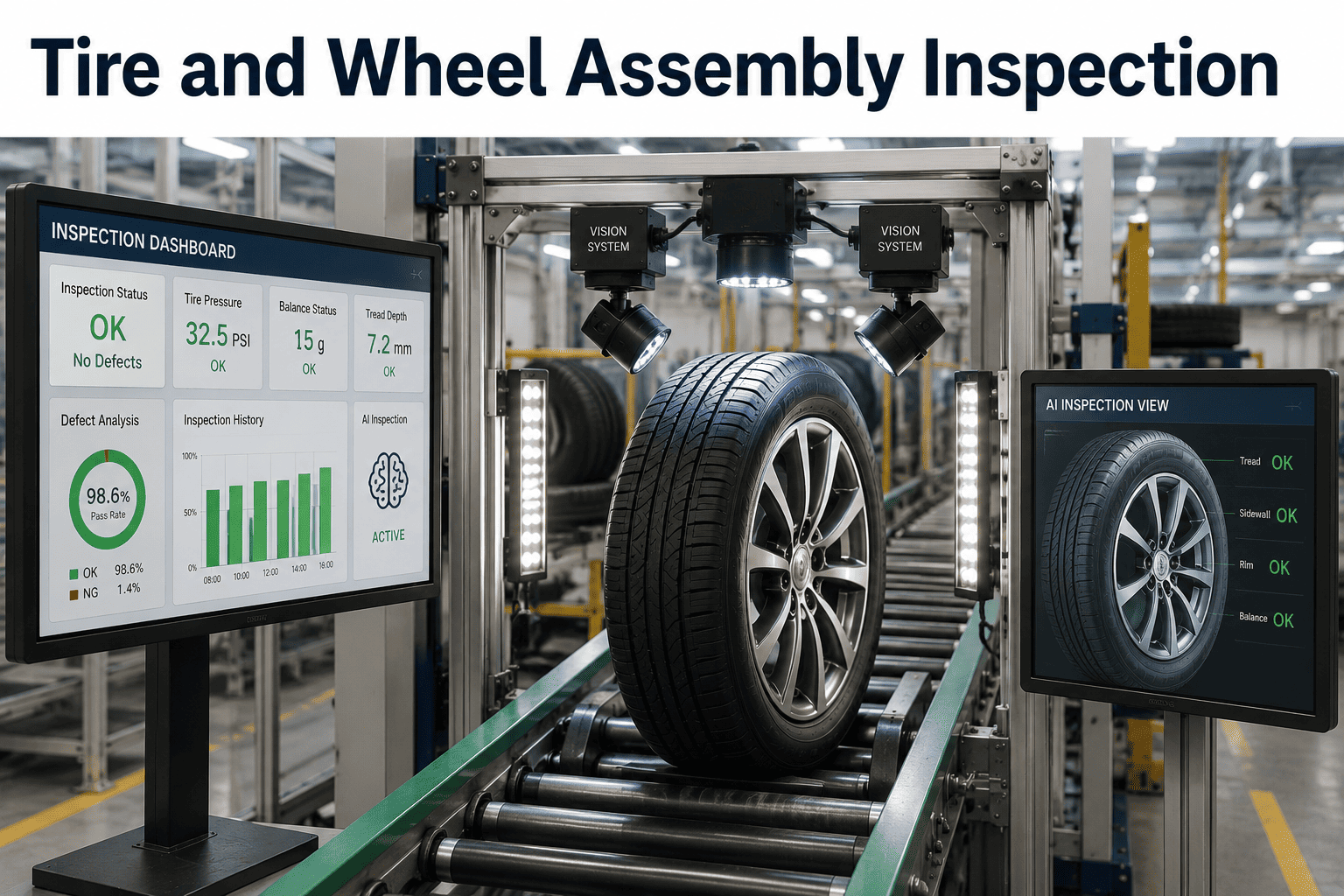
Tire fitment verification is a multi-layered process that begins with the tire's bead seating on the wheel rim. AI vision systems use structured light and stereo cameras to create a 3D profile of the tire-wheel interface. The algorithm checks for uniform bead contact around the entire circumference, identifying any gaps that could indicate improper seating. This is critical because even a 1mm gap can lead to air leakage or bead unseating under load. The system also verifies the tire's sidewall markings against the bill of materials, ensuring the correct tire size, speed rating, and load index are matched to the vehicle. Deep learning models trained on thousands of tire models can recognize subtle variations in tread patterns and sidewall fonts, catching mismatches that would otherwise go unnoticed. Additionally, the vision system inspects the valve stem for correct orientation and seating. A misaligned valve can cause interference with brake components or tire pressure monitoring sensors, leading to failures down the line.
From Assembly Line to AI: A Step-by-Step Journey
Image Acquisition
Multiple high-resolution cameras capture the wheel assembly from all angles as it passes through the inspection zone. Synchronized lighting eliminates shadows and reflections.
Feature Extraction
Convolutional neural networks isolate key features: tire bead, valve stem, lug nuts, and rim edge. The system identifies each component and its spatial relationship.
Defect Classification
Trained models classify each feature against a library of known defects. A heuristic engine then scores the assembly's overall quality, flagging any anomalies.
Torque Verification
Using torque-angle sensors and vision-based bolt pattern recognition, the system confirms each lug nut is tightened to specification. Cross-threading or under-torque triggers immediate rejection.
Data Logging & Feedback
All inspection results are stored in a centralized database. Real-time dashboards provide production supervisors with actionable insights, and the system can automatically adjust downstream processes.
Ready to Achieve Zero-Defect Assembly?
Our AI vision solutions integrate seamlessly with your existing line. Reduce scrap, increase throughput, and protect your brand.
Traditional vs. AI Vision Inspection
| Metric | Traditional Inspection | AI Vision Inspection |
|---|---|---|
| Inspection Speed | 10-15 seconds per unit | Less than 1 second per unit |
| Accuracy | 85-95% (subject to fatigue) | 99.9%+ (consistent) |
| Defect Coverage | Limited to visual cues | Full spectrum (visual, torque, dimensional) |
| Data Collection | Manual logs, error-prone | Automated, real-time, integrable |
| Recall Rate | 0.5-2% of production | Near zero |
| Cost per Inspection | High (labor + rework) | Low (automated, scalable) |
Wheel Torque Verification: The Critical Safety Check
Wheel torque verification is arguably the most critical safety step in the assembly process. Under-torqued lug nuts can loosen over time, leading to wheel separation, while over-torquing can damage the studs or brake components. AI vision systems enhance traditional torque wrenches by visually confirming that each lug nut is present, correctly seated, and has been turned to the proper angle. The system uses a combination of torque-angle sensors and high-speed cameras to monitor the tightening sequence. If a lug nut fails to reach the specified torque within the required angle, the assembly is flagged for rework. Furthermore, the AI can detect cross-threading by analyzing the pattern of resistance during tightening. This level of precision is impossible with manual methods, where torque sticks or click wrenches are subject to operator technique and calibration drift. By integrating vision-based torque verification, manufacturers can ensure that every wheel leaving the line meets stringent safety standards, dramatically reducing the risk of field failures.
Frequently Asked Questions
How does AI vision handle different tire sizes and wheel designs?
AI vision systems are trained on a diverse dataset encompassing thousands of tire and wheel combinations. Deep learning models generalize across variations in size, shape, and color, adapting to new designs without manual reprogramming. The system uses transfer learning, where a pre-trained model is fine-tuned on your specific assembly line data. This ensures high accuracy even with custom or low-volume wheels. Additionally, the vision system automatically adjusts its inspection parameters based on the product code scanned from the assembly, ensuring each unit is inspected against the correct specifications. For more details on customization, contact our support team.
What is the typical return on investment for implementing AI vision in wheel assembly?
Most manufacturers see a full ROI within 6 to 12 months. The savings come from multiple streams: reduced scrap and rework costs (often 30-50% reduction), lower warranty claims (up to 80% reduction in wheel-related claims), increased throughput (20-30% faster inspection), and decreased labor costs (reallocation of inspectors to higher-value tasks). Additionally, the data collected enables predictive maintenance of assembly equipment, further reducing downtime. A detailed ROI analysis can be provided during a consultation—book a demo to get started.
Can the system integrate with my existing manufacturing execution system (MES)?
Yes, our AI vision platform is designed for seamless integration with major MES platforms such as Siemens, Rockwell, and SAP. We provide standard APIs and SDKs for data exchange, allowing inspection results to be automatically logged against production orders. The system also supports OPC-UA and MQTT protocols for real-time communication with PLCs and SCADA systems. Our integration specialists work closely with your IT team to ensure a smooth deployment with minimal disruption to existing workflows. For integration support, visit our support page.
How does the system handle environmental factors like lighting changes or dust?
Our vision systems are built for rugged industrial environments. We use high-intensity, controlled LED lighting that is immune to ambient fluctuations. The cameras are housed in IP65-rated enclosures with integrated air knives to keep lenses clean. The AI models are trained on images with varying lighting conditions, shadows, and partial occlusions, making them robust to real-world variations. Regular self-calibration routines ensure the system maintains accuracy over time. If environmental conditions exceed operational thresholds, the system automatically alerts maintenance personnel. For more on environmental robustness, check our technical specs.
What training is required for operators to use the AI vision system?
The system is designed with an intuitive user interface that requires minimal training. Most operators become proficient within a few hours. The dashboard provides clear visual indicators of inspection results, with color-coded alerts for defects. We provide comprehensive training programs for both operators and maintenance staff, covering system operation, basic troubleshooting, and data interpretation. Advanced users can access configuration tools to adjust inspection parameters without needing programming skills. Our training materials include online modules, on-site workshops, and 24/7 support. To schedule training, book a demo and we will tailor a plan for your team.
Secure Your Assembly Line's Future
Don't let a single defect compromise your reputation. Implement AI vision for tire and wheel inspection and achieve unparalleled quality and safety.