Airport electrical infrastructure is the invisible backbone that keeps every runway light, navigational aid, terminal system, and safety-critical circuit operational — 24 hours a day, 365 days a year. Managing high-voltage substations, primary distribution networks, airfield series circuits, and emergency power systems at the standard of reliability aviation demands is one of the most technically complex challenges in airport facilities management. Yet most airports still operate their electrical systems on reactive maintenance models, where transformer failures, switchgear degradation, and series circuit interruptions surface as unplanned events rather than scheduled interventions. AI-driven preventive analytics changes this entirely — converting continuous electrical system condition data into structured maintenance intelligence that keeps airport power infrastructure reliable through every operational cycle. To see how leading airport operations teams are transforming their electrical infrastructure programs, Book a Demo and explore what condition-based analytics delivers for airfield electrical reliability.
Ready to Modernize Your Airport Electrical Infrastructure Program?
iFactory's preventive analytics platform gives airport electrical teams real-time substation health scoring, transformer condition monitoring, airfield series circuit analytics, and AI-driven compliance documentation — purpose-built for aviation electrical infrastructure reliability.
Why Airport Electrical Infrastructure Analytics Is the Foundation of Aviation Power Reliability
Traditional airport electrical maintenance programs operate on fixed inspection intervals — substations are tested annually, transformer oil is sampled on a calendar schedule, and switchgear is exercised according to manufacturer recommendations regardless of actual load history or environmental stress exposure. This approach leaves the most consequential failure modes — insulation degradation in high-voltage cables, dielectric breakdown in power transformers, contact erosion in medium-voltage switchgear — entirely undetected between inspection cycles. Airport electrical infrastructure analytics replaces static inspection calendars with continuous condition intelligence. When a transformer shows early thermal anomaly signatures or a series circuit constant current regulator begins exhibiting output instability, analytics converts that developing failure into a scheduled maintenance intervention — weeks before it becomes a runway lighting outage during active flight operations. Airports that have deployed condition-based electrical analytics report not just fewer failures, but a fundamental shift in how electrical maintenance is planned, resourced, and executed.
Airport Substation Analytics: High-Voltage System Monitoring for Operational Continuity
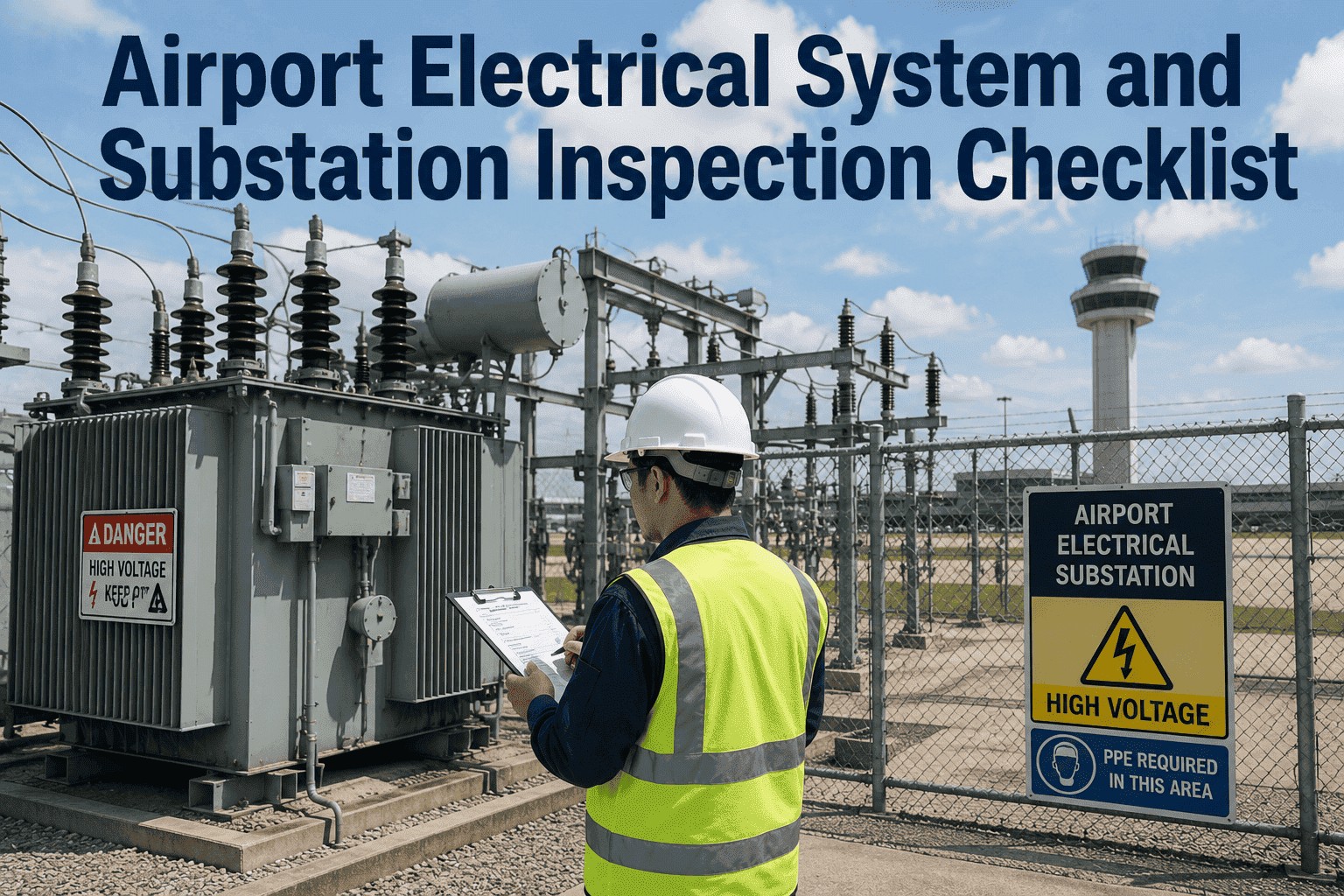
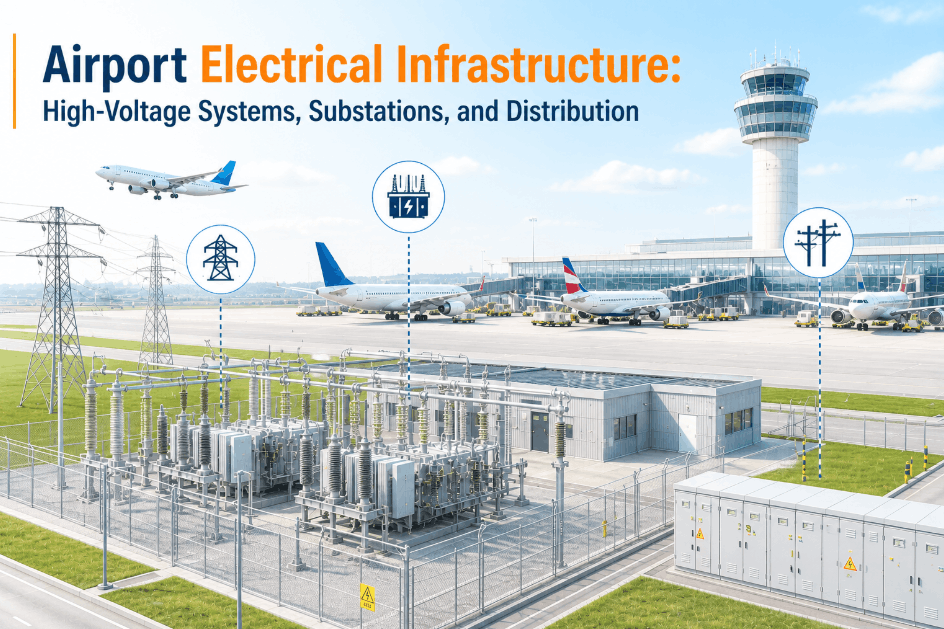
Airport substations — the primary transformation and switching infrastructure that steps utility transmission voltage down to distribution levels serving terminals, airfield lighting vaults, and support facilities — represent the single highest-consequence failure point in the entire airport electrical system. A substation failure that interrupts primary power to airfield lighting circuits triggers immediate NOTAMs, flight diversions, and FAA notification obligations that begin accumulating regulatory and financial costs within minutes. Airport substation analytics platforms deploy continuous monitoring across the component categories most likely to produce unplanned interruptions: power transformer thermal and dielectric condition, medium-voltage switchgear contact integrity and mechanism health, protective relay calibration status, and bus insulation condition across primary and secondary distribution. Airports looking to close the gap between substation inspection cycles and actual condition awareness can Book a Demo to walk through a substation monitoring configuration matched to their infrastructure topology.
Transformer Thermal and Dielectric Condition Analytics
Continuous winding temperature monitoring, dissolved gas analysis trend integration, and load-adjusted thermal modeling detect insulation degradation and cooling system performance issues before dielectric breakdown events occur. Transformer condition scoring aggregates multiple health indicators into a single readiness metric that drives predictive maintenance scheduling across the substation asset base.
Medium-Voltage Switchgear Contact and Mechanism Health Monitoring
Contact resistance trending, operating mechanism timing analysis, and SF6 gas pressure monitoring in gas-insulated switchgear detect contact erosion, spring mechanism fatigue, and insulation degradation before they produce switching failures or arc flash events. Automated mechanism exercise tracking maintains compliance with operational testing requirements without manual recordkeeping burden.
Protective Relay Calibration and Trip Function Verification
Protective relay analytics track calibration drift, test interval compliance, and event log anomalies that indicate nuisance tripping risk or protection coverage gaps. Automated test scheduling ensures relay protection schemes remain current with system configuration changes — maintaining the fault isolation capability that prevents localized failures from cascading into substation-wide outages.
High-Voltage Cable Insulation Condition and Partial Discharge Monitoring
Underground high-voltage cable insulation degradation is among the most difficult failure modes to detect through conventional inspection — and among the most consequential when it produces unexpected faults. Partial discharge monitoring and cable sheath current analysis identify insulation deterioration in medium and high-voltage feeder cables before breakdown, enabling planned cable section replacement during scheduled outage windows rather than emergency repairs.
Airfield Series Circuit Analytics: Runway and Taxiway Lighting System Reliability
Airfield lighting systems — including runway edge lights, centerline lights, touchdown zone lighting, approach lighting systems, and taxiway guidance — operate on series circuits supplied by constant current regulators (CCRs) that maintain precise current levels regardless of the number of fixtures in the circuit. This topology creates a unique failure dynamic: a single open circuit fault anywhere in the series loop interrupts the entire circuit, extinguishing every light downstream. For a runway in active IMC operations, a series circuit failure has immediate and severe safety consequences. Airfield series circuit analytics monitors CCR output stability, harmonic distortion levels, and insulation resistance trends across primary and secondary feeder circuits — identifying developing faults in isolation transformers, series cable insulation, and fixture connections before they produce circuit interruptions during critical operations. Teams responsible for airfield lighting reliability can Book a Demo to see how series circuit monitoring is structured for their specific lighting system configuration.
Constant Current Regulator Performance and Output Stability
CCR output current trending detects regulation drift, power factor degradation, and thyristor wear before they produce output instability that affects lighting intensity compliance with FAA Advisory Circular requirements. Thermal imaging integration identifies hot-spot development in CCR cabinets during load cycles.
Series Isolation Transformer Insulation Condition Monitoring
Insulation resistance trending across series isolation transformers identifies moisture ingress, insulation aging, and mechanical damage in underground transformer pits before they produce open circuit faults. Condition-based replacement scheduling eliminates the emergency excavation and repair timeline that accompanies unplanned isolation transformer failures.
Series Circuit Cable Health and Fault Location Analytics
Continuous insulation resistance monitoring across series circuit primary and secondary feeder cables tracks degradation trends that precede ground fault events. Integrated fault location analytics reduce mean-time-to-repair for series circuit outages by directing maintenance personnel directly to the fault zone rather than requiring systematic section isolation testing.
Airfield Lighting Fixture Condition and Lamp Outage Tracking
Individual fixture current monitoring detects lamp failures, lens contamination, and socket connection degradation on a per-fixture basis — enabling condition-based lamp replacement programs that maintain intensity compliance without the labor intensity of manual nighttime inspection cycles for every fixture on every circuit.
Airport Power Distribution Analytics: Primary and Secondary Network Condition Management
Between the substation and the individual loads — terminal systems, gate equipment, airfield lighting vaults, pump stations, and ground support power outlets — airport power distribution networks encompass hundreds of circuit breaker panels, medium-voltage ring bus segments, automatic transfer switches, and distribution transformers. Each component category has specific failure modes that analytics can detect before they produce operational interruptions. Distribution transformer loading analysis identifies units approaching thermal capacity limits during peak demand periods. Automatic transfer switch exercise cycle tracking ensures emergency transfer capability is maintained between formal test events. Medium-voltage ring bus insulation monitoring tracks the condition progression of underground distribution cable that serves the most operationally critical airside loads. Airport teams building a comprehensive distribution network analytics program can Book a Demo to review an infrastructure-specific monitoring architecture for their campus topology.
Emergency Power System Analytics: Generator Reliability and Automatic Transfer Performance
Airport emergency power systems — standby generators, uninterruptible power supplies (UPS), and automatic transfer switching infrastructure — are activated only when normal utility power is interrupted, but their reliability at that moment is absolute. A generator that fails to start during a utility power outage exposes safety-critical loads — airfield lighting, ILS systems, approach lighting, security systems, and emergency egress lighting — to extended interruption with no fallback. Emergency power system analytics continuously monitors generator engine health indicators (coolant temperature, oil pressure, battery charge state, and fuel system condition), executes and documents automatic test sequences, and tracks load bank test results against acceptance thresholds. Preventive maintenance scheduling driven by condition data rather than calendar intervals ensures emergency power assets are genuinely ready when normal power fails — not simply assumed to be ready because a scheduled test was completed two months prior.
Electrical Asset Inventory and Condition Baseline Establishment
Analytics deployment begins with a structured asset inventory covering substations, transformers, switchgear, CCRs, distribution equipment, and emergency power systems. Initial condition assessments establish health baselines against which ongoing monitoring data is compared — identifying assets already operating outside normal condition parameters before the first storm or peak demand event of the season.
Continuous Condition Monitoring and Anomaly Detection
Deployed sensors and integrated data feeds deliver continuous condition telemetry across monitored asset categories. AI anomaly detection algorithms identify deviation from baseline condition signatures, generating early-warning alerts for developing failure modes weeks or months before they reach fault thresholds — providing the planning horizon required for scheduled maintenance intervention rather than emergency response.
Risk-Ranked Maintenance Work Order Generation
Condition alerts are translated into risk-ranked maintenance work orders that account for operational consequence, failure probability, and maintenance resource availability. High-consequence assets on critical airside circuits receive prioritized intervention scheduling, while lower-consequence distribution equipment follows condition-optimized PM intervals that maximize service life without operational risk exposure.
Regulatory Documentation and FAA Compliance Reporting
Completed maintenance records, inspection documentation, and test results are automatically compiled into the structured documentation packages required for FAA safety management system records, NFPA 70B compliance reporting, and airport certification maintenance program documentation — replacing manual record compilation with continuously generated, audit-ready compliance archives.
Airport Electrical Infrastructure Maturity Benchmarking
Understanding where your airport electrical infrastructure program stands relative to industry capability benchmarks requires structured evaluation across monitoring coverage, maintenance strategy maturity, compliance documentation practices, and emergency system readiness verification. The table below maps current industry distribution across operational capability levels against the analytics infrastructure that defines each stage. Operations teams ready to benchmark their current electrical program can Book a Demo and run a maturity gap analysis for their specific infrastructure profile.
| Maturity Level | Substation Monitoring | Maintenance Strategy | Series Circuit Analytics | Compliance Documentation |
|---|---|---|---|---|
| Level 1 — Reactive | Visual inspection only | Breakdown-triggered repair | Manual fault response | Paper-based logs |
| Level 2 — Scheduled | Annual inspection cycles | Calendar-based PM | Periodic CCR testing | Spreadsheet tracking |
| Level 3 — Condition-Based | Continuous sensor monitoring | Threshold-triggered PM | Real-time circuit analytics | Digital record systems |
| Level 4 — Predictive | AI health scoring | Predictive work orders | Fault trend modeling | Automated compliance reports |
| Level 5 — Autonomous | Closed-loop optimization | Self-scheduling PM | Adaptive circuit management | Real-time regulatory feeds |
FAA Compliance and Airport Electrical Safety: How Analytics Strengthens Regulatory Posture
Airport electrical infrastructure operates under a complex regulatory overlay that includes FAA Advisory Circular 150/5340-26 for airfield lighting maintenance, NFPA 70B recommended practices for electrical equipment maintenance, OSHA 29 CFR 1910.269 electrical safety requirements, and airport certification standards under 14 CFR Part 139. Maintaining compliance across this regulatory landscape requires not just technically sound maintenance practices, but comprehensive, structured documentation that demonstrates compliance at every audit touchpoint. Analytics platforms that continuously capture maintenance records, test results, condition data, and corrective action documentation generate the compliance evidence base that manual recordkeeping systems cannot consistently produce. When an FAA safety inspector requests documentation of protective relay test results or series circuit inspection records for the past three years, an analytics-backed electrical program produces it immediately — rather than assembling it from disconnected paper files and spreadsheet logs under time pressure.
Building the Business Case for Airport Electrical Infrastructure Analytics
The financial case for airport electrical infrastructure analytics investment compounds across four value dimensions that grow in impact as program maturity advances. Direct downtime prevention delivers the most visible payback — a single prevented substation transformer failure or series circuit outage during active instrument flight operations eliminates costs that routinely exceed annual analytics program investment within one event. Extended electrical asset service life through condition-optimized maintenance reduces capital replacement expenditure on transformers, switchgear, and CCR equipment that carries six-figure unit replacement values. Regulatory compliance risk avoidance — the FAA finding that did not occur because records were complete, the NFPA audit that passed because maintenance documentation was current — delivers risk-adjusted value that every airport director fully understands. And labor efficiency gains from analytics-directed maintenance versus time-based inspection programs reduce maintenance cost per unit of reliability delivered across the entire electrical infrastructure program.
Frequently Asked Questions: Airport Electrical Infrastructure Analytics
What types of sensors are used in airport substation analytics programs?
Temperature sensors, partial discharge monitors, current transformers, voltage transducers, and vibration sensors are deployed across transformer windings, switchgear mechanisms, and bus systems. Most installations use non-invasive sensor technologies that can be installed during normal operations without requiring substation outages, minimizing implementation risk for operationally critical infrastructure.
How does airfield series circuit analytics reduce runway lighting outage risk?
Continuous insulation resistance monitoring and CCR output analytics detect developing faults in series circuit cables, isolation transformers, and regulator components before they produce open-circuit conditions. Early fault detection allows planned maintenance intervention during scheduled outage windows, eliminating the unplanned runway lighting interruptions that require immediate NOTAM issuance and may trigger flight diversions.
Can airport electrical analytics platforms integrate with existing SCADA and BMS systems?
Yes. Modern airport electrical analytics platforms support integration with existing SCADA, building management systems, and power monitoring infrastructure through standard communication protocols including Modbus, DNP3, and IEC 61850. This integration enriches analytics with operational context data while preserving existing operator interface investments.
How does preventive analytics support FAA Part 139 electrical compliance documentation?
Analytics platforms automatically generate structured maintenance records, inspection logs, and test documentation that map to Part 139 airport certification maintenance program requirements. Automated documentation workflows eliminate the record gaps that create compliance exposure during FAA inspections, providing continuously updated, audit-ready records across all monitored electrical infrastructure categories.
What is the typical implementation timeline for airport electrical analytics deployment?
A structured deployment covering priority substation, series circuit, and emergency power assets typically requires 8–12 weeks from sensor installation through baseline modeling and alert calibration. Phased deployment approaches allow airports to instrument highest-consequence assets first — establishing operational value before extending monitoring coverage across the full electrical infrastructure inventory.
How does airport transformer analytics extend equipment service life?
Transformer analytics optimize maintenance timing by identifying assets that genuinely require intervention based on actual condition data rather than conservative calendar intervals. Preventing thermal stress events through load management recommendations, scheduling oil treatment before dielectric degradation advances, and detecting cooling system issues before they produce winding damage all contribute to service life extension that delays capital replacement on assets valued in the hundreds of thousands of dollars.
Build a Resilient Airport Electrical Infrastructure Program — Backed by AI-Driven Analytics
iFactory's preventive analytics platform equips airport electrical teams with real-time substation health scoring, transformer condition monitoring, airfield series circuit analytics, and automated FAA compliance documentation — converting high-voltage infrastructure risk into a scheduled, managed variable rather than an operational emergency.