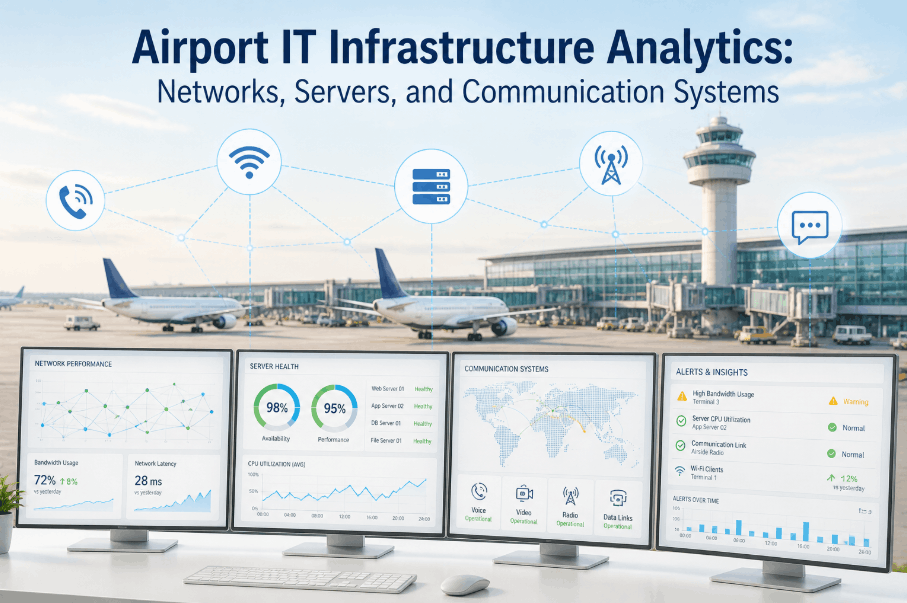
Airport IT infrastructure analytics is transforming how airports manage mission-critical systems — from fiber optic backbone networks and server room environments to Wi-Fi coverage, flight information display systems (FIDS), and public address (PA) communication platforms. As passenger volumes grow and digital dependency intensifies, airports relying on reactive maintenance face escalating risks: network outages, server failures, delayed flight data, and communication blackouts that directly impact operational continuity and passenger experience. AI-driven preventive analytics shifts airport IT teams from firefighting mode to proactive infrastructure governance — with real-time visibility across every system layer, from fiber splices to display endpoints. Book a demo to see how iFactory's preventive analytics platform transforms airport IT infrastructure management.
What Is Airport IT Infrastructure Analytics and Why Does It Matter?
Airport IT infrastructure analytics refers to the continuous, AI-driven monitoring, performance measurement, and predictive maintenance of all technology systems that underpin airport operations — including physical and logical network layers, data center and server room environments, wireless access infrastructure, passenger-facing display systems, intercom and PA systems, and radio communication networks. Unlike enterprise IT environments where a server room anomaly triggers a low-priority ticket, airport IT infrastructure operates under zero-downtime expectations where the same event can cascade into grounded aircraft and stranded passengers. AI-driven platforms ingest telemetry from network switches, server hardware sensors, access point signal data, FIDS feed processors, and PA amplifiers — correlating signals to detect degradation patterns days before they produce visible failures, making analytics operationalization a core competency for every airport technology leadership team.
Airport Fiber Network Analytics: Monitoring the Backbone of Airport Connectivity
The airport fiber optic network is the foundational layer connecting every digital system in the terminal — from check-in kiosks and baggage handling controllers to security screening systems and airside communication platforms — and fiber network analytics monitors optical signal loss, reflectometry data, splice point integrity, and switch port utilization across the entire campus topology to detect micro-degradations caused by physical stress, connector contamination, or aging splice boxes long before they produce packet loss or link failures, giving airport network teams early warnings measured in days or weeks that are sufficient to schedule replacement or re-splicing during planned maintenance windows rather than emergency responses during peak terminal operations. Book a demo to see how iFactory's network analytics module maps and monitors airport fiber infrastructure in real time.
Effective airport fiber network analytics must track optical return loss (ORL) trending across splice points, OTDR event markers indicating physical stress locations, switch port error rate escalation on fiber uplinks, inter-building dark fiber utilization rates, and power budget margin erosion on long-haul runs between terminal buildings and remote concourses — enabling AI models to identify which network segments carry the highest failure risk within a defined maintenance planning window.
Airport Server Room and Data Center Management: Environmental and Performance Analytics
Airport server rooms and data centers house the compute infrastructure powering reservation systems, baggage reconciliation platforms, security screening databases, and operational coordination applications — and server room analytics must encompass environmental sensing, power distribution integrity, cooling system performance, and hardware health trending across every rack and chassis, with AI models trained on historical failure data detecting cooling inefficiency patterns such as hot aisle containment breaches or CRAC unit capacity degradation up to 30 days before thermal events occur, while also providing lifecycle intelligence that identifies hardware approaching end-of-life based on runtime hours and error rate trends to support data-backed refresh budgeting instead of age-based replacement rules. Book a demo to explore iFactory's server room monitoring capabilities for airport data center environments.
Environmental Monitoring and Thermal Analytics
Continuous temperature, humidity, and airflow analytics across all rack positions, identifying hotspots, cooling inefficiencies, and environmental threshold violations before hardware is at risk.
Power Distribution and UPS Health Analytics
PDU load balancing analysis, UPS battery capacity trending, transfer switch test result tracking, and generator fuel level integration for complete power chain visibility.
Hardware Health and Failure Prediction
BMC telemetry ingestion, SMART drive data analysis, memory error rate trending, and CPU thermal throttling detection — correlated into predictive failure scores per device.
Capacity and Asset Lifecycle Management
Rack utilization trending, compute capacity forecasting against seasonal traffic projections, and IT asset lifecycle scoring to support hardware refresh planning and capital budget submissions.
Airport Wi-Fi Analytics: Ensuring Connectivity Across High-Density Passenger Environments
Airport Wi-Fi infrastructure is one of the most operationally complex wireless environments in any industry — and AI-driven airport wireless analytics addresses this by correlating access point performance data with passenger flow information to identify coverage degradation patterns during peak boarding periods, co-channel interference from reconfigured gate assignments, and dedicated SSID failures on ground service equipment (GSE) tablets and baggage handling system controllers, enabling Wi-Fi teams to pre-position channel planning adjustments and power tuning before passenger experience degrades or operational device failures impact aircraft turnaround times and gate coordination metrics. Book a demo to see how iFactory's wireless analytics module delivers AP health trending and coverage gap detection for airport environments.
| Wi-Fi Analytics Metric | Monitoring Frequency | Failure Risk Indicator | Impacted System |
|---|---|---|---|
| Access Point RSSI per Zone | Continuous (30-sec polling) | RSSI below -70 dBm in operational areas | Ground crew devices, GSE tablets |
| Client Association Success Rate | Per-event capture | Association failure rate above 3% | Passenger connectivity, boarding systems |
| Channel Utilization by AP | 5-minute intervals | Utilization above 75% sustained | All Wi-Fi dependent systems |
| AP Uptime and Reboot Events | Real-time event stream | 3+ unexpected reboots in 24 hours | Coverage continuity, SLA compliance |
| Co-Channel Interference Score | 15-minute intervals | Interference index above 40% overlap | Throughput quality across affected zones |
| Rogue Access Point Detection | Continuous RF scanning | Any unrecognized SSID/BSSID on floor | Network security, compliance posture |
Flight Information Display System (FIDS) Analytics: Keeping Passenger Data Accurate and Available
FIDS analytics encompasses the complete display ecosystem — feed processing servers receiving data from airline departure control systems (DCS) and airport operational databases (AODB), network distribution to display endpoints, display hardware health monitoring, and content rendering integrity verification — with AI-driven platforms detecting feed latency anomalies, display endpoint connectivity gaps, and hardware degradation patterns such as brightness loss or intermittent panel failures that enable proactive replacement before a dark display creates a passenger experience incident, while simultaneously generating automated uptime audit trails that reduce SLA reporting effort by over 70% and improve accuracy compared to manual documentation methods. Book a demo to see how iFactory's FIDS monitoring module tracks display health and data pipeline integrity across the full airport terminal.
Airport PA System and Public Address Infrastructure Analytics
Airport public address systems are safety-critical communication infrastructure governing emergency evacuation announcements, security alerts, boarding calls, and general passenger information — and PA system analytics monitors amplifier thermal trends indicating component degradation, speaker line resistance shifts suggesting wiring faults or environmental ingress damage, DSP processing load anomalies that precede audio quality degradation, and microphone station availability across every terminal and airside zone, while also generating automated test result logs for regulatory-required periodic system verification and integrating with incident management workflows to deliver pre-diagnosed fault data that enables technicians to arrive at failure locations with the correct parts rather than spending the first 30 minutes diagnosing the affected zone and component. Book a demo to see how iFactory's PA infrastructure analytics module integrates with airport operations and compliance workflows.
Airport Radio Communication System Analytics: Operational and Safety Network Monitoring
Airport radio communication systems provide voice infrastructure for ground control coordination, airline operations, emergency services, and airside safety management — and AI-driven radio system analytics monitors transmitter power output trends, receiver sensitivity degradation, battery backup health for remote repeater sites, and inter-site connectivity on radio backbone networks to replace calendar-based preventive maintenance schedules with condition-based planning, while also tracking TETRA and P25 digital radio network registration rates, call setup success percentages, and talkgroup traffic distribution to optimize channel configurations as operational patterns evolve with new airline routes, terminal expansions, and seasonal traffic shifts.
Building an Airport IT Infrastructure Analytics Roadmap: A Practical Implementation Guide
For airport IT directors implementing AI-driven analytics across a complex, multi-system environment where systems cannot be taken offline for extended periods and data sources span dozens of vendors and protocols, a structured five-phase implementation roadmap — moving from infrastructure inventory through telemetry integration, baseline profiling, predictive model configuration, and automated compliance reporting — reduces deployment risk, accelerates time-to-value, and produces a continuously improving analytics foundation as incident data enriches predictive models over time.
Infrastructure Inventory and Telemetry Source Mapping
Audit all IT infrastructure assets — network hardware, servers, access points, FIDS endpoints, PA amplifiers, and radio base stations — and document available telemetry sources (SNMP, syslog, API, BMC) to define the data integration architecture for the analytics platform.
Baseline Performance Profiling Across All System Domains
Deploy analytics data collection across all system domains and allow the AI platform to establish performance baselines under normal operating conditions over a 4-to-6 week period — capturing daily traffic patterns, seasonal load variations, and system behavior during peak passenger periods.
Predictive Model Configuration and Alert Threshold Tuning
Configure predictive failure models for each system domain using established baselines, tuning alert thresholds to airport-specific criticality levels and integrating with existing incident management and CMMS platforms for alert routing and work order creation.
Preventive Maintenance Workflow Integration
Connect analytics-generated maintenance predictions to work order creation workflows — automatically generating preventive maintenance orders with pre-diagnosed fault data, parts requirements, and priority classifications to replace calendar-based PM schedules with condition-based triggers.
Compliance Reporting Automation and Continuous Improvement
Configure automated uptime reporting, SLA performance dashboards, and regulatory compliance documentation outputs across all monitored system domains, then establish a monthly model accuracy review cycle to refine failure signatures as new incident data enriches the training dataset.
Airport IT Compliance and Audit Readiness Through Analytics
Airport IT infrastructure operates within a complex regulatory framework — encompassing aviation authority requirements for communication system availability, cybersecurity frameworks for critical infrastructure, airline SLA obligations for FIDS and network uptime, and environmental health and safety standards for data center operations — and AI-driven analytics platforms address all of these simultaneously by generating continuous compliance evidence including automated system test logs, uptime records with incident timestamps, environmental monitoring reports, and network traffic baseline deviation alerts that feed directly into the airport's security operations center (SOC) and support compliance with NIST CSF, ISO 27001, and ICAO cybersecurity guidance, compressing audit preparation from weeks of manual compilation to hours of system-generated documentation retrieval.
Frequently Asked Questions: Airport IT Infrastructure Analytics
What systems does airport IT infrastructure analytics cover?
Airport IT infrastructure analytics covers the full technology stack: fiber optic and copper network infrastructure, data center and server room environments, wireless access point networks, flight information display systems (FIDS), public address systems, and radio communication networks — with advanced platforms also integrating building management, physical security, and passenger processing technology.
How does AI-driven analytics differ from traditional airport network monitoring?
Traditional network monitoring alerts on failures that have already occurred, while AI-driven airport network analytics detects degradation patterns — in signal quality, hardware performance, environmental conditions, and traffic behavior — that precede failures by days or weeks, enabling preventive intervention before operational impact occurs.
How long does it take to deploy airport IT analytics across a full terminal?
Most airport IT analytics deployments achieve full telemetry coverage across all system domains within 6 to 10 weeks, with initial anomaly detection active within the first 2 weeks — airports with existing SNMP and API infrastructure can compress this timeline significantly through standardized integration connectors.
Can airport IT analytics integrate with existing CMMS and incident management platforms?
Yes — purpose-built airport IT analytics platforms provide native integration with CMMS platforms, ServiceNow-based ITSM systems, and airport operations control center (AOCC) workflows, enabling analytics-generated predictions to automatically create work orders, escalate incidents, and update asset records without manual data re-entry.
What ROI do airports typically achieve from IT infrastructure analytics?
Airports implementing AI-driven IT infrastructure analytics typically report 40–60% reductions in unplanned downtime events, 25–35% reductions in emergency maintenance labor costs, 15–20% improvements in IT asset lifecycle extension, and 50–70% compliance reporting efficiency gains within the first year of deployment.