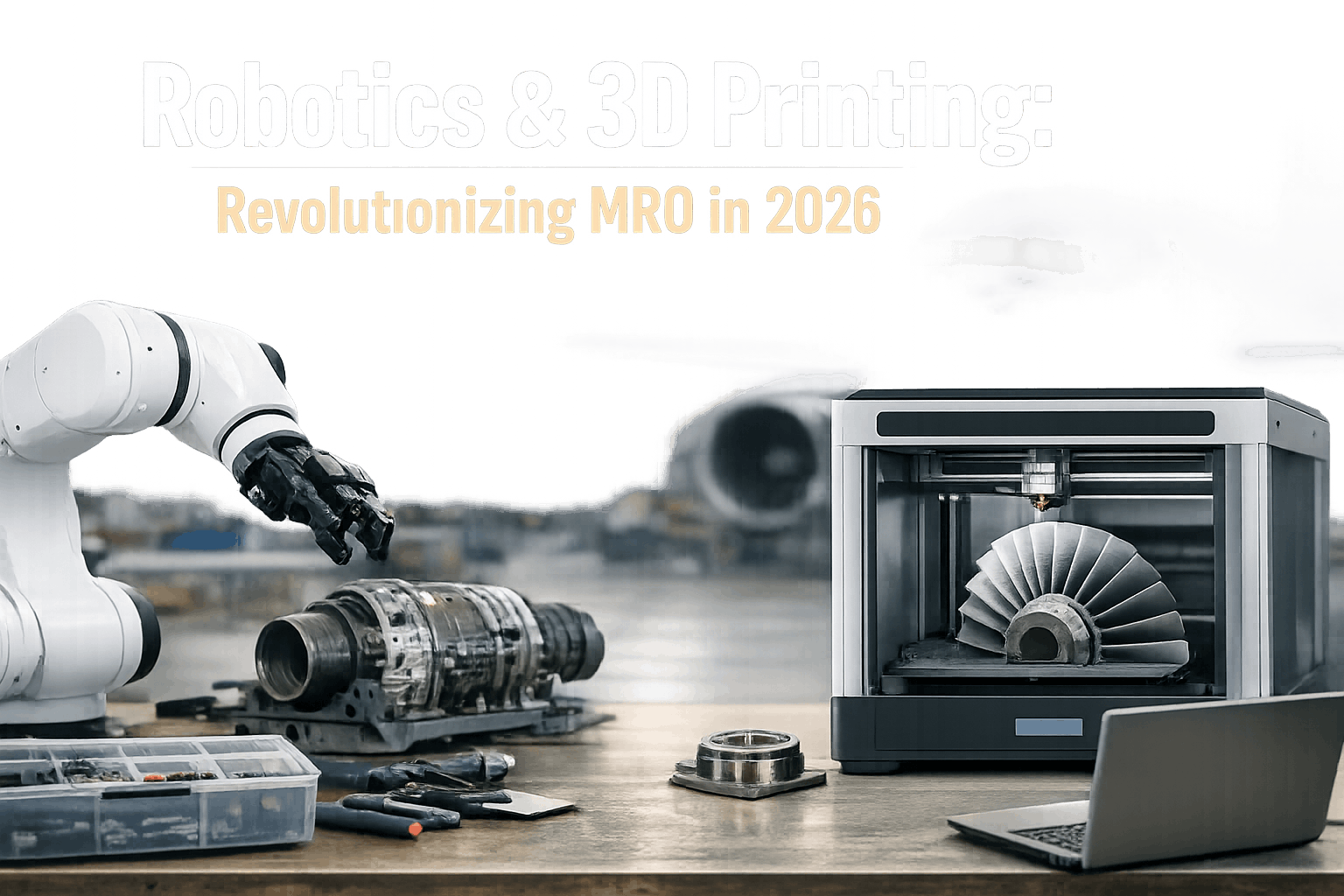
Robotics & 3D Printing: Revolutionizing MRO in 2026
By Taylor on March 5, 2026
Aircraft Maintenance, Repair, and Overhaul (MRO) is undergoing its most significant technological transformation since the introduction of computerized maintenance management in the 1990s. Two converging forces — autonomous robotic inspection and repair systems, and additive manufacturing (3D printing) for certified aircraft parts — are fundamentally rewriting the economics, speed, and safety of how airlines and MRO providers keep aircraft airworthy. A single wide-body aircraft heavy check that traditionally requires 50,000+ labor hours over 4–6 weeks is being compressed by robotic automated inspection that covers fuselage surfaces in hours instead of days, robotic drilling and fastening systems that execute 10,000+ precision holes without fatigue-induced quality drift, and 3D-printed replacement parts that arrive in days instead of the 8–16 week lead times that ground aircraft waiting for legacy cast or machined components. In 2026, iFactory's AI platform connects these robotic and additive manufacturing capabilities to digital twin models, predictive maintenance engines, and CMMS work order automation — transforming MRO from a labor-constrained bottleneck into an AI-orchestrated, robotically-executed, digitally-documented precision operation. Book a free MRO technology assessment and see how iFactory powers the connected MRO facility of 2026.
Robotics & 3D Printing in Aviation MRO: 2026 Market Transformation
Traditional Manual MRO
$100B+
Global MRO Market — Labor-Constrained
4–6 week heavy checks, 8–16 week part lead times
VS
Robotic + 3D Print + iFactory AI
40-60%
Faster Turnaround Achievable
AI-orchestrated robotics, on-demand printed parts
— Oliver Wyman MRO Forecast 2025; FAA Additive Manufacturing Advisory 2024; iFactory Platform Deployment Data
Two Technologies, One Revolution: How Robotics and 3D Printing Transform MRO
Aviation MRO providers face two compounding constraints simultaneously: a global shortage of 40,000+ certified aircraft mechanics by 2026, and supply chain disruptions that extend replacement part lead times to months. Robotics and 3D printing address each constraint directly — but they deliver maximum value only when orchestrated through an AI platform that connects robotic task execution and additive manufacturing to digital twin models, CMMS work orders, and airworthiness documentation. Understanding both technologies is essential for building a connected MRO program.
Robotics
Autonomous MRO Robotic Systems
1
Robotic crawler or drone scans full fuselage in 2–4 hours vs. 2–3 days manual
iFactory Link:Digital Twin + CMMS task cards + AI dispatch
3D Print
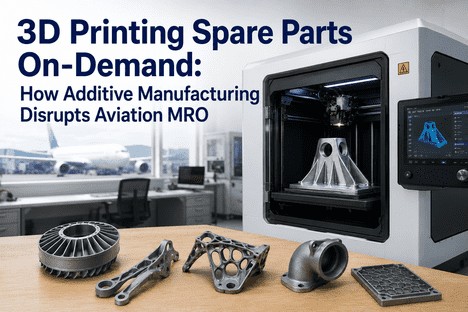
Additive Manufacturing for Aircraft Parts
1
Digital part file retrieved from iFactory asset library — certified geometry and material spec
2
Metal or polymer 3D printer produces part on-site or at nearest certified facility
3
Part inspected, certified, and traced — print parameters logged in quality record
4
Installed on aircraft — full traceability from digital file to airworthiness release
Best For:Brackets, ducts, interior parts, tooling, legacy spares
Lead Time:Days vs. 8–16 weeks for cast/machined parts
iFactory Link:Part library + print certification + install WO
Still waiting months for replacement parts that could be 3D printed in days? Book a free MRO technology assessment to identify your highest-impact robotics and additive manufacturing opportunities.
The MRO Efficiency Crisis: Why Traditional Methods Cannot Scale
The global MRO market exceeds $100 billion annually — and demand is growing 4–5% per year as the global fleet expands. But the labor pool of certified mechanics is shrinking, supply chains remain fragile, and heavy check turnaround times directly determine aircraft availability and airline revenue. Manual methods that worked for a 5,000-aircraft global fleet cannot scale for a 30,000+ aircraft fleet without robotic augmentation and additive manufacturing.
The MRO Capacity Gap — Traditional vs. Technology-Augmented
Robotic + 3D Print + iFactory AI — MRO Throughput Capacity
2.5× Throughput
Hybrid (Some Robotics + Traditional Supply Chain)
1.5× Capacity
Traditional Manual MRO Program
1× Baseline
40,000+Certified mechanic shortage projected globally by 2026
8–16 wkTypical lead time for cast/machined replacement parts
$100B+Global MRO market — growing 4–5% annually with constrained labor
How iFactory Orchestrates Robotic and 3D Printing MRO Operations
Deploying a robot or a 3D printer is only the first step. The operational value depends entirely on how robotic inspection findings trigger repair work orders, how 3D-printed parts are traced from digital file to installed aircraft, and how every action feeds the digital twin and airworthiness records. iFactory's four-module MRO integration connects every robotic action and every printed part to a continuous, auditable maintenance record.
AI-Driven Robotic Task Orchestration
iFactory's AI engine analyzes digital twin data, maintenance history, and flight cycle counts to generate optimized robotic inspection and repair task sequences. Robots receive prioritized task cards with exact locations, acceptance criteria, and documentation requirements — executing complex heavy check procedures with zero task sequencing errors.
Zero task sequencing errors — AI optimizes robotic workflow for minimum aircraft ground time
3D Print Part Lifecycle Traceability
Every 3D-printed aircraft part carries a complete digital birth certificate in iFactory: source file version, printer ID, material batch, print parameters (layer height, temperature, speed), post-processing steps, quality inspection results, and FAA/EASA certification status. Full traceability from digital design file to installed aircraft — satisfying Part 21 production approval documentation.
Complete part genealogy — digital file to installed aircraft, every parameter traced
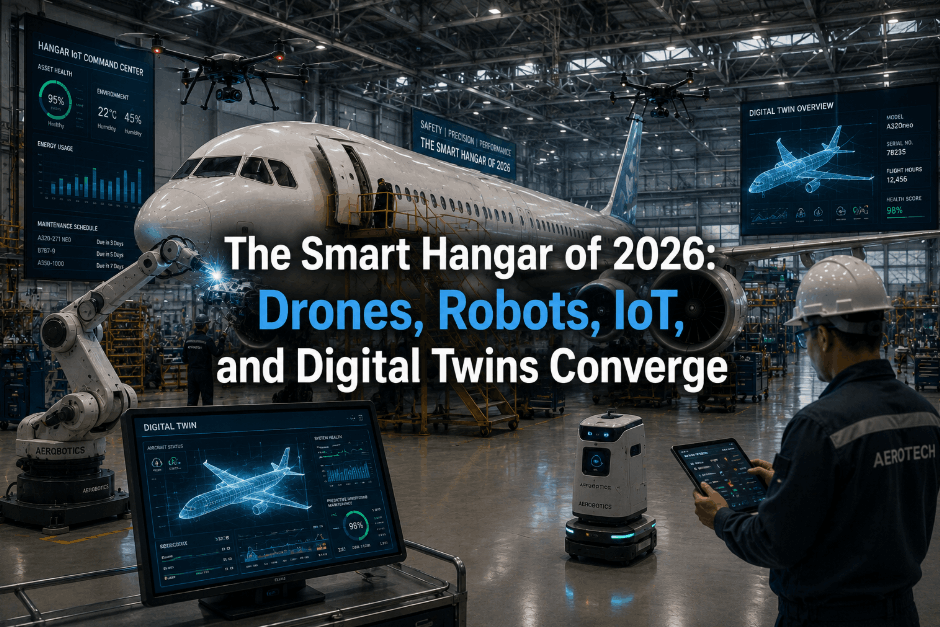
Digital Twin MRO Integration
Every robotic inspection finding, every 3D-printed part installation, and every repair action updates the aircraft's digital twin in real time. The twin models component aging, predicts next maintenance intervals, and simulates the impact of repair-versus-replace decisions — giving MRO planners data-driven intelligence for every aircraft in the hangar.
Live aircraft digital twin — updated with every robotic and additive manufacturing event
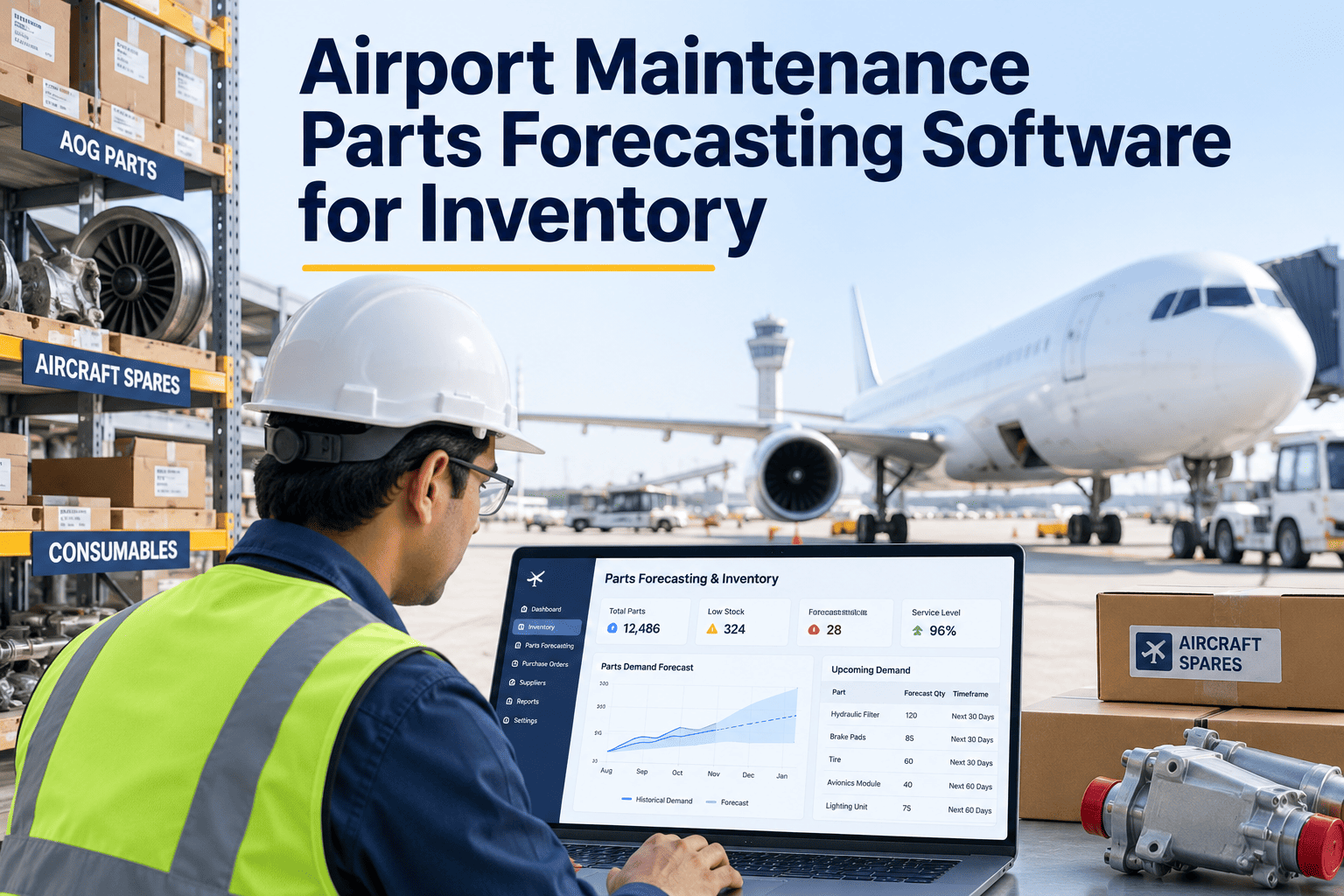
Predictive Parts Demand & Inventory AI
iFactory's AI analyzes fleet maintenance history, digital twin degradation models, and upcoming check schedules to predict which parts will be needed 30–90 days in advance. For parts eligible for additive manufacturing, the system auto-queues print jobs at certified facilities — eliminating the 8–16 week supply chain wait that grounds aircraft.
30–90 day predictive parts demand — 3D print jobs queued before the aircraft arrives at the hangar
Connect Robotics, 3D Printing, Digital Twin & CMMS in One MRO Platform
iFactory integrates robotic inspection and repair systems with additive manufacturing traceability, digital twin modeling, and predictive maintenance AI — delivering end-to-end MRO intelligence for airlines and MRO providers operating in 2026 and beyond.
The MRO Technology Gap — Traditional vs. AI-Orchestrated
What separates MRO providers achieving 40–60% faster turnaround from those still constrained by labor shortages and supply chain delays? It is not just having robots and printers — it is the AI orchestration layer that connects them to work orders, digital twins, and certification records.
Scroll to compare
MRO Capability
Traditional Manual MRO
Robotic + 3D Print + iFactory AI
Fuselage Inspection
Manual visual — 2–3 days per aircraft, human fatigue limits quality
Robotic crawler/drone — 2–4 hours, AI defect recognition 95%+
Drilling & Fastening
Manual — quality drift after 500+ holes, fatigue errors compound
Robotic — 10,000+ precision holes per shift, zero drift
Replacement Parts
8–16 week lead time for cast/machined — aircraft grounded waiting
3D printed in days — certified, traced, installed on schedule
Documentation
Paper task cards — transcribed to system post-check
Auto-documented per robotic action — timestamped, photo-verified
Part Traceability
Batch certificates filed in binders — manual lookup
Digital birth certificate per 3D-printed part — instant audit access
40–60% faster — robotics + on-demand parts + AI orchestration
Still running 6-week heavy checks with 8-week part lead times? Connect with our MRO technology specialists to see how robotics and additive manufacturing compress your turnaround.
Expert Perspective
"The convergence of autonomous robotics and additive manufacturing in aviation MRO is not an incremental improvement — it is a structural transformation of the industry's capacity model. For three decades, MRO throughput has been directly limited by the number of certified mechanics available per shift and the lead time for replacement parts from traditional supply chains. Robotics removes the labor constraint by multiplying what each mechanic can accomplish. 3D printing removes the supply chain constraint by manufacturing parts on demand. But neither technology delivers its full potential without an AI orchestration layer that connects robotic findings to repair decisions, part demand to print queues, and every action to the aircraft's digital twin and airworthiness record. That orchestration — not the hardware — is where the competitive advantage lies in 2026."
The Future of MRO Is Robotic, Additive, and AI-Orchestrated
As the global fleet grows, the mechanic shortage deepens, and supply chains remain fragile, MRO providers who deploy robotics and 3D printing with AI orchestration will set the standard for turnaround speed, quality, and cost. iFactory connects every robot, every printer, and every maintenance action to a unified digital twin and CMMS platform — built for the MRO facility of 2026.
What types of MRO tasks can robots perform on aircraft?
In 2026, robotic systems are performing or augmenting five primary MRO task categories: fuselage inspection (magnetic crawlers and drones with HD cameras, thermal, and ultrasonic sensors covering full airframe surfaces in 2–4 hours), automated drilling and fastening (robotic arms executing 10,000+ precision holes per shift for panel installation and structural repair), automated painting and coating (robotic spray systems applying uniform coatings without human exposure to hazardous materials), non-destructive testing (robotic-mounted phased array UT, eddy current, and thermographic inspection), and engine borescope inspection (miniaturized robotic platforms navigating internal engine pathways). A certified mechanic must still evaluate findings and sign airworthiness releases — robots are precision tools, not certification authorities.
Are 3D-printed aircraft parts FAA/EASA certified for flight-critical applications?
Yes, with specific qualifications. FAA and EASA have approved additive manufacturing for a growing range of aircraft parts under Part 21 production approval and supplemental type certificates (STCs). GE Aviation's LEAP engine fuel nozzle — 3D printed in metal — has accumulated millions of flight hours. Cabin interior parts, brackets, ducting, and non-structural components are routinely 3D printed under approved processes. Flight-critical structural parts require more extensive qualification testing. iFactory's 3D Print Part Lifecycle module tracks every certification requirement — material qualification, process validation, batch testing, and installation traceability — ensuring every printed part carries complete regulatory documentation from digital file to installed aircraft. Book a demo to see part certification tracking in action.
How does iFactory connect robotic inspection findings to repair work orders?
When a robotic inspection system identifies a defect — crack, corrosion, dent, or coating damage — the finding is classified by the AI engine with severity, location (mapped to the aircraft's 3D digital twin), and recommended corrective action. iFactory auto-generates a CMMS work order with the defect photo, location coordinates, severity classification, applicable task card reference, and required parts. If a replacement part is eligible for 3D printing, the system auto-queues the print job at the nearest certified facility. The mechanic receives the work order with everything needed to execute the repair — no manual transcription, no lost findings, no parts procurement delay.
How does predictive parts demand work with 3D printing?
iFactory's AI analyzes fleet-wide digital twin data — component aging curves, flight cycle counts, failure probability models, and upcoming scheduled maintenance — to predict which parts will be needed 30–90 days in advance. For parts in the approved additive manufacturing catalog, the system automatically queues print jobs at certified production facilities, scheduling delivery to coincide with the aircraft's arrival at the MRO hangar. This eliminates the traditional scenario where an aircraft arrives for a heavy check and then waits weeks for a part that could have been printed and ready. Visit our Support Center for detailed predictive parts documentation.
What does deployment look like for a robotic and additive MRO program?
A typical deployment runs 12–16 weeks: Phase 1 (weeks 1–4) covers MRO workflow audit, robotic task identification, and 3D-printable parts catalog assessment. Phase 2 (weeks 4–8) configures iFactory's digital twin integration, robotic task card templates, and 3D print lifecycle traceability modules. Phase 3 (weeks 8–12) runs supervised robotic operations alongside existing manual procedures to validate AI accuracy and build mechanic confidence. Phase 4 (weeks 12–16) activates full robotic and additive manufacturing workflows with predictive parts demand and AI task orchestration. Quick wins — robotic fuselage inspection and first 3D-printed parts — are typically live within the first 6 weeks.