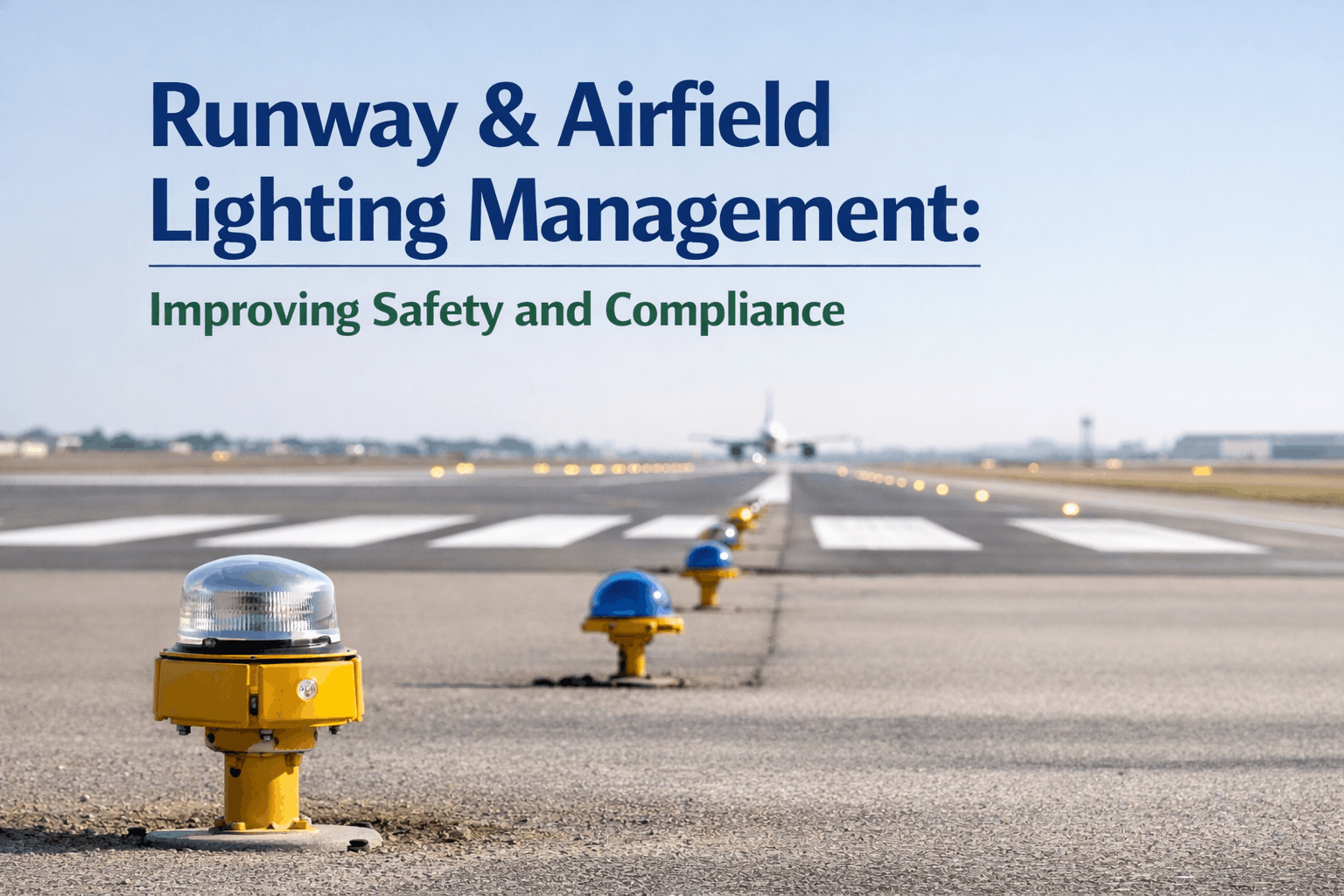
Runway & Airfield Lighting Management: Improving Safety and Compliance
By Taylor on March 2, 2026
Runway and airfield lighting is one of the most safety-critical systems at any airport. Every approach light, edge light, centerline fixture, and taxiway marker must perform flawlessly — because when a light fails at the wrong moment, aircraft, crews, and passengers are at risk. Yet most airports still manage airfield lighting through reactive maintenance and manual inspection rounds, discovering failures only after they've already compromised safety margins. In 2026, iFactory's AI-powered platform is transforming airfield lighting management with predictive maintenance, IoT sensor networks, digital twin simulation, and CMMS-integrated autonomous decision-making — shifting airports from reactive compliance to proactive safety intelligence. Book a free consultation and discover how AI keeps every light on, every runway safe, and every audit passed.
45K+
Individual Lights on a Major Airport's Airfield
$4.2M
Avg. Annual Airfield Lighting Maintenance Cost
60%
Of Lighting Failures Detectable Before Outage via AI
99.8%
Uptime Required by ICAO Annex 14 Standards
What Is Airfield Lighting Management — and Why Does It Matter Now?
Airfield lighting management encompasses the monitoring, maintenance, and compliance governance of every lighting system on the airside — from high-intensity approach lights and runway edge lights to taxiway centerline guidance and apron floodlighting. These systems operate in extreme conditions: temperature swings, moisture intrusion, vibration from nearby aircraft, and constant electrical load cycling.
In 2026, regulatory bodies including ICAO, FAA, and EASA are enforcing stricter uptime requirements and documentation standards. Airports that cannot demonstrate proactive lighting maintenance face audit failures, operational restrictions, and — in worst cases — runway closures. Meanwhile, the transition from halogen to LED fixtures is creating a generational infrastructure overhaul that demands intelligent asset lifecycle management. iFactory's AI platform addresses every dimension of this challenge.
Reactive vs. AI-Powered Airfield Lighting Management
Dimension
Reactive (Legacy)
AI-Powered (iFactory)
Failure Detection
Discovered during patrol or pilot report
Predicted 48–72 hours before outage via IoT
Compliance
Manual logs, audit scrambles
Automated ICAO/FAA audit-ready reports
Work Orders
Phone calls, paper tickets
Auto-generated CMMS work orders with parts
Circuit Monitoring
Periodic manual megger testing
Continuous current/voltage IoT monitoring
LED Transition
Fixture-by-fixture, no lifecycle data
AI-optimized retrofit roadmap with ROI modeling
Cost Control
Reactive spend, emergency procurement
Predictive budgeting with 35% cost reduction
The 6 Phases of Intelligent Airfield Lighting Management
iFactory's deployment follows a disciplined 6-phase framework that transforms airfield lighting from a reactive maintenance burden into an AI-driven safety and compliance system.
Phase 01 — Discovery
Airfield Lighting Infrastructure Audit
Complete inventory of every lighting circuit, fixture, regulator, and control system across runways, taxiways, approaches, and aprons. Map existing CMMS data quality, sensor coverage gaps, and regulatory compliance status against ICAO Annex 14 and FAA AC 150/5340 requirements.
Duration: 1–2 weeks
Phase 02 — Instrumentation
IoT Sensor Deployment & CCR Monitoring
Install current transformers, voltage monitors, and insulation resistance sensors on constant current regulators (CCRs) and series lighting circuits. Deploy photometric sensors on critical approach and runway fixtures to monitor actual light output intensity in real time.
Duration: 2–4 weeks
Phase 03 — Digital Twin
Airfield Lighting Digital Twin Creation
Build a real-time digital replica of your entire airfield lighting network — every circuit, regulator, fixture, and control panel. The twin mirrors live sensor data, establishes degradation baselines, and enables what-if failure scenario testing without affecting live runway operations.
Duration: 2–3 weeks
Phase 04 — Intelligence
Predictive AI Model Training & Calibration
Machine learning models are trained on your airport's specific lighting failure history, environmental exposure patterns, and fixture aging data. Models learn to predict lamp degradation, cable insulation breakdown, CCR failures, and connector corrosion 48–72 hours before they cause outages.
Duration: 2–4 weeks
Phase 05 — Validation
Supervised Prediction & Compliance Verification
AI predictions run alongside existing maintenance operations for 4–6 weeks. Every alert is verified against actual outcomes, refining accuracy and building trust. Simultaneously, automated compliance reporting is validated against ICAO/FAA documentation requirements.
Duration: 4–6 weeks
Phase 06 — Autonomous
Full Predictive Operations & Continuous Compliance
The platform operates autonomously — predicting failures, generating CMMS work orders, pre-staging replacement fixtures, and producing audit-ready compliance reports. AI continuously learns from new data, seasonal patterns, and infrastructure changes for compounding accuracy.
Airfield lighting failures are rarely random — they follow predictable degradation patterns that AI can detect weeks before a visible outage. Here's where airports lose time, money, and safety margins without predictive intelligence.
68%
Cable Insulation Degradation
Solve with: Continuous insulation resistance monitoring via IoT sensors on series circuits
$18K
Avg. Cost per Runway Closure Event
Solve with: 48–72hr predictive alerts that schedule repairs during planned downtime windows
42%
Premature LED Fixture Failures
Solve with: Photometric degradation tracking and thermal profiling per fixture via digital twin
3–5×
Emergency vs. Planned Repair Cost
Solve with: AI-optimized maintenance scheduling that converts emergencies into planned tasks
The Airfield Lighting Safety Cascade
1
Cable insulation degrades undetected underground
2
CCR compensates until circuit overloads
3
Multiple fixtures fail on same circuit
4
Runway downgraded or closed for repairs
5
Flight diversions, audit failure, revenue loss
iFactory AI — Airfield Lighting Predictive Architecture
What AI-Powered Airfield Lighting Management Delivers
iFactory's platform goes beyond monitoring — it delivers end-to-end intelligent management across every dimension of airfield lighting operations, safety, and compliance.
01
Predictive Fixture Maintenance
AI monitors photometric output, thermal signatures, and electrical draw of every fixture — predicting lamp failures, LED driver degradation, and connector corrosion weeks before visible symptoms appear.
02
Series Circuit Health Monitoring
Continuous IoT monitoring of constant current regulators and series lighting circuits detects insulation degradation, ground faults, and open circuits — the root cause of 68% of airfield lighting outages.
03
Automated Compliance Reporting
Generate audit-ready documentation for ICAO Annex 14, FAA AC 150/5340, and EASA CS-ADR-DSN automatically. Every fixture inspection, light measurement, and maintenance action is timestamped and traceable.
04
LED Transition Lifecycle Management
AI-optimized retrofit planning for halogen-to-LED conversions — prioritizing circuits by ROI, energy savings, and failure risk. Track every fixture through its entire lifecycle from installation to decommission.
05
Intelligent Spare Parts Management
AI predicts which fixtures and components will need replacement in the next 30/60/90 days — enabling just-in-time procurement that eliminates both stockouts and excess inventory waste.
06
Runway Availability Optimization
Coordinate maintenance windows with flight schedules and ATC to minimize runway closure time. AI identifies optimal repair windows and batches nearby fixture replacements to reduce airside access events.
Every Light Failure Is Predictable. Every Audit Should Be Effortless.
iFactory's AI platform gives your airfield electrical team predictive intelligence, automated compliance, and a digital twin of every lighting circuit — so safety is engineered in, not inspected after.
High-intensity approach lights are the first visual reference for pilots on final approach. Predictive monitoring ensures every sequenced flasher, steady-burn bar, and decision bar light performs within ICAO photometric requirements.
Runway Edge & Centerline Lights
HIRL, MIRL, LIRL, Centerline & TDZ
Edge and centerline lights define the usable runway boundary in low visibility. AI tracks individual fixture brightness degradation and circuit health to maintain category III ILS compatibility at all times.
Taxiway Guidance & Stop Bars
Centerline, Edge, Clearance Bars, Stop Bars
Taxiway lighting prevents runway incursions — one of aviation's most dangerous events. AI monitors stop bar activation systems, clearance bar circuits, and taxiway centerline fixture chains for any degradation.
PAPI, VASI & Apron Floodlighting
Precision approach, visual aids, ramp lighting
PAPI/VASI systems provide critical glide path guidance. AI monitors beam alignment, lamp color temperature shift, and photometric output to ensure visual aids remain within calibration tolerance continuously.
The ROI of Predictive Airfield Lighting Management
Airports that shift from reactive to predictive airfield lighting management see measurable improvements across safety, cost, and compliance within the first 12 months of deployment.
Without AI-Powered Management
Failures discovered during night patrol or pilot reports
Emergency runway closures for unplanned lighting repairs
Compliance documentation assembled manually before audits
Spare parts overstocked or emergency-ordered at premium cost
No lifecycle data for LED transition planning decisions
With iFactory AI Platform
Failures predicted 48–72 hours ahead via IoT + digital twin
Repairs scheduled during planned maintenance windows
AI-optimized inventory with 70% reduction in excess stock
Complete asset lifecycle data powering LED retrofit ROI models
35%
Average reduction in airfield lighting maintenance costs within 12 months
92%
Reduction in unplanned runway closures due to lighting failures
99.8%
Lighting system uptime achieved — meeting ICAO Annex 14 requirements
Your Runway Lights Shouldn't Fail Before You Know They're Failing
iFactory's AI gives your airfield team the predictive intelligence to keep every light on, every circuit healthy, and every compliance audit passed — automatically. See it in action with a free 30-minute demo.
Predictive maintenance for airfield lighting uses IoT sensors, machine learning, and digital twin technology to continuously monitor the health of every runway, taxiway, and approach lighting fixture, circuit, and regulator. Instead of waiting for lights to fail during nighttime operations, AI detects degradation patterns — lamp dimming, cable insulation breakdown, CCR performance drift — and predicts failures 48–72 hours in advance, enabling planned repairs that prevent safety incidents and regulatory violations.
Core sensor types include current transformers on CCR outputs (monitoring circuit load), insulation resistance monitors on series cables, photometric sensors on critical fixtures (measuring actual light output), thermal profilers on LED drivers and regulators, and ambient light sensors for automatic brightness calibration. iFactory assesses your existing infrastructure during the Discovery phase and recommends only additional sensors needed to close monitoring gaps.
The platform automatically generates compliance documentation aligned with ICAO Annex 14, FAA AC 150/5340, and EASA CS-ADR-DSN requirements. Every maintenance action, photometric measurement, circuit test, and fixture replacement is timestamped and stored in an audit-ready format. When regulators arrive, your compliance reports are already produced — no scramble, no missing records, no failed audits.
Yes. iFactory connects via pre-built API connectors with all major CMMS and EAM platforms including SAP, Maximo, eMaint, and Infor. When a predictive alert is triggered, the system auto-generates a work order in your CMMS with the specific fixture location, predicted failure mode, required parts, and optimal repair window — all without manual data entry.
A standard deployment for a mid-size airport runs 12–18 weeks from infrastructure audit to full autonomous predictive operations. Larger hub airports with complex multi-runway airfield systems may require 18–24 weeks. Book a free 30-minute demo to get a deployment timeline scoped to your specific airfield lighting infrastructure.
Absolutely. The platform provides complete asset lifecycle data for every fixture — age, failure history, energy consumption, and photometric degradation curve. AI uses this data to generate an optimized LED retrofit roadmap that prioritizes circuits by ROI, energy savings potential, and failure risk. This ensures your LED transition investment delivers maximum value. Visit our Support Center for more details on LED transition advisory.