AI-Driven SCADA Integration: Remote Control for Biogas Plants
By oxmaint on March 7, 2026
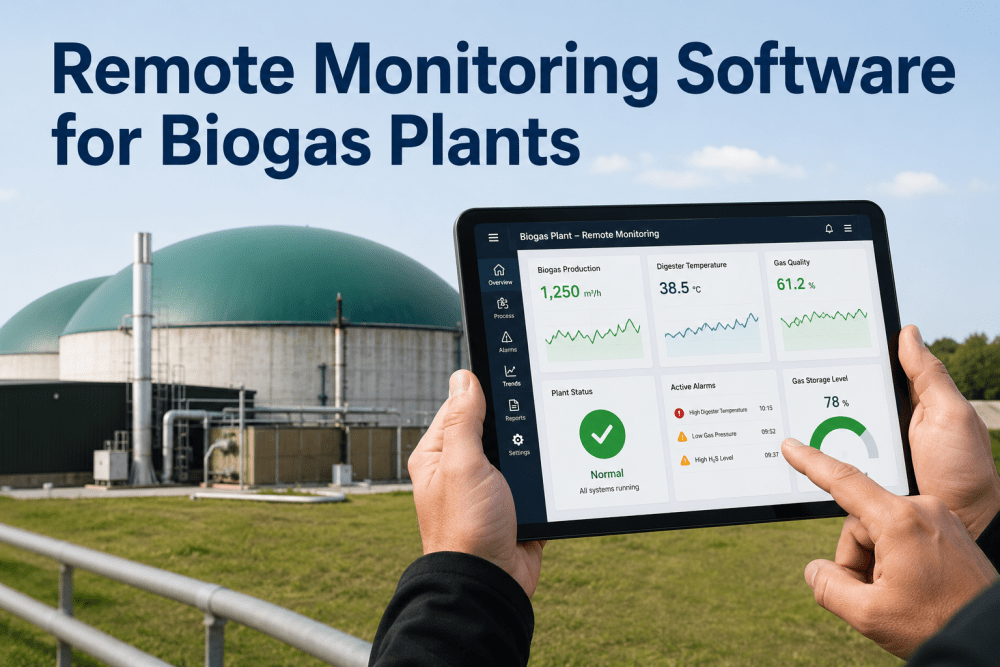
Running a biogas plant without intelligent remote oversight is like flying blind — you only discover problems after they have already cost you hours of downtime and thousands in lost gas production. AI-driven SCADA integration brings every PLC, sensor, and controller across your facility into a single intelligent layer that watches, learns, and acts in real time. Instead of dispatching technicians for every temperature fluctuation or pressure anomaly, operators gain secure remote control over digesters, CHP engines, flare systems, and gas upgrading units from any device, anywhere. The result is fewer emergency callouts, faster response to process deviations, and biogas yields that steadily climb as the AI optimizes what manual monitoring never could. Schedule a free consultation to see how SCADA integration can reshape your biogas operations.
Why Biogas Operators Are Shifting to AI-Powered SCADA Systems
Biogas facilities are uniquely complex — living biological processes that shift with feedstock quality, ambient temperature, and microbial health. Legacy SCADA setups display raw data and trigger alarms, but they cannot interpret patterns, predict failures, or correlate variables across subsystems. AI-driven platforms close this intelligence gap by layering machine learning on top of your existing PLC infrastructure, transforming passive monitoring into proactive plant management that learns your operation's rhythms and flags deviations before they become breakdowns.
What AI Adds to Traditional SCADA in Biogas
Predictive Biology Alerts
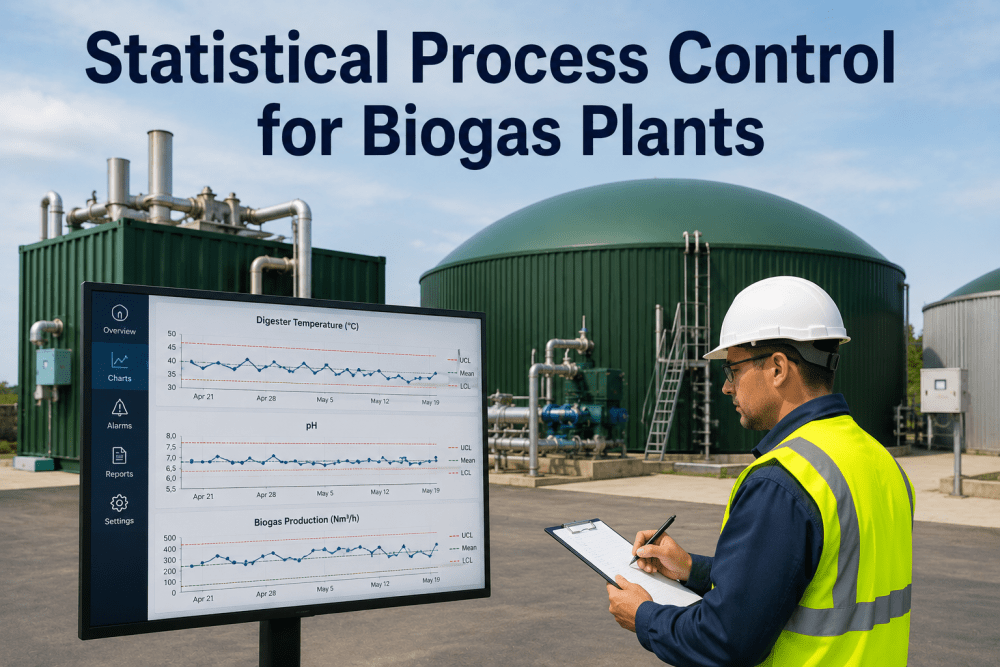
AI monitors pH, VFA/alkalinity ratios, and gas composition trends simultaneously — spotting digester upsets 48 to 72 hours before conventional alarms would fire, giving operators time to adjust feed recipes remotely.
Autonomous Setpoint Optimization
Rather than relying on fixed thresholds, the AI continuously recalculates optimal operating parameters for mixing intensity, heating loops, and gas engine load based on real-time digester conditions and weather data.
Cross-System Correlation
Traditional SCADA monitors each subsystem in isolation. AI correlates feedstock deliveries with gas quality shifts, engine exhaust anomalies with methane content drops, and foam events with mixing schedules — revealing root causes invisible to siloed views.
Stop reacting to alarms. Start predicting them. See how AI-driven SCADA gives your team remote visibility and control over every biogas process — before issues impact production.
How PLC-to-Cloud Connectivity Works for Biogas Facilities
The foundation of AI-driven SCADA is a reliable data pipeline from your field-level PLCs to a cloud or hybrid analytics platform. Modern edge gateways bridge the gap between legacy industrial protocols and IP-based communication, letting you keep existing Siemens, Allen-Bradley, Schneider, or ABB controllers while gaining centralized intelligence and remote access. Here is the architecture that makes it work.
Existing PLCs communicate via Modbus TCP/RTU, OPC-UA, Profinet, and HART protocols. No hardware replacement needed — edge gateways handle protocol translation automatically.
Edge Layer
Industrial Edge GatewayLocal Data BufferSafety Interlock Firewall
Edge computers aggregate data from hundreds of I/O points, perform initial anomaly filtering, and buffer data during network outages. Critical safety interlocks remain hardwired locally and cannot be overridden remotely.
Intelligence Layer
AI Analytics EnginePredictive ModelsUnified DashboardRemote Control Interface
Machine learning models trained on biogas-specific operational data deliver real-time anomaly detection, consumption forecasting, and optimization recommendations. Operators access everything through a secure web dashboard with role-based controls and full audit logging. Get Support to unify your biogas PLC data into one intelligent dashboard across all your facilities.
Real-Time Digester Monitoring Without Constant On-Site Staff
Anaerobic digesters are the biological heart of every biogas plant — and also the most unpredictable component. Gas composition shifts, foam events, temperature stratification, and acidification can develop rapidly and destroy weeks of biological stability. AI-driven SCADA transforms digester management from reactive babysitting into data-driven remote oversight by tracking dozens of interdependent variables simultaneously and alerting operators only when intervention is genuinely needed.
Biological Health Index
AI calculates a composite biology score from pH, VFA, alkalinity, ammonia, and gas composition — giving operators a single number that represents digester stability instead of forcing them to interpret six separate trend lines.
Gas Yield Trend Analysis
Continuous methane output tracking normalized against feedstock input. AI detects yield declines within hours rather than days, correlating drops with specific feed batches, temperature deviations, or mixing interruptions.
Foam Detection and Prevention
Ultrasonic level sensors and AI pattern recognition identify foam formation in early stages. Automated responses adjust mixing speed or activate anti-foam dosing remotely — preventing overflow without sending anyone to site.
Temperature Stratification Alerts
Multi-point temperature profiling inside the digester catches hot and cold zones that indicate mixing failures or heating loop issues. AI triggers corrective actions before mesophilic or thermophilic bacteria are stressed.
Your digesters are generating thousands of data points every minute. See how AI turns that flood of raw numbers into clear, actionable intelligence you can act on remotely — with real-time digester monitoring built for biogas operators.
Predictive Maintenance for CHP Engines and Gas Upgrading Equipment
CHP gas engines and gas upgrading systems are the revenue-generating assets of a biogas plant — when they go down, income stops immediately. AI-driven SCADA shifts engine and upgrading maintenance from calendar-based schedules to condition-based predictions, monitoring vibration signatures, exhaust temperature profiles, oil quality indicators, and membrane pressures in real time to forecast failures weeks before they occur.
CHP Engine Intelligence
Vibration Pattern Analysis — AI baselines each engine's unique vibration signature and detects bearing wear, misalignment, or combustion irregularities months before catastrophic failure.
Exhaust Temperature Mapping — Cylinder-by-cylinder exhaust monitoring identifies uneven combustion linked to gas quality changes, allowing remote fuel-air ratio adjustments.
Oil Degradation Tracking — Continuous oil condition monitoring extends change intervals where safe and flags accelerated degradation early, reducing both waste and risk.
Gas Upgrading Oversight
Membrane Performance Tracking — AI monitors methane purity, pressure differentials, and methane slip rates to detect membrane degradation before grid injection quality drops.
H2S Removal Efficiency — Real-time desulfurization monitoring prevents both engine corrosion and off-spec gas, with automated alerts when carbon bed or chemical dosing needs attention.
Compressor Health Scoring — Continuous assessment of compressor vibration, temperature, and power draw flags developing issues before they force an unplanned shutdown.
Reducing Site Visits: The Operational and Financial Case
Every unscheduled site visit costs time, fuel, and labor — often for issues that could have been diagnosed or resolved remotely. AI-driven SCADA integration dramatically reduces the need for physical presence by enabling secure remote diagnostics, setpoint changes, and equipment control. The operational savings compound rapidly, especially for operators managing multiple distributed facilities.
70%
Reduction in routine site visits through remote monitoring and AI-automated parameter adjustments
<30s
Average response to critical process deviations — versus 2 to 4 hours with manual on-site response
45%
Decrease in unplanned downtime through predictive fault detection and automated corrective sequences
12%
Increase in average biogas yield achieved through continuous AI-driven feedstock and process optimization
Before and After AI-SCADA Integration
Before: Manual SCADA Operations
Operators physically present 24/7 at each site
Alarm floods of 200+ daily alerts, most non-actionable
Digester upsets discovered after gas yield has already dropped
Engine maintenance on fixed calendar schedules regardless of condition
Separate data silos per site with no portfolio-level view
15-25 hrs/weekon-site monitoring per facility
After: AI-Driven SCADA Integration
One remote operator oversees 3-5 sites from a central screen
AI-filtered alerts averaging 8-12 meaningful notifications per day
Biology upsets predicted 48-72 hours before visible impact
Condition-based maintenance driven by real-time equipment health data
Unified portfolio dashboard with cross-site benchmarking
3-5 hrs/weekremote oversight per facility
Manage multiple biogas plants from a single control room. Eliminate unnecessary site visits, reduce emergency callouts, and let your team focus on optimization instead of fire-fighting.
Cybersecurity and Safety in Remote Biogas SCADA Operations
Remote access to industrial control systems raises legitimate security concerns. AI-driven SCADA platforms address these through layered defense architectures that protect both data integrity and physical plant safety — ensuring that remote convenience never compromises operational security.
Encrypted VPN Tunnels
All remote communications travel through AES-256 encrypted VPN connections with certificate-based authentication. No PLC data ever traverses the public internet unprotected.
Hardwired Safety Interlocks
Emergency shutdowns, gas detection responses, and pressure relief remain hardwired at the local PLC level. These critical safety functions operate independently and cannot be overridden remotely under any circumstances.
Role-Based Access and Audit Trails
Multi-factor authentication and granular role permissions ensure only authorized personnel can execute control actions. Every setpoint change, acknowledgment, and login is logged with timestamps for full regulatory traceability.
Network Resilience
Edge gateways buffer all data locally during connectivity loss and synchronize automatically when links restore. Local PLC logic and safety systems continue operating independently, ensuring zero production impact from network interruptions.
Getting Started: From Legacy SCADA to AI-Driven Remote Control
Transitioning to AI-driven SCADA does not require ripping out your existing control infrastructure. The integration process works with your current PLCs, sensors, and field instruments — adding an intelligence layer on top rather than replacing what already works. Most biogas facilities complete the transition within 6 to 8 weeks while maintaining full production throughout.
Integration Deployment Phases
1
Week 1-2
Discovery and Mapping
Full audit of existing PLC hardware, communication protocols, sensor inventory, and network topology. Integration architecture designed around your specific equipment and security requirements.
2
Week 3-4
Edge Deployment and Connectivity
Industrial edge gateways installed, protocol bridges configured, VPN tunnels established. PLC data flows into the cloud platform while existing control logic remains untouched.
3
Week 5-6
AI Calibration and Baselining
Machine learning models ingest historical and real-time data to establish operational baselines for your specific digesters, engines, and processes. Anomaly detection thresholds are tuned to minimize false positives.
4
Week 7+
Live Remote Operations
Full remote monitoring and control activated. AI predictions go live, automated response sequences enabled, and the dashboard is rolled out to all authorized operators. Get Support to start building your SCADA integration roadmap with a customized deployment plan for your facility.
We operated three biogas plants with eight rotating operators. After deploying AI-driven SCADA, two remote operators now manage all three sites from a centralized control room. Alarm noise dropped by 85 percent, digester biology issues are caught days earlier, and our CHP engine uptime went from 89 to 97 percent in the first six months.
— Biogas Portfolio Operations Director, Northern Europe
Transform Your Biogas Plant Into a Remotely Managed, AI-Optimized Operation
Every minute your digesters, engines, and gas systems generate data that could be driving better decisions. AI-driven SCADA integration captures that intelligence, predicts problems before they cost you production, and gives your team secure remote control from anywhere — turning reactive operations into continuously optimized performance.
Can AI-driven SCADA connect with our existing PLCs and field instruments?
Yes. The integration layer uses open industrial protocols including OPC-UA, Modbus TCP/RTU, Profinet, and HART to communicate with virtually any PLC brand — Siemens, Allen-Bradley, Schneider, ABB, and others. Your existing sensors and control hardware stay in place; edge gateways handle all protocol translation. There is no need to replace or reprogram your current controllers. Schedule a compatibility assessment for your specific equipment.
Is it safe to control biogas plant equipment remotely?
Absolutely. All remote commands pass through encrypted VPN tunnels with multi-factor authentication and role-based access controls. Critical safety interlocks — emergency shutdowns, gas detection, and pressure relief — remain hardwired at the local PLC level and cannot be overridden from the remote interface. Every operator action is logged with a full audit trail for compliance and accountability.
What happens if internet connectivity between the site and the cloud platform drops?
Edge gateways are built for resilience. During connectivity interruptions, all local PLC logic, safety systems, and basic control sequences continue running independently on-site. The edge device buffers all process data locally and synchronizes automatically once the connection restores — no data is lost. Critical alerts can also route through cellular backup channels to ensure operators are always informed.
How quickly does the AI start delivering useful predictions?
You will see value from the unified remote dashboard and centralized alarm management immediately upon going live. AI-driven anomaly detection typically begins delivering actionable insights within 30 to 60 days as models learn your specific operational patterns. Full predictive capabilities for digester biology, engine health, and process optimization generally mature within 3 to 4 months. Get Support to get AI-driven predictions running on your biogas plant and see results within the first month.
Can one control room manage multiple biogas sites simultaneously?
Yes — multi-site management is a core design principle. A single operator can monitor and control multiple plants from one unified dashboard, with portfolio-level KPI comparisons, site-specific drill-downs, and cross-site benchmarking that highlights performance gaps and best practices. AI models also learn from the entire portfolio, applying insights from top-performing plants to improve underperformers. Book a demo to experience multi-site SCADA control firsthand and see how one operator can manage your entire biogas portfolio.