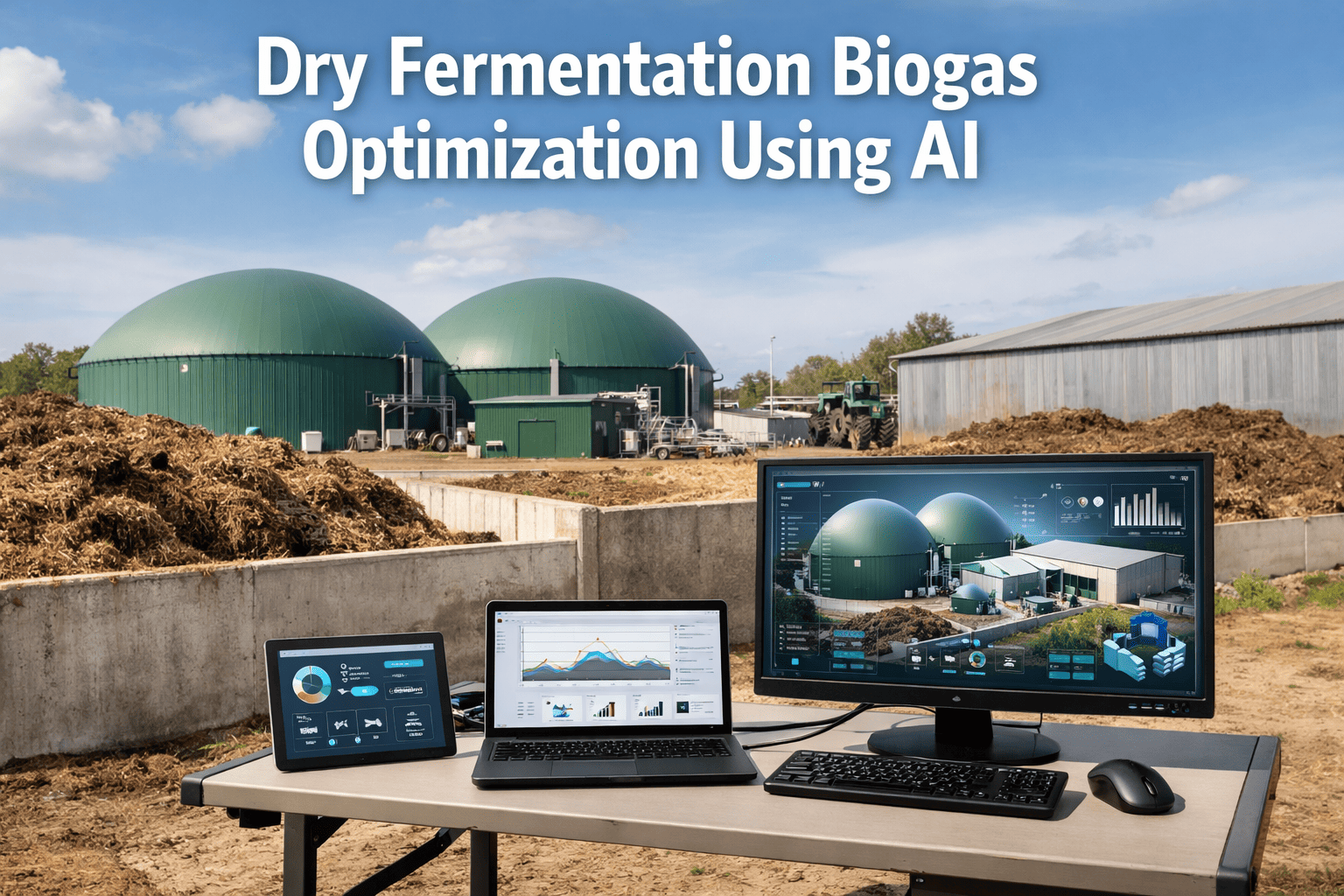
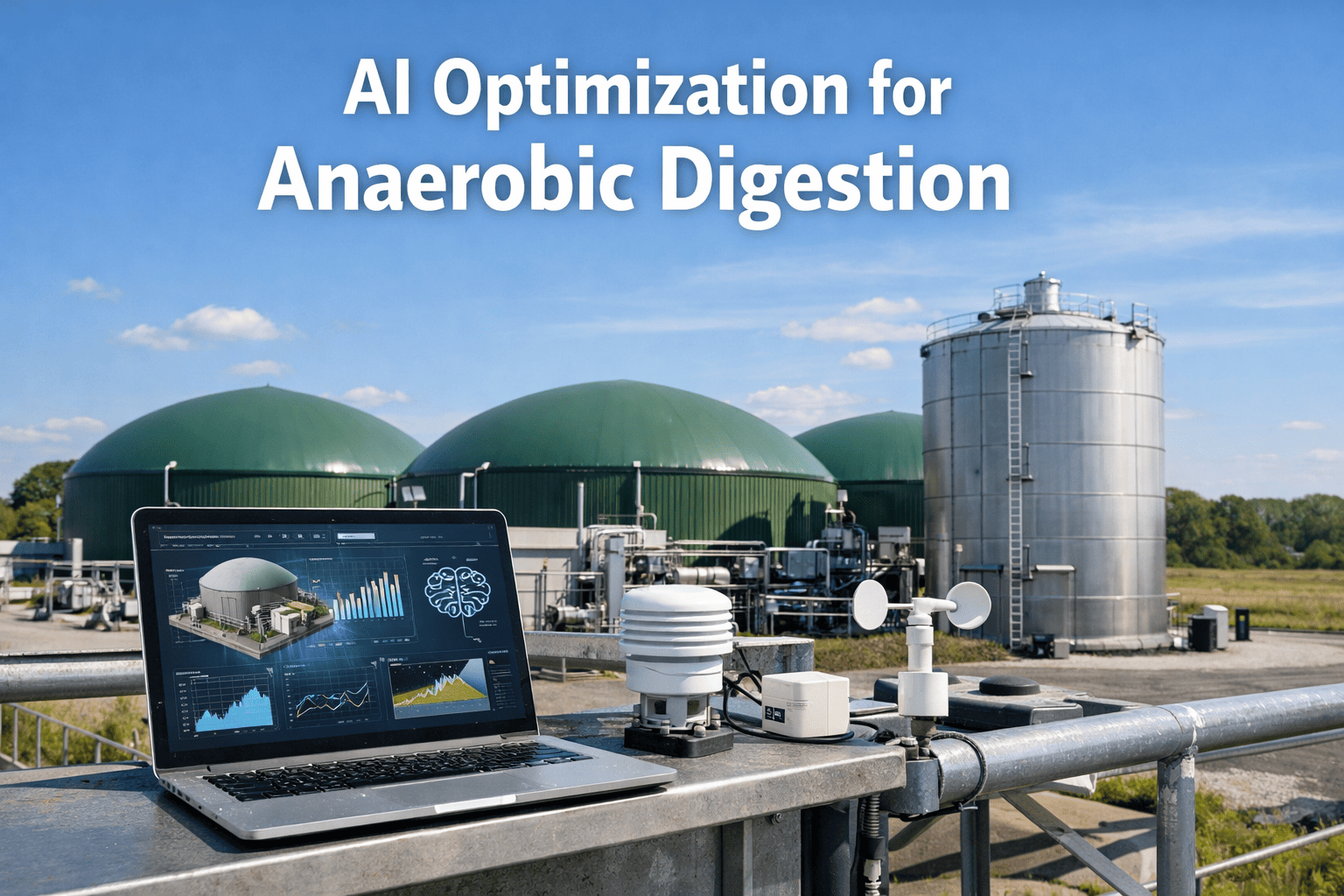
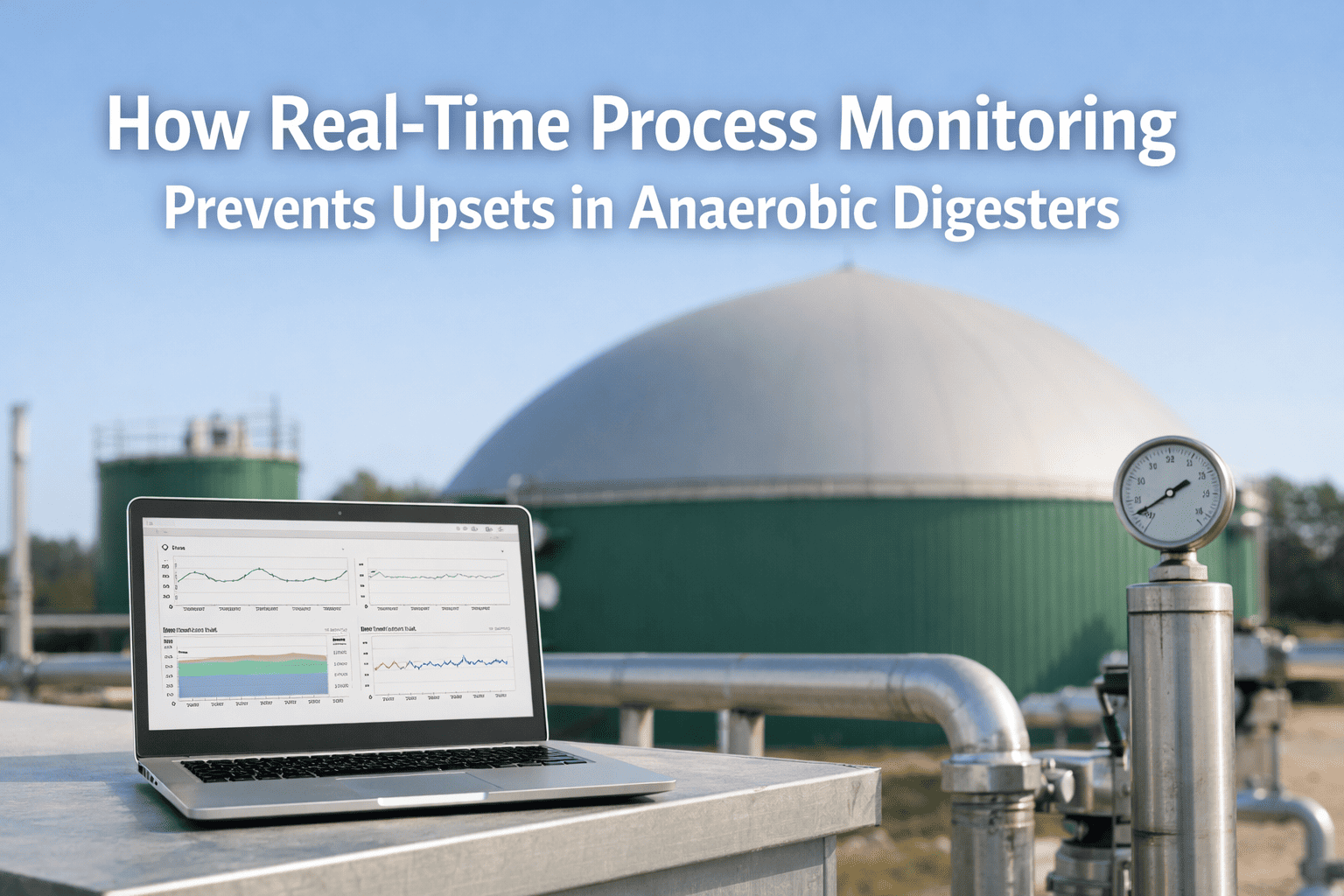
Biogas plants worldwide leave up to 30% of their methane potential on the table, not because the biology fails, but because operators lack real-time visibility into what their digesters are doing. AI and data analytics are closing that gap. By connecting IoT sensors, machine learning models, and predictive algorithms directly to the anaerobic digestion process, operators can now forecast yield shifts days in advance, fine-tune feedstock recipes automatically, and catch instabilities before they escalate into costly shutdowns. Explore how AI-driven analytics can maximize methane output at your facility with a free expert walkthrough.
How AI Predicts and Prevents Biogas Yield Loss
Yield loss in anaerobic digestion rarely happens overnight. It builds silently through subtle shifts in pH, volatile fatty acid accumulation, temperature drift, and feedstock inconsistencies that manual sampling catches too late. AI-powered analytics platforms change this equation entirely by learning the unique microbial and operational fingerprint of each digester and flagging deviations the moment they begin.
Machine learning models trained on historical plant data can now predict biogas output with correlation coefficients above 0.92, identifying the specific operational variables most responsible for yield fluctuations. Research demonstrates that neural network models have improved biogas productivity by over 40% at test facilities by calculating optimal daily feeding patterns. These models do not replace operator expertise; they amplify it by surfacing hidden patterns across thousands of data points that no human could track simultaneously.
0.98
Correlation coefficient achieved by advanced deep learning models in predicting biogas output from operational parameters
43%
Increase in daily biogas productivity demonstrated through AI-optimized feeding patterns at plant-scale facilities
<15 min
Anomaly detection speed for process deviations, compared to days or weeks using periodic lab sampling
Ready to stop losing methane to invisible process drift?
Join operators who use predictive analytics to catch yield loss before it reaches the gas meter, not after.
Get Support
Real-Time Digester Monitoring: IoT Sensors Meet Machine Learning
The foundation of any AI analytics system is continuous, high-resolution data from the digestion process. Modern IoT sensor networks installed across digesters, gas lines, and feedstock systems capture temperature, pH, gas composition, pressure, flow rates, and substrate characteristics at intervals as short as every five seconds. This data feeds directly into machine learning pipelines that transform raw measurements into actionable intelligence.
What Sensors Capture
pH and Temperature: Measured every 30-60 seconds to detect thermal drift and acidification risk before microbial communities are disrupted
Volatile Fatty Acids: Online VFA sensors provide 15-minute readings, the single most important early warning for digester instability
Gas Flow and Composition: Methane percentage and total flow measured continuously to track energy value and detect production anomalies
H2S and CO2 Levels: Gas quality monitoring protects downstream CHP engines and ensures compliance with grid injection standards
What AI Does With It
Pattern Recognition: ML algorithms identify correlations between feeding events, temperature shifts, and gas output across weeks of operational history
Anomaly Detection: Adaptive baselines learn your digester's normal behavior and flag deviations within minutes, not days
Predictive Alerts: Forecast VFA spikes, pH crashes, and yield drops 24-72 hours before they reach critical thresholds
Automated Optimization: Recommend or auto-adjust feed rates, mixing intensity, and heating to maintain peak biological activity
Recent research confirms that sub-hourly SCADA data outperforms daily lab analysis for biogas prediction, offering higher resolution and sample sizes over 175 times larger. The takeaway is clear: continuous digital monitoring is not just faster than manual sampling, it is fundamentally more accurate. Get started with real-time digester monitoring for your plant and see sensor-driven analytics in action.
Feedstock Optimization Through Predictive Analytics
Feedstock variability is the single largest source of biogas yield inconsistency. Substrate composition changes daily based on supply chain conditions, seasonal availability, and waste stream quality. AI analytics transforms this unpredictability from a liability into an optimization opportunity by modeling the methane potential of every incoming feedstock batch and recommending ideal blending ratios in real time.
01
Substrate Characterization Modeling
ML models analyze volatile solids, C/N ratio, moisture content, and biochemical methane potential data to predict gas yield per ton for each feedstock type. Studies show that co-digestion can boost yields by 25-400% compared to single-substrate digestion when ratios are optimized correctly.
02
Dynamic Recipe Adjustment
Rather than following fixed feeding schedules, AI calculates the optimal daily blend based on current digester biology, incoming substrate quality, and target methane output. Feed volume and composition adjust dynamically as conditions change.
03
Loading Rate Optimization
Organic loading rate is one of the most critical parameters for digester stability. Predictive models determine the maximum safe loading for current conditions, pushing production higher without triggering acidification or foaming events.
04
Digital Twin Simulation
Before applying changes to a live digester, virtual replicas simulate the impact of new feedstock combinations, temperature adjustments, and retention time modifications. This eliminates costly trial-and-error experimentation on operational equipment.
See how predictive feedstock analytics works in practice.
Book a walkthrough and we will demonstrate real-time recipe optimization using your plant's actual substrate profile.
Book a Demo
Manual vs. AI-Driven Biogas Operations: What Actually Changes
Transitioning from conventional plant management to AI-driven operations is not about replacing operators with algorithms. It is about giving experienced teams tools that extend their reach far beyond what periodic lab reports and daily walk-throughs can achieve. Here is what that shift looks like in practice.
Conventional Plant Management
Weekly Lab sampling with 2-5 day turnaround for results
Reactive Problems discovered after yield has already dropped
Fixed Feeding schedules unchanged regardless of conditions
Siloed Data trapped in spreadsheets and paper logs
Estimated Yield predictions based on historical averages
60-70%
of methane potential typically realized
AI-Powered Analytics Operations
Continuous Sensor readings every 5-60 seconds with instant analysis
Predictive Anomalies flagged 24-72 hours before impact
Dynamic Feed rates adjusted based on live digester biology
Connected Centralized dashboards with automated reporting
Modeled ML forecasts calibrated to your plant's unique patterns
85-95%
of methane potential with continuous optimization
Close the Gap Between Current Output and Maximum Methane Potential
AI analytics does not replace your team. It gives them the real-time visibility and predictive intelligence they need to push every digester closer to its theoretical maximum, every day, without guesswork.
Measurable Impact: Yield Gains, Downtime Reduction, and Cost Savings
The business case for AI-driven biogas analytics rests on quantifiable improvements across multiple operational dimensions. Facilities that have deployed intelligent monitoring consistently report higher gas output, fewer process disruptions, and reduced labor costs for reporting and compliance.
Biogas Yield Increase
20-43%
AI-optimized feeding patterns and process parameters deliver sustained yield improvements over manual operation
Prediction Accuracy
85-98%
Machine learning models achieve high correlation with actual biogas output, enabling reliable energy dispatch planning
Unplanned Downtime Reduction
35-50%
Predictive maintenance and early anomaly detection prevent equipment failures and process upsets
Reporting Time Savings
55-70%
Automated compliance reporting and carbon accounting reduce manual data collection and report generation effort
Model the ROI for your specific operation.
Create a free account and our engineering team will calculate projected yield gains and payback period based on your plant data.
Get Support
Step-by-Step: Deploying AI Analytics at Your Biogas Facility
Successful deployment follows a phased approach designed to deliver measurable value quickly while building toward full intelligent plant management. Most facilities see initial yield improvements within the first 30 days.
Week 1-3
Baseline Audit and Data Mapping
Comprehensive assessment of current digester performance, existing sensor infrastructure, and data availability. Engineers establish yield baselines and identify the highest-impact monitoring gaps to address first.
Week 4-6
Sensor Installation and Data Pipeline
Deploy IoT sensors on critical monitoring points. Connect edge computing hardware, validate data flows, and establish secure connections to your SCADA and plant control systems. No existing infrastructure needs replacing.
Week 7-9
Model Training and Calibration
Import historical operational data and train ML models on your plant's specific microbial and process patterns. Calibrate anomaly detection thresholds and validate prediction accuracy against real production data.
Week 10+
Live Optimization and Continuous Learning
The nonlinear and dynamic nature of biogas production makes conventional modeling less effective. Machine learning addresses this by learning directly from operational data, capturing complex relationships between feedstock, process conditions, and gas output that deterministic models miss entirely. Plants that embrace this shift move from hoping for good performance to engineering it.
-- Biogas Process Engineering Review, 2025
Turn Digester Data into Sustainable Yield Gains
Your weekly lab reports cannot detect a VFA spike building 48 hours from now or calculate whether switching 15% of your feedstock blend would boost methane output by 12%. AI-driven analytics can. Connect your sensors, train your models, and start operating every digester at its biological maximum, continuously and automatically.
Frequently Asked Questions
How quickly will AI analytics improve biogas yield at our plant?
What sensors and infrastructure do we need to get started?
AI analytics can start delivering value with basic instrumentation like temperature, pH, and gas flow sensors. Additional parameters such as online VFA measurement, H2S monitoring, and methane composition unlock deeper optimization layers. We recommend a phased sensor deployment that prioritizes monitoring points with the highest yield impact potential.
Can machine learning handle the variability in our feedstock supply?
Does this integrate with our existing SCADA and plant control systems?
Yes. AI analytics platforms connect through standard industrial protocols including Modbus, OPC-UA, and MQTT. Integration with existing SCADA, CMMS, and plant historians enables automated data collection without replacing any current infrastructure. The analytics layer works alongside your existing controls, adding predictive intelligence on top.
How accurate are AI predictions for biogas production?
Published research shows machine learning models achieving R-squared values between 0.85 and 0.98 for biogas yield prediction at industrial-scale facilities. Prediction accuracy improves continuously as models train on more data from your specific plant. Hybrid models that combine neural networks with optimization algorithms consistently outperform standalone approaches.
See real prediction accuracy benchmarks from plants similar to yours in a live walkthrough.