Every biogas digester is a continuous biological process where mechanical mixing is the most critical operational variable separating healthy methane production from process instability.Digester mixer monitoring — applied across submersible mixers, top-entry agitators, side-entry propellers, and gas injection mixing systems simultaneously — is the operational intelligence layer that converts raw vibration, motor current, and torque data into the kind of actionable insight that drives measurable improvements in gas yield, energy efficiency. This guide covers the complete monitoring methodology for modern biogas digester mixing systems and how iFactory AI's platform delivers continuous, automated performance monitoring that gives plant engineers the mixing visibility that manual data collection simply cannot match.
Why Digester Mixer Monitoring Is Structurally Different from Rotating Equipment Monitoring
The analytical challenge in digester mixer monitoring is fundamentally different from monitoring a pump or a fan in a clean industrial environment — and applying standard rotating equipment monitoring methodologies to digester mixers produces incomplete, often misleading results. In a clean environment pump or fan, the monitored medium does not attack the equipment. The vibration signature changes gradually over time as bearings wear, and the failure progression is predictable. In a digester, every element of the mixer is operating in a hostile biological environment that accelerates degradation mechanisms in ways that standard monitoring models do not account for.
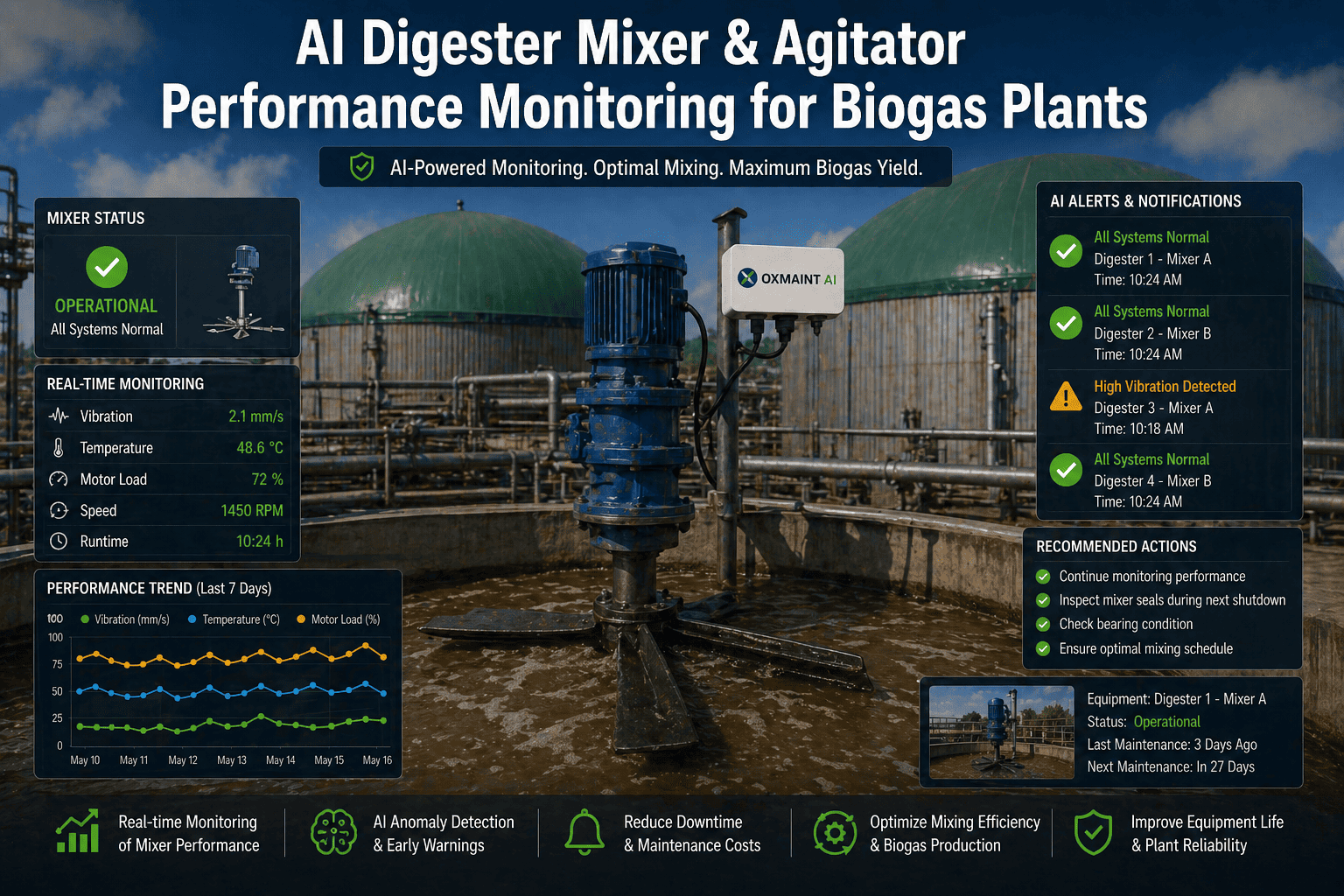
iFactory's digester mixer monitoring engine ingests vibration, motor current, torque, and thrust data at sub-minute resolution while simultaneously correlating with digester chemistry — volatile fatty acid concentration, total solids, ammonia level — to distinguish between mechanical degradation and process-driven load changes. Book a Demo to Monitor Performance
- Mixer failure detected by gas production drop — hours after biological stratification began
- Bearing replacement scheduled by calendar interval, ignoring actual seal condition
- Impeller balance assessed only during out-of-tank service — months between checks
- Seal failure discovered via oil-in-digestate contamination found in lab analysis
- Motor load increase attributed to "thicker digestate" — actual bearing drag missed
- Gas injection nozzle clogging detected by pressure rise — after flow distribution degraded
- Bearing vibration trend acceleration flagged 14-30 days before failure threshold
- Seal health monitored via oil moisture sensor and motor current signature — replacement planned
- Impeller balance tracked continuously via vibration spectral analysis — service scheduled by condition
- Seal failure predicted 5-12 days before breach — digester drain-down avoided
- Motor current trend correlated with digestate viscosity — bearing drag isolated from process load
- Nozzle back-pressure trend identifies clogging 3-7 days before flow distribution impact
Submersible Mixer Monitoring: Bearing, Seal, and Impeller Health Tracking
Submersible mixers are the most common mixing equipment type in continuously stirred tank reactor (CSTR) digesters, and they operate under the most challenging conditions of any digester asset. The biological impact of losing one mixer on a multi-mixer digester is felt within hours in the gas production trend. iFactory's submersible mixer monitoring operates at the bearing, seal, and impeller level simultaneously, providing the advance warning needed to schedule out-of-tank service during planned downtime rather than emergency response. Book a Demo to Monitor Submersible Mixers
Top-Entry and Side-Entry Agitator Monitoring: Thrust Load and Gearbox Analytics
Top-entry and side-entry agitators face a different reliability challenge than submersible mixers. Side-entry agitators, mounted through a nozzle in the digester wall at a 7-15° downward angle, experience cantilever beam loading that subjects the internal gearbox bearings to combined radial and axial forces not present in vertical shaft configurations.
iFactory's top-entry and side-entry monitoring module tracks gearbox health, shaft deflection, and thrust load patterns with a sensor configuration tailored to each agitator type. For top-entry units, the platform monitors gearbox vibration and oil condition combined with motor current and torque — correlating thrust load changes with digester feeding events to distinguish between process-driven load variation and gearbox degradation. For side-entry units, the platform adds radial load monitoring on the gearbox output bearing, which is the most common failure point in this agitator configuration. The correlation between thrust load and gas production rate is tracked continuously to identify mixing effectiveness degradation before it affects methane yield — providing the biological performance insight that mechanical monitoring alone cannot deliver. Schedule a top-entry agitator assessment
Gas Injection Mixing Systems: Nozzle Fouling and Bubble Distribution Analytics
Gas injection mixing systems — where compressed biogas is injected through a ring of nozzles at the bottom of the digester to create bubble-driven circulation — represent a fundamentally different monitoring challenge than mechanical agitators. There are no bearings, seals, or rotating components to monitor.
a progressive pressure increase indicating scale buildup on the nozzle orifice. When individual nozzles require cleaning, the platform identifies the specific nozzle ring segment and estimates the cleaning urgency based on the pressure trend acceleration rate. This nozzle-level targeting eliminates the need to drain the digester to inspect the injection ring and enables cleaning to be scheduled during planned feedstock gaps rather than driven by yield decline. Book a Demo for Gas Injection Systems
Frequently Asked Questions: Digester Mixer Monitoring
For submersible mixers installed in a guide rail system, sensors can be installed during a planned mixer extraction — the mixer is pulled from the digester using the guide rail system, sensors are attached to the mixer housing and cable assembly, and the unit is re-deployed in the normal service cycle. Typical sensor fit includes a tri-axial accelerometer (magnetic mount or stud-mounted) on the motor housing, an oil moisture sensor in the seal chamber, and an RTD temperature probe.
This is the central analytical challenge in digester mixer monitoring — and the reason power-only monitoring approaches produce unacceptable false alarm rates in variable-feedstock biogas operations. iFactory's platform addresses this through multi-parameter correlation. When motor power increases, the platform simultaneously checks: (1) digester total solids content — if solids increased, the power rise is expected process load; (2) digestate viscosity from in-line sensors or inferred from mixing torque at constant speed; (3) vibration levels at bearing defect frequencies — mechanical degradation produces vibration changes that process load variation does not;
iFactory's platform is OEM-agnostic and supports all major submersible mixer manufacturers used in biogas digester applications including Xylem (Flygt), Sulzer (ABS), KSB (Amarex, Salmson), Wilo (FA, FKT series), ITT (Goulds), and Hidrostal. For top-entry and side-entry agitators, the platform supports Chemineer, Philadelphia Mixing Solutions, Ekato, Mixel, Sharpe Mixers, and Greaves. Connection to the mixer's motor terminal box, VSD, or junction box provides motor current, power, and temperature data. Vibration sensors are typically added as retrofit components.
Yes — and hybrid mixing systems (mechanical agitators plus gas injection in the same digester) present one of the most valuable monitoring opportunities because the interaction between the two mixing mechanisms produces diagnostic information that neither system alone would provide. For example, a developing temperature gradient in a digester with both mechanical mixing and gas injection tells a different story depending on which mixing system is active at the time
iFactory's digester mixer monitoring deployments typically reach full cost recovery within 6 to 14 months of deployment, with the fastest payback cases occurring when the platform detects a developing submersible mixer bearing failure in the first 60 days — enabling a planned extraction and service during a scheduled feedstock gap rather than an emergency digester draw-down and crane mobilization.
Conclusion: The Monitoring Layer Your Digester Mixing System Is Missing
The gap between what a digester's mixing system is capable of delivering and what it actually delivers on any given day is a data problem before it is an equipment problem. Submersible mixers that could run 18 months between services are being pulled every 6 months on a conservative fixed schedule. Top-entry gearboxes that are developing bearing wear are identified only when the vibration is audible from the catwalk
iFactory's digester mixer monitoring platform brings bearing-level vibration analysis, seal integrity tracking, process-correlated load monitoring, and gas injection system analytics to biogas operations that have been managing these critical assets on fixed schedules and subjective observations. The result is a mixing system that runs closer to its design capability, produces fewer biological stratification events, spends less on unplanned maintenance, and delivers more methane per tonne of volatile solids fed — with no digester modifications and no digester downtime required to begin monitoring. The vibration data, motor current, and process chemistry are already there. The analytics just needs to be applied to it.