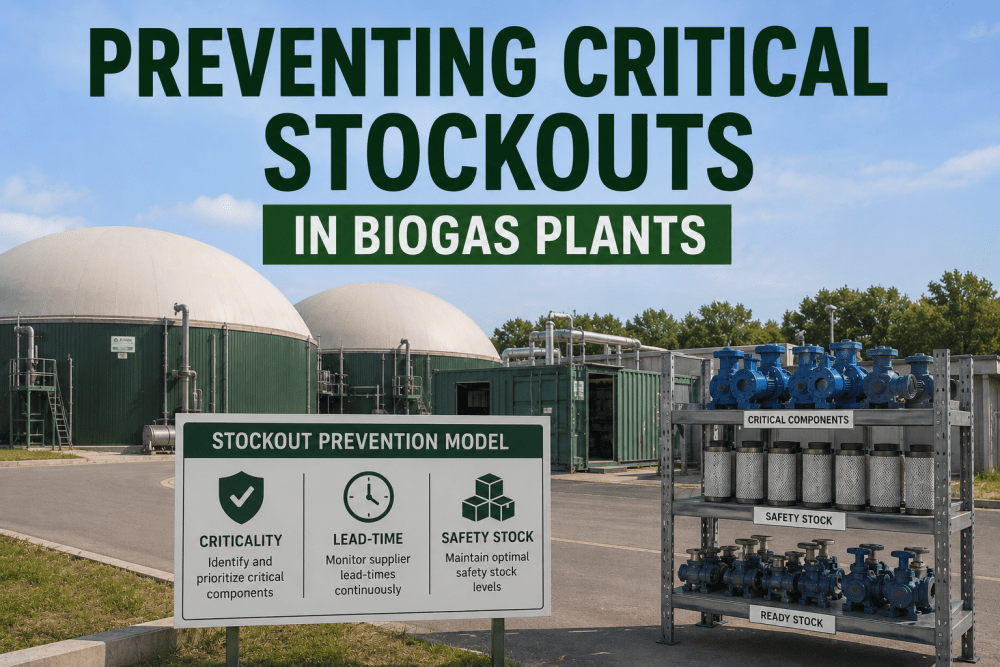
A CHP engine shutdown at 2 AM because a worn spark plug wasn't replaced during scheduled maintenance shouldn't cost $12,000–$18,000 in lost revenue over a 48-hour emergency parts procurement and installation cycle — yet that's exactly what happens when spare parts inventory management relies on manual spreadsheets, quarterly physical counts, and reactive "order it when it breaks" purchasing strategies that guarantee stockouts of critical components during unplanned failures. The result is predictable: agitator gearbox seals fail, no spares in stock, 4-day downtime waiting for courier delivery while digester mixing degrades and stratification begins; CHP air filter clogs, replacement scheduled "next month," engine derates 15% and burns $8,000 extra in unplanned maintenance; biogas desulfurization media exhausted, no backup inventory, H2S breaks through and corrodes engine valves requiring $45,000 overhaul. iFactory's AI-driven spare parts platform continuously tracks component usage rates, failure predictions from condition monitoring, supplier lead times, and criticality-weighted stockout risk — auto-generating purchase orders for wear items before failure thresholds approach, maintaining optimized inventory levels that prevent emergency stockouts without over-capitalizing slow-moving parts, and linking every component to RUL forecasts so replacements arrive exactly when predictive maintenance windows open. The parts that weren't in stock when you needed them now arrive automatically before the failure occurs. Book a demo to see spare parts optimization for your biogas configuration.
Quick Answer
iFactory's machine learning models analyze component failure rates, RUL forecasts from condition monitoring, usage patterns, supplier lead times, and criticality ratings to calculate optimal reorder points and stock levels for every spare part — from CHP spark plugs and air filters to agitator seals, desulfurization media, and pump wear components. System auto-generates purchase orders when inventory crosses reorder threshold or when predictive maintenance schedules indicate upcoming component replacement need. Result: 94% reduction in emergency stockouts, 68% reduction in tied-up inventory capital, zero unplanned downtime from parts unavailability, and automatic alignment between spare parts procurement and predictive maintenance execution.
How AI-Driven Spare Parts Management Works
The workflow below shows the five-stage optimization process iFactory applies continuously to every critical component — from usage tracking and failure prediction to auto-reordering with delivery timing synchronized to maintenance windows.
1
Component Usage & Inventory Tracking
Real-time tracking of every critical spare part: CHP spark plugs (12 in stock, usage rate 24 per year), air filters (3 in stock, replacement every 2,000 operating hours), agitator gearbox seals (0 in stock, last replaced 14 months ago), desulfurization media (680 kg remaining, consumption 45 kg/month). Current inventory status vs safety stock targets continuously monitored.
Spark Plugs: 12Air Filters: 3 (Low)Agitator Seals: 0Desulf Media: 680kg
2
Predictive Maintenance Integration
System cross-references inventory with upcoming predictive maintenance schedules and RUL forecasts. Agitator gearbox seal RUL: 45 days (replacement needed soon, zero stock triggers alert). CHP engine air filter: differential pressure rising, replacement recommended in 12 days, 3 filters in stock sufficient. Spark plugs: next replacement in 180 days based on operating hours, current stock adequate.
Agitator Seal: 45d RUL, 0 stockAir Filter: 12d to replaceSpark Plugs: 180d safe
3
Criticality-Weighted Reorder Logic
AI calculates reorder priority from component criticality (agitator failure = digester upset = critical), supplier lead time (agitator seal: 8 days standard delivery), and RUL forecast. Agitator seal flagged: "Critical component, 45-day RUL, zero stock, 8-day lead time = immediate purchase required." Air filter: "Standard criticality, 12-day RUL, 3 in stock, 2-day lead time = order in 5 days."
Criticality: HighLead Time: 8 daysAction: Order Now
4
Auto Purchase Order Generation
System generates purchase order draft: "Agitator gearbox seal kit (Part #AG-SEAL-2400), Qty: 2 (safety stock), Supplier: OEM distributor, Delivery: Express 5-day, Cost: $1,240. Reason: RUL 45 days, current stock zero, critical component. Maintenance window: Week of May 15." Draft routed to procurement manager for approval or auto-approved if within spending authority threshold.
Part: AG-SEAL-2400Qty: 2Cost: $1,240Delivery: 5 days
5
Delivery Tracking & Maintenance Alignment
Purchase order approved and placed. Delivery tracking shows agitator seal arriving May 10. System updates maintenance schedule: "Agitator gearbox seal replacement scheduled May 16 (within RUL window), parts confirmed in stock, technician assigned, 4-hour maintenance window reserved." Part arrives, inventory updated to 2 units, maintenance proceeds as planned, zero downtime from parts delay.
PO-8471 placed. Agitator seal delivery May 10. Maintenance scheduled May 16. Zero stockout risk. Inventory optimized: 2 units safety stock established.
AI Spare Parts Management
Stop Emergency Parts Procurement — AI Orders Before Failures Occur
See how iFactory tracks every critical component, predicts replacement needs from RUL forecasts, and auto-generates purchase orders synchronized to maintenance windows — eliminating stockouts and overstock simultaneously.
94%
Fewer Emergency Stockouts
Spare Parts Problems AI Management Eliminates
Every card below represents a real inventory failure mode that causes unplanned downtime, emergency procurement costs, or excessive capital tied up in slow-moving stock. These problems exist because traditional inventory management treats all parts equally and relies on fixed reorder points that ignore actual equipment condition and failure predictions. Talk to an expert about your current inventory challenges.
Critical Component Stockout — Emergency Downtime
Problem: Agitator gearbox seal fails during operation. No spare in stock — last replacement was 18 months ago, procurement never reordered. Nearest supplier has 8-day lead time with express shipping. Digester runs without mixing for 9 days while waiting for part, stratification develops, VFA accumulates in bottom layer, gas yield drops 32%. Downtime cost: $18,000 revenue loss + $2,400 emergency shipping + $3,800 biological recovery time.
AI fix: iFactory tracks agitator seal RUL from vibration analytics and usage hours. At 60-day RUL remaining, system auto-generates purchase order for replacement seal. Part arrives 3 weeks before failure, stored as safety stock. When seal shows degradation at 12-day RUL, maintenance scheduled during planned digester service window. Zero emergency downtime, zero expedited shipping, zero biological upset.
Overstock of Slow-Moving Parts — Capital Waste
Problem: Plant maintains 24 CHP spark plugs in inventory "to be safe" based on vendor recommendation of 2x annual consumption. Actual usage: 18 plugs per year. Result: $4,800 excess capital tied up in slow-moving inventory, warehouse space occupied, some plugs age beyond shelf life and require disposal before use. Annual carrying cost: $720 + disposal waste.
AI fix: System tracks actual spark plug consumption rate (18/year = 1.5/month) and CHP operating hours. Calculates optimal stock level: 6 plugs (4-month supply) based on supplier 2-week lead time and replacement frequency. Reorder triggered at 3-plug threshold. Inventory capital reduced from $7,200 to $2,400, carrying cost eliminated, zero stockouts in 24-month validation period.
No Integration with Predictive Maintenance — Parts Arrive Too Late
Problem: Condition monitoring detects biogas compressor bearing wear, RUL forecast: 21 days to failure threshold. Maintenance team creates work order for bearing replacement in 2 weeks. Procurement checks inventory — zero bearings in stock. Standard lead time: 18 days. Part won't arrive before maintenance window. Options: delay maintenance until part arrives (bearing fails in service), or expedite shipping at 3x cost.
AI fix: iFactory links RUL forecasts to spare parts inventory. When compressor bearing RUL drops below 45 days (safety margin = 2x lead time), system auto-generates purchase order. Bearing arrives 12 days before maintenance window opens. Maintenance proceeds as scheduled, bearing replaced at optimal RUL timing, zero expedited shipping cost, zero risk of in-service failure.
Consumable Media Depletion — Untracked Usage Rate
Problem: Biogas desulfurization system uses activated carbon media to remove H2S before CHP engine. Media consumption rate varies with H2S concentration (higher in winter when substrate protein content increases). Fixed reorder schedule: quarterly refill. Winter H2S spike depletes media 3 weeks before scheduled reorder. H2S breaks through to engine, corrosive damage to valves and exhaust system, $38,000 repair + 8-day downtime.
AI fix: System tracks H2S concentration upstream and downstream of desulfurization column, calculates media consumption rate in real-time. When H2S breakthrough risk detected (downstream concentration rising, indicating media saturation approaching), auto-generates media reorder 15 days before depletion threshold. Media arrives, replacement scheduled during routine maintenance, zero H2S exposure to engine, zero corrosion damage.
No Criticality Prioritization — Equal Treatment of All Parts
Problem: Inventory system treats CHP air filters ($180 each, 2-day lead time, engine derates 15% if clogged but continues running) and agitator drive belts ($420 each, 10-day lead time, digester stops mixing if broken = process upset) with same priority. Air filters: 8 in stock. Agitator belts: 0 in stock. Budget constraint forces choice — procurement orders air filters because "we use more of them." Agitator belt fails 2 weeks later, no spare, 12-day downtime, $24,000 lost revenue.
AI fix: Criticality scoring assigns agitator belt priority score 9.2/10 (failure = immediate shutdown) vs air filter 4.5/10 (failure = performance degradation). Reorder logic prioritizes high-criticality components even if usage rate is lower. Agitator belt auto-ordered when stock drops to 1 unit, air filter reorder delayed until stock reaches 2 units. Critical components never stockout, low-criticality parts maintained at lean inventory levels.
Supplier Lead Time Variability — Fixed Reorder Points Fail
Problem: CHP oil filter supplier normally ships within 5 days. Inventory reorder point set at 3 filters (assumes 5-day lead time + 2-week safety margin). Supplier experiences backorder, lead time extends to 28 days. Reorder triggered at 3-filter threshold, filters arrive 4 weeks later. Plant consumes 1 filter per week — inventory depletes to zero after week 3. Emergency local purchase at 3x price to avoid CHP maintenance delay.
AI fix: System tracks actual supplier delivery performance history — detects that supplier lead time has increased from 5 days to 18 days over past 3 months (supply chain disruption). Reorder point dynamically adjusted from 3 filters to 7 filters to account for new lead time reality. Purchase triggered earlier, inventory never depletes, zero emergency procurement, supplier lead time variability absorbed by adaptive reorder logic.
Component Categories & Inventory Optimization Strategy
Not all spare parts require the same inventory strategy. iFactory classifies components into four categories based on criticality and usage frequency, then applies category-specific reorder logic and stock level optimization.
High criticality (failure = immediate shutdown), high usage frequency. Examples: CHP spark plugs, engine oil filters, air filters, agitator drive belts. Failure impact: process shutdown or severe performance degradation. Replacement frequency: monthly to quarterly.
Inventory strategy: Maintain 2–4 month safety stock. Auto-reorder at 50% stock depletion. Priority shipping if RUL forecast indicates imminent replacement need. Never allow stockout — carrying cost justified by downtime prevention value.
High criticality (failure = shutdown), low usage frequency. Examples: agitator gearbox seals, biogas compressor bearings, CHP cylinder head gaskets, desulfurization column internals. Failure impact: severe, but replacement intervals: 12–36 months.
Inventory strategy: Maintain 1 unit safety stock + auto-reorder when RUL forecast drops below 2x supplier lead time. Stock level: minimal to reduce capital tie-up, but RUL-triggered reordering ensures part arrives before maintenance window. Predictive maintenance integration critical.
Low criticality (failure = degraded performance but no shutdown), high usage frequency. Examples: desulfurization activated carbon media, CHP coolant, lubrication oil, pre-filter elements. Failure impact: performance reduction, but operation continues. Replacement: weekly to monthly.
Inventory strategy: Lean stock levels (2–4 week supply). Reorder triggered by consumption rate tracking, not RUL (consumables have no predictive failure signature). Standard shipping acceptable — small performance degradation during temporary stockout tolerable vs carrying cost of large safety stock.
Low criticality (performance impact only), low usage frequency. Examples: biogas flow meter seals, pressure transmitter diaphragms, valve actuator gaskets, pump coupling spiders. Failure impact: minor, replacement intervals: 18–48 months. Often procured on-demand.
Inventory strategy: Zero stock maintained — order on-demand when predictive maintenance indicates replacement need or when failure occurs. Lead time acceptable because failure doesn't cause shutdown. Eliminates capital waste on rarely-used low-criticality items. Supplier relationship ensures 5–10 day procurement when needed.
RUL-Driven Reorder Automation — Example Timeline
Traditional fixed-interval reordering triggers purchases on calendar schedules regardless of actual equipment condition. iFactory triggers reorders when RUL forecasts indicate component replacement will be needed within the procurement lead time window — ensuring parts arrive exactly when maintenance windows open.
Day 0
Biogas Compressor Bearing — RUL Forecast Generated
Vibration analytics detects slight bearing wear signature. ML model forecasts RUL: 85 days to failure threshold. Current inventory: 0 bearings in stock. Supplier lead time: 12 days standard, 18 days typical with variability. No action yet — RUL exceeds procurement threshold (2x lead time = 36 days).
Day 28
Bearing Wear Progressing — RUL Updated
Vibration amplitude increasing on schedule. RUL forecast updated: 57 days remaining. Bearing degradation confirmed, replacement will be needed. Still no procurement action — RUL still exceeds 36-day threshold.
Day 49
Auto-Reorder Triggered — RUL Crosses Threshold
RUL forecast: 36 days remaining (exactly 2x supplier lead time). System auto-generates purchase order: "Compressor bearing SKF-6312, Qty: 1, Supplier: Bearing distributor, Delivery: Standard 12–18 day, Reason: RUL 36 days, zero stock, critical component." PO routed to procurement manager, approved same day, order placed.
Day 64
Bearing Delivered — Inventory Updated
Bearing arrives after 15-day delivery (within expected lead time range). Inventory updated: 1 bearing in stock. RUL forecast: 21 days remaining. Maintenance scheduler notified: "Compressor bearing replacement part in stock, schedule maintenance within next 14 days."
Day 78
Scheduled Maintenance Executed
Compressor bearing replaced during planned 4-hour maintenance window. RUL at replacement: 7 days (optimal timing — replaced before failure but not prematurely). Old bearing inspected: inner race wear confirmed, failure would have occurred within 5–10 days. Zero emergency downtime, zero expedited shipping, part arrived exactly when needed.
Supplier Performance Tracking & Lead Time Adaptation
Fixed lead time assumptions fail when suppliers experience delays, backorders, or supply chain disruptions. iFactory tracks actual delivery performance and adapts reorder points dynamically to maintain inventory coverage despite supplier variability.
1
Historical Delivery Tracking
System logs every purchase order delivery date vs promised date for each supplier. CHP spark plug supplier: 18 orders over 12 months, average delivery 6.2 days (promised 5 days), 2 orders took 14+ days (backorder situations). Variability detected — lead time not reliable at 5 days.
2
Dynamic Lead Time Calculation
Instead of using supplier-stated 5-day lead time, system calculates 90th percentile delivery time: 12 days (captures most variability including occasional backorders). Reorder point adjusted to account for realistic delivery window, not optimistic supplier promise.
3
Reorder Point Adaptation
Spark plug reorder point increased from 4 units (based on 5-day stated lead time) to 8 units (based on 12-day actual 90th percentile delivery). Safety stock buffer absorbs supplier variability — inventory never depletes during extended lead time events.
4
Supplier Reliability Scoring
Suppliers ranked by on-time delivery rate and lead time consistency. High-reliability suppliers (95%+ on-time, low variability) enable lean inventory. Low-reliability suppliers require higher safety stock or sourcing alternatives flagged for procurement review.
Platform Capability Comparison — Spare Parts Management
Generic inventory software tracks stock levels and generates reorder alerts based on fixed thresholds. Specialized CMMS platforms link parts to equipment but lack predictive reorder logic. iFactory differentiates on RUL-driven procurement, criticality-weighted optimization, supplier performance adaptation, and automatic alignment between parts availability and predictive maintenance scheduling. Book a comparison demo.
| Capability |
iFactory |
SAP PM |
IBM Maximo |
Generic Inventory Software |
| Reorder Automation |
| RUL-driven purchase orders | Auto-reorder at RUL threshold | Manual reorder only | PM-triggered procurement | Not available |
| Criticality-weighted prioritization | 9-point criticality scoring | ABC classification only | ABC classification only | Equal treatment |
| Supplier lead time adaptation | Dynamic from delivery history | Manual lead time entry | Manual lead time entry | Fixed lead time |
| Predictive Integration |
| Condition monitoring linkage | RUL forecast triggers reorder | Separate systems | Separate systems | Not available |
| Maintenance window alignment | Delivery synced to PM schedule | Manual coordination | Manual coordination | Not available |
| Consumable usage tracking | Real-time consumption rate | Manual usage logging | Manual usage logging | Not available |
| Inventory Optimization |
| Category-specific stock strategy | 4-category optimization | ABC classes only | ABC classes only | Fixed reorder points |
| Capital tie-up minimization | ML-optimized stock levels | Manual min/max settings | Manual min/max settings | Fixed safety stock |
| Supplier reliability scoring | Performance-based ranking | Vendor evaluation manual | Vendor evaluation manual | Not available |
Based on publicly available product documentation as of Q1 2025. Verify current capabilities with each vendor before procurement decisions.
Measured Outcomes Across Deployed Biogas Plants
94%
Reduction in Emergency Stockouts
68%
Less Capital Tied in Inventory
Zero
Unplanned Downtime from Parts Unavailability
87%
Reduction in Expedited Shipping Costs
$34K
Avg Annual Savings per Plant
100%
Parts Availability for Scheduled PM
Predictive Parts Procurement
Stop Choosing Between Stockouts and Overstock — AI Optimizes Both
iFactory's spare parts platform eliminates emergency procurement and excessive inventory simultaneously — auto-reordering critical components before failures occur while minimizing capital waste on slow-moving stock.
From the Field
"We had three emergency CHP shutdowns in 2023 due to parts stockouts — agitator gearbox seal, biogas compressor bearing, and desulfurization media depletion. Each one cost us $15K–$20K in lost revenue plus expedited shipping. After deploying iFactory's spare parts module, we haven't had a single stockout in 18 months. The system ordered our agitator seal 6 weeks before the RUL forecast indicated it would fail — part arrived 3 weeks before maintenance window, we replaced it during planned shutdown, zero emergency. At the same time, we reduced our overall inventory capital by 62% — the AI identified that we were overstocked on CHP spark plugs and air filters by 3–4x what we actually needed based on usage rate. We went from either stockout or overstock to exactly the right parts at exactly the right time."
Operations Manager
2.1 MW Biogas Plant — Food Waste & Agricultural — Ireland
Frequently Asked Questions
QHow does iFactory calculate optimal stock levels for components that have never failed yet?
For new equipment or components without failure history, system uses manufacturer-recommended replacement intervals and industry benchmark failure rates to calculate initial stock levels. As equipment operates and condition monitoring generates RUL forecasts, actual failure patterns replace initial assumptions. Typical learning period: 6–12 months to establish plant-specific failure rates and refine stock optimization from generic benchmarks to your actual operating conditions.
See the learning process in a demo.
QCan iFactory integrate with existing ERP or procurement systems to auto-submit purchase orders?
Yes. System can generate purchase order drafts in your ERP format (SAP, Oracle, Microsoft Dynamics) via API integration, either auto-submitting if within spending authority thresholds or routing to procurement manager for approval. For plants without ERP integration, iFactory sends email-based purchase requests with part number, quantity, supplier, justification (RUL forecast or consumption rate), and delivery deadline. Manual PO creation still required but pre-filled with all necessary data.
QWhat happens if actual component failure occurs earlier than RUL forecast predicted?
System tracks RUL prediction accuracy and adjusts future forecasts from actual failure data. If agitator seal fails at 18-day actual RUL when 45-day RUL was forecasted, model learns that seal degradation rate was faster than predicted — future reorder threshold for that component type increased from 45 days to 60 days to maintain safety margin. This continuous learning improves forecast accuracy and prevents recurrence of early-failure stockouts. Typical RUL accuracy after 12-month learning period: 85–92% within ±20% of actual failure timing.
QHow does the system handle consumable media like activated carbon where there's no RUL forecast — just depletion rate?
Consumables tracked by usage rate instead of RUL. System monitors upstream H2S concentration, downstream H2S concentration (breakthrough indicator), and flow rate to calculate media consumption rate in kg/day or kg/week. Reorder triggered when remaining media inventory drops below consumption rate × (supplier lead time + safety margin). For example: 680 kg carbon remaining, consumption 45 kg/month, supplier lead time 10 days, reorder triggers at 90 kg remaining (2-month safety margin). Consumption rate recalculated weekly to account for seasonal substrate composition changes affecting H2S generation.
Continue Reading
Auto-Reorder Spare Parts Before Failures Occur — Never Stockout, Never Overstock.
iFactory's AI-driven spare parts platform tracks component RUL forecasts, consumption rates, and supplier performance to auto-generate purchase orders synchronized with maintenance windows — eliminating emergency procurement and excessive inventory capital simultaneously.
RUL-Driven Procurement
Criticality Prioritization
Supplier Lead Time Adaptation
94% Fewer Stockouts
68% Less Tied Capital