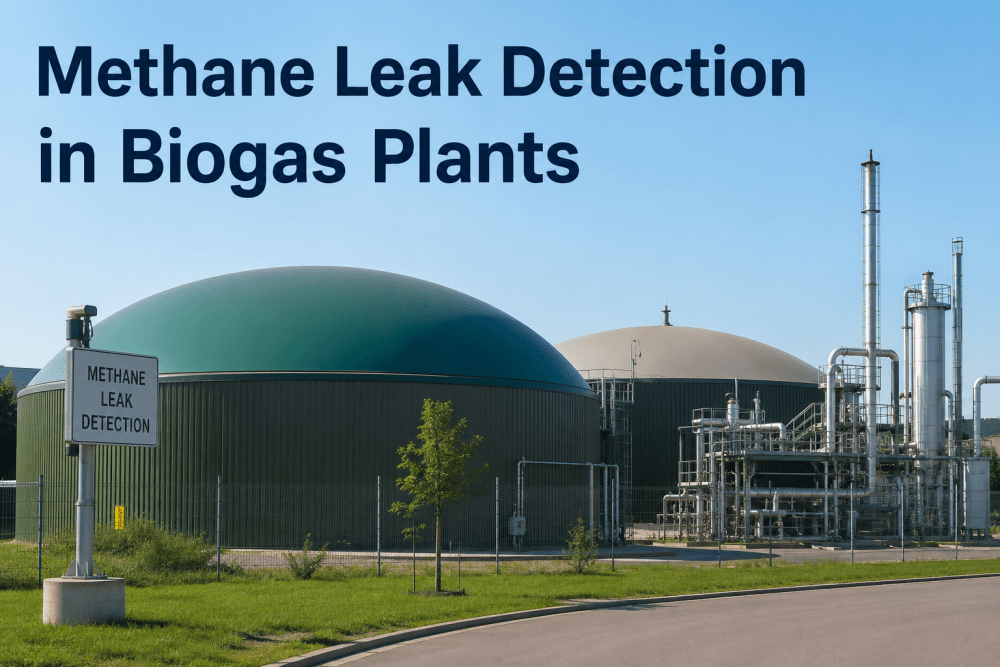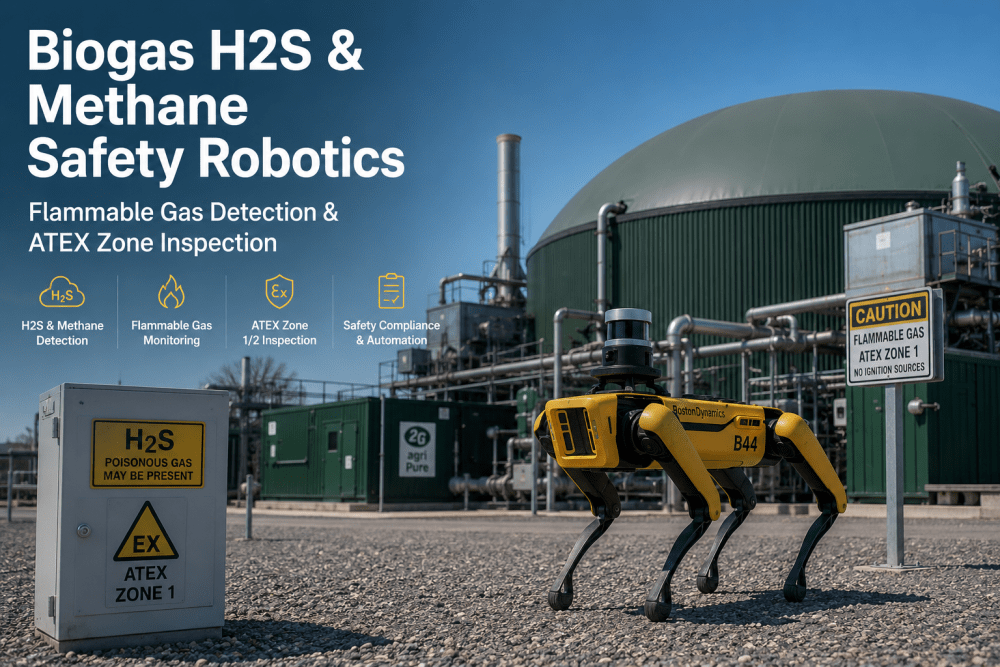
The classification of explosive atmospheres in biogas facilities is not merely a regulatory checkbox—it is the foundational risk control that determines every electrical equipment selection, ventilation requirement, and hot-work procedure in the plant. To see how iFactory digital twin and gas monitoring data validates your ATEX zone boundaries in real time, Book a Demo with our biogas process safety engineering team.
ATEX Zone Intelligence for Biogas Plants
A technical framework for classifying explosive atmospheres across biogas production, storage, and energy conversion assets, with digital validation through continuous gas monitoring and digital twin visualization.
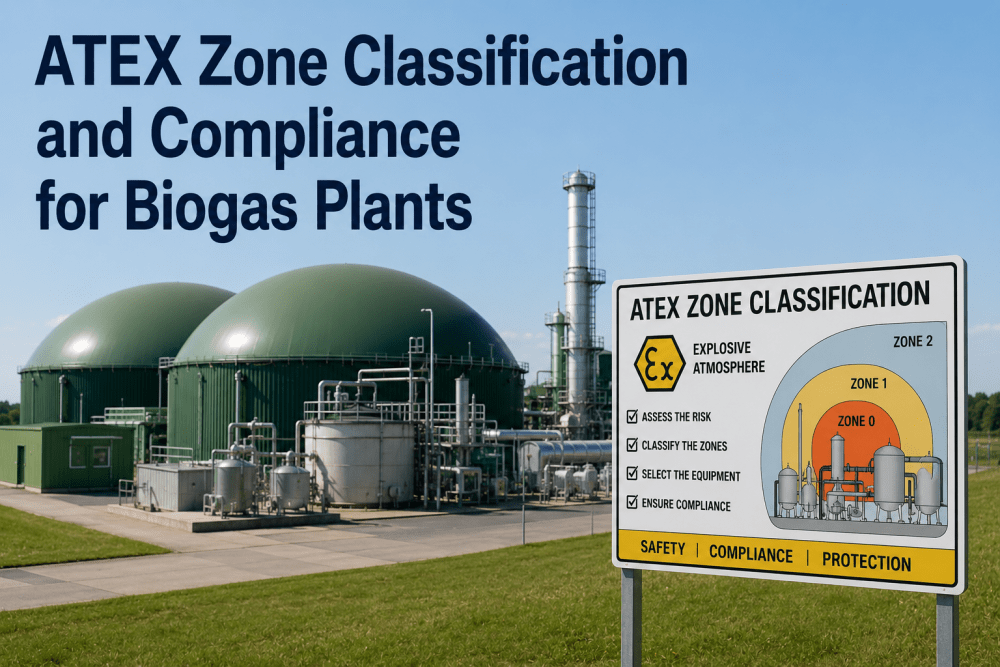
ATEX Zone Classification Reference for Biogas Plant Areas
Every biogas facility contains a distinct set of explosive atmosphere zones defined by the frequency and duration of flammable gas presence. The table below maps each ATEX gas zone to its specific application within a standard biogas plant, including the required equipment protection level and the corresponding equipment category under ATEX 2014/34/EU. Misclassifying a single zone can result in either dangerous under-specification of equipment or unnecessary capital expenditure on over-specified apparatus. Book a Demo to see how iFactory validates zone boundaries with live gas monitoring data.
| ATEX Zone | Definition & Duration | Biogas Plant Example | EPL Required | Equipment Category |
|---|---|---|---|---|
| Zone 0 | Explosive atmosphere present continuously or for long periods (>1,000 hrs/yr) | Digester headspace, gas holder interior, enclosed biogas pipeline interior | Ga (Very High) | Category 1G |
| Zone 1 | Explosive atmosphere likely to occur in normal operation (10–1,000 hrs/yr) | Flare area within 3m radius, CHP enclosure without overpressure, valve manifolds, condensate drain points | Gb (High) | Category 2G |
| Zone 2 | Explosive atmosphere not likely in normal operation or only for short periods (<10 hrs/yr) | Well-ventilated CHP room with gas detection, biogas sampling cabinets, pipe corridors with mechanical ventilation | Gc (Normal) | Category 3G |
Are Your ATEX Zone Drawings Still Accurate?
Facility modifications, piping reroutes, and ventilation changes can shift zone boundaries. Let iFactory validate your current ATEX zone map against real gas monitoring data.
Biogas Plant ATEX Risk Zones by Equipment Area
Each processing zone in a biogas facility presents a unique explosive atmosphere risk profile determined by biogas composition, ventilation rate, equipment surface temperature, and the probability of fugitive emissions. The grid below maps the dominant ATEX zone classification for each major equipment area and identifies the primary ignition control requirement.
Digester & Gas Holder
Zone 0 inside the headspace and gas holder envelope. All internal instruments must be Category 1G with EPL Ga. iFactory provides non-invasive external monitoring solutions that eliminate the need for penetrating the Zone 0 boundary with electrical apparatus.
CHP / Engine Enclosure
Zone 1 within 1m of engine gas connections and Zone 2 in the general enclosure with mechanical ventilation. iFactory monitors methane concentration continuously and can trigger ventilation boost or engine shutdown if zone conditions approach the lower explosive limit.
Flare Station
Zone 1 within 3m radius of the flare tip and gas isolation valves. Zone 2 extends to 10m in open installations. iFactory correlates flare status with gas pressure to detect leaking isolation valves that could create an undetected explosive atmosphere during flare downtime.
Pipe Corridors & Valve Manifolds
Zone 2 with mechanical ventilation drops to Zone 1 if ventilation failure occurs. iFactory tracks ventilation air changes per hour and automatically reclassifies the zone status in the digital twin when airflow drops below the design threshold.
Condensate Drain & Sampling Points
Zone 1 during manual drain or sampling operations. iFactory automates condensate drainage and gas sampling to minimize operator exposure time in classified zones and provides real-time zone entry logging for compliance auditing.
Gas Upgrading & Injection Station
Zone 1 around membrane separation units and compressor seals. Zone 2 in general area with active ventilation. iFactory continuously monitors seal integrity and methane slip to detect developing leaks before they create an explosive atmosphere.
"Our biogas facility underwent a major piping reroute to accommodate a new CHP unit, and nobody updated the ATEX zone drawings. During a routine hot-work permit review, our iFactory digital twin flagged that the new pipe corridor passed through what was now an unclassified area on paper but was measuring methane above 20% LEL in practice. We halted the work, reclassified the zone to Zone 2, and upgraded the electrical equipment before the first flame touched the pipe. That digital twin validation saved us from a potential explosion event and an HSE enforcement action."
ATEX Compliance Frameworks for Biogas Operations
Biogas facility operators must navigate multiple regulatory frameworks depending on jurisdiction. iFactory provides the continuous monitoring data and digital audit trail required to demonstrate compliance with each standard. For a detailed compliance gap assessment mapped to your specific regulatory obligations, Book a Demo with iFactory's ATEX compliance engineers.
| Framework | Jurisdiction | Key Requirement | iFactory Compliance Value |
|---|---|---|---|
| ATEX 2014/34/EU | European Union | Equipment certification for use in explosive atmospheres | Digital twin verifies that installed equipment EPL matches zone classification in every plant area |
| ATEX 1999/92/EC | European Union | Workplace safety and explosion protection document | Continuous gas monitoring data provides living validation of zone boundary assumptions in the EP Document |
| DSEAR 2002 | United Kingdom | Risk assessment and hazardous area classification | Automated hazardous area classification reports with timestamped gas monitoring records for HSE inspection |
| IECEx Scheme | International | Global equipment certification and repair standards | Equipment registry with certification tracking and maintenance scheduling for all Ex-rated apparatus |
Conclusion: Closing the ATEX Validation Gap
ATEX zone classification is not a one-time engineering exercise completed during plant design and filed away for regulatory inspection. It is a living safety control that must be continuously validated against real operating conditions. Ventilation degradation, equipment modifications, corrosion of flange seals, and even seasonal temperature changes can shift zone boundaries in ways that paper-based risk assessments cannot capture. iFactory provides the continuous gas monitoring data, digital twin visualization, and automated compliance reporting that transforms ATEX zone management from a static document into a dynamic safety intelligence system. By correlating real-time methane concentration data with your facility's zone map, iFactory identifies boundary drift, ventilation failures, and developing leak conditions before they create an explosive atmosphere in an unclassified area. Book a Demo to see how iFactory can validate and protect your ATEX zone strategy.
ATEX Zone Compliance: Frequently Asked Questions
Q: How often should ATEX zone drawings be reviewed and updated for a biogas plant?
ATEX zone classification should be reviewed whenever a facility modification occurs—piping reroute, ventilation change, new equipment installation, or digester expansion. Additionally, an annual review against continuous gas monitoring data is recommended to validate that actual methane migration patterns remain within the original zone boundaries. iFactory automates this comparison and flags deviations in real time.
Q: What is the difference between ATEX gas zones and dust zones in a biogas facility?
Gas zones (Zone 0, 1, 2) apply to explosive atmospheres from biogas methane. Dust zones (Zone 20, 21, 22) apply where combustible dusts are present—primarily in the feedstock reception area, solid digestate handling, and biomass storage. Some biogas facilities processing organic waste with dry feedstock must classify both gas and dust zones simultaneously.
Q: Can continuous gas monitoring replace the need for ATEX zone classification?
No. ATEX zone classification is a fundamental design safety control that determines fixed equipment selection and facility layout. Continuous gas monitoring serves as an operational control that validates zone assumptions and detects conditions that could shift zone boundaries. Both are required under ATEX 1999/92/EC. iFactory connects the two by using monitoring data to validate classification assumptions continuously.
Q: How does ventilation design affect ATEX zone boundaries in a CHP enclosure?
Ventilation is one of the primary determinants of zone extent. A CHP enclosure with natural ventilation and no gas detection is typically classified Zone 1 throughout. With mechanical ventilation achieving six air changes per hour and continuous gas detection interlocked to ventilation, the general area can be classified Zone 2. iFactory monitors airflow and methane concentration to verify that zone-reducing ventilation conditions are maintained continuously.
Q: What documentation does an ATEX compliance audit require for a biogas facility?
An ATEX compliance audit requires the explosion protection document (EPD), hazardous area classification drawings, equipment inventory with certification records, maintenance logs for Ex-rated apparatus, hot-work permit records, and evidence of zone boundary validation. iFactory centralizes all of these in a single digital platform with automated audit trail generation for regulator inspection.
Validate Your ATEX Zone Strategy with Live Data
Our biogas process safety engineers will review your current ATEX zone drawings, cross-reference them against your facility's gas monitoring data, and deliver a gap analysis with prioritized recommendations.