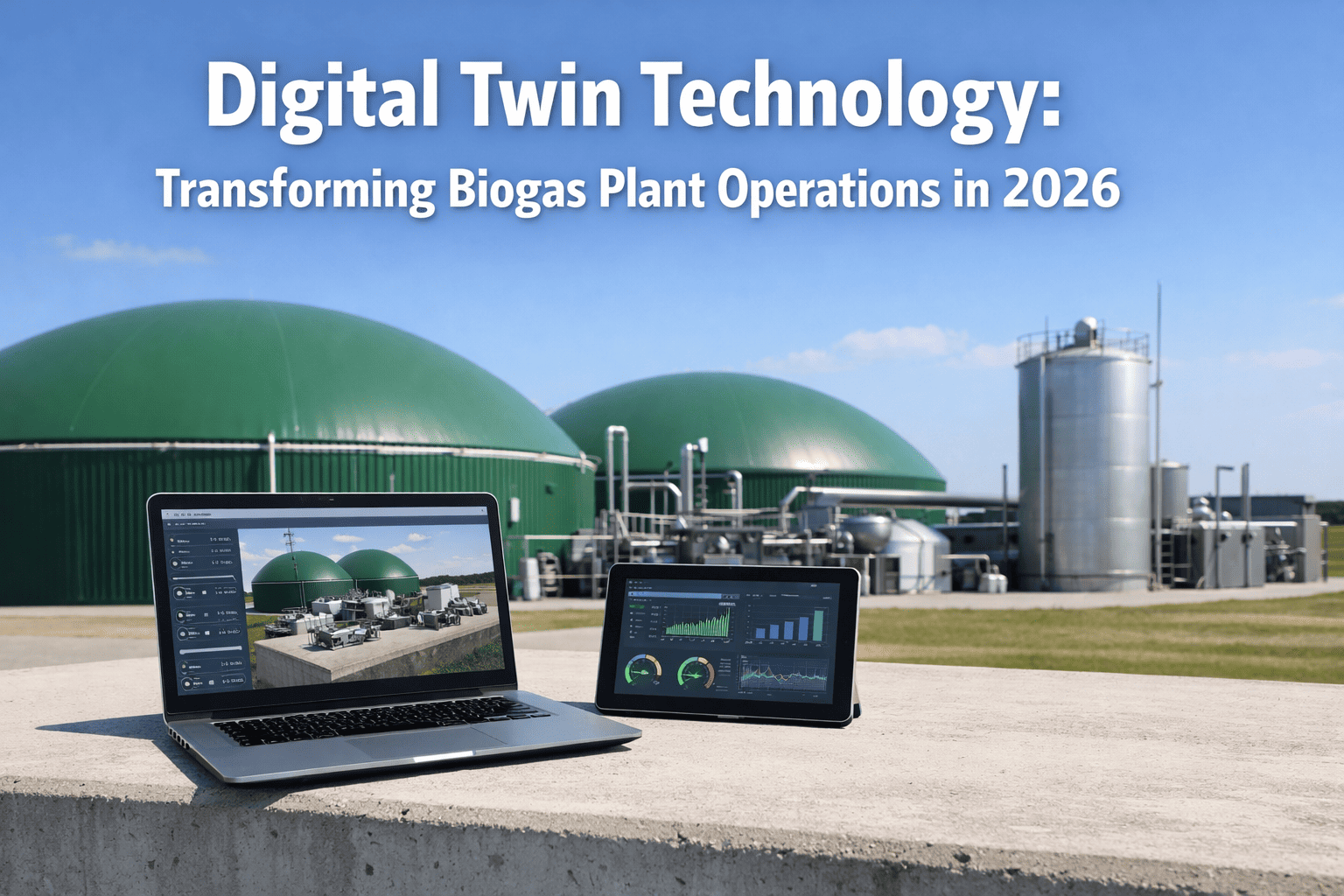
Every biogas plant operator has asked the same question: what would happen to my methane yield if I shifted the feedstock blend by 10%, raised the digester temperature by two degrees, or switched from mesophilic to thermophilic operation? Without a digital twin, the answer to that question requires an expensive real-world experiment
The biogas industry is at the inflection point where digital twin technology — proven across aerospace, automotive, and oil and gas — meets the specific requirements of biological process optimization. Unlike static engineering models that require manual recalibration, a living digital twin updates its parameters automatically as new sensor data, laboratory results, and operational outcomes are recorded.
+22%
Average methane yield improvement reported by AD plants using digital twin-driven operational optimization
90 Days
Minimum historical data required to calibrate a physics-informed biogas digital twin with actionable prediction accuracy
±6%
Gas yield prediction accuracy of a fully calibrated biogas digital twin compared to actual production data
50+
Operational scenarios a digital twin can evaluate per shift — feedstock blends, OLR changes, temperature profiles
What a Biogas Digital Twin Actually Does Inside Your Operation
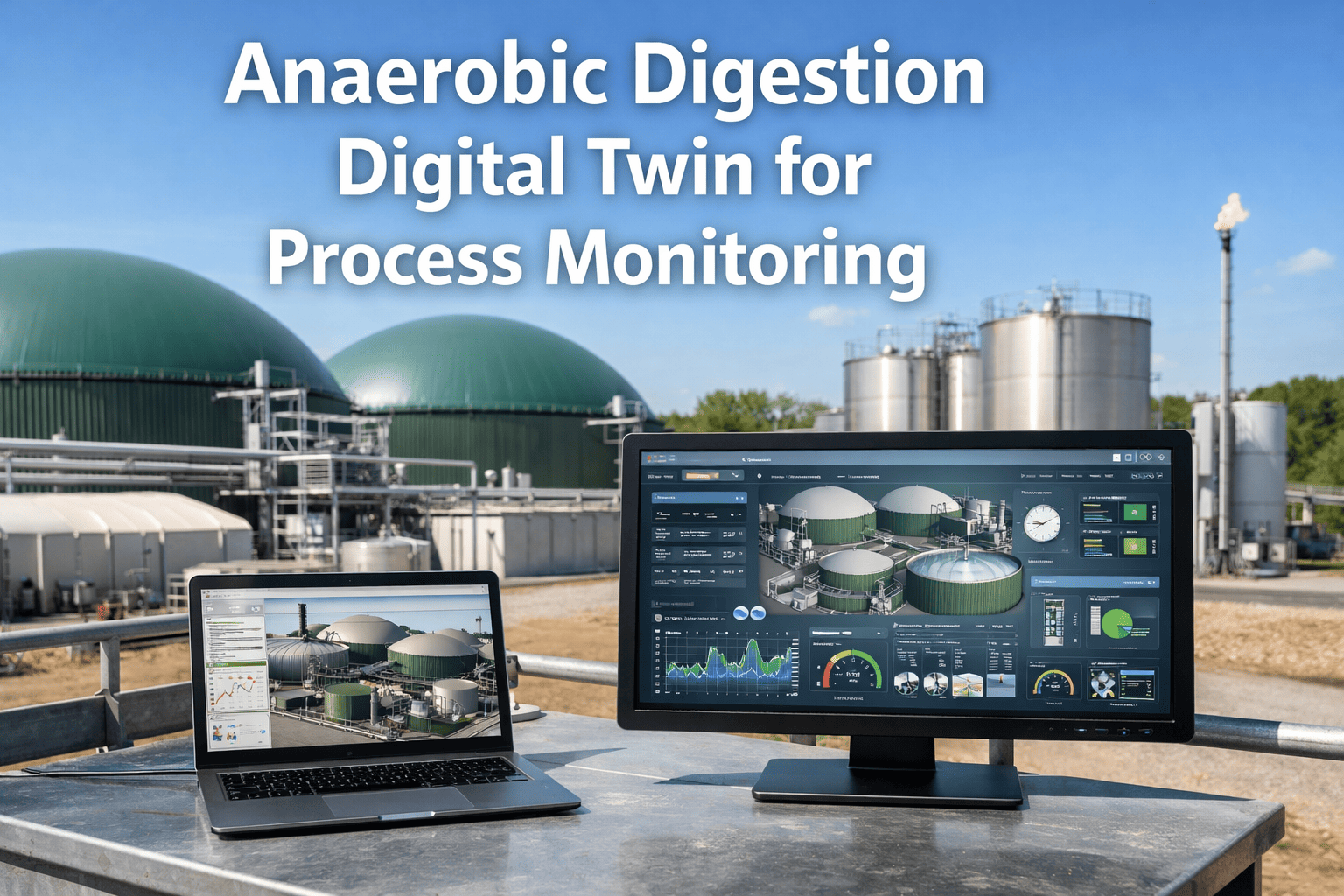
A biogas digital twin is not a single model but a layered simulation environment that represents the complete anaerobic digestion process — from feedstock characterization through biogas yield to digestate composition — and updates its state continuously as real-world data flows in from plant sensors, laboratory analyses, and operational records. The twin's core value is its ability to predict the outcome of operational changes before those changes touch the live digester, compressing weeks of observation into seconds of computation.
Book a demo to see how iFactory's data validation engine assesses data quality and identifies gaps before model calibration begins.
Feedstock Blend Optimization
The digital twin evaluates 50+ co-substrate blend ratios per session, predicting the methane yield, VFA impact, and C:N ratio for each combination before any change reaches the digester.
HIGH IMPACT
Process Stability Prediction
The twin simulates VFA production-consumption balance and alkalinity buffering capacity 72 hours ahead, flagging scenarios that increase acidification risk before yield impact is detectable.
HIGH IMPACT
Temperature Shift Simulation
Each 2°F change in digester temperature shifts gas yield by 3–6%. The twin simulates mesophilic-to-thermophilic transitions and seasonal setpoint adjustments with ±6% accuracy.
STABLE IMPACT
Hydraulic Retention Time Analysis
Shorter HRT increases throughput but reduces destruction efficiency. The twin identifies the retention time that maximizes net daily gas production per unit of digester volume.
BALANCED IMPACT
Co-Substrate Screening
The twin screens 100+ potential co-substrate combinations per week, evaluating methane potential, degradation kinetics, and interaction effects that pure SMP weighting misses.
HIGH POTENTIAL
Energy Balance Integration
The twin models the complete plant energy balance — CHP electrical efficiency, digester heat demand, parasitic loads — identifying scenarios that maximize net energy export.
Digital Twin vs. Traditional Modelling: A Comparison for Biogas Operators
Biogas plant operators have historically relied on two analytical approaches: steady-state mass balance models built in spreadsheet environments and published methane potential lookup tables from academic literature. Both approaches are valuable for initial design and high-level scoping, but neither supports the operational decision-making that a calibrated digital twin enables. The fundamental difference is time resolution: a mass balance model tells you what the plant should produce at steady state; a digital twin tells you what it will produce tomorrow given today's specific feedstock, temperature, and loading conditions — and updates that prediction as conditions change.
Capability
Spreadsheet Mass Balance
Published Methane Potential Data
Calibrated Digital Twin
Operational Advantage
Prediction Timeframe
Steady-state only — one equilibrium point
Static — single value per feedstock
Dynamic — hourly or daily predictions updated continuously
Real-time decision support, not annual planning
Feedstock Variability
Requires manual input for each batch change
Assumes consistent feedstock composition
Incorporates actual daily feedstock lab data automatically
Accurate predictions despite batch-to-batch variability
Process Stability Warning
No dynamic stability modeling
Not applicable
VFA and pH trajectory predicted 72 hours ahead
Preventive intervention before upset events
Model Calibration
Manual — requires expert to re-fit parameters
No calibration — literature-based values
Continuous — auto-updates with each new data point
Improving accuracy over time without manual effort
What Data Does a Biogas Digital Twin Require, and How Long Does Calibration Take?
The most common question plant operators ask about digital twin technology is whether their existing data infrastructure can support it. The answer depends on three factors: data availability for the calibration period, data quality in terms of measurement frequency and accuracy, and the plant's instrumentation for key process variables. iFactory's digital twin methodology follows a structured data readiness assessment that identifies gaps before any model development begins, ensuring the calibration timeline is predictable and the prediction accuracy target is achievable.
Data Readiness Checklist for Biogas Digital Twin Calibration
Minimum 90 days of historical operational data — daily feedstock volume and composition, gas production and methane concentration, digester temperature, OLR. More data improves accuracy; 90 days is the minimum for actionable predictions.
Feedstock characterization data — volatile solids (VS), chemical oxygen demand (COD), C:N ratio, specific methane potential (SMP) for each feedstock type. Laboratory analysis frequency of at least weekly during the calibration period.
Process stability indicators — volatile fatty acid (VFA) profile, alkalinity, pH, total ammonia nitrogen (TAN) and free ammonia. Weekly or bi-weekly sampling during calibration is sufficient for most plant configurations.
Equipment configuration parameters — digester volume, mixing system type and intensity, heat exchanger capacity and efficiency, gas storage volume, CHP or upgrading unit efficiency curves.
Ambient and operational contextual data — ambient temperature (impacts digester heat demand), feedstock storage conditions, any process interruption events, maintenance downtime, and feedstock supply chain disruptions.
SCADA or historian connectivity — ability to pull operational data programmatically at daily or hourly intervals. iFactory connects to common biogas control platforms via Modbus, OPC-UA, or file-based data transfer for plants without historian infrastructure.
±6%
Gas yield prediction accuracy after 90-day calibration with daily feedstock and gas data
72 Hrs
VFA trajectory prediction window — process stability warnings before yield impact is visible
4–6 Wks
Typical digital twin calibration timeline from data readiness assessment to operational twin
Ready to assess your plant's data readiness for digital twin deployment? Book a 30-minute digital twin assessment with iFactory's biogas process engineering team.
How a Biogas Digital Twin Is Built: From Data to Operational Predictions
The process of building a biogas digital twin follows a structured methodology that ensures the model reflects the specific behavior of your digester — not a generic anaerobic digestion curve. iFactory's implementation approach divides the build process into six stages, each with defined deliverables and validation checkpoints. The result is a twin that operators trust for daily decisions rather than a theoretical model that requires constant expert interpretation.
01
Data Readiness Assessment and Gap Analysis
iFactory's data engineering team audits your existing data infrastructure — SCADA systems, laboratory databases, feedstock records, operational logs — and maps available data streams against the model's minimum requirements. The assessment produces a gap analysis identifying which variables are available at sufficient resolution, which require additional instrumentation or sampling, and what historical data is usable for calibration. This assessment is completed within 1–2 weeks and delivered with a calibration timeline commitment.
02
Physics-Informed Model Architecture Configuration
The twin's core model architecture is configured to match the plant's specific configuration: single-stage or multi-stage digestion, mesophilic or thermophilic operation, wet or dry fermentation, continuous stirred-tank or plug-flow design. The model incorporates established anaerobic digestion kinetics — including the IWA Anaerobic Digestion Model No. 1 (ADM1) framework — calibrated to the plant's feedstock degradation characteristics and operational history.
03
Model Calibration Against Historical Data
The model is calibrated against the historical dataset — typically 90–180 days of daily operational data — by optimizing key kinetic parameters (maximum specific uptake rate, half-saturation coefficient, methane yield coefficient) to minimize the prediction error across the full calibration period. Calibration targets ±10% prediction accuracy for gas yield, with refinement to ±6% achieved through iterative parameter tuning and validation against holdout data segments.
04
Validation Against Independent Operational Period
The calibrated model is validated against a holdout dataset — a continuous operational period not used in calibration — to verify that prediction accuracy holds for data the model has never seen. Validation metrics are documented and shared with the plant's process engineering team. If accuracy targets are not met, additional calibration refinement cycles are executed before the twin is approved for operational use.
05
Continuous Data Connector and Live Update Activation
Once validated, the twin is connected to live operational data feeds — SCADA historian, laboratory database, feedstock tracking system — and configured to update its state automatically as new data arrives. Every new gas production measurement, feedstock batch analysis, and operational adjustment refines the model's parameters through iFactory's continuous learning engine, ensuring prediction accuracy improves over time without manual recalibration.
06
Operator Dashboard and Scenario Interface Launch
The twin's predictions and scenario simulation capability are delivered through an operator-facing dashboard designed for daily use — not a research tool requiring specialized training. Operators can run feedstock blend scenarios, evaluate temperature adjustments, and assess OLR changes through an intuitive interface that presents results as ranked recommendations with confidence intervals. Process engineers who Book a demo see the scenario interface configured with their plant's data during the live walkthrough.
Deploy a Digital Twin That Your Operators Actually Use
iFactory's biogas digital twin platform is built for operational decision support — not academic simulation. Calibrated to your specific digester, connected to your live data, and designed for daily scenario testing by plant operators, not data scientists.
Expert Perspective: What Digital Twins Change in Biogas Process Management
I have been designing and operating anaerobic digesters for over 20 years, and the single most frustrating limitation has always been the feedback delay. You make a change to the feedstock blend, and then you wait — and wait — to see if it worked. In a 30-day HRT plant, that is a month of production at a suboptimal operating point before you even know you made the right or wrong decision. The digital twin compresses that cycle from 30 days to 30 seconds. What used to be a quarterly optimization conversation — should we try a different co-substrate blend? — is now a daily operational question that gets answered before the morning shift briefing. That is not an incremental improvement. That is a fundamentally different way of managing a biological process.
Senior Process Engineer, Biogas Division
National Renewable Energy Operator, 12 Digester Facilities — 28 Years Industry Experience
The most common misconception I encounter is that a digital twin requires a massive investment in additional sensors and IIoT infrastructure before you can even start. In reality, we can build a highly functional digital twin for most AD plants using the data they already collect — daily feedstock records, gas production meters, digester temperature probes, and a few months of operational logs. The twin's value comes from integrating that data into a calibrated model, not from adding more data sources. Do additional sensors improve accuracy? Absolutely. But the 80% solution that delivers +15% yield improvement is achievable with standard plant instrumentation. The sensor upgrade conversation comes after the operator has seen what the twin can do, not before.
Digital Twin Implementation Lead
Industrial IoT and Biogas Process Optimization, 14 Years — 40+ AD Plant Twin Deployments
Frequently Asked Questions
iFactory requires a minimum of 90 days of daily operational data to calibrate a physics-informed digital twin with actionable prediction accuracy. The required data includes daily feedstock volume and composition, gas production and methane concentration, digester temperature, and organic loading rate. For plants with less than 90 days of data, iFactory provides a pre-calibrated model using industry-standard degradation kinetics that can be refined as data accumulates. Weekly laboratory analysis — VFA profile, alkalinity, pH, TAN — significantly improves prediction accuracy during calibration but is not strictly required to begin the process. A data readiness assessment is available at no cost to determine your plant's specific calibration timeline.
iFactory's digital twin achieves gas yield prediction accuracy of ±6–8% for fully calibrated digesters with at least six months of operational data. For the first 90 days following deployment, during which the model is primarily using historical calibration with limited live data integration, accuracy ranges from ±10–12%. The model is self-correcting: each time a scenario prediction is compared against actual production data, the discrepancy is used to refine the model parameters, so prediction accuracy improves continuously over the life of the deployment. The forecast accuracy for VFA trajectory and process stability indicators is typically higher than yield prediction because VFA dynamics follow more deterministic kinetics than methanogenic yield, which is influenced by feedstock variability that cannot be fully characterized. Book a demo to see validation results from your plant's specific operating profile.
Yes — multi-feedstock co-digestion is the most frequently used scenario type in iFactory's digital twin deployments. The model incorporates the specific methane potential (SMP) and first-order degradation kinetics of each individual feedstock, as well as documented interaction effects between co-substrates. Operators can define up to six feedstocks in a single scenario, adjust each ratio from 0% to 100%, and receive the predicted yield, VFA impact, C:N ratio, and process stability index for every blend combination tested. The twin also accounts for practical constraints: feedstock availability, storage capacity, pumping limitations, and maximum OLR for each substrate type. For plants considering a new co-substrate that has never been tested at the facility, iFactory can incorporate published SMP data and degradation characteristics from its feedstock database — supplemented by optional bench-scale BMP testing if high accuracy is required for a capital-investment decision.
Process stability prediction is integrated directly into every digital twin scenario run. The model tracks the production-consumption balance for each VFA species (acetic, propionic, butyric, valeric), the alkalinity buffering capacity, pH trajectory, and ammonia inhibition risk for each simulated scenario — producing a composite process stability index (0–100) alongside the gas yield prediction. Scenarios that predict yield improvements but show a stability index below 70 are flagged as high-risk, preventing operators from pursuing yield gains that could trigger a process upset. The stability prediction extends 72 hours beyond the scenario execution date, giving operators advanced warning before VFA levels cross the alarm threshold. This dual-output approach — yield prediction plus stability assessment — is the feature that distinguishes iFactory's digital twin from research-focused simulation tools that model yield in isolation.
The complete timeline from project kickoff to an operational digital twin that operators use for daily scenario testing is 6 to 10 weeks for plants with adequate existing data infrastructure. The timeline breaks down as follows: data readiness assessment and gap analysis (1–2 weeks), model architecture configuration and data ingestion (1 week), model calibration against 90–180 days of historical data (2–4 weeks), validation against holdout dataset (1 week), live data connector activation and continuous learning engine deployment (1 week), and operator dashboard configuration and training (1 week). Plants requiring additional instrumentation or data collection before calibration can proceed will have an extended readiness phase; iFactory's data readiness assessment identifies these requirements before any timeline commitments are made. Contact iFactory for a site-specific deployment timeline estimate.
A Digital Twin That Predicts Methane Yield, Protects Process Stability, and Puts Operational Intelligence in Your Operators' Hands — Built from Your Existing Plant Data
iFactory's biogas digital twin platform delivers calibrated, continuously learning virtual replicas of your anaerobic digestion process — enabling feedstock blend optimization, temperature scenario testing, OLR adjustment simulation, and process stability prediction from a single platform. Deployed on your data infrastructure, calibrated to your specific digesters, and designed for daily use by plant operators.