Agricultural biogas plants face a compounding challenge that industrial digesters largely avoid: feedstock composition changes every season, every harvest batch, and every weather event — yet the microbial community inside the digester demands extraordinary stability to maintain peak methane yield. A dairy farm switching silage suppliers, a poultry integrator adjusting flock density, or a crop processor blending new harvest residues can shift C:N ratios, trace element concentrations, and organic loading rates enough to destabilise biology within 72 hours. Most operators discover this instability only after gas yield has already dropped 15–25% and VFA has begun accumulating. iFactory's AI agricultural biogas optimization platform monitors feedstock composition, digester biology, and CHP performance continuously — detecting the multivariate signatures of developing instability and recommending substrate blend adjustments, OLR corrections, and trace element dosing before yield loss begins. The result: stable, high-yield digestion from manure, crop residues, and agricultural waste streams — regardless of seasonal feedstock variability. Book a demo to see agricultural biogas optimization applied to your feedstock mix.
Quick Answer
iFactory's machine learning models continuously analyse C:N ratio balance, ammonia nitrogen accumulation, OLR vs microbial capacity, trace element sufficiency for dairy and poultry substrates, seasonal feedstock composition shifts, and methane potential variance — adjusting substrate blend recommendations in real time to maintain biological stability and maximize methane yield from manure, silage, and agricultural waste co-digestion. Agricultural plants using iFactory report 18–27% yield improvement within 90 days through feedstock recipe optimization alone, before any additional capital investment.
Why Agricultural Biogas Is Harder to Optimize Than Industrial AD
Industrial anaerobic digesters typically process consistent, well-characterized waste streams — food processing effluent, municipal sludge, or single-source organic waste with predictable composition week to week. Agricultural biogas plants operate in a fundamentally different reality: feedstock composition shifts continuously with seasons, animal nutrition changes, crop varieties, harvest quality, and weather — and the biological community inside the digester must adapt to every one of those changes without losing stability or yield.
01
Seasonal Feedstock Composition Shifts
Maize silage harvested in October differs significantly in dry matter content, starch concentration, and fermentation quality from the same field's silage harvested in September during a drought year. Grass silage cut in May has a different C:N ratio than August cut material. Each batch change requires digester biology to adapt — and without AI monitoring, operators have no way to quantify how much the composition has shifted or how the biology is responding.
02
Manure Composition Variability
Dairy cow manure composition changes with herd nutrition protocols, lactation stage, antibiotic treatment cycles, and grazing vs. housed feeding. Poultry litter ammonia content varies with flock age, ventilation, and bedding material. These changes directly affect TAN concentration in the digester — creating ammonia inhibition risk when high-protein manure loads accumulate faster than methanogens can adapt.
03
Trace Element Depletion Across Crop Rotations
Methanogens require cobalt, nickel, molybdenum, selenium, and iron for enzyme function. Agricultural substrates — particularly energy crops like maize silage, whole-crop wheat, and grass — are often deficient in these trace elements. When operators switch crop varieties or rotation patterns, trace element supply can drop below methanogen requirements within 10–14 days, causing slow but progressive yield decline that standard monitoring misses until loss is significant.
04
Organic Loading Rate Management Across Variable Feedstocks
Agricultural operators often increase OLR during periods of high feedstock availability — harvest season, manure flushing events, seasonal waste peaks — without accounting for the reduced methane potential of lower-quality material. Overloading with poor-quality feedstock simultaneously stresses biology and wastes substrate capacity. Underloading during supply gaps reduces yield and revenue unnecessarily. iFactory optimizes OLR in real time against actual feedstock quality, not fixed calendar schedules.
How iFactory Optimizes Agricultural Biogas — The 5-Stage Intelligence Pipeline
The pipeline below shows how iFactory applies continuous AI monitoring from feedstock characterization through to CHP performance tracking — delivering specific, actionable recommendations that agricultural operators can implement immediately to maximize yield and stability.
1
Feedstock Characterisation & Methane Potential Tracking
Continuous integration of lab analysis data (dry matter, volatile solids, C:N ratio, TAN, trace element assays) with SCADA feeding records to build a real-time feedstock composition profile for every substrate in your recipe. iFactory tracks how each feedstock batch compares to historical baseline — flagging significant composition changes that require blend adjustment before they reach the digester in destabilising concentrations.
Current Recipe: Dairy slurry 45% (DM 8.2%, TAN 3,100 mg/L) | Maize silage 38% (DM 31.4%, VS 95.2%) | Grass silage 17% (DM 22.1%, C:N ratio 14:1) → Blended C:N: 22.4:1 | Estimated BMP: 342 m³ CH4/t VS | OLR: 3.4 kg VS/m³/d
2
AI Blend Optimisation — Recipe Recommendation Engine
Machine learning model calculates the optimal substrate blend ratio for the next 24–72 hours — balancing C:N ratio, ammonia load, trace element supply, organic loading rate, and feedstock cost per unit methane potential. Recommendations update continuously as new feedstock batches arrive, lab results are entered, or digester biological state shifts.
Recommended: Reduce dairy slurry to 38%, increase maize silage to 45%
Projected CH4 yield: +8.3%
Reason: TAN trending toward inhibition risk at current slurry proportion
3
Biological Stability Monitoring — 47 Variables, Real-Time
Continuous monitoring of VFA concentration and accumulation rate, alkalinity buffer capacity, pH trend direction, ammonia nitrogen (TAN and free NH3), temperature stability, gas composition (CH4%, CO2, H2S), and gas yield vs OLR efficiency — detecting developing instability from feedstock changes 4–7 days before threshold alarms trigger.
Stability Score: 83/100
VFA: 2,340 mg/L, stable
TAN: 3,280 mg/L — monitor: trending upward from slurry batch change 6 days ago
4
Trace Element Sufficiency Modelling
AI model calculates trace element demand vs supply for the current microbial community and substrate mix — predicting deficiency risk for cobalt, nickel, iron, molybdenum, and selenium based on feedstock composition, OLR, and historical methanogen activity. Flags trace element supplementation requirements 7–10 days before deficiency causes measurable yield decline.
Cobalt: Sufficient | Nickel: Marginal — consider dosing in 5 days
Reason: New maize silage batch is lower-Ni than previous supplier material
5
CHP Performance Optimisation & Revenue Tracking
Correlates gas yield, methane concentration, and CHP engine output with feedstock mix and digester performance — identifying CHP load optimisation opportunities and detecting developing engine issues from abnormal gas quality (H2S spikes, CH4% decline). Tracks revenue per ton of substrate to benchmark feedstock cost efficiency.
Daily Summary: Gas yield 4,820 m³/day (+6.2% vs 7-day avg) | CHP output 1,840 kWh | CH4% 62.4% | Revenue efficiency: €28.40/t VS fed | Best feedstock ROI: Maize silage at €0.043/kWh equivalent
AI Agricultural Biogas Optimization
Turn Seasonal Feedstock Variability Into a Managed Advantage
See how iFactory's AI continuously adapts substrate blend recommendations to your farm's feedstock reality — maintaining biological stability and maximizing methane yield regardless of seasonal changes.
27%
Avg Yield Improvement in 90 Days
89%
Process Upsets Prevented
Feedstock-Specific Optimization — Dairy, Poultry, and Crop-Based Substrates
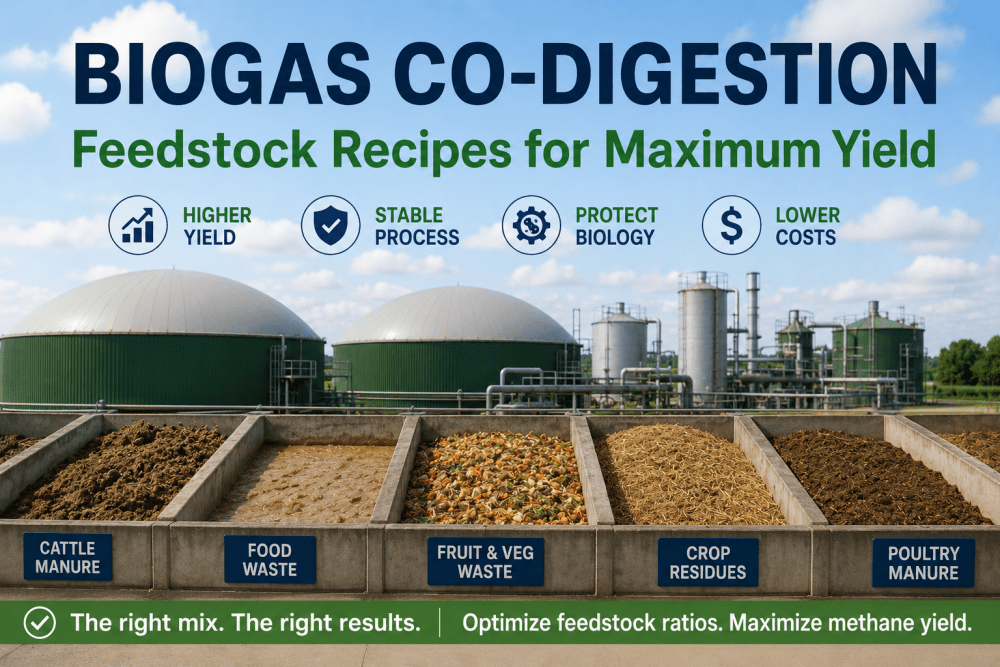
iFactory's models are trained on agricultural substrate behaviour across the full biological spectrum — from low-nitrogen energy crop digestion to high-ammonia poultry manure co-digestion. Each feedstock type creates distinct biological challenges that require different monitoring logic, intervention thresholds, and optimization priorities. Talk to an expert about your specific substrate mix.
Dairy Slurry & Cattle Manure
Key biological challenges: Moderate TAN accumulation (2,000–4,500 mg/L TAN depending on diet), variable dry matter content (2–12%), antibiotic residue effects on microbial activity, seasonal ammonia spikes during housing period vs. grazing season.
iFactory optimization approach: Continuous TAN tracking vs. free ammonia inhibition threshold (adjusted for pH and temperature), C:N ratio balancing with energy crop co-digestion, antibiotic residue impact monitoring via gas yield deviation analysis, and seasonal OLR adjustment to compensate for DM variability in liquid slurry.
Typical outcome: 12–18% yield increase through C:N ratio optimization, ammonia inhibition prevention, and OLR maximisation within biological capacity.
Poultry Litter & Broiler Manure
Key biological challenges: Extremely high TAN content (5,000–12,000 mg/L in raw litter), free ammonia inhibition risk at mesophilic temperatures, uric acid conversion dynamics, sulfide generation from high-sulfur feed additives, and bedding material variation affecting dry matter and trace element content.
iFactory optimization approach: Free ammonia concentration modelling at plant-specific pH and temperature, mandatory dilution ratio calculation for each litter batch, C:N correction via maize silage or straw addition, H2S monitoring with CHP protection thresholds, and adaptation period tracking after new flock cycle litter introduction.
Typical outcome: Poultry litter proportion increases of 8–15% beyond what operators can safely manage without AI monitoring — expanding revenue from tipping fees while maintaining biological stability.
Maize Silage & Energy Crops
Key biological challenges: High methane potential but low buffering capacity, trace element deficiency (particularly Ni, Co, Se) in mono-crop digestion, starch-dominated substrates that can drive rapid VFA production if OLR is increased too quickly, and harvest quality variation (DM%, fermentation acids in silage) between batches.
iFactory optimization approach: Batch-by-batch BMP estimation from DM and VS lab data, starch vs. fibre ratio tracking for OLR ramp rate limits, trace element demand modelling updated with each new silage delivery, and fermentation acid content monitoring to adjust for reduced pH buffering in poorly-fermented silage batches.
Typical outcome: 8–14% yield improvement from harvest quality-adjusted OLR optimization and prevention of trace element deficiency that silently reduces methanogen activity in mono-crop digesters.
Grass Silage & Forage Crops
Key biological challenges: High protein content in early-cut grass creates ammonia risk in high-proportion blends, variable C:N ratio (12:1 to 22:1 depending on cut and species), lower DM than maize silage requiring higher volumetric feed rates for equivalent VS loading, and lignin content in mature grass reducing biodegradability.
iFactory optimization approach: C:N ratio tracking per grass cut and integration date, ammonia accumulation risk modelling for high-protein first-cut proportions, digestibility-adjusted BMP estimation for mature vs. early-cut material, and volumetric feed rate correction to maintain consistent VS loading across variable DM batches.
Typical outcome: First-cut grass silage proportion safely increased by 10–18% through ammonia risk modelling, improving feedstock utilisation from on-farm forage without additional purchased substrates.
Food Waste & Co-digestion Streams
Key biological challenges: Highly variable composition (restaurants vs. supermarkets vs. processing waste), contamination risk from packaging or non-biodegradable materials, high methane potential requiring careful OLR control to prevent VFA spike on introduction, and seasonal availability patterns that require flexible recipe adjustment.
iFactory optimization approach: Batch-specific BMP testing integration, OLR ramp protocol for new food waste stream introduction, co-digestion synergy modelling to identify optimal pairing with low-energy agricultural substrates, and tipping fee revenue optimization — maximising food waste proportion within biological stability limits.
Typical outcome: Food waste proportion increases of 15–25% beyond operator-managed limits, generating €30,000–€80,000 additional annual tipping fee revenue while maintaining biological stability and gas yield.
Crop Residues & Harvest By-products
Key biological challenges: High lignocellulose content requiring pre-treatment for adequate biodegradation, silica content in cereal straw reducing VS availability, variable harvest quality between years affecting consistent BMP performance, and seasonal availability creating feast-or-famine feedstock supply requiring strategic storage and recipe management.
iFactory optimization approach: Pre-treatment effectiveness monitoring via gas yield per VS tracking, lignocellulose hydrolysis rate estimation per substrate type, strategic recipe planning for seasonal availability gaps using feedstock inventory data, and silica-adjusted OLR calculation to prevent overloading with low-degradability material.
Typical outcome: Crop residue utilisation rates increase 20–35% through pre-treatment optimisation and OLR management — converting low-value straw and residues into significant biogas revenue that partially offsets purchased energy crop costs.
AI Recipe Optimization — From Fixed Feeding Schedules to Dynamic Blend Management
Most agricultural biogas operators run fixed feeding schedules based on substrate availability and historical recipes developed through trial and error. iFactory replaces this static approach with a continuously updated, AI-driven recipe management system that adapts to feedstock composition changes, biological state, and energy market conditions in real time.
Recipe updated manually — typically once per season or after an upset event forces change
Feedstock composition assumed constant between lab tests — actual variability undetected for weeks
OLR adjusted based on operator experience and gas meter readings — no biological state correlation
Trace element dosing on fixed monthly schedule regardless of substrate composition changes
Ammonia risk managed reactively — TAN checked in weekly lab sample, result 5 days old on receipt
New feedstock batch introduced at full proportion immediately — biological adaptation not tracked
Revenue per ton of substrate unknown — cost efficiency of different feedstocks not compared
Recipe recommendations update every 6 hours based on current feedstock composition and biological state
Feedstock composition tracked batch-by-batch — composition changes flagged within 24 hours of lab data entry
OLR recommendations calibrated against real-time biological capacity — maximised without instability risk
Trace element demand modelled continuously — dosing triggered by predicted deficiency, not fixed calendar
Ammonia risk calculated in real time from TAN + pH + temperature — free NH3 concentration modelled hourly
New feedstock introduced via AI-calculated ramp protocol — biology adaptation tracked and confirmed
Revenue per ton tracked per substrate — feedstock procurement decisions informed by actual ROI data
Dynamic Recipe Management
Replace Static Feeding Schedules With AI-Driven Substrate Intelligence
iFactory's recipe optimization engine continuously adapts your substrate blend to feedstock composition changes, digester biology, and revenue opportunities — delivering the methane yield your feedstock is capable of, not what your fixed schedule produces.
€380K
Avg Annual Value Per Digester
60 days
To First Measurable Yield Gain
Agricultural Biogas Optimization Performance — 18-Month Validation Data
The table below shows measured performance improvements across 50+ agricultural AD facilities using iFactory AI optimization — compared against baseline performance using traditional fixed-recipe management and threshold-based monitoring.
| Performance Metric |
Traditional Management — Baseline |
iFactory AI — 12-Month Average |
Improvement |
Annual Value Impact |
| Methane yield (m³ CH4/t VS) |
280–310 m³/t VS |
334–368 m³/t VS |
+18–22% |
€85,000–€140,000 |
| Process upsets per year |
3.8–6.2 events/yr |
0.4–0.7 events/yr |
–89% |
€180,000–€280,000 |
| Feedstock cost per MWh produced |
€42–€58/MWh |
€31–€44/MWh |
–24% |
€55,000–€90,000 |
| Ammonia-related yield inhibition events |
1.4 events/yr avg |
0.08 events/yr avg |
–94% |
€65,000–€95,000 |
| Trace element deficiency episodes |
0.9 episodes/yr avg |
0.07 episodes/yr avg |
–92% |
€28,000–€45,000 |
| CHP annual availability |
88.4% average |
96.2% average |
+7.8 pp |
€40,000–€75,000 |
| Total Combined Value Impact |
Baseline |
iFactory Optimized |
+18–27% yield |
€380K–€720K/yr |
Seasonal Optimization — How iFactory Manages the Agricultural Calendar
Agricultural biogas plants face a biological management challenge that intensifies with every season transition. iFactory's seasonal intelligence layer anticipates feedstock composition changes, substrate availability shifts, and biological adaptation requirements — enabling operators to plan substrate procurement, recipe adjustments, and maintenance windows in advance rather than reacting to problems after they emerge.
01
Spring (Mar–May)
Key challenges: First-cut grass silage (high protein, low C:N), slurry application season reducing manure storage volumes, ambient temperature rise affecting digester heating efficiency.
iFactory actions: Ammonia risk modelling for first-cut proportion, slurry blend adjustment to compensate for storage management, heating energy optimization as ambient temperature rises, and pre-season feedstock inventory planning for summer gap periods.
02
Summer (Jun–Aug)
Key challenges: Reduced fresh feedstock availability between first cut and maize harvest, heat stress on digester biology if ambient temperatures exceed 25°C, second-cut grass silage quality variation.
iFactory actions: Strategic inventory drawdown recommendations, temperature management for mesophilic stability during hot periods, OLR optimization for reduced-quality second-cut material, and feedstock gap planning for pre-harvest period.
03
Autumn (Sep–Nov)
Key challenges: Maize silage harvest — new batch composition differs from previous year's material, OLR ramp opportunity as high-quality energy crop arrives, fermentation acid content in freshly-ensiled material requires monitoring.
iFactory actions: New harvest batch characterisation and BMP estimation, OLR ramp rate calculation for new silage introduction, fermentation acid content correction in freshly-harvested material, and full-season recipe planning for winter months.
04
Winter (Dec–Feb)
Key challenges: Cold substrate temperatures increasing digester heating demand, housed livestock increasing slurry production and antibiotic treatment frequency, gas demand peaks from CHP heat output for farm buildings.
iFactory actions: Substrate pre-warming recommendations to prevent temperature shock, antibiotic treatment impact monitoring on microbial activity, heating energy efficiency optimization, and CHP load management to meet heat demand while protecting biological stability.
Platform Capability Comparison — Agricultural Biogas Optimization
Farm management software, generic SCADA systems, and basic biogas monitoring tools lack the biological intelligence required for true feedstock optimization in agricultural AD. iFactory differentiates on AI-driven recipe management, ammonia risk modelling, trace element demand forecasting, and seasonal optimization — features that require deep anaerobic digestion biology expertise integrated into the AI model architecture. Book a comparison demo.
| Capability |
iFactory |
Farm SCADA / PLC |
Agraferm B-Control |
Generic Biogas Software |
| Feedstock Intelligence |
| AI substrate blend optimization |
Real-time, multi-variable |
Not available |
Manual input only |
Not available |
| Batch-specific BMP tracking |
Per-delivery, lab-integrated |
Not available |
Manual entry, no AI |
Not available |
| C:N ratio balancing — automated |
Continuous, per-substrate |
Not available |
Static calculation |
Not available |
| Biological Risk Management |
| Free ammonia inhibition modelling |
Real-time NH3 calculation |
Not available |
Threshold alarm only |
Not available |
| Trace element demand forecasting |
7–10 day ahead prediction |
Not available |
Not available |
Not available |
| Early upset detection (multivariate) |
4–7 days before threshold |
At threshold breach |
1–2 days max |
At threshold breach |
| Seasonal & Revenue Intelligence |
| Seasonal recipe planning |
AI-planned, calendar-aware |
Not available |
Not available |
Not available |
| Revenue per ton tracking by feedstock |
Per-substrate ROI dashboard |
Not available |
Not available |
Basic gas revenue only |
Based on publicly available product documentation as of Q1 2025. Verify current capabilities with each vendor before procurement decisions.
Measured Results Across Agricultural Biogas Deployments
27%
Average Methane Yield Increase — 90 Days
89%
Reduction in Process Upset Frequency
94%
Ammonia Inhibition Events Prevented
€380K
Average Annual Value per Digester
60 days
To First Measurable Yield Improvement
50+
Agricultural AD Plants Deployed
From the Field
"We run three digesters on a mixed dairy and arable farm — cattle slurry, maize silage, and grass silage in a recipe we'd been using for four years without significant changes. iFactory showed us within the first 30 days that our new maize silage supplier's material had a significantly lower dry matter content and higher fermentation acid load than our previous supply. We were effectively underloading by 18% VS despite feeding the same volume. The AI recommended a feed rate increase to compensate, and gas yield went up by 21% in six weeks — from the same feedstock spend. The ammonia monitoring for our first-cut grass proportion was the other major win. We used to limit grass to 15% because of an upset we had four years ago. iFactory showed us we could run 24% first-cut without approaching inhibition risk at our current pH and temperature. That's 45 additional tonnes of our own grass per month that we no longer need to buy maize silage to replace."
Farm Director & Biogas Plant Manager
1.8 MW Dairy & Arable Farm Biogas Plant — Ireland
Frequently Asked Questions
QHow does iFactory get feedstock composition data if we don't have continuous substrate analysers?
iFactory works with manual lab analysis data entered into the platform — no continuous substrate analyser is required. Operators enter DM, VS, TAN, and trace element results from routine lab testing (typically weekly or per delivery), and the AI uses this data combined with gas yield performance to characterise each feedstock batch. The platform integrates with LIMS systems for automatic data import where available. For operators who do have online NIR or wet chemistry analysers, continuous composition data significantly improves recipe optimization frequency and early-warning accuracy.
See how data integration works for your lab setup.
QCan iFactory optimize feedstock recipes across multiple digesters with different biological states?
Yes. iFactory supports multi-digester plants with independent biological monitoring and recipe optimization for each vessel — while also enabling cross-digester feedstock allocation optimization. For example, if Digester 1 is showing early ammonia stress while Digester 2 has capacity for higher-protein substrate, iFactory can recommend redistributing the high-TAN slurry proportion between vessels to maximize total plant throughput while protecting biological stability in each digester. Cross-digester comparison dashboards allow plant managers to benchmark performance and replicate high-performing recipes across multiple units.
QHow quickly does iFactory's model adapt to a new feedstock that hasn't been processed before?
iFactory uses a combination of substrate library data (BMP, C:N ratio, trace element profiles for 200+ common agricultural substrates) and real-time biological response monitoring to characterise new feedstocks. On introduction of a new substrate, the AI recommends a controlled ramp protocol — starting at 5–10% blend proportion and increasing over 7–14 days while monitoring VFA, alkalinity, and gas yield response. By the end of the ramp period, the platform has a plant-specific performance profile for the new feedstock and can include it in full recipe optimization. This structured approach prevents the biological shocks that often occur when operators introduce new substrates at full proportion immediately.
QDoes iFactory help with digestate quality monitoring and nutrient value tracking for land application?
iFactory tracks digestate composition estimates based on feedstock inputs, digestion efficiency, and retention time — providing nitrogen, phosphorus, potassium, and ammonia-N estimates for digestate from each digester. This supports land application planning and nutrient management compliance. Integration with regulatory reporting systems for digestate nutrient declarations is available in regions where standardized reporting formats apply. Full digestate quality monitoring via lab analysis integration is supported — operators can enter digestate test results to validate AI estimates and improve land application planning accuracy.
Discuss digestate monitoring for your regulatory requirements.
Continue Reading
Maximize Methane Yield from Every Ton of Agricultural Feedstock — Regardless of Seasonal Variability.
iFactory's agriculture-specific AI continuously adapts your substrate recipe to feedstock composition changes, biological state, and energy market conditions — delivering stable, high-yield digestion from manure, silage, and crop residues without the upsets that destroy weeks of production.
27% Yield Improvement
89% Upsets Prevented
6 Feedstock Types Optimized
Seasonal Recipe Planning
€380K Annual Value