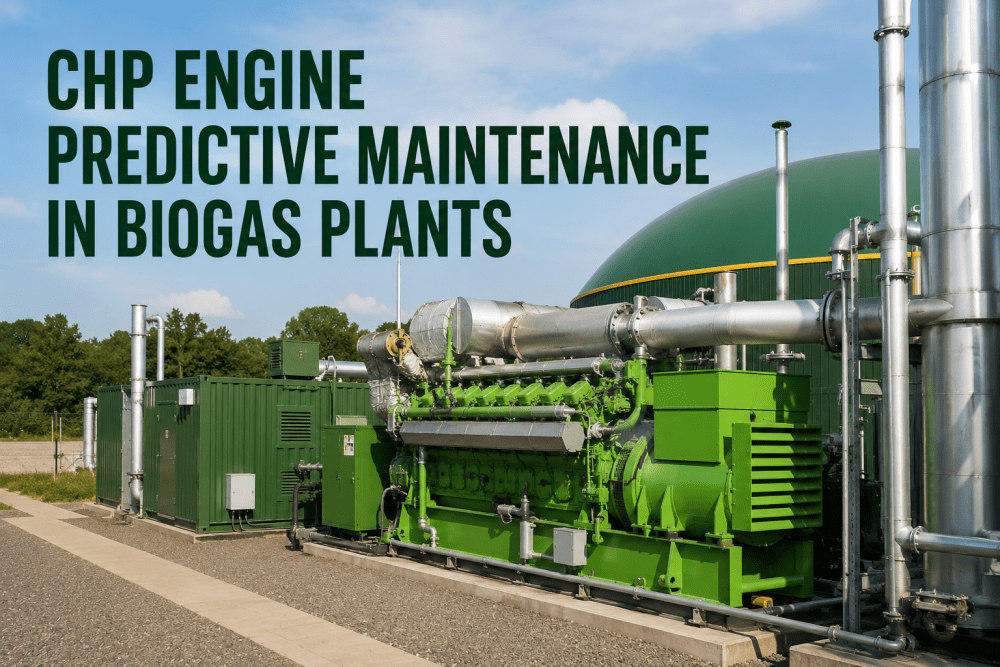
A biogas CHP engine running on raw biogas faces degradation mechanisms that natural gas engines never encounter. H2S above 200 ppm corrodes valve seats and piston rings at 3–5× normal wear rate. Siloxane deposits from food waste and sewage sludge cause pre-ignition and knock damage that accumulates invisibly between service intervals. A Jenbacher J320 running on off-spec biogas can degrade from 95% availability to forced shutdown in under 72 hours — with no warning from standard engine telemetry until the damage is done. iFactory's CHP predictive analytics platform monitors every engine parameter continuously, classifies developing faults by type and severity, and triggers maintenance at the right moment — not too early, not too late. Book a free CHP engine analytics assessment.
iFactory monitors cylinder temperatures, oil pressure, exhaust deviation, vibration, gas quality, and lube oil condition continuously — classifying developing faults per cylinder per failure mode and predicting engine health 30 days ahead. Automated PM scheduling eliminates both early replacement waste and run-to-failure risk. Average result: 95%+ CHP availability, 35% reduction in engine maintenance cost.
CHP Engine Failure Modes iFactory Detects & Prevents
Each card below represents a failure mode that destroys CHP availability and maintenance budgets — and that standard engine controller telemetry misses until damage is already done. Book a demo to see CHP fault classification on your engine make and model.
iFactory solution: Correlates gas analyser H2S readings with cylinder compression deviation and oil acid number trends — flagging accelerated wear before it compounds into ring or valve failure.
iFactory solution: Tracks knock sensor amplitude per cylinder and ignition timing deviation — scheduling spark plug replacement based on deposit progression, not fixed hours.
iFactory solution: Monitors oil pressure trend, filter differential pressure, and H2S concentration to estimate oil condition continuously — triggering change when condition warrants it.
iFactory solution: Monitors boost pressure deviation from expected curve at load, detects surge precursors from pressure fluctuation signatures — triggering cleaning before efficiency loss becomes mechanical failure.
iFactory solution: Monitors CH4%, CO2%, and H2S continuously, links deviations to upstream digester biological state, and alerts engine and digester operators simultaneously before a protection stop occurs.
iFactory solution: Monitors per-cylinder exhaust temperature deviations, classifies asymmetry to exhaust valve, spark plug, or injector fault type, and delivers a pre-populated work order with affected cylinder and likely cause.
iFactory connects to your engine controller, gas analyser, and SCADA via OPC-UA or Modbus. First fault classifications active within 4 weeks — no new hardware required for most configurations.
Supported CHP Engine Platforms
iFactory is engine-agnostic — connecting to any make via OPC-UA or Modbus without requiring OEM analytics packages or proprietary hardware. Every platform below is fully supported for per-cylinder fault classification, condition-based maintenance, and gas quality correlation.
iFactory CHP Analytics Deployment Roadmap
iFactory activates CHP engine intelligence in four structured phases — each building on existing engine controller data before any new instrumentation is required.
iFactory audits engine make, model, operating hours, and maintenance history — mapping each unit to its specific failure mode library. Existing engine controller logs, gas analyser data, and oil analysis records build plant-specific health baselines.
OPC-UA or Modbus connection to engine controllers and gas analysers. Per-cylinder temperature, knock index, boost pressure, oil pressure, and gas quality parameters ingested continuously. Engine health dashboard goes live.
AI fault classification goes live — per-cylinder fault detection, oil condition scoring, turbocharger health, and siloxane deposit tracking. Condition-based PM triggers replace fixed-interval schedules. Automated work orders generated on fault detection.
RUL estimates per component — spark plugs, oil, valves, turbocharger — drive parts procurement before lead times expire. Monthly engine health reports track availability, maintenance cost per running hour, and fault event history per unit.
Platform Capability Comparison — CHP Engine Analytics
INNIO Jenbacher myPlant, MWM myAvatar, Caterpillar VisionLink, and generic vibration monitoring platforms offer engine telemetry and threshold alerts. iFactory differentiates on per-cylinder fault classification, biogas-specific H2S and siloxane damage modelling, condition-based oil triggers, and gas quality-to-engine health correlation. Book a comparison demo.
| Capability | iFactory | INNIO myPlant | MWM myAvatar | Cat VisionLink | Generic Vibration |
|---|---|---|---|---|---|
| Fault Detection & Classification | |||||
| Per-cylinder exhaust temp fault classification | Valve, plug, injector classified | Engine-level alarms only | Engine-level alarms only | Engine-level alarms only | Not available |
| Knock index per cylinder | Per cylinder, trended | Jenbacher units only | MWM units only | Not available | Not available |
| Turbocharger surge precursor detection | Pressure fluctuation signature | Alarm threshold only | Not available | Not available | Not available |
| Biogas-Specific Intelligence | |||||
| H2S corrosion wear rate modelling | Gas conc. correlated to wear | Not available | Not available | Not available | Not available |
| Siloxane deposit tracking | Feedstock-linked, knock-correlated | Not available | Not available | Not available | Not available |
| Gas quality linked to engine health | CH4%, H2S, CO2 correlated | Not available | Not available | Not available | Not available |
| Maintenance & Planning | |||||
| Condition-based oil change trigger | Acid number + pressure + H2S | Fixed interval advisory | Fixed interval advisory | Fixed interval only | Not available |
| 30-day RUL per component | Plug, oil, valve, turbo | Not available | Not available | Not available | Not available |
| Auto CMMS work order on fault | Pre-classified, parts listed | API integration required | API integration required | Limited | Not available |
Based on publicly available product documentation as of Q1 2025. Verify current capabilities with each vendor before procurement decisions.
Measured Outcomes Across Deployed Plants
iFactory's pre-deployment assessment reviews your existing engine controller logs and gas analyser data to identify active fault signatures and wear patterns — before any new software is installed.
From the Field
Frequently Asked Questions
Continue Reading
iFactory maps every biogas-specific failure mode — H2S corrosion, siloxane deposits, turbo fouling, gas quality deviation — to your engine make and model, with condition-based maintenance triggers that replace fixed-interval schedules.