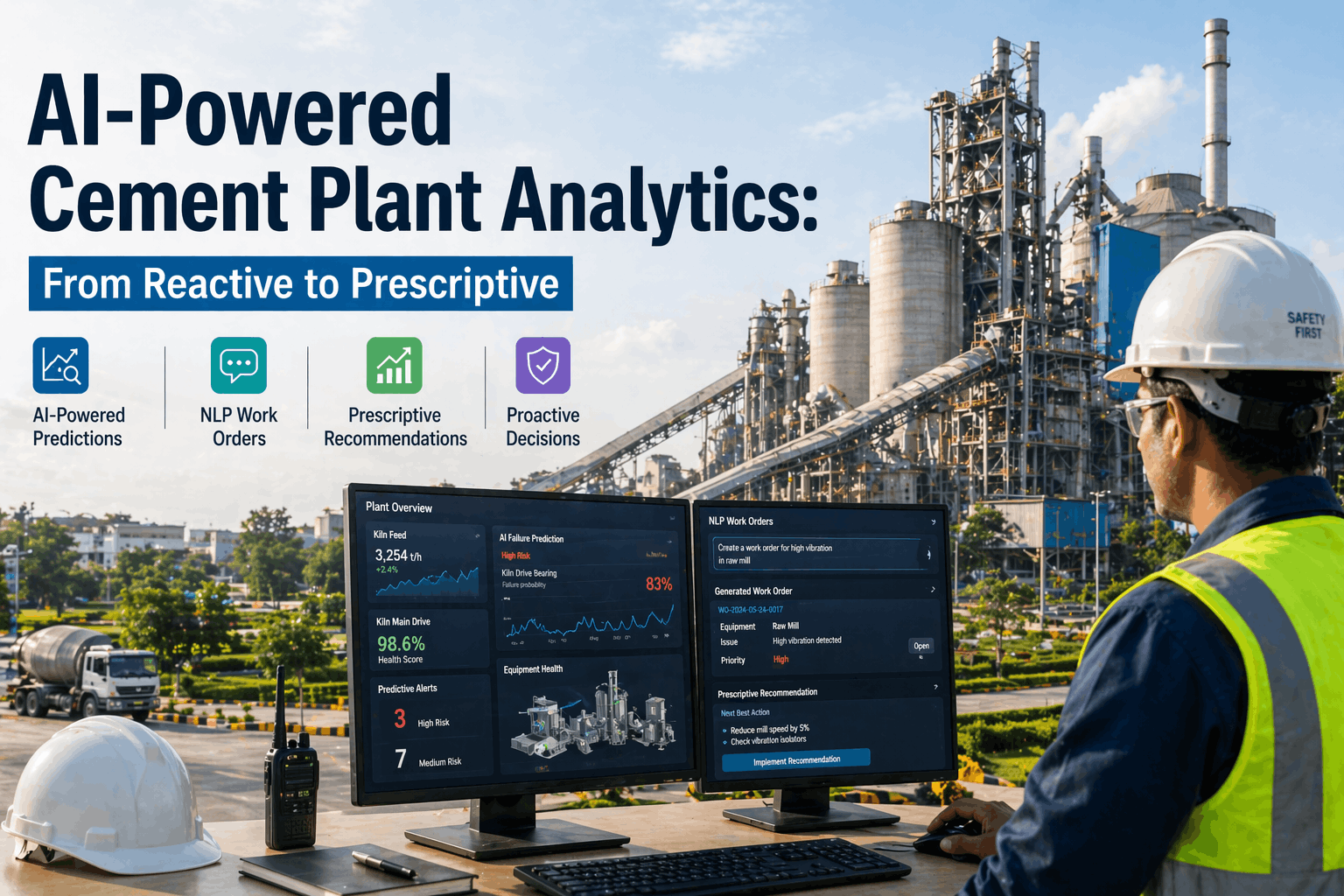
AI-powered cement plant analytics is fundamentally rewriting how heavy industrial facilities bridge the "intelligence gap" between siloed DCS data and actionable field maintenance. By evolving from basic preventive schedules to true prescriptive AI recommendations, iFactory’s intelligence layer allows operations teams to not only predict equipment failure 14 days in advance but to receive the exact parameter adjustments needed to prevent the failure from occurring. For cement manufacturers managing high alternative fuel (AF) substitution and tightening ESG mandates, adopting AI-driven asset health is no longer a peripheral innovation. It is the operational foundation for maximizing clinker quality and eliminating the $3.5M+ annual cost of unplanned kiln outages. This guide explores how AI prediction engines, NLP-driven work orders, and real-time process intelligence combine to deliver measurable ROI across every production zone.
From "What Happened" to "How to Fix It Automatically"
iFactory's AI engine delivers real-time failure forecasting, clinker chemistry stability models, and NLP-automated work orders purpose-built for cement operations.
The Four Stages of Industrial Intelligence Maturity
Most cement facilities are trapped in Level 1 (Reactive) or Level 2 (Preventive) cycles, where they perform maintenance based on arbitrary calendar dates rather than actual asset stress. In 2026, the AI-powered cement plant achieves Level 4 (Prescriptive) maturity. When a Vertical Roller Mill (VRM) experiences a sub-audible vibration anomaly, the AI doesn't just log an alarm—it simulates the structural impact on the main bearing, correlates it with the current stabilizer bed thickness, and automatically generates an NLP-driven work order for the next scheduled changeover. Manufacturers who book a demo with iFactory consistently find that moving to prescriptive AI is the fastest path to year-one OEE recovery.
AI Prediction Engine
Continuously analyzes kHz vibration, torque, and pressure data streams to identify "silent" failure precursors. Generates failure forecasts with 14+ day lead times across kilns and mills.
NLP-Automated Work Orders
Natural Language Processing transforms raw anomaly data or operator voice-memos into fully structured work orders, complete with necessary spare parts and safety protocols.
Prescriptive Optimization
Algorithms provide specific operational parameter recommendations (e.g., "Reduce ID Fan speed by 4% to stabilize bearing temp") to extend asset life in real-time.
Clinker Chemistry Stability
AI correlates burner performance with clinker free-lime levels, predicting quality deviations before lab results are processed, reducing off-spec production batches.
Quantifying the Intelligence Shift: AI-Driven Economic KPIs
Digital intelligence resolves the friction between production throughput and maintenance overhead. By using AI to "see" inside the machinery, cement plants can defer overhaul CapEx safely based on condition data rather than factory specifications. Plants that have deployed this approach with iFactory report that booking a demo typically reveals that 40% of their current preventive maintenance actions are technically unnecessary and labor-wasteful.
Traditional Analytics vs. iFactory AI-Prescriptive Standard
The jump from data-logging to data-intelligence is where the competitive edge is won. A plant using traditional analytics knows *that* a motor is vibrating; a plant using iFactory knows *why* it's vibrating and *how* to adjust the process to keep it running until the next stop. This granularity is the core of cement Industry 4.0, and it is why we routinely request a demo to show the logic in action on live DCS tags.
| Intelligence Mode | Traditional / Legacy | AI iFactory Prescriptive | Financial Impact |
|---|---|---|---|
| Failure Detection | Threshold alarms (Static) | Pattern Anomaly (Dynamic AI) | +3.5% kiln availability |
| Incident Reporting | Paper / Spreadsheet logs | NLP-Automated Work Orders | 70% reduction in data labor |
| Refractory Strategy | Calendar relines (Fixed) | Predictive Thin-Spot AI | $600k inventory saving |
| Process Guidance | Operator Experience | Closed-Loop Recommendations | 5% higher AF substitution |
| Audit Readiness | Weeks of prep | Persistent Digital Compliance | "Always-Audit" Readiness |
"The transition to iFactory's prescriptive AI engine was like turning on a high-definition radar for our kiln operations. We no longer wait for alarms to ring; the AI quietly adjusts our burner parameters 48 hours before a hotspot would have even formed."
— Maintenance Director, Global Tier-1 Cement Group
AI Performance Benchmarks in Cement Operations
The measurable impact of AI analytics scales across every KPI — from energy reduction to clinker quality. The chart below benchmarks the average improvement achieved within 12 months of prescriptive AI deployment, based on iFactory's cross-fleet cement plant data.
AI-Powered Cement Analytics — Frequently Asked Questions
How does "Prescriptive" AI differ from standard "Predictive" maintenance?
Predictive maintenance tells you *when* an asset will fail. Prescriptive AI tells you *why* and *how to fix it*. For example, if a kiln drive motor shows thermal stress, a predictive system flags an alarm; iFactory’s prescriptive system recommends a specific reduction in feed speed or adjustment in lubrication flow to mitigate the stress immediately.
What is "NLP Work Order Automation" and how does it help a cement plant?
Natural Language Processing (NLP) allows technicians to dictate observations or allows the AI to ingest raw sensor anomalies and automatically write a detailed work order. It translates technical data into "maintenance-speak," reducing the time shift leads spend on paperwork by 85%.
Can your AI predict Clinker Quality (Free-Lime) without a new lab sample?
Yes. By using virtual sensing (AI models that correlate kiln burner pressure, rotational torque, and thermal heatmaps), iFactory predicts Free-Lime levels with 92% accuracy, allowing for real-time burner adjustments before a batch is compromised.
How long does the AI engine take to "learn" my specific cement plant behavior?
iFactory uses "Transfer Learning" with pre-trained models from hundreds of cement assets. We typically achieve 80%+ accuracy on day one, with full plant-specific calibration (94%+) occurring within 4–6 weeks of data ingestion.
Does the AI platform require us to replace our existing DCS or PLC hardware?
No. iFactory is a software-intelligence layer that sits on top of your existing infrastructure. We ingest data from any modern DCS (Siemens, ABB, Rockwell) via secure industrial protocols like OPC-UA or MQTT.
How does AI-driven maintenance support our ESG / Net Zero targets?
Unplanned cooling and reheating of a kiln cost massive amounts of energy and CO2. By eliminating unplanned stops (+3.5% availability), AI directly reduces your specific heat consumption and total Scope 1 emissions.
Is my plant's data used to train models for our competitors?
No. iFactory maintains strict "Data Sovereignty." Your raw plant data stays in your secure tenant. Only anonymized, aggregated meta-trends are used to improve the global baseline, ensuring your competitive operational secrets remain yours.
What is the ROI payback period for deploying the iFactory AI engine?
Integrated cement plants typically achieve full payback in 6–9 months. The most immediate ROI driver is the prevention of a single unplanned kiln "stop/start" event, which alone can cost $250k–$400k in lost production and energy.
Stop Analyzing Yesterday's Data. Start Predicting Tomorrow's Profit.
iFactory's AI cement analytics platform delivers real-time prescriptive alerts, autonomous chemistries, and NLP-driven field intelligence — purpose-built for the clinker line.