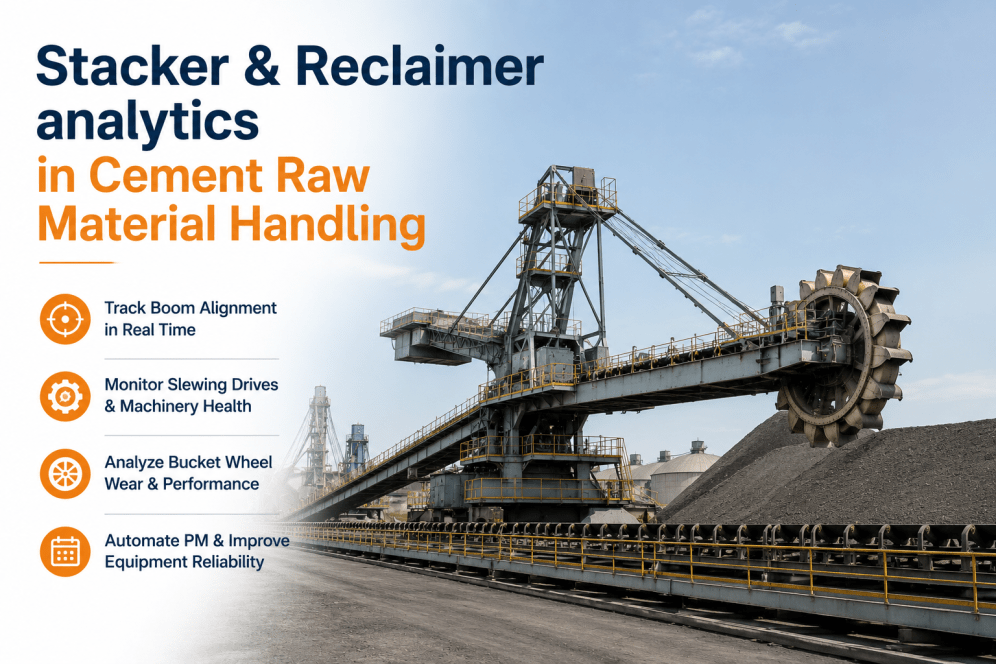
Stackers and reclaimers are the largest moving machines in any cement plant — with booms spanning 30 to 50 meters, slewing drives rotating 360 degrees on massive ring gears, and bucket wheels excavating 500 to 2,000 tons of material per hour from stockpiles that cover the area of multiple football fields. A single unplanned stacker or reclaimer failure can stop raw material feed to the raw mill for 8 to 48 hours, costing $20,000 to $120,000 in lost production depending on the affected material circuit and downstream inventory levels. The challenge is that boom alignment drifts gradually as the structural steel flexes under load, slewing drive gearboxes develop tooth wear over years of bidirectional rotation, bucket wheel wear accelerates when the machine operates in abrasive materials and rail alignment shifts with foundation settlement and temperature changes — each developing at a different rate and detectable only through different measurement methods. Conventional inspection relies on annual structural surveys, quarterly gearbox oil sampling, and visual bucket wear checks during scheduled downtime — intervals that guarantee most degradation is discovered after it has already caused secondary damage to mating components. AI-driven stacker-reclaimer analytics closes these visibility gaps by monitoring boom alignment through strain gauge and inclinometer data, tracking slewing drive health through vibration and current signature analysis, predicting bucket wheel wear from power draw and throughput trends, and detecting rail misalignment from travel drive parameters — enabling maintenance to be scheduled based on actual structural and mechanical condition rather than calendar intervals. Book a Demo to see how iFactory's Equipment-Specific PM Templates and Alignment Tracking modules optimize your stacker and reclaimer operations.
The Four Critical Sub-Systems of Stacker-Reclaimer Analytics
Effective AI-driven monitoring of stacker and reclaimer equipment depends on instrumenting and modeling four distinct sub-systems, each with unique failure modes, measurement parameters, and maintenance requirements. A typical circular or longitudinal stacker-reclaimer combines all four into a single integrated machine, meaning a degradation in any one sub-system affects the operating condition of the others. Facilities that monitor all four continuously achieve 45 to 55 percent fewer unplanned stoppages compared to plants relying on periodic inspection alone.
Boom Structure & Alignment
The boom is the primary structural element, supporting the conveyor belt, bucket wheel, and counterweight under cyclic loading from every slewing and luffing movement. Boom alignment drifts as structural welds develop fatigue cracks, the truss deflects under repeated loading, and the pivot pin wears. AI monitors alignment from inclinometer and strain gauge trends, predicting when structural realignment or weld inspection is needed.
Slewing Drive & Rotation System
The slewing drive rotates the entire superstructure through a pinion meshing with a ring gear that can exceed 10 meters in diameter. Gear tooth wear, bearing degradation, and drive motor misalignment develop gradually and are detectable through vibration spectrum analysis and motor current signature analysis months before they cause a jam or tooth fracture.
Bucket Wheel & Excavation System
The bucket wheel is the highest-wear sub-system on any reclaimer, with buckets, wear plates, and the wheel rim eroding in proportion to material abrasiveness and throughput volume. AI predicts remaining bucket life from power draw per ton of material handled, cumulative throughput tracking, and vibration changes as the wheel becomes imbalanced from uneven wear.
Rail & Travel System
Stacker-reclaimers traveling on rails face wheel flange wear, rail head deformation, and drive wheel slip that increase with foundation settlement and track misalignment. AI monitors travel drive power draw, wheel vibration, and position tracking data to detect rail misalignment and wheel wear trends before they cause derailment risk or travel drive overload.
Performance Comparison — Conventional vs. AI-Driven Stacker-Reclaimer Management
The table below compares conventional stacker-reclaimer management with AI-driven methods across the key sub-systems and operational functions that determine equipment reliability, maintenance cost, and service life. Data reflects deployment results across cement plant raw material handling operations using iFactory's Equipment-Specific PM and Alignment Tracking platform. Book a Demo to see the platform configured for your stacker-reclaimer equipment type and configuration.
| Equipment Sub-System | Conventional Approach | AI-Driven Approach | Improvement | iFactory Module |
|---|---|---|---|---|
| Boom Alignment Monitoring | Annual structural survey with total station + visual weld inspection during scheduled downtime | Continuous inclinometer and strain gauge monitoring with AI trend analysis detecting alignment drift at 0.1 degree resolution | Alignment issues detected 3-6 months earlier; structural repairs planned vs. emergency | Alignment Tracking + Predictive Maintenance |
| Slewing Drive Condition | Quarterly gearbox oil sample + annual borescope inspection of ring gear teeth | Continuous vibration spectrum, motor current signature, and oil condition monitoring with ML fault classification | Gear tooth damage detected 60+ days before fracture; unplanned drive stoppages reduced 50% | Predictive Maintenance + CMMS |
| Bucket Wheel Wear | Visual bucket thickness measurement during quarterly inspections + reactive replacement after failure | AI wear prediction from motor power draw per ton, cumulative throughput, and vibration imbalance trending | Bucket change-outs reduced 60%; replacement planned during scheduled outages | Equipment-Specific PM Templates |
| Rail & Travel System | Annual rail alignment survey + visual wheel flange inspection during gearbox overhauls | Continuous travel drive power, vibration, and position tracking with AI rail deviation detection | Rail-related travel issues detected 90+ days before derailment risk; wheel flange life extended 35% | Alignment Tracking + Predictive Maintenance |
| Stockpile Inventory Automation | Manual volume estimation from periodic surveys + operator experience for reclaimer positioning | AI-driven stockpile modeling from reclaimer position, boom angle, and travel data with real-time inventory updates | Inventory accuracy improved from 80% to 98%; reclaimer positioning optimized for maximum reclaim rate | Production Monitoring |
| Maintenance Scheduling | Fixed calendar intervals for structural inspection, gearbox overhaul, and bucket replacement | AI-generated condition-based work orders from structural health, drive condition, and wear prediction models | PM costs reduced 30%; equipment life extended 25% through condition-based intervention | CMMS + Equipment-Specific PM Templates |
Deploying AI for Stacker-Reclaimer Analytics — A Structured Workflow
The interval between deciding to implement AI-driven monitoring and having live condition data on every stacker-reclaimer sub-system depends on the existing sensor infrastructure, equipment configuration, and data integration requirements. A structured deployment workflow ensures that each phase delivers measurable value while building toward full equipment coverage and closed-loop maintenance integration.
Sensor Integration & Data Foundation
Establish real-time data ingestion from existing PLC systems for slewing drive motor power, bucket wheel drive current, travel drive parameters, and boom luffing cylinder pressure. Deploy additional IoT sensors — inclinometers on the boom structure, accelerometers on slewing drive gearbox and ring gear, vibration sensors on travel drive wheels, and strain gauges on critical boom truss members. iFactory's pre-built connectors for major equipment control systems accelerate this phase to 2 to 4 weeks.
AI Model Training & Calibration
Train site-specific ML models using 12 to 24 months of historical maintenance records, inspection reports, and operational data. Models cover boom structural drift prediction, slewing drive gearbox fault classification, bucket wheel wear rate estimation, and rail deviation detection. Each model is calibrated against known past events — previous boom realignments, gearbox failures, bucket change-outs — to validate accuracy before deployment on live equipment.
Dashboard & Alert Configuration
Configure unified stacker-reclaimer health dashboards with sub-system-specific KPIs — boom alignment deviation in degrees, slewing drive vibration trend at gear mesh frequencies, bucket wheel remaining life in operating hours, and rail alignment deviation in millimeters. Automated alerts are tuned to each sub-system's criticality and failure development timeline, ensuring operators and maintenance planners receive warnings with sufficient lead time for planned intervention.
CMMS Workflow Integration
AI-generated condition-based work orders flow directly into the iFactory CMMS, creating specific maintenance tasks — boom alignment verification, slewing drive gearbox inspection, bucket wheel wear measurement, and rail alignment survey. Work orders include the detected anomaly, sensor data summary, recommended action, and priority level based on remaining useful life, production criticality, and safety risk.
Continuous Learning & Fleet Scaling
Models retrain continuously on new inspection findings, repair outcomes, and operational data — improving detection accuracy and extending prediction horizons with each equipment operating cycle. The platform scales to additional stackers, reclaimers, and other raw material handling equipment across the plant using standardized sensor packages and model transfer learning.
Deploy Predictive Analytics for Your Raw Material Handling Equipment
iFactory's Alignment Tracking and Equipment-Specific PM Templates module digitizes the entire stacker-reclaimer monitoring workflow — boom alignment, slewing drive health, bucket wheel wear, and rail integrity — in a single platform accessible from the control room or maintenance planner's desk.
Industry Expert Perspective on AI in Stacker-Reclaimer Operations
Business Impact of AI-Driven Stacker-Reclaimer Analytics
The financial and operational impact of moving from calendar-based stacker-reclaimer maintenance to AI-driven, condition-based monitoring extends across equipment reliability, maintenance cost, and production continuity. The impact grid below maps iFactory's monitoring capabilities to the measurable outcomes that matter to plant managers, maintenance planners, and operations leaders evaluating predictive analytics investments for their raw material handling equipment.
Equipment Reliability
- Unplanned stacker-reclaimer stoppages reduced by 45 to 55%
- Boom structural issues detected 3 to 6 months before annual survey
- Slewing drive gear tooth damage identified 60+ days before fracture risk
- Rail alignment deviations detected 90+ days before derailment hazard
Maintenance Optimization
- Bucket wheel change-outs reduced by 60% through condition-based replacement
- Structural inspection intervals extended by AI-triggered vs. calendar-based scheduling
- Gearbox overhauls planned from vibration trend vs. fixed running hours
- PM costs reduced 30% by eliminating unnecessary inspections and aligning work with true condition
Operational Efficiency
- Stockpile inventory accuracy improved from 80% to 98% with AI-driven modeling
- Reclaimer positioning optimized for maximum reclaim rate from real-time stockpile data
- Material flow interruptions eliminated by predictive detection of equipment degradation
- Raw mill feed reliability improved through continuous stacker-reclaimer availability
Conclusion
Stacker and reclaimer equipment represents the largest mechanical asset investment in any cement plant's raw material handling system — and the most consequential source of production interruption when a critical sub-system fails. Boom alignment that drifts 2 millimeters per month goes undetected until the annual structural survey, slewing drive gear tooth spalls develop for 60 days before they are visible during a scheduled borescope inspection, and bucket wheel wear accelerates silently until a hole appears and material spills onto the stockpile. AI-driven stacker-reclaimer analytics eliminates these visibility gaps by creating continuous, real-time condition data for every mechanical and structural sub-system — detecting boom drift at 0.1 degree resolution, identifying gear tooth damage at the mesh frequency vibration signature, predicting bucket wear from power draw trends per ton of material, and flagging rail misalignment from travel drive deviations. Each operating cycle generates more training data, improving model accuracy, driving better maintenance decisions, and reducing the unplanned stoppages that cost $20,000 to $120,000 per event. iFactory AI provides the unified platform — Alignment Tracking, Equipment-Specific PM Templates, Predictive Maintenance, and CMMS integration — that delivers this integrated capability across any stacker, reclaimer, or raw material handling equipment configuration. Book a Demo to see the iFactory platform configured for your stacker-reclaimer equipment.
Deploy AI-Driven Stacker-Reclaimer Analytics With iFactory
iFactory gives cement plant reliability teams a structured, digitized stacker-reclaimer monitoring platform — from boom alignment tracking and slewing drive analytics to bucket wheel wear prediction and CMMS integration — protecting raw material handling availability with every operating cycle.
Stacker-Reclaimer Analytics — Frequently Asked Questions
How does AI monitor stacker boom alignment and structural integrity?
AI monitors stacker boom alignment through inclinometers mounted at strategic points along the boom structure — typically at the pivot, mid-span, and tip — that measure angular deviation in two axes at 1-minute intervals. The AI model tracks the trend of angular change relative to the baseline established after the most recent structural alignment, detecting deviations as small as 0.1 degrees that indicate structural settlement, pivot pin wear, or truss deflection. Strain gauges on critical truss members provide complementary data on structural loading patterns, identifying overstress events that could accelerate fatigue crack development. When the alignment trend exceeds a configurable threshold, the platform generates an alert with the measured deviation and recommended inspection scope.
How does AI predict slewing drive failures before they cause a stoppage?
AI predicts slewing drive failures through three continuous data streams analyzed by machine learning models. Vibration spectrum analysis on the gearbox input and output bearings detects developing gear tooth damage at the gear mesh frequency — typically 60 to 90 days before a tooth fracture occurs. Motor current signature analysis on the slewing drive motor identifies rotor bar cracks, bearing wear, and load anomalies that precede drive trips. In-line oil condition sensors on the gearbox measure viscosity, moisture, wear particle count, and ferrous debris concentration, detecting gear and bearing wear from particle composition. The model integrates all three data streams into a single slewing drive health score with automated work order generation at critical thresholds.
How is bucket wheel wear tracked and predicted using AI?
Bucket wheel wear is tracked through the correlation between motor power draw and material throughput — as the bucket edges and wear plates erode, the specific energy per ton of material reclaimed increases because the buckets lose their cutting efficiency. The AI model establishes a baseline power-per-ton relationship for the bucket wheel when newly rebuilt and continuously compares current performance to this baseline. A 10 to 15 percent increase in specific energy indicates wear that warrants inspection, while a 20 percent increase triggers a replacement recommendation. Cumulative throughput in tons is tracked alongside specific energy to provide a secondary wear indicator based on the known wear rate per ton for the specific material type being reclaimed.
What data infrastructure is needed to support AI-driven stacker-reclaimer analytics?
The core data infrastructure requirements include real-time data acquisition from the existing equipment PLC or DCS system for slewing drive motor power, bucket wheel drive current, travel drive parameters, and luffing cylinder pressure at sub-second intervals. Additional IoT sensors include dual-axis inclinometers on the boom structure, accelerometers on slewing drive gearbox and ring gear (2 to 4 sensors), vibration sensors on travel drive wheel assemblies, and strain gauges on critical boom truss members. iFactory's platform includes pre-built connectors for major equipment control systems, support for Modbus, OPC-UA, and API-based data ingestion, and on-premise deployment on an NVIDIA edge server with wireless connectivity for mobile equipment.
How long does it take to deploy AI for stacker-reclaimer analytics and when can results be expected?
A structured five-phase deployment typically takes 8 to 14 weeks from project initiation to full operational integration for a single stacker or reclaimer unit. Phase 1 (sensor integration and data foundation) takes 2 to 4 weeks depending on existing sensor infrastructure. Phase 2 (AI model training and calibration) takes 3 to 4 weeks using historical maintenance and operational data. Phase 3 (dashboard and alert configuration) takes 2 to 3 weeks. Phase 4 (CMMS workflow integration) takes 1 to 2 weeks. Phase 5 (continuous learning) begins at week 8 and continues indefinitely. Initial results — boom alignment trends, slewing drive vibration baselines, and bucket wheel specific energy — are available within 3 to 4 weeks of sensor installation.
Deploy Stacker-Reclaimer Analytics With iFactory Today
Cement plant reliability teams across North America are using iFactory's Alignment Tracking and Equipment-Specific PM Templates to replace calendar-based stacker-reclaimer maintenance with condition-based analytics. Schedule a 30-minute demo to see the platform configured for your equipment type and raw material handling configuration.