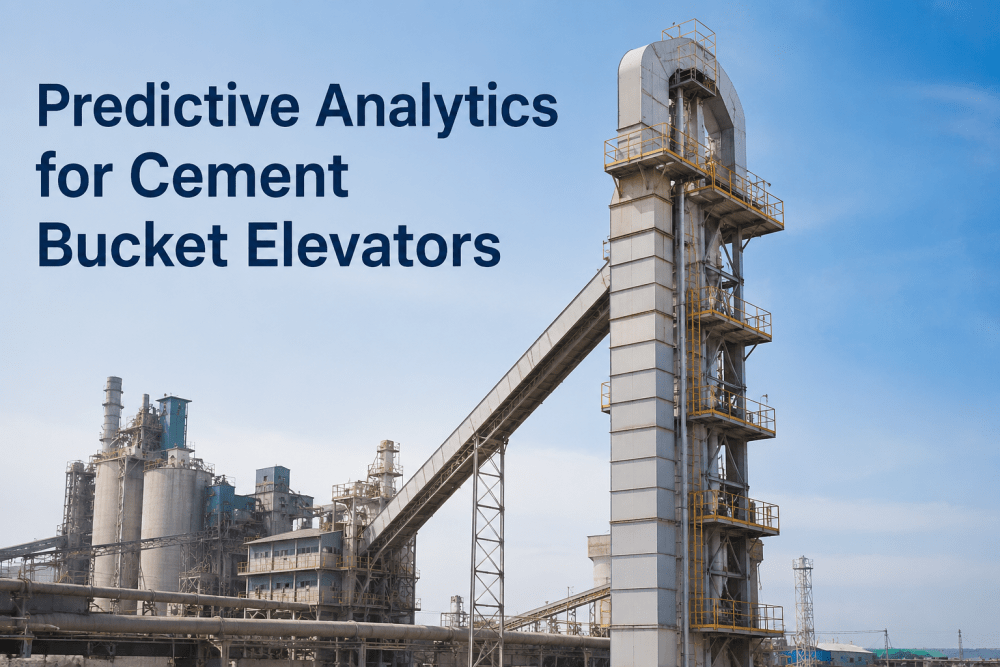
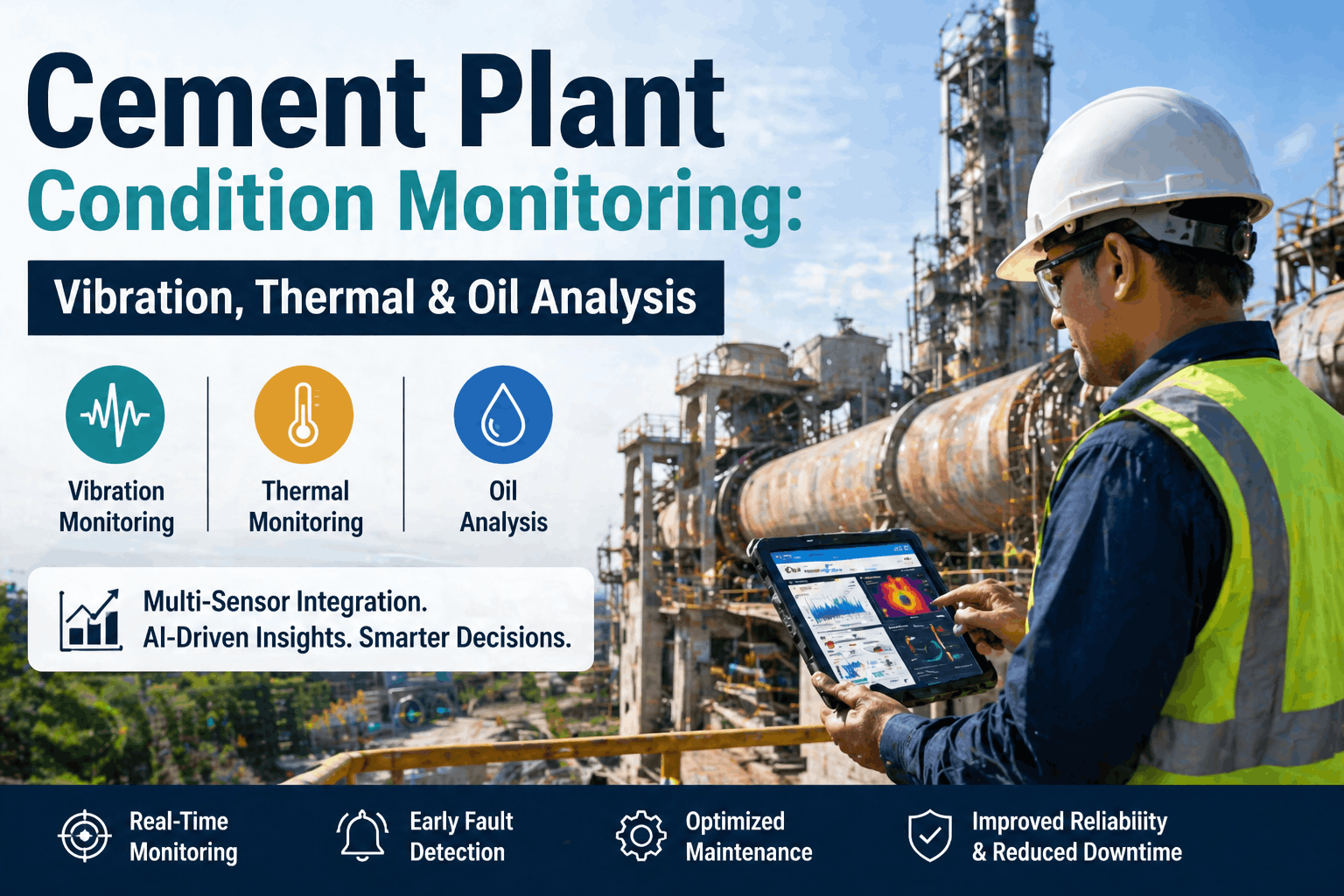
Cement plants run on the reliability of equipment that never stops moving — and few assets are more punishing, or more overlooked, than bucket elevators. These machines carry raw meal, clinker and finished cement vertically through the plant, often 24 hours a day, 365 days a year. When a bucket elevator chain snaps or a drive bearing seizes and the entire material handling chain stops. Production halts and Clinker piles up and maintenance teams face an unplanned repair that typically costs between $80,000 and $350,000 in direct costs alone — before accounting for lost throughput.
The traditional response is to run bucket elevators to failure, or to replace chains and bearings on fixed schedules that are either too early (wasting asset life) or too late (arriving after the failure has already happened). Predictive analytics changes that calculus entirely. Motor current signature analysis and vibration AI now detect chain elongation and drive wear weeks before a catastrophic failure — giving maintenance teams a planned repair window instead of an emergency shutdown. This guide shows how modern cement plants implement these technologies and what the measurable outcomes look like.
Why Bucket Elevators Fail — and Why You Don't See It Coming
Bucket elevator failures are rarely sudden. They follow a predictable degradation path that standard maintenance practices simply aren't sensitive enough to detect. Understanding this path is the foundation for understanding why predictive analytics works.
Schedule a Demo to know Why Elevators Fails
Chain Elongation
Chains stretch as pin-and-bushing wear accumulates over millions of cycles. As pitch increases beyond 2–3%, chain-to-sprocket engagement degrades, causing irregular loading pulses that accelerate further wear and eventually result in chain jump or snap.
Avg. time from measurable elongation to failure: 6–14 weeks
Drive Bearing Degradation
Head and tail shaft bearings operate under continuous load in high-dust, high-temperature environments. Lubrication breakdown triggers spalling and race wear. Vibration signatures in the 2–10 kHz band reveal bearing defect frequencies long before thermal runaway.
Detection window with vibration AI: 4–12 weeks ahead
Motor Current Anomalies
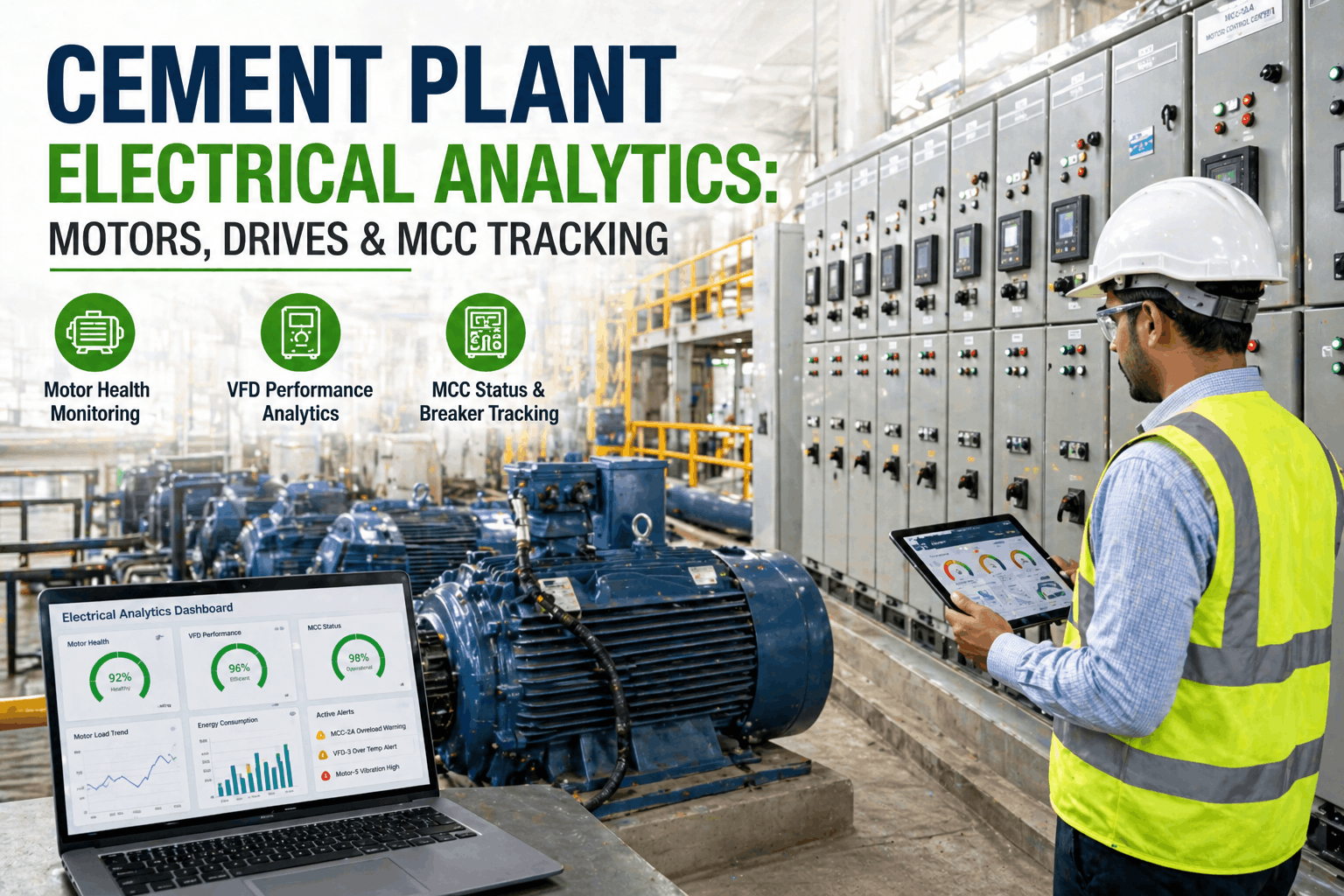
A healthy elevator draws a consistent current signature at steady-state load. Chain elongation, bucket imbalance, and mechanical binding all create current harmonics and RMS deviations that motor current signature analysis (MCSA) captures without adding any sensors to the mechanical system.
MCSA detects early faults: 3–8 weeks before failure
Structural Misalignment
Casing distortion from thermal cycling, foundation settlement, or improper tensioning shifts the chain path laterally. Buckets begin to rub the casing, accelerating wear on both the bucket attachments and the casing lining — and drawing higher current under load.
Undetected misalignment reduces chain life by: 30–50%
Motor Current Signature Analysis: How It Works in Practice
MCSA is among the most cost-effective technologies in the predictive analytics toolkit for bucket elevators — because it extracts mechanical fault data from electrical signals already available at the motor control center with no additional mechanical sensors required.Book a Demo for Motor Current Signature Analysis
01
Current Signal Acquisition
High-frequency current sensors (typically 10–50 kHz sampling) are clipped onto the motor supply cables at the MCC. No mechanical access, no production interruption. Raw current waveforms stream continuously to edge processing hardware.
02
FFT Spectral Decomposition
Fast Fourier Transform converts the time-domain current waveform into a frequency spectrum. Each mechanical fault produces characteristic sidebands around the fundamental supply frequency — chain mesh frequency, bearing defect frequencies, and rotor slot harmonics each have a predictable spectral address.
03
AI Baseline Modeling
During the first 4–6 weeks of monitoring, the AI builds a load-normalized baseline for each elevator — accounting for material density variation, throughput changes, and ambient temperature. This baseline is what makes the system context-aware rather than threshold-dependent.
04
Anomaly Detection and Trending
The AI tracks deviation from baseline across 40+ spectral features simultaneously. Early-stage faults appear as subtle trending changes — a 0.3 dB rise in a bearing defect frequency, a slight asymmetry in phase currents. The system tracks rate-of-change, not just absolute thresholds.
05
Maintenance Alert and Work Order Generation
When the AI determines a fault is confirmed and progressing, it generates a structured alert with fault type, severity, estimated remaining useful life, and recommended action. The CMMS receives the alert automatically and creates a prioritized work order with the relevant inspection procedure attached.
Vibration AI: Bearing and Structural Health from Acceleration Data
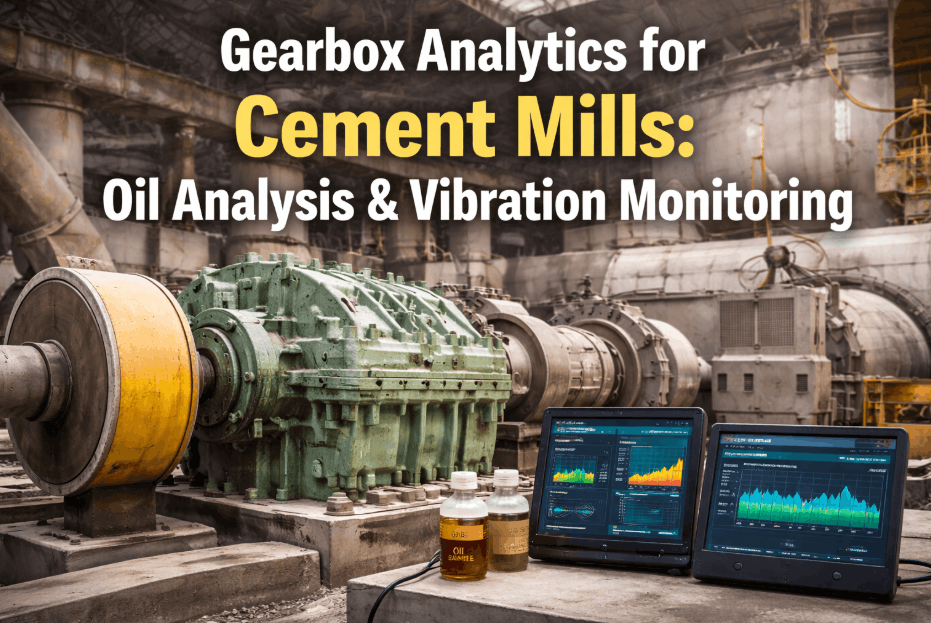
While MCSA handles motor-side diagnostics, vibration sensors mounted directly on bearing housings deliver structural health data that current analysis alone cannot provide — particularly for early-stage bearing spalling and misalignment.
| Fault Type |
Vibration Frequency Band |
Detection Method |
Typical Detection Lead Time |
Action Triggered |
| Head shaft bearing — outer race |
BPFO × shaft speed harmonics |
Envelope analysis (HFR) |
8–12 weeks |
Plan bearing replacement at next kiln stop |
| Head shaft bearing — inner race |
BPFI × shaft speed harmonics |
Envelope + kurtosis |
6–10 weeks |
Schedule shutdown within 30 days |
| Chain elongation — sprocket engagement |
Chain mesh frequency ± sidebands |
Spectral band energy trending |
4–8 weeks |
Inspect chain stretch; measure pitch deviation |
| Bucket imbalance / missing bucket |
1× and 2× rotational frequency |
Time-synchronous averaging |
Immediate (hours) |
Stop for inspection within 24 hours |
| Structural misalignment |
Broadband RMS increase + 1× axial |
Multi-axis RMS trending |
2–6 weeks |
Measure casing alignment; adjust tensioner |
| Tail shaft bearing — rolling element |
BSF harmonics + sidebands |
Envelope analysis |
6–12 weeks |
Plan replacement at scheduled maintenance |
Running bucket elevators without predictive analytics costs cement plants $80K–$350K per unplanned failure — before lost production.
iFactory's AI monitoring platform integrates MCSA and vibration analytics with your existing CMMS to deliver structured alerts, automated work orders, and 4–12 weeks of detection lead time on every major bucket elevator failure mode.
Implementation Roadmap: From First Sensor to Full Fleet Coverage
Most cement plants operate 6–20 bucket elevators across raw mill, kiln, and finish mill circuits. A structured rollout — starting with the highest-criticality assets and expanding from there — delivers ROI within the first monitored failure prevented.
Phase 1 — Weeks 1–2
Asset Criticality Ranking and Sensor Specification
Map all bucket elevators to their circuit, throughput dependency, and average unplanned downtime cost. Rank by criticality index. Select the 3–5 highest-criticality elevators for Phase 1 deployment. Specify sensor placement: MCSA clamps at MCC, triaxial accelerometers on head and tail bearing housings, and optional temperature sensors on drive gearboxes.
Output: Criticality ranking, sensor BOM, installation plan
Phase 2 — Weeks 3–4
Edge Hardware Installation and Data Stream Validation
Install edge compute nodes near each elevator's MCC. Connect current sensors and vibration sensors. Validate data stream quality — sampling rate, signal-to-noise ratio, timestamp synchronization. Confirm CMMS integration is receiving asset IDs and can accept automated work order creation via API.
Output: Live data streams from Phase 1 elevators, CMMS integration confirmed
Phase 3 — Weeks 5–10
AI Baseline Learning and Threshold Calibration
The AI models build load-normalized baselines for each elevator across the full range of operating conditions. Maintenance teams review early alerts, confirm or reject fault classifications, and feed that label data back into the model. By the end of this phase, false positive rates typically drop below 8% and detection sensitivity is fully calibrated to the specific plant and material conditions.
Output: Calibrated AI models, less than 8% false positive rate, first real fault detections
Phase 4 — Months 3–6
Fleet Expansion and Cross-Asset Analytics
Roll monitoring out to the full bucket elevator fleet. Cross-asset analytics begin identifying patterns — elevators in a specific circuit showing correlated wear rates, or a common bearing model failing at predictable intervals across multiple units. PM schedules are revised based on actual condition data rather than OEM fixed intervals, typically extending component life by 15–25%.
Output: Full fleet coverage, revised PM schedules, cross-asset insights active
Phase 5 — Month 6 onward
Continuous Optimization and ROI Reporting
Monthly ROI reporting tracks unplanned failures prevented, planned repair cost vs. emergency repair cost, and component life extension value. AI models continue retraining on accumulated production data. Most cement plants achieve full payback within 8–14 months, with ongoing annual savings of $400,000–$1.2M depending on fleet size and failure history.
Output: Full payback in 8–14 months, $400K–$1.2M annual savings at scale
The Business Case: Reactive vs. Predictive Cost Comparison
The financial argument for bucket elevator predictive analytics is straightforward. The question is never whether to invest — it's how quickly the investment pays back. The comparison below is based on a mid-size cement plant operating 10 bucket elevators with historical failure rates typical for the industry.
Reactive Maintenance Model
Run-to-failure with fixed PM schedules
Unplanned failures per year (10 elevators)
3–5 events
Average repair cost per failure (parts + labor)
$85,000–$210,000
Average downtime per failure
18–72 hours
Lost production cost per failure
$40,000–$180,000
Annual component replacement (over-scheduled PM)
$120,000–$200,000
Total annual cost (mid-estimate)
$650,000–$1,400,000
Predictive Analytics Model
MCSA + vibration AI with CMMS integration
Unplanned failures per year (10 elevators)
0–1 events
Planned repair cost per intervention
$18,000–$55,000
Average downtime per planned repair
4–8 hours
Lost production cost per planned repair
$6,000–$22,000
Annual component replacement (condition-based)
$75,000–$130,000
Platform cost (sensors + software + support)
$90,000–$160,000/yr
Net annual savings: $400,000–$1,200,000
Expert Review: What Works — and What Fails — in Cement Plant Implementations
What consistently works
MCSA deployed at MCC level — no mechanical access required, no production downtime for installation, and current data is already available at every motor. This is the fastest, lowest-disruption path to early fault detection in elevator drives.
Vibration sensors on head bearing housings with wireless transmission — eliminates cable routing through dusty elevator casings and allows sensor repositioning as operating conditions change.
CMMS-integrated alert routing — alerts that create work orders automatically in the CMMS get acted on. Alerts that go to a separate monitoring dashboard get ignored within 90 days as alert fatigue sets in.
Focusing the first phase on the 3 highest-criticality elevators and building a confirmed success story before expanding to the full fleet. This overcomes maintenance team skepticism faster than a fleet-wide rollout with thin coverage.
Where implementations fail
Sensor placement without a vibration specialist present. Head shaft bearings on bucket elevators require accelerometer mounting on the load zone side of the bearing housing — a detail that's correct in fewer than half of self-directed installations.
Setting fixed threshold alerts instead of AI-modeled baselines. Fixed thresholds on heavily variable-load equipment like bucket elevators produce false positive rates above 30%, which kills operator trust within weeks.
Skipping the 4–6 week baseline learning period and jumping to production alerts. Models calibrated on less than 4 weeks of data miss the full range of normal operating conditions and generate excessive false alerts during season changes or throughput shifts.
Treating the platform as a technology project rather than a maintenance workflow change. The technology is straightforward — the behavioral change (maintenance teams trusting algorithm alerts and acting on them before failure is visible) is where most implementations stall.
The first unplanned bucket elevator failure your analytics platform catches pays for the entire deployment — typically within 90 days of go-live.
iFactory's cement industry specialists have deployed MCSA and vibration AI on bucket elevator fleets from 4 to 28 units. Every deployment includes sensor placement validation, CMMS integration, and a 90-day false-positive tuning period.
Conclusion: The Detection Window Is the Asset
Bucket elevator predictive analytics is not complex technology in isolation — MCSA and vibration analysis have existed for decades. What has changed is the AI layer that converts continuous multi-parameter sensor streams into actionable, context-aware alerts weeks before failure, without the false positive rates that made earlier threshold-based systems impractical in high-variability cement plant environments.
The economics are straightforward. A single prevented unplanned failure on a high-criticality clinker elevator — with typical repair costs of $150,000 and 36 hours of kiln-constrained production loss — pays for a year of monitoring across the entire elevator fleet. The question cement plant maintenance directors consistently face is not whether to implement predictive analytics on their bucket elevators. It is how quickly they can get the AI baseline established and the first fault detected. Every week of reactive operation is a week of undetected chain elongation and bearing wear accumulating toward the next failure.
Frequently Asked Questions