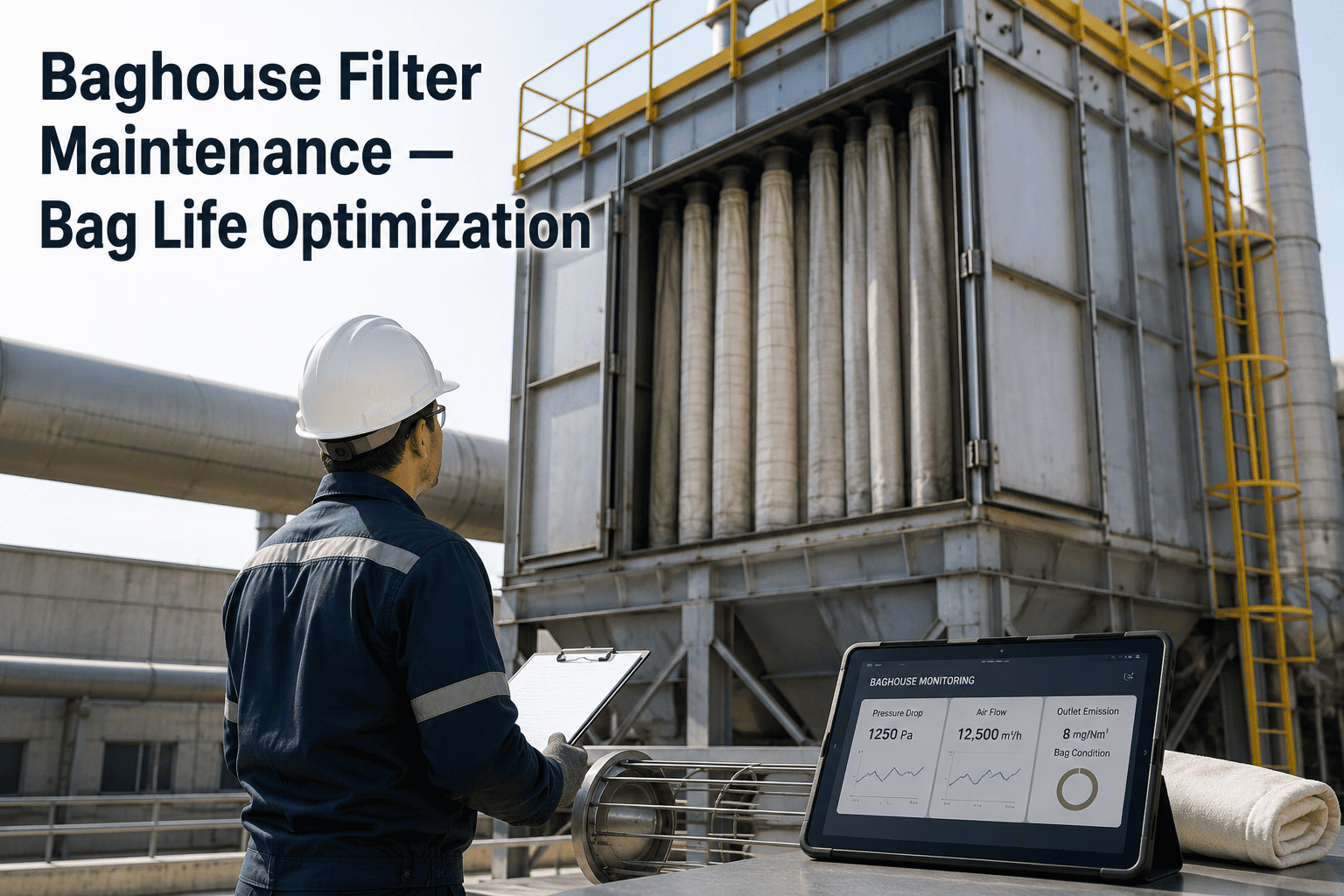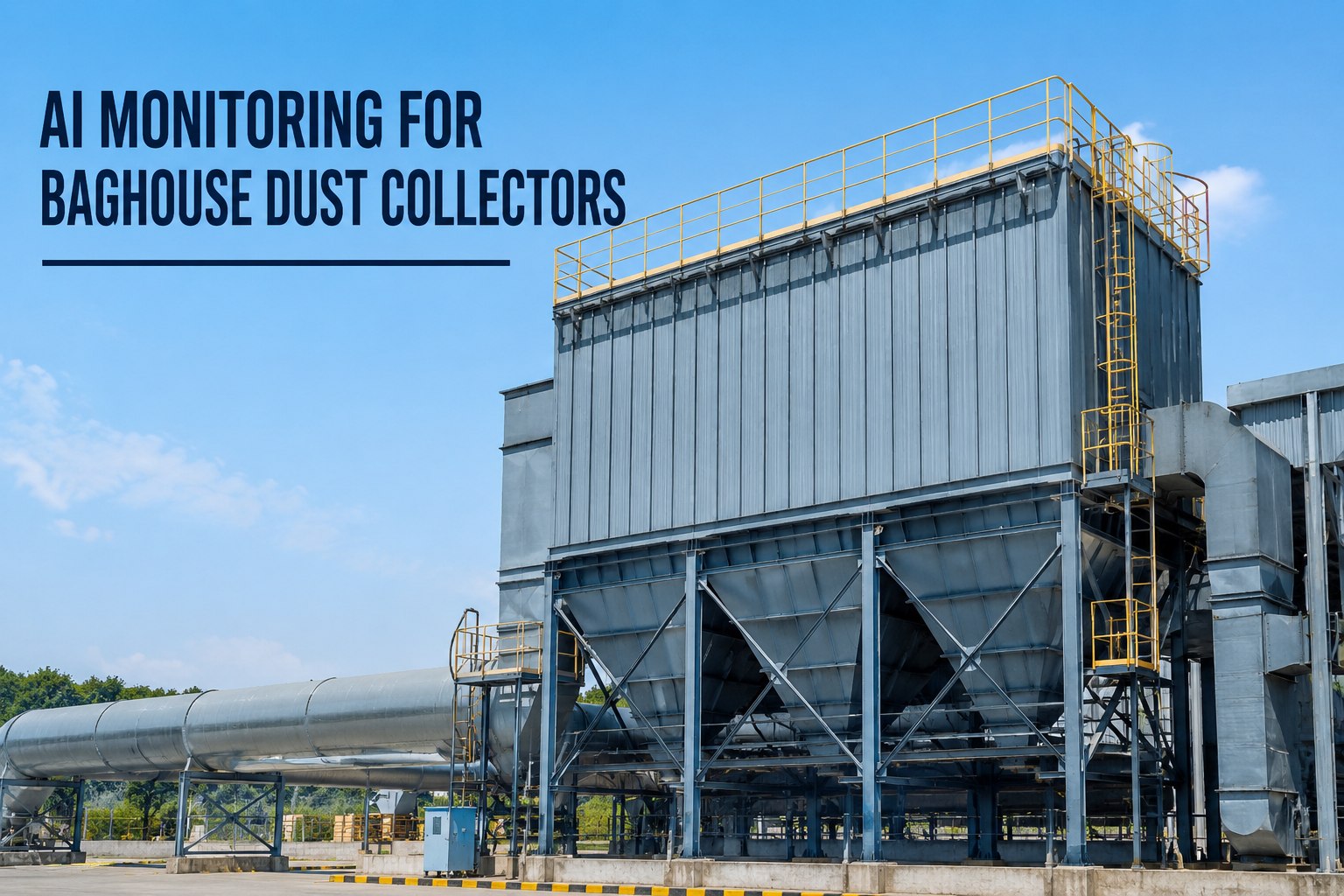
Baghouse dust collectors are the last line of defense between a cement plant's production process and its regulatory compliance record. When a filter bag blinds — choked with fine particulate that pulse-jet cleaning can no longer dislodge — differential pressure climbs, airflow drops, and the plant faces a choice between unplanned downtime for emergency bag replacement or running at reduced capacity until the next scheduled maintenance window. Neither option is acceptable in a facility where kiln throughput drives every financial metric. AI monitoring for baghouse dust collectors changes that calculus entirely — integrating differential pressure sensors, temperature data, and cleaning cycle telemetry into a predictive model that identifies blinding progression weeks before it becomes an emissions event or an unplanned shutdown. If your cement plant is still managing baghouse performance on fixed replacement schedules or operator walkarounds, Book a Demo to see how iFactory's AI platform predicts filter blinding before it costs you a compliance violation.
AI Monitoring for Baghouse Dust Collectors
Why Baghouse Filter Blinding Is a Compliance and Throughput Risk
A baghouse filter does not fail catastrophically. It degrades — gradually, predictably, and invisibly to operators relying on periodic manual checks or fixed-interval replacement schedules. Filter blinding is the accumulation of fine particulate within the filter media itself, as opposed to the surface cake that pulse-jet cleaning is designed to remove. Once blinding begins, differential pressure rises progressively. Airflow through the collector drops. The induced draft fan — operating at a fixed RPM — cannot compensate indefinitely. At some point, the kiln or raw mill it serves must reduce throughput or the plant exceeds its permitted emission limit for particulate matter.
For U.S. cement facilities operating under EPA NESHAP 40 CFR Part 63 Subpart LLL or state-level Title V permits, exceeding opacity or PM emission limits triggers NOV (Notice of Violation) exposure that starts at $37,500 per day per violation under Clean Air Act Section 113. The operational cost is equally serious — emergency bag replacements on a 6,000-bag baghouse run $180,000 to $400,000 in parts and labor, plus the production loss from unplanned kiln shutdown. The fundamental problem is that conventional monitoring does not see blinding coming. Differential pressure gauges read the current state. Operators read the gauges on rounds. By the time the gauge shows a problem, the problem is already expensive.
The Four Data Streams That Power Baghouse AI
Baghouse AI is not a single sensor. It is the integration of four distinct data streams — each of which is individually insufficient, but together create a predictive model that can identify blinding progression 48–96 hours before it becomes an operational or compliance event. iFactory's sensor integration architecture ingests all four streams in real time through standard industrial protocols and normalizes them into a unified monitoring model.
Differential Pressure Monitoring
Differential pressure across the filter media is the primary blinding indicator — the delta between inlet and outlet static pressure measured in inches of water column (in. w.c.). A healthy baghouse in a cement raw mill application typically runs 4–6 in. w.c. As bags blind, DP climbs. The AI model does not just monitor current DP — it analyzes the rate of DP rise between cleaning cycles, the DP recovery profile after each pulse-jet event, and the long-term baseline drift across compartments. These three signals together identify blinding 3–5 weeks before DP reaches the alarm threshold a conventional gauge would trigger.
iFactory integrates with existing Magnehelic gauges fitted with 4–20mA transmitters, or with installed differential pressure transmitters from Rosemount, Dwyer, or equivalent via Modbus or HART. No new sensing infrastructure required in most installations.
Temperature Monitoring
Inlet gas temperature is the second critical parameter. Cement plant baghouses handle gas streams at 180–320°F in normal operation. Temperature excursions above design limits — from kiln upsets, raw material changes, or cooling system malfunctions — accelerate bag degradation in ways that DP alone cannot detect. Conversely, temperature drops below acid dewpoint (typically 250–280°F for high-sulfur clinker) cause condensation on bag surfaces, which creates a sticky particulate layer that pulse-jet cleaning cannot remove — the fastest path to catastrophic blinding.
iFactory's AI correlates temperature data with DP trends to distinguish normal blinding progression from temperature-accelerated degradation events — enabling maintenance teams to respond differently to each failure mode rather than treating all DP rises as equivalent.
Cleaning Cycle Telemetry
Pulse-jet cleaning cycles generate a rich stream of diagnostic data that most facilities completely ignore. Cleaning frequency — how often the controller triggers a pulse to a given compartment row — is a direct function of how quickly DP rises after each cleaning event. When blinding progresses, cleaning frequency accelerates as the controller fights to keep DP in range. iFactory monitors cleaning cycle frequency, pulse duration, compressed air pressure at the manifold, and the DP recovery achieved by each pulse event.
The AI model tracks the ratio of cleaning energy input to DP recovery output over time. A declining ratio — more cleaning energy required to achieve the same DP drop — is the earliest detectable signature of surface blinding transitioning to depth blinding. This pattern typically becomes measurable 4–6 weeks before DP reaches operator-visible alarm levels.
Opacity and Particulate Matter Monitoring
Continuous Opacity Monitoring Systems (COMS) and Continuous Particulate Matter monitors (CPMS) required under EPA NESHAP are typically used only for regulatory reporting. iFactory integrates COMS and CPMS data as a fourth input stream — correlating opacity and PM readings against DP, temperature, and cleaning cycle data to build a multi-parameter model of filter condition. Opacity spikes that correlate with low DP may indicate bag failure (holes or seam separation), while opacity increases correlated with high DP and declining cleaning efficiency confirm blinding rather than mechanical failure.
This failure mode discrimination changes the maintenance response: blinding requires planned bag replacement; mechanical failure requires emergency inspection and may require partial compartment isolation. The AI model enables your maintenance team to dispatch the right response, not the most expensive one.
Blinding Detection vs. Reactive Monitoring: The Performance Gap
The operational and financial performance differential between cement plants using AI predictive blinding detection and those relying on conventional threshold monitoring is not a matter of degree — it is a structural difference in when the plant knows about a problem and what response options remain available. The comparison below is based on documented performance data from cement manufacturing operations that have transitioned from conventional baghouse monitoring to iFactory's AI platform.
Implementation Sequence — From Sensor Integration to Predictive Alert
iFactory's baghouse AI monitoring deployment follows a four-phase implementation sequence designed to reach full predictive capability within 30 days — without interrupting production operations or requiring baghouse downtime for sensor installation. The sensor integration is entirely non-invasive: we connect to existing transmitters and controllers through standard industrial protocols.
1
Sensor Audit and Protocol Integration
Existing DP transmitters, temperature sensors, COMS/CPMS outputs, and baghouse controller I/O mapped and verified. Protocol connections established via Modbus RTU/TCP, HART, OPC-UA, or direct 4–20mA — whichever is already wired. iFactory edge gateway installed in the MCC room with no baghouse shutdown required. Data flow verified to cloud historian within 48 hours of gateway installation.
2
Baseline Modeling and Historical Calibration
AI model trained on available historical DP, temperature, and cleaning cycle data — typically 6–18 months available from existing SCADA historian. Normal operating envelopes established per compartment, per shift, per production campaign type. Baseline DP profiles calibrated against known good filter condition periods. Model validated against any documented blinding or bag replacement events in the historical record before live prediction begins.
3
Alert Threshold Configuration and Compliance Integration
Pre-exceedance alert thresholds configured against your specific Title V or NESHAP permit limits — not generic defaults. Compliance margin alerts set at 75%, 85%, and 95% of permitted opacity and PM limits. CMMS work order auto-generation configured: blinding alerts trigger planned replacement work orders 72 hours before predicted threshold breach. Mechanical failure alerts trigger priority inspection work orders with compartment isolation procedures attached.
4+
Live Prediction and Continuous Model Refinement
Full predictive monitoring live. Every bag replacement event feeds back into the model — actual condition at replacement versus predicted condition, actual time-to-blinding versus predicted, actual compliance margin at replacement. Model accuracy improves with each cycle. 90-day performance report benchmarks post-deployment unplanned shutdown rate, energy consumption at the ID fan, and bag replacement cost per production tonne against pre-deployment baseline.
The Financial Case: ROI Across Three Value Streams
The ROI calculation for baghouse AI monitoring is driven by three quantifiable financial streams — each independently significant, and together typically delivering full cost recovery within 4 to 7 months of deployment at a mid-size cement facility. The following figures are based on a representative 4,000-tonne-per-day clinker facility with two primary kiln baghouses and four raw mill baghouses.
Expert Perspective: What Changes When Baghouse Monitoring Becomes Predictive
Conclusion: Baghouse Monitoring Is Not an Operational Detail — It Is a Compliance Strategy
Baghouse dust collector monitoring is not a maintenance optimization project. It is the technical foundation of your facility's regulatory compliance posture. A cement plant that cannot predict filter blinding with sufficient lead time to schedule planned replacement is a plant that will, eventually, generate a compliance exceedance event — not because of negligence, but because conventional monitoring is structurally incapable of providing the advance warning that intelligent scheduling requires.
iFactory's baghouse AI monitoring platform deploys in 30 days, integrates with your existing sensor infrastructure without requiring baghouse downtime, and delivers 48–96 hours of advance warning before blinding reaches your compliance threshold. The differential pressure data is already flowing through your transmitters. The cleaning cycle telemetry is already being generated by your baghouse controller. The COMS data is already required by your permit. iFactory is the intelligence layer that connects those three streams into a predictive model that tells your maintenance team what to do, when to do it, and why — before the problem becomes visible to anyone else.
Frequently Asked Questions
Normal DP variation in a cement baghouse follows predictable patterns — it rises with increasing inlet dust loading (kiln feed rate, raw mill throughput), drops after pulse-jet cleaning cycles, and tracks diurnally with temperature-driven gas volume changes. iFactory's AI model builds a baseline of these normal variation patterns per compartment, per production mode, and per ambient condition range. Blinding onset is detected not from the absolute DP value, but from deviations in three secondary signals: the rate at which DP rises between cleaning events (accelerating rate signals blinding), the magnitude of DP drop achieved by each cleaning event (declining recovery signals depth blinding), and the inter-cleaning interval required to maintain target DP (shortening interval signals controller fighting against blinding progression). These three signals together are detectable 4–6 weeks before absolute DP reaches threshold levels that would trigger a conventional alarm.
Yes — in the majority of U.S. cement facility deployments, no new sensing infrastructure is required. iFactory's edge gateway connects to existing DP transmitters, temperature sensors, baghouse controllers, and COMS/CPMS outputs through standard industrial protocols: Modbus RTU, Modbus TCP/IP, OPC-UA, HART, or direct 4–20mA signal acquisition. The gateway installs in the MCC room or a local control panel and communicates with iFactory's cloud platform over a secure HTTPS connection. For facilities that have existing SCADA or DCS historians — Wonderware, OSIsoft PI, Ignition, or equivalent — iFactory can also ingest historical data directly from the historian API, which both accelerates baseline model training and eliminates any requirement for the edge gateway to poll field devices directly. Integration configuration is typically completed in 3–5 days of plant IT and instrumentation team involvement.
iFactory models each compartment independently. Large kiln baghouses with 4, 6, or 8 compartments typically show significant variation in blinding rates between compartments — driven by non-uniform inlet gas distribution, variations in bag age across replacement zones, and differences in cleaning system performance (failed diaphragm valves, blocked nozzle rows) per compartment. The platform maintains a separate predictive model for each compartment and generates compartment-specific replacement recommendations and compliance risk scores. The plant operations dashboard displays a compartment-level heat map showing current blinding progression state across the full baghouse — maintenance teams can immediately identify which compartments are approaching replacement threshold versus which have remaining service life, enabling surgical replacement of the highest-risk compartments during planned outages rather than full-baghouse replacement on schedule.
Yes — CMMS integration with automated work order generation is a standard deployment feature, not an add-on. iFactory integrates with SAP PM, IBM Maximo, Infor EAM, Fiix, and other common CMMS platforms via REST API. When the AI model predicts blinding threshold breach within the configured alert window (default 72 hours, configurable 24–120 hours), it automatically generates a planned replacement work order in the CMMS with the predicted compartment, predicted breach date and time, current DP trend data attached, and the recommended bag quantity from the spare parts module. The work order is routed to the maintenance supervisor for approval — human authorization is retained in the workflow; the AI generates the recommendation and the draft work order, but a supervisor confirms before crew mobilization. For facilities where bag inventory is managed through the CMMS, iFactory's parts module also triggers a procurement alert if the required bag quantity is not confirmed in stock at the time the work order is generated.
Cement facilities deploying iFactory's baghouse AI monitoring typically achieve full platform cost recovery within 4 to 7 months. The primary ROI driver in most deployments is the elimination of unplanned kiln-down emergency replacement events — at $180,000 to $400,000 per event in parts, labor, and lost production, a single avoided emergency event typically covers 6 to 12 months of platform subscription cost. Secondary ROI streams from bag material cost savings through condition-based replacement extension (18–35% life extension at $60,000 to $120,000 per replacement cycle) and energy savings from eliminating elevated-DP fan operation (15–25% ID fan energy reduction, typically $8,000 to $18,000 per month per baghouse) are additive and significant. iFactory provides a site-specific ROI model using your facility's bag replacement history, emergency event history, permit limits, and energy rates at no cost during the evaluation process — before any commitment is made.