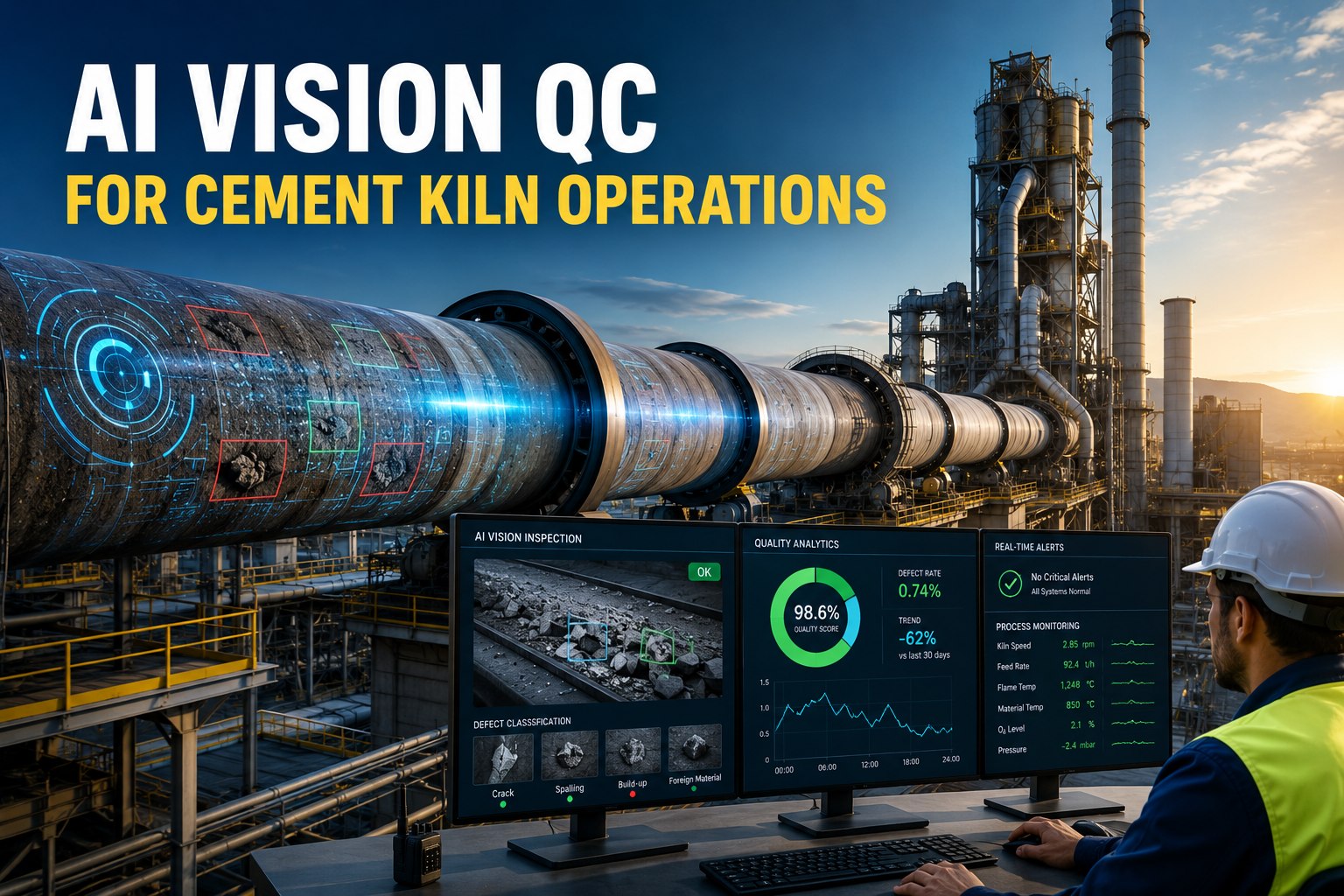
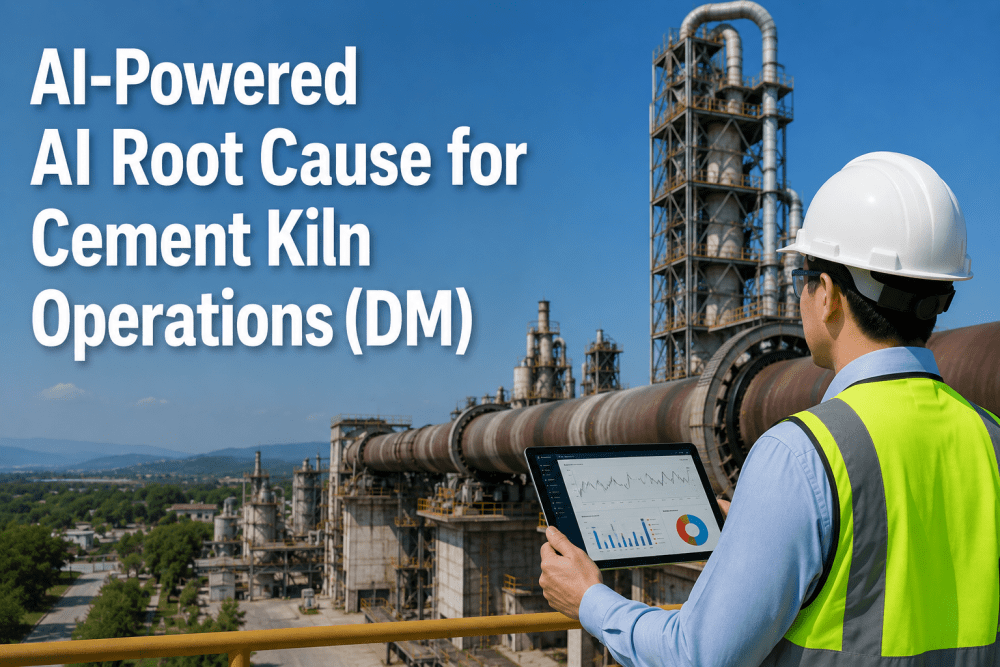
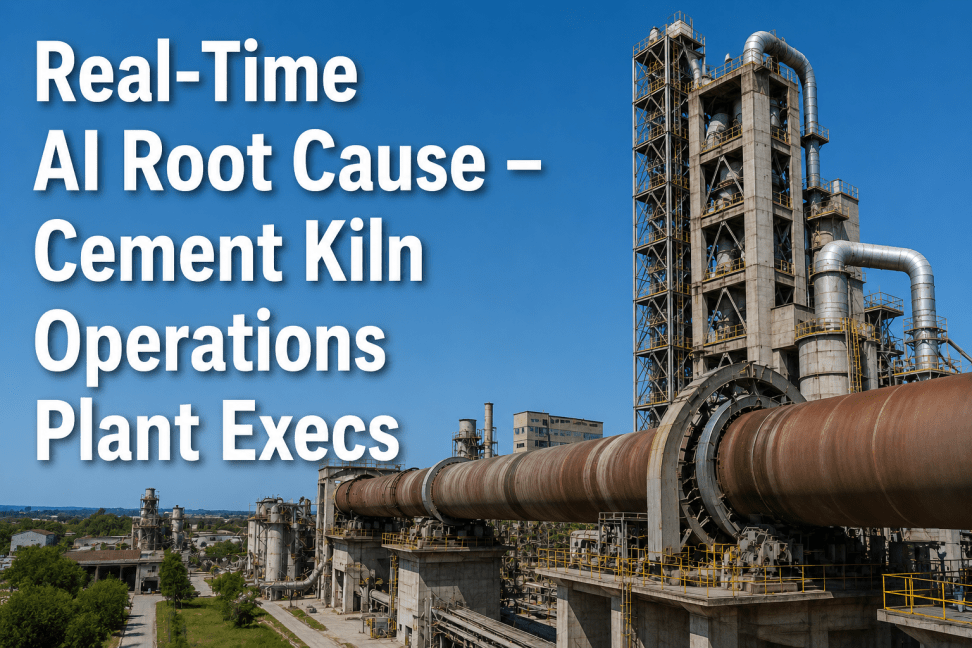
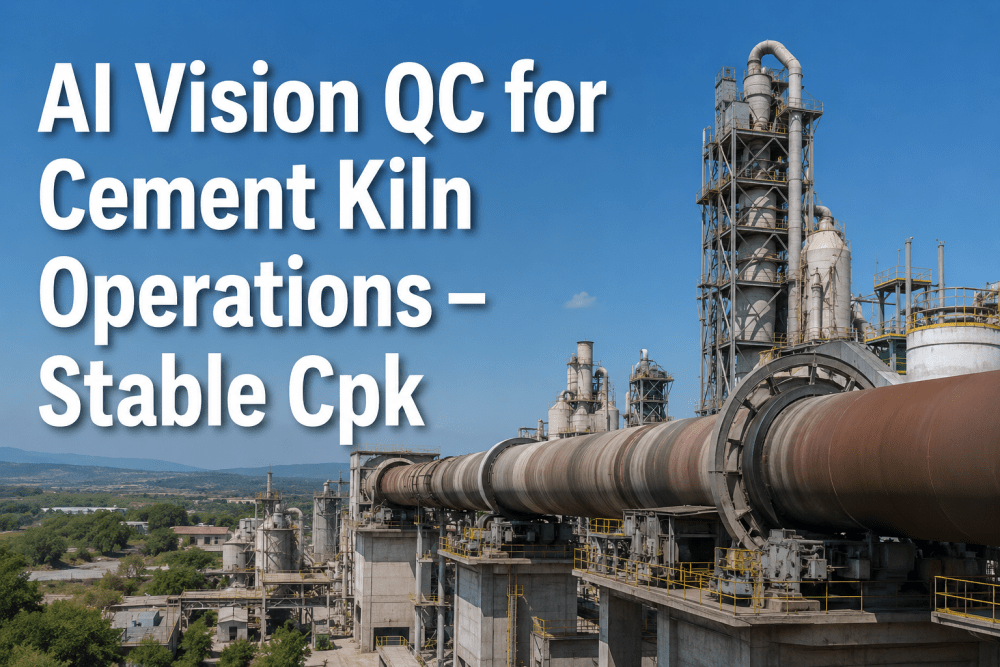
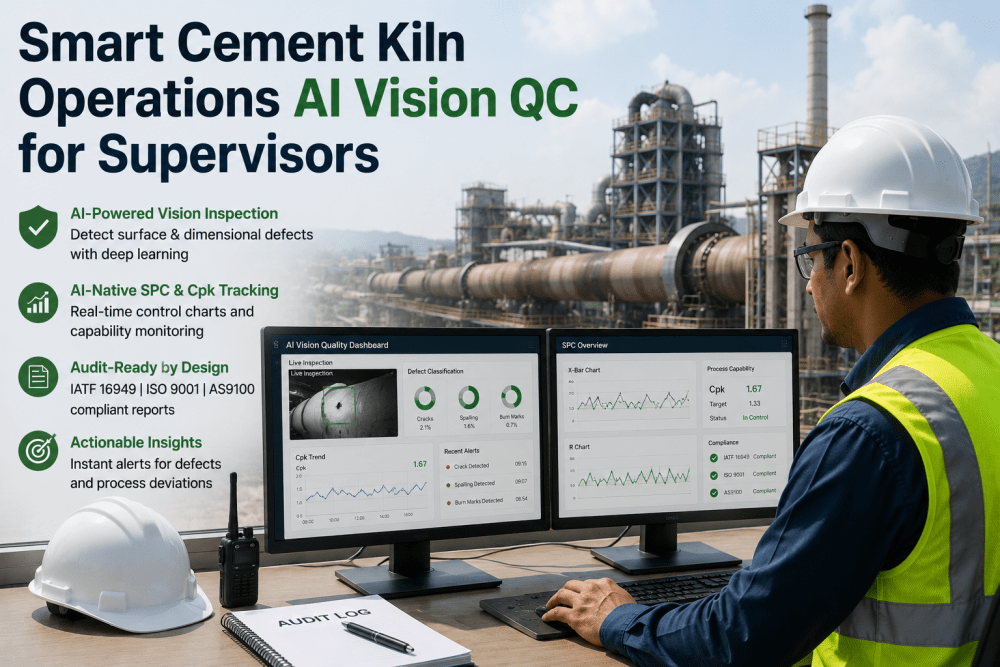
A cement kiln runs at 1,450°C, twenty-four hours a day, three hundred sixty days a year. Inside that fireball, a flame shape changes by the second, clinker nodules form and break, refractory bricks lose millimeters of life, and dust occludes every camera lens. For a digital manufacturing director, this is the single hardest visual environment in heavy industry — and it’s where AI vision quality for cement kiln operations is now delivering 30–70% defect reduction at plants that were already considered well-run. The shift isn’t about adding more cameras. It’s about turning the cameras you already have into an always-on deep-learning inspector that sees what fatigued operators miss, correlates what siloed systems can’t, and acts before the next tonne of off-spec clinker leaves the cooler.
Where Vision AI Lives Inside Your Kiln Line
Five inspection zones, one unified deep-learning platform — running on the cameras you already have.
For digital transformation leaders, the question is no longer “does vision AI work on a kiln?” — the academic literature answered that with YOLOv8 models hitting 98.8% mean average precision on flame and clinker identification at 25 frames per second. The real question is how to operationalize it across an entire production line in a way that pays back in months, not years. Book an AI manufacturing roadmap session to map it for your plant.
The Five Vision AI Use Cases That Actually Move the Needle
Not every camera installation is a vision AI project. The plants generating real ROI focus on five high-value zones where human inspection is either dangerous, fatigued, or simply too slow. Each of these maps to a specific deep-learning model architecture and a measurable defect-elimination KPI.
01
Burning Zone Flame Analysis
Deep-learning models (YOLOv8, CNN) segment flame, plume, and clinker regions from kiln-camera video at 25 FPS. The model classifies burning state — under-burnt, normal, over-burnt — and predicts free lime trend before lab sampling.
98.8%flame/clinker detection accuracy at 25 FPS
02
Kiln Shell Thermal Mapping
Infrared line-scanners feed continuous shell-temperature maps into a CNN that learns each kiln’s baseline thermal signature. Anomalies as small as a 20°C deviation flag refractory thinning weeks before failure.
30%longer refractory life via early detection
03
Clinker Cooler Exit Inspection
High-resolution vision at the cooler exit measures clinker nodule size distribution, color (a proxy for burning quality), and the presence of dust rings or snowman formation that signal cooler instability.
100%clinker coverage vs. 2–3 manual samples/min
04
Conveyor & Belt Surveillance
Edge-AI cameras detect belt misalignment, material spillage, surface tears, and — critically — hot clinker fragments that can ignite belts. Inference under 200 ms triggers automated stop sequences before fire risk.
<200 msdetection-to-alert latency on edge
05
Bag & Dispatch Quality
Line-scan cameras inspect every cement bag for print misregistration, weight-fill defects, seal failures, and tear damage. Defective units are auto-rejected before they reach the customer pallet.
~80%human-inspector baseline replaced with 24/7 coverage
See All Five Live
Walk through each vision model running on real cement plant data in a 30-minute working session.
From Pixels to KPIs: How a Single Frame Becomes a Defect-Prevention Decision
The director’s real question isn’t about model accuracy — it’s about workflow. What happens between a camera capturing a frame and an operator changing a setpoint? In a mature deployment, that loop closes in milliseconds, not meetings. Here’s the four-stage pipeline that makes it work.
1
Capture & Preprocess
Existing kiln cameras, IR scanners, and conveyor cams stream over OPC-UA / RTSP. Edge gateways handle dust correction, exposure normalization, and frame buffering.
Hardware-agnostic
2
Deep-Learning Inference
YOLOv8 and CNN models segment, classify, and score each frame on-edge. Detection of burning state, defects, and anomalies happens under 200 ms — faster than the next operator glance.
Edge AI
3
Correlate & Predict
Vision outputs fuse with DCS tags — kiln zone temperatures, NOx, feed rate, fuel flow — through adaptive SPC. Free lime is predicted 30–90 min before lab confirmation.
Multimodal fusion
4
Act & Audit
Prescriptive setpoint guidance arrives on the operator HMI; auto-reject triggers fire on the bagger; every event logs into a signed CAPA trail for ISO and ESG audit readiness.
The Director’s ROI Picture: What the Numbers Actually Look Like
Vision AI projects fail when they’re scoped as point solutions. They succeed when they’re scoped as a defect-elimination program with verifiable monthly metrics. Here’s the impact pattern across cement plants that have moved past pilot.
30–70%
Defect rate reduction
Across surface, dimensional, thermal, and process defects when vision AI runs across all five zones
50–70%
Quality variation drop
Continuous 100% inspection eliminates the sampling gaps where defects historically slipped through
90 days
Time to measurable ROI
Typical window from go-live to verified defect reduction signed off by finance, not the vendor
$50K–$100K
Per-hour kiln stoppage avoided
Refractory hotspot detection alone justifies the program when one prevented kiln stop pays for the year
3–5%
Thermal energy reduction
Flame analysis enables tighter burning zone control, eliminating over-burn fuel consumption per tonne of clinker
$250B
AI vision market by 2035
Up from $32B in 2025 — the speed of adoption is the strategic risk for directors who delay
Build Your Vision AI Roadmap
Get a plant-specific AI manufacturing roadmap session covering zone prioritization, camera audit, model selection, MES/DCS integration, and a finance-grade ROI projection for your kiln line.
Why “Just Add Cameras” Fails — And What Actually Works
Most failed vision AI pilots share a pattern: a camera vendor was hired before a deep-learning architect, integration with the DCS became an afterthought, and the model was trained on generic data instead of plant-specific failure history. Here’s the architecture pattern that separates pilots that scale from pilots that stall.
Pilots That Stall
Camera-First Thinking
New hardware specified before the use case is defined
Off-the-shelf models trained on non-cement images
No connection to DCS, LIMS, or CMMS — alerts die in a dashboard
Single-zone proof-of-concept, no plant-wide roadmap
ROI measured by “model accuracy” not defect-rate reduction
Pilots That Scale
Outcome-First Architecture
Use cases ranked by defect-cost first; cameras follow the priorities
Models retrained on the plant’s own failure history and grades
Vision outputs fused with DCS/LIMS; alerts close as CAPA tickets
Phased plant-wide roadmap with monthly verified ROI reporting
Success metric is defect-rate reduction, signed off by finance
"The strategic mistake most digital directors make on vision AI is treating it as a quality department project. It isn’t. It’s a production-line nervous system. When flame analysis, shell scanning, clinker sizing, and conveyor surveillance all flow into the same fused model, you’re not buying inspection — you’re buying a real-time observability layer the plant has never had before. That’s the lens that produces 30–70% defect reduction. Pilots that stall always treat it as a single-camera tool."
— Industrial Vision AI Architecture, Cement 4.0 Practitioner Insight
35%
of cement plants already running IoT at extensive scale
25 FPS
real-time YOLOv8 inference on kiln flame imagery
2–4 hr
lab-result lag eliminated by vision-based prediction
Conclusion: The Director’s Window to Lead, Not Catch Up
The cement industry is in the middle of a vision-AI inflection that mirrors the predictive-maintenance shift of the last decade — except this time the timeline is faster. With 35% of heavy-industry plants already running IoT at extensive scale and another 41% experimenting, the directors who define their plant’s vision AI roadmap in 2026 will be operating with a measurable inspection advantage by 2027. Those who wait will be matching it. The technology has matured past pilot risk: 98.8% precision flame analysis, sub-200 ms edge inference, 30–70% verified defect reduction. What remains is the architectural decision — treating vision AI as a plant-wide observability layer rather than another camera contract — and the discipline to scope it as an outcome program with monthly finance-verified KPIs. Both are within a single roadmap session of being decided.
Lead Cement 4.0 From Your Plant
iFactory’s Vision AI platform deploys across your existing camera infrastructure, fuses with your DCS and LIMS, and delivers measurable defect reduction within 90 days. Get a free roadmap session built around your kiln, your grades, and your priorities.
What is AI vision quality for cement kiln operations?
AI vision quality for cement kiln operations is the application of deep-learning computer vision — typically YOLOv8, CNN, and transfer-learning architectures — to continuously inspect five high-value zones of the kiln line: burning zone flame, kiln shell thermal profile, clinker cooler exit, conveyor surveillance, and bag dispatch. Models run on edge gateways under 200 ms per frame, fuse with DCS and LIMS data, and trigger prescriptive operator guidance or automated rejection. The outcome is 30–70% defect reduction, 50–70% quality variation drop, and continuous 24/7 coverage that replaces fatigued manual sampling.
Do we need to replace our existing cameras and DCS to deploy vision AI?
No. Modern vision AI platforms are explicitly hardware-agnostic. They consume video streams from your existing kiln cameras, IR shell scanners, and conveyor cams over RTSP or OPC-UA, and integrate with your current DCS, SCADA, MES, and LIMS through standard industrial protocols. Edge gateways handle dust correction and inference locally so no cloud upload is required for time-critical decisions. Most cement plants reach measurable ROI within 90 days of deployment without replacing any plant automation infrastructure.
How accurate is deep-learning flame analysis on a real cement kiln?
Published research using YOLOv8 on rotary cement kilns documents 98.8% mean average precision (mAP50) for flame, plume, and clinker region segmentation at 25 frames per second on industrial deployments using existing kiln imaging devices. Support vector machine and CNN classifiers achieve roughly 96% accuracy distinguishing under-burnt from normal clinker, and RBF neural networks predict free lime within 1.3% precision. These accuracy levels enable operators to make confident real-time setpoint adjustments, with kiln working condition recognition typically improving by about 5% over traditional methods when transfer learning is applied.
Which use case should a digital manufacturing director prioritize first?
The highest-ROI starting point is almost always kiln shell thermal mapping for refractory hotspot detection, because a single prevented kiln stoppage saves $50K–$100K per hour and easily pays for the program. Burning zone flame analysis typically comes second as it drives both fuel efficiency (3–5% thermal energy reduction) and quality consistency. Conveyor surveillance is the fastest to deploy and de-risks fire incidents from hot clinker fragments. The right answer for any specific plant depends on its current defect cost distribution, which is exactly what a roadmap session is designed to identify.
How fast can we move from kickoff to verified defect reduction?
A typical timeline for a mid-sized cement plant runs roughly 30 days to first model insights and 90 days to measurable, finance-verified defect reduction. The first 30 days cover camera audit, model retraining on plant-specific imagery, DCS and LIMS integration, and operator HMI deployment. The next 60 days are calibration, alert tuning to eliminate false positives, and parallel running against existing inspection protocols. From day 90 onward the plant tracks defect-rate reduction monthly, with full plant-wide rollout typically completing within 3–6 months depending on zone count and grade complexity.