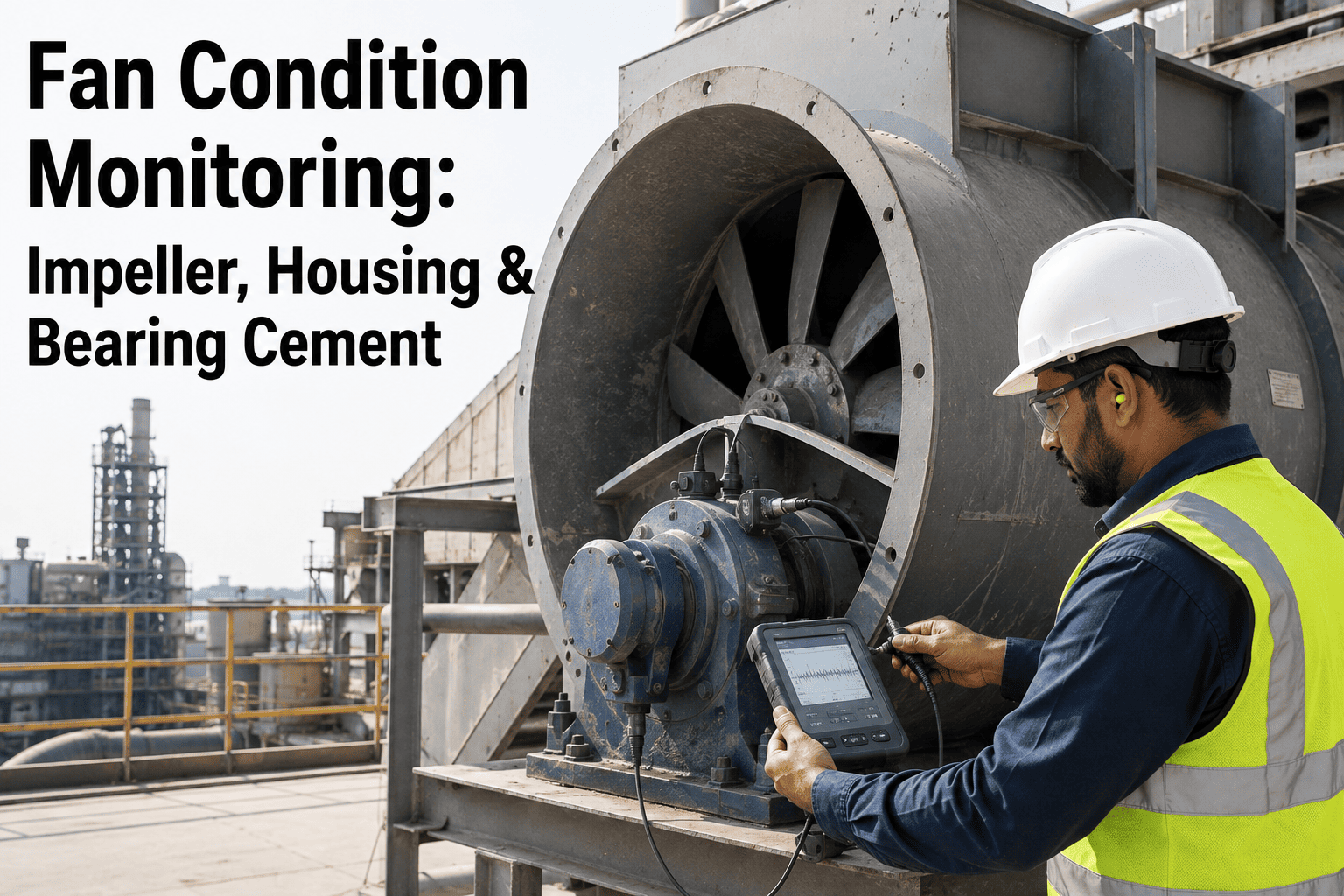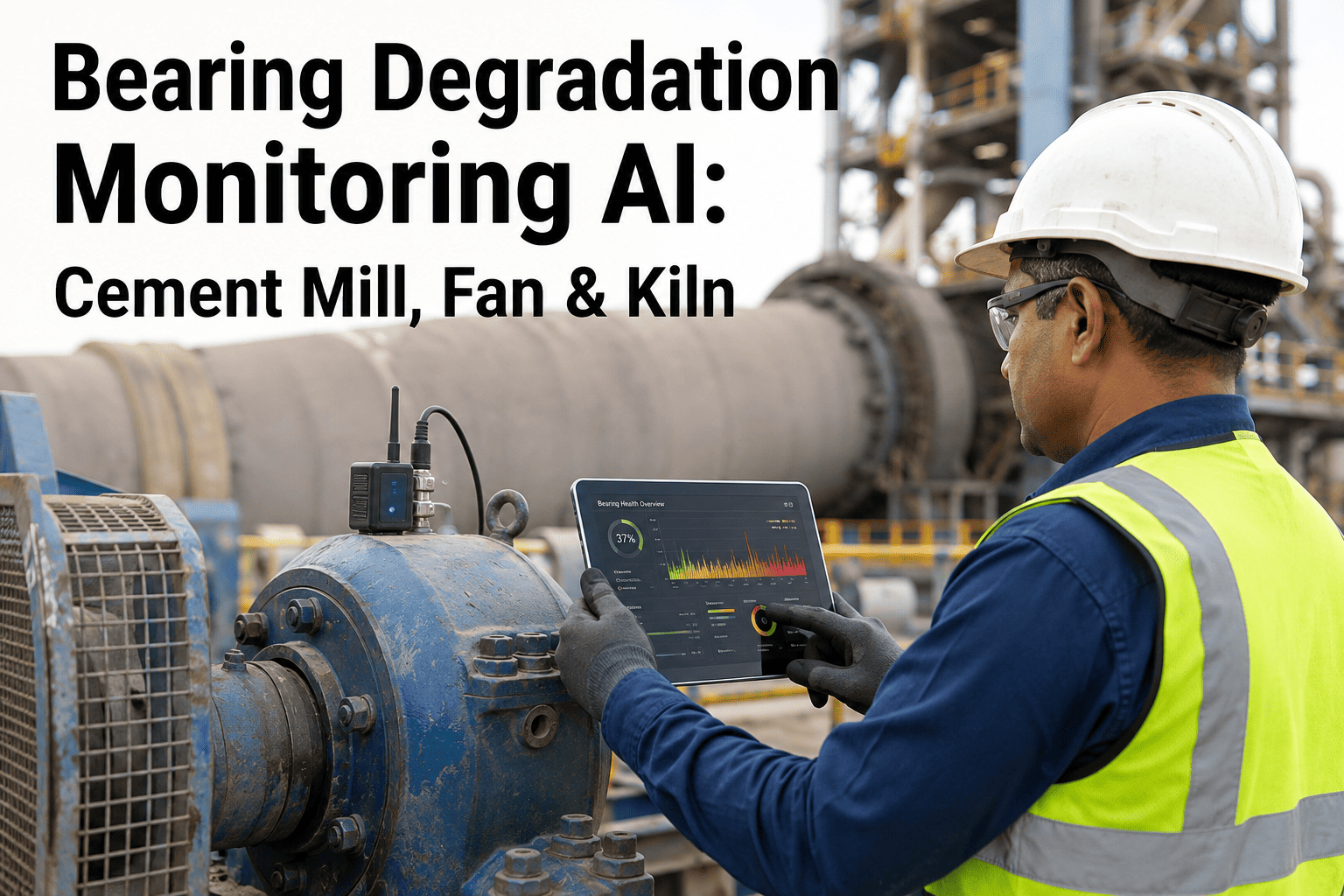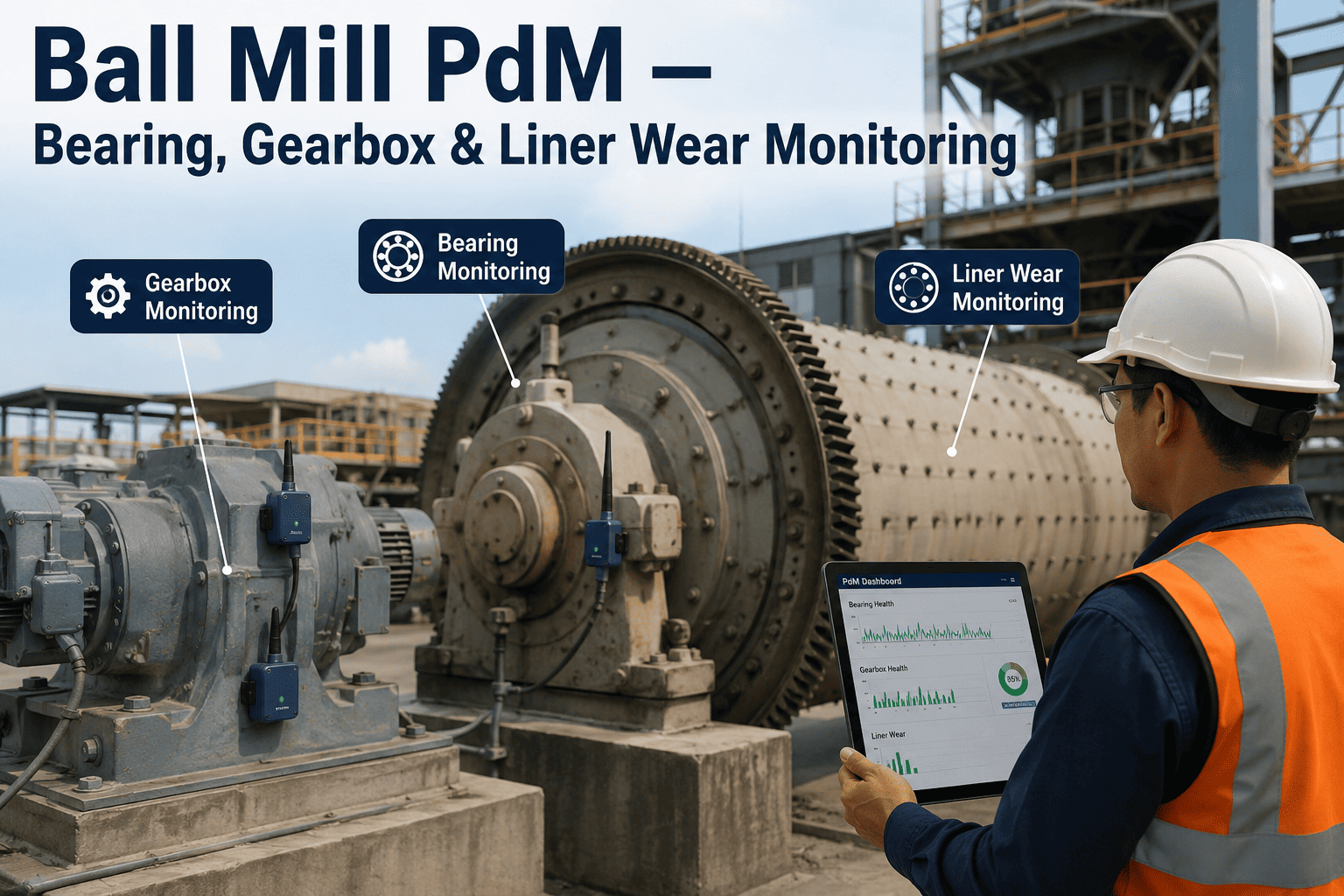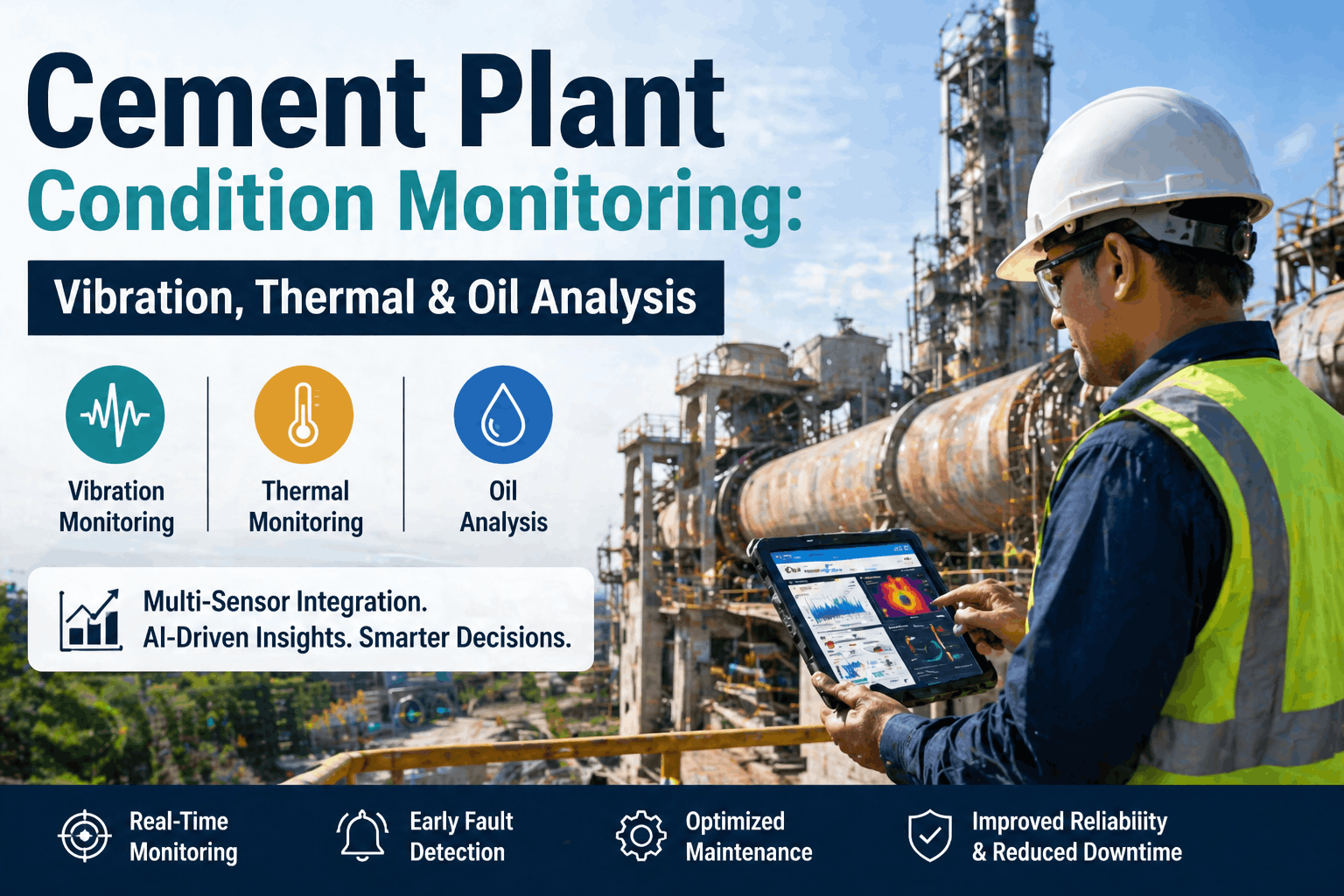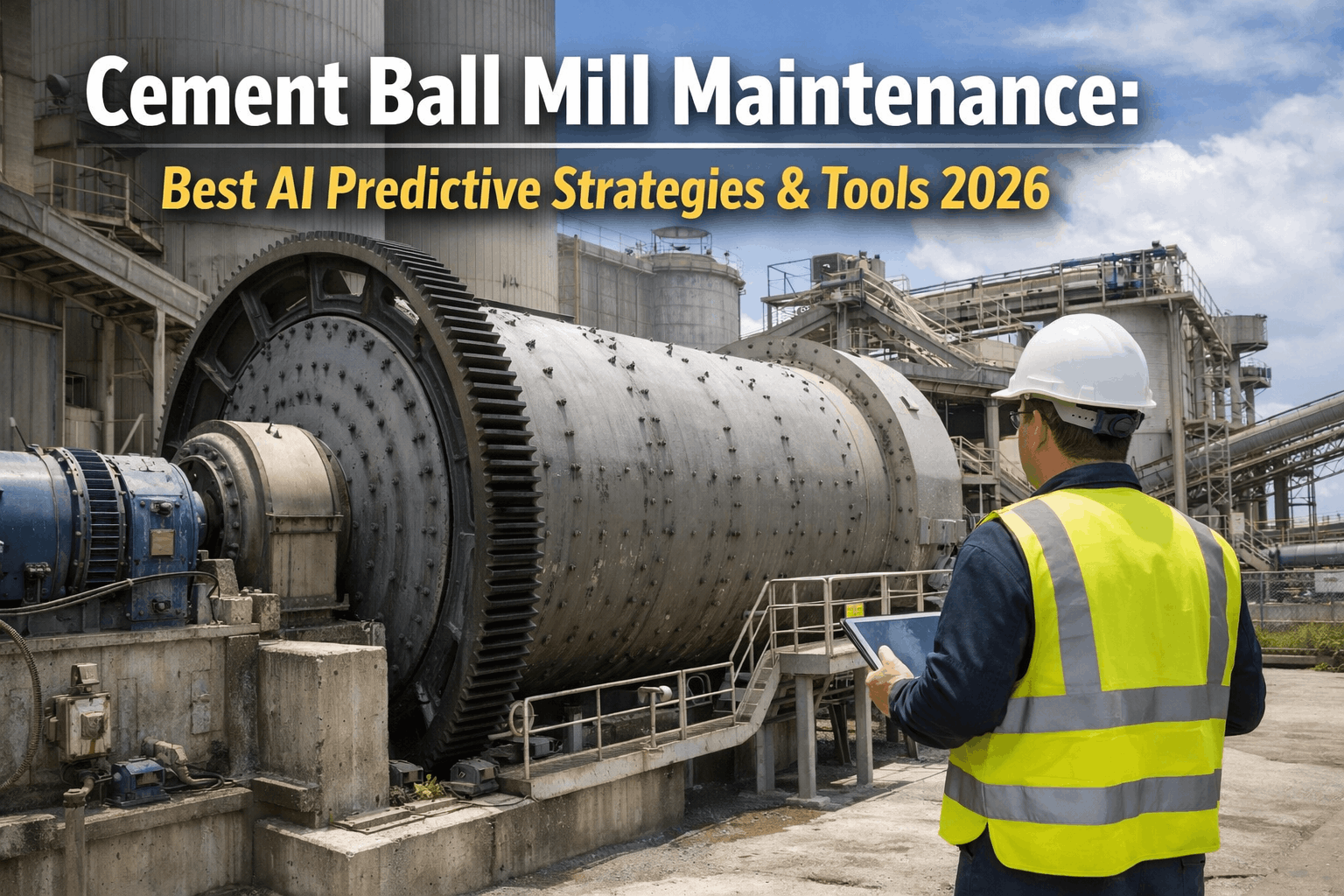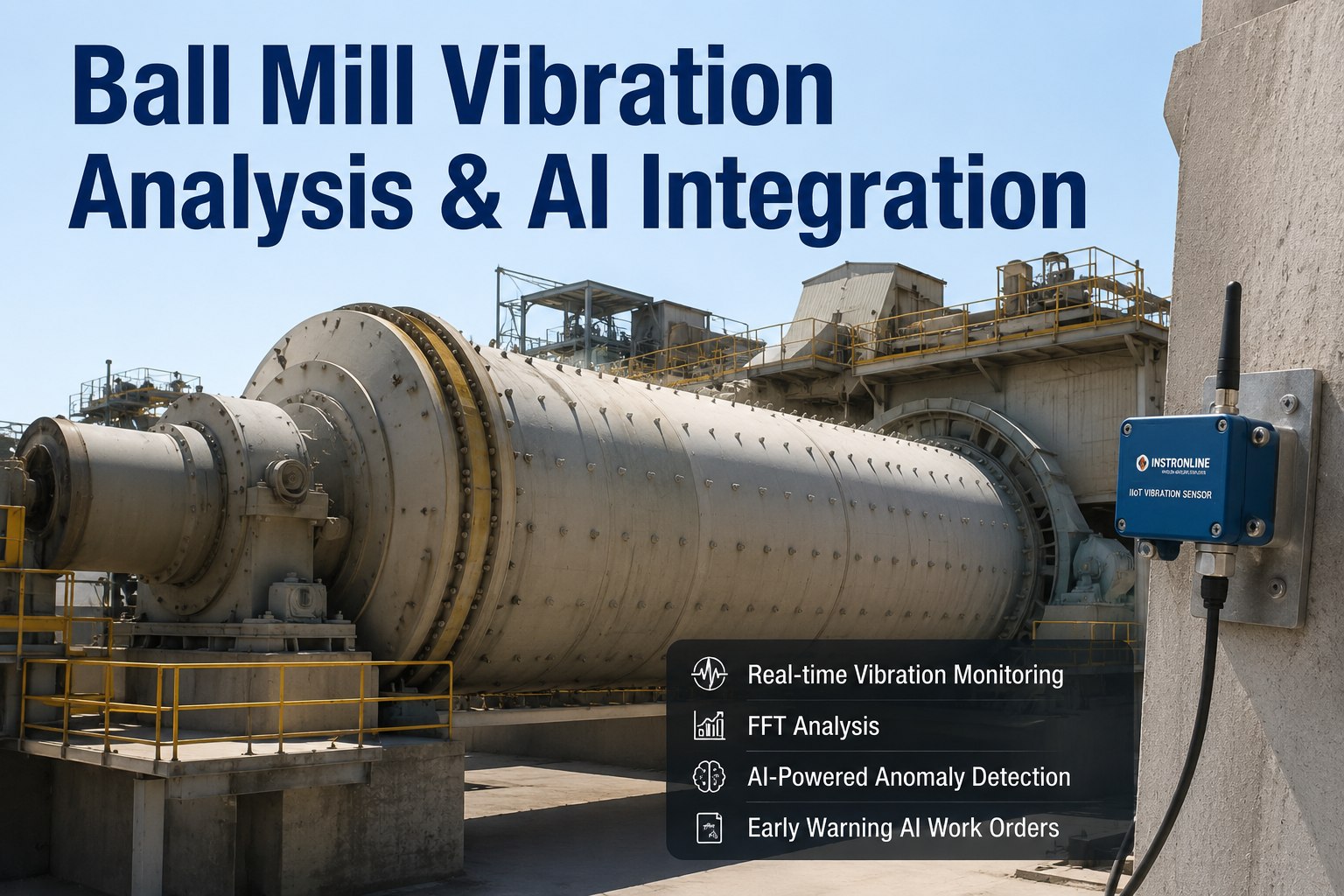
Ball mill vibration analysis is no longer a reactive discipline reserved for post-failure forensics. In 2026, the cement plants running the lowest unplanned downtime rate are the ones that have deployed wireless IIoT vibration sensors directly on their grinding mill bearings, trunnions and drive pinions — streaming FFT spectral data in real time to edge AI engines that detect anomalies days, or weeks before catastrophic failure occurs. If your maintenance team is still pulling monthly vibration readings manually and making bearing change decisions based on calendar schedules, Book a Demo to see how iFactory's AI vibration integration platform converts raw sensor data into early-warning work orders that protect your grinding circuit uptime.
Protect Your Ball Mill Before the Bearing Fails
iFactory's AI vibration platform connects wireless IIoT sensors, FFT spectral analysis, and predictive work order automation into a single condition monitoring layer — purpose-built for cement grinding circuits.
Why Ball Mill Vibration Analysis Is the Highest-ROI Condition Monitoring Investment in Cement
The ball mill is the single highest-consequence rotating asset in a cement grinding circuit. A trunnion bearing failure on a 4,000 kW finish mill doesn't just take the mill offline — it idles the entire downstream cement dispatch chain while a part with a 16-to-22-week OEM lead time is sourced, shipped, and installed. The financial exposure from a single unplanned trunnion failure at a 1.5M tonne-per-year plant can exceed $3.8M in lost production, emergency procurement premiums, and expedited repair labor.
What makes ball mill vibration analysis uniquely valuable — compared to monitoring crusher drives or kiln fans — is the mechanical complexity of the failure signatures. Ball mills generate overlapping vibration signals from the shell rotation, the charge dynamics, the trunnion bearing journals, the main drive girth gear mesh, and the pinion shaft bearings simultaneously. Separating these signals and identifying early-stage defect patterns requires FFT spectral decomposition and AI-based pattern recognition that manual monthly readings cannot deliver. The plants that have deployed continuous IIoT vibration monitoring on their grinding circuits report defect detection windows of 14 to 28 days before a bearing failure that would otherwise have been discovered at the moment of seizure.
Spalling Detection Lag
Manual quarterly readings miss the 3-to-6-week spalling progression window. AI FFT catches the characteristic BPFO frequency rise at the earliest stage of race surface deterioration.
Girth Gear Mesh Masking
The dominant shell rotation frequency masks developing pinion tooth defects in raw vibration data. Cepstral analysis and sidebands separation are required — impossible without FFT spectral resolution.
Load-Dependent Masking
Ball mill vibration signature shifts with feed rate and charge weight. Static alarm thresholds trigger false positives or miss real defects depending on current operating load — AI normalization eliminates this.
The Four-Layer AI Vibration Architecture for Ball Mills
Effective ball mill vibration analysis is not a single-sensor problem. It is a systems architecture problem — requiring coordinated data acquisition at the sensor level, FFT processing at the edge, anomaly classification at the AI model layer, and automated maintenance response at the CMMS integration layer. The plants achieving 14-to-28-day early warning windows are running all four layers simultaneously.
Wireless IIoT Sensor Placement Strategy
Sensor placement on a ball mill is not arbitrary. The trunnion bearing housings — both feed-end and discharge-end — require triaxial accelerometers positioned at the load zone, orthogonal to the shaft centerline in the horizontal and vertical planes. The main drive pinion bearings require radial and axial sensors to capture both the gear mesh frequency and the bearing defect frequencies independently. For shell-mounted monitoring on long mills, distributed sensor arrays at 1/4 and 3/4 shell length positions capture charge dynamics and identify uneven liner wear patterns that change the shell's vibrational mode shape before they affect throughput.
Edge FFT Processing: Why Cloud-Only Latency Is Unacceptable
Ball mill vibration data volumes are large. A triaxial accelerometer sampling at 25.6 kHz on a continuous basis generates approximately 1.8 GB of raw time-series data per sensor per day. Sending this volume to a cloud platform for FFT processing introduces 4-to-8 second latency windows and creates network dependency that is unacceptable in a cement plant environment where network interruptions are common. iFactory's edge gateway performs full FFT decomposition locally — computing the frequency spectrum from 0 to 10,000 Hz in real time, extracting the bearing defect frequency bands (BPFI, BPFO, BSF, FTF) for each bearing on the mill, and transmitting only the processed spectral features and alarm states to the cloud platform. Raw data is retained locally for 72 hours for post-event forensic analysis.
AI Anomaly Classification: Beyond Simple Threshold Alarms
Threshold-based vibration alarms are the most common and the most unreliable approach to ball mill condition monitoring. A static overall vibration level alarm at 7.5 mm/s RMS will trigger on a mill running a heavy charge at high feed rate and miss a developing spalling defect on a lightly loaded mill that stays below the threshold. iFactory's AI classification engine operates on the extracted spectral features — the amplitude at each bearing defect frequency, the harmonic series amplitudes, the sidebands around the gear mesh frequency — and compares the current signature against the machine-specific baseline learned during the first 30 days of operation. The model outputs a condition severity score from 0 to 100 and a fault classification (early-stage race spalling, lubrication film breakdown, girth gear tooth wear, misalignment) with a confidence percentage for each finding.
Automated Work Order Generation: Closing the Loop from Alert to Action
The most common failure mode in vibration monitoring programs is not a detection failure — it is an action failure. The sensor catches the anomaly, the alarm fires, and the maintenance team receives a notification that sits in an inbox while the bearing continues to degrade. iFactory's CMMS integration layer eliminates this gap by automatically generating a prioritized work order in SAP PM, Maximo, or the plant's CMMS the moment the AI condition severity score crosses a defined threshold. The work order includes the fault classification, the affected asset and bearing location, the recommended maintenance action, the parts required with current stock check from the inventory system, and a recommended completion window based on the AI-projected remaining useful life estimate.
Ball Mill Failure Mode Reference: What FFT Finds and When
Understanding which vibration signatures correspond to which failure modes is the foundation of a credible ball mill condition monitoring program. The table below maps the seven most critical ball mill failure modes to their FFT spectral signatures, the detection window available with continuous AI monitoring, and the cost differential between planned intervention and unplanned failure.
| Failure Mode | Primary FFT Signature | Detection Window (AI Continuous) | Planned Repair Cost | Unplanned Failure Cost |
|---|---|---|---|---|
| Trunnion Bearing Race Spalling | BPFO / BPFI harmonics + sidebands | 14–28 days | $85,000–$140,000 | $950,000–$3.8M |
| Girth Gear Tooth Wear | GMF sidebands, ghost frequencies | 21–45 days | $120,000–$280,000 | $1.2M–$4.5M |
| Pinion Bearing Degradation | BSF + FTF amplitude rise | 10–21 days | $22,000–$48,000 | $380,000–$900,000 |
| Lubrication Film Breakdown | Broadband noise floor rise, sub-synchronous | 3–7 days | $8,000–$18,000 | $140,000–$620,000 |
| Shell Liner Looseness | 1× + integer harmonics, impact impulsivity | 7–14 days | $35,000–$75,000 | $280,000–$700,000 |
| Drive Coupling Misalignment | 2× axial dominant, 1× radial phase shift | 7–18 days | $12,000–$28,000 | $95,000–$350,000 |
| Trunnion Seal Wear | High-frequency friction signature, sub-1× instability | 4–10 days | $15,000–$32,000 | $60,000–$180,000 |
The Ball Mill Vibration Monitoring Deployment Process: From Sensor to Control Tower in 30 Days
iFactory's ball mill deployment is engineered around a structured 30-day activation sequence designed to deliver the first AI-generated work order before the end of the first month. The sequence is executed without production interruption — sensor installation is completed during a planned maintenance window of 4 to 6 hours, and all subsequent configuration is performed remotely.
Sensor Installation & Network Commissioning
Triaxial IIoT sensors installed on trunnion housings, pinion bearings, and girth gear zone during a 4–6 hour maintenance window. Edge gateway commissioned and wireless backhaul validated. Raw vibration stream verified at all sensor points before first data collection cycle begins.
Baseline Learning & FFT Calibration
AI engine ingests the first 7 days of continuous spectral data across all operating load conditions — building the machine-specific baseline signature for each bearing and drive component. Bearing defect frequencies calculated from mill geometry and confirmed against measured shaft speed. Load normalization model calibrated.
CMMS Integration & Work Order Template Configuration
API bridge to SAP PM or Maximo configured and tested. Work order templates for each failure mode linked to asset hierarchy and parts catalog. Inventory system connection validated — parts stock checks confirmed live. Escalation thresholds and notification routing set by maintenance team.
Live Control Tower Activation & First AI Work Order
iFactory Control Tower dashboard activated for maintenance and plant operations teams. Condition severity scores, trend charts, and spectral waterfall displays live. First AI-generated predictive work order issued based on current asset condition — demonstrating the full detection-to-action loop before the deployment month closes.
Get Your Ball Mill's First Predictive Work Order in 30 Days
iFactory's 30-day deployment sequence puts IIoT sensors on your trunnion bearings and generates the first AI early-warning work order before the end of month one — with no production interruption required.
Vibration Monitoring Maturity: Where Is Your Grinding Circuit Today?
Most cement plants are operating their ball mills at Level 1 or Level 2 condition monitoring maturity. The gap between where they are and where AI-continuous monitoring operates is not a technology gap — it is a data architecture and integration gap. Schedule a Maturity Audit to see your plant's current position and the specific steps to reach Level 4.
| Maturity Level | Monitoring Method | Detection Capability | Average Warning Lead Time | Unplanned Failure Risk |
|---|---|---|---|---|
| Level 1: Reactive | Manual handheld readings, monthly or quarterly | Post-failure confirmation only | 0 days (failure already in progress) | High — full unplanned downtime exposure |
| Level 2: Periodic Digital | Route-based data collector, biweekly | Late-stage defect detection | 0–5 days | Moderate — misses fast-progression failures |
| Level 3: Online Monitoring | Wired sensors, fixed installation, threshold alarms | Mid-stage defect detection | 5–14 days | Low — but false positive rate is high |
| Level 4: AI Continuous | Wireless IIoT + Edge FFT + AI classification | Early-stage defect detection with fault type classification | 14–28 days | Near-Zero — automated work orders before failure |
ROI Breakdown: The Financial Case for Ball Mill AI Vibration Integration
The ROI calculation for ball mill vibration AI integration is driven by three distinct financial streams that compound on each other. Understanding each stream — and the realistic magnitudes involved at a typical 1.5M TPY cement plant — is essential for building the internal business case that gets capital approval for the sensor and software investment.
Stream 1: Avoided Unplanned Downtime
A single unplanned trunnion failure at a 1.5M TPY plant — factoring in lost production revenue, emergency repair labor, OEM expedite premiums, and logistics — costs between $1.1M and $3.8M depending on severity. AI vibration monitoring that prevents one such event per 18 months pays for the entire platform investment multiple times over.
Stream 2: Extended Planned Maintenance Intervals
Condition-based maintenance replaces calendar-based bearing and liner change intervals. Bearings that are condition-healthy at their scheduled change date are run to their actual condition limit — the AI monitoring watches the degradation trajectory. Plants using iFactory's condition scoring report 18–22% fewer planned maintenance events annually without any increase in unplanned failures.
Stream 3: Eliminated Emergency Procurement Premium
When a bearing failure is predicted 14–28 days in advance, the replacement bearing is sourced through normal procurement channels at standard lead times and standard pricing. When a bearing fails unplanned, the same part arrives by air freight at 3× to 8× the standard cost — or the mill sits idle waiting for parts. AI early warning eliminates this cost premium on every intercepted failure event.
Expert Perspective: What Changes When You Move from Route-Based to AI-Continuous Ball Mill Monitoring
We had been running biweekly route-based vibration routes on our two finish mills for eleven years. The program was well-managed — our reliability technician was experienced and the data was collected consistently. What we discovered after deploying iFactory's continuous monitoring was that our biweekly window was missing critical failure progressions entirely. Three of the first six AI early warnings we received were for defects that had developed, progressed, and would have reached failure before our next scheduled route date. The FFT caught a BPFO harmonic series on Mill 2's discharge trunnion at 14 days out. Our route would have visited in 9 days — too late for planned intervention at the severity it would have reached. We pulled the bearing at the next weekend window. When it came out, the race had a 40mm spall that the reliability team said was accelerating fast. The avoided downtime on that one event — we estimated $2.1M. The platform paid for three years of subscription cost in that single catch.
Frequently Asked Questions: Ball Mill Vibration Analysis & AI Integration
A standard two-bearing trunnion mill with a single-pinion drive requires a minimum of 6 sensors for complete coverage: one triaxial accelerometer on the feed-end trunnion housing, one triaxial on the discharge-end trunnion housing, one radial and one axial sensor on the pinion bearing (drive side), and one radial and one axial on the pinion bearing (non-drive side). For dual-pinion mills, the sensor count increases to 10. For mills with inboard lubrication systems, a temperature sensor pair at each trunnion bearing augments the vibration data with a thermal confirmation channel that cross-validates lubrication film condition. iFactory's sensor placement engineering team specifies the exact sensor positions and orientations for each mill geometry before installation, ensuring that each defect frequency band is observable at at least two sensor positions for redundancy.
Yes — and this is one of the most critical differentiation capabilities of the iFactory AI model compared to simple threshold-based systems. Ball charge dynamics generate broadband sub-synchronous energy and impact impulsivity that can superficially resemble early-stage bearing defect signatures to a simple alarm system. iFactory's AI model uses multi-channel feature correlation — comparing the spectral signature simultaneously across the trunnion bearing sensor and the shell-mounted sensor at the same time index — to separate charge-related dynamics from bearing defect signatures. Additionally, the model correlates the vibration signature with the feed rate and charge weight signal from the process control system. A vibration increase that tracks linearly with feed rate increase is a process-load signature; a vibration increase that is independent of load variation and concentrates at the calculated bearing defect frequencies is a bearing defect signature. This separation eliminates more than 90% of false positive alarms reported by plants running fixed-threshold systems on ball mills.
Sensor installation on a ball mill requires a planned maintenance window of 4 to 6 hours — the mill must be stopped, locked out, and the bearing housing surfaces prepared for sensor mounting. Installation does not require an extended shutdown or kiln circuit idle period; it can be executed during a scheduled liner change, lubrication service, or weekend maintenance window that is already in the plant schedule. The edge gateway and wireless network infrastructure can be installed and commissioned while the mill is running — only the final sensor mounting step requires the mill to be stationary. iFactory provides a detailed installation procedure document and can support a remote installation supervision call with the plant's maintenance team to ensure first-time commissioning success without an iFactory engineer traveling to site.
iFactory connects to SAP PM and IBM Maximo via REST API and OData interfaces that are standard in both platforms. The integration does not require custom ABAP development in SAP or a Maximo customization — it uses the standard notification and work order creation APIs that both platforms expose natively. Configuration involves mapping iFactory's asset hierarchy to the CMMS asset structure, defining the work order type and priority codes for AI-generated predictive orders, and configuring the parts catalog cross-reference so that iFactory's parts recommendations resolve to the correct CMMS material numbers. This configuration is completed remotely during Week 3 of the deployment sequence and typically requires 8 to 12 hours of involvement from the plant's SAP or Maximo administrator. No production disruption and no system downtime is required for the integration configuration.
For a single ball mill circuit at a 1.5M TPY cement plant, the typical platform payback period is 6 to 10 months from deployment. The payback calculation is driven primarily by the probability-weighted value of prevented unplanned failures — not by marginal efficiency gains. At a plant where a trunnion bearing failure has a historical frequency of one event every 4 to 6 years, the expected annual avoided cost from preventing that failure is $180,000 to $950,000 per year in expected value terms — typically exceeding the platform's annual subscription cost by a factor of 3× to 8×. For plants that have experienced an unplanned trunnion failure in the past 24 months, the payback timeline compresses significantly because the avoided cost reference is recent and concrete rather than probabilistic. iFactory provides a site-specific ROI model using your mill's production economics, historical failure data, and current parts procurement costs at no cost during the evaluation process.
Conclusion: Continuous AI Vibration Monitoring Is the Standard — Not the Exception
Ball mill vibration analysis has crossed a threshold in 2026. The combination of low-cost wireless IIoT sensors, edge FFT processing that operates independently of network connectivity, and AI classification models that learn each machine's unique signature has made continuous condition monitoring accessible to every cement grinding circuit — not just plants with the largest capital budgets or the most sophisticated reliability engineering teams.
The plants that continue to manage their ball mill bearing health through monthly route-based readings and calendar-based maintenance intervals are not just accepting higher downtime risk. They are accepting a structural cost disadvantage relative to competitors whose maintenance teams receive an AI-generated work order with a 14-to-28-day action window every time a trunnion bearing begins to develop a defect. That cost advantage — measured in avoided emergency freight premiums, avoided catastrophic failure repairs, and additional saleable tonnes produced per operating year — compounds over time into a durable operational gap that is very difficult to close without making the technology investment.
The data your ball mill is generating right now — the vibration signature your trunnion bearings are producing at this moment — contains the information your maintenance team needs to prevent the next unplanned failure. iFactory's AI vibration platform is the intelligence layer that reads that data, interprets it, and converts it into a scheduled maintenance event before it becomes an emergency. The sensors are the starting point. The control tower is the destination.
Your Ball Mill's Next Bearing Failure Is Predictable. Make It Planned.
iFactory's AI vibration platform installs in one maintenance window, learns your mill's signature in 14 days, and delivers the first early-warning work order before the end of Month 1 — with no production interruption required.