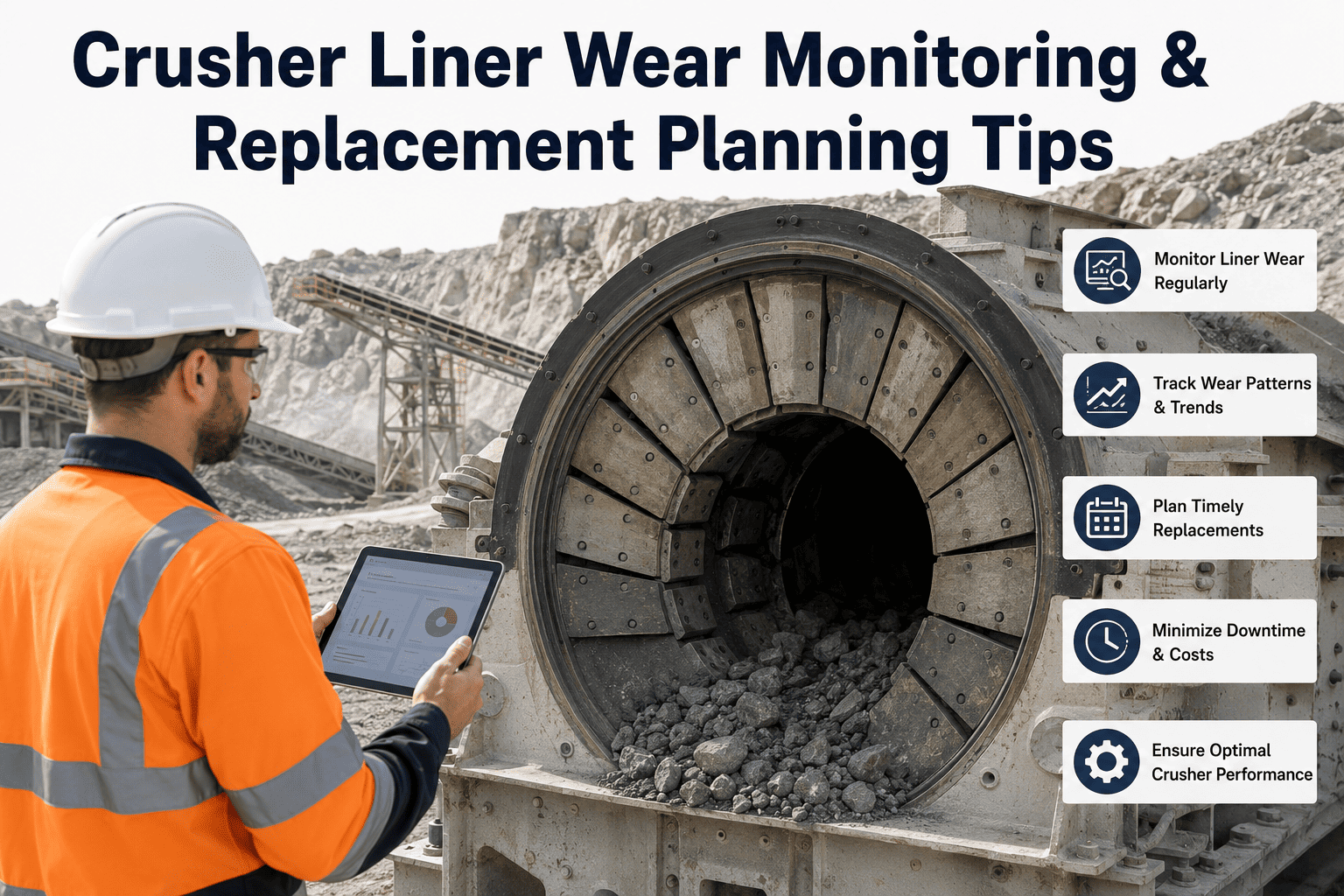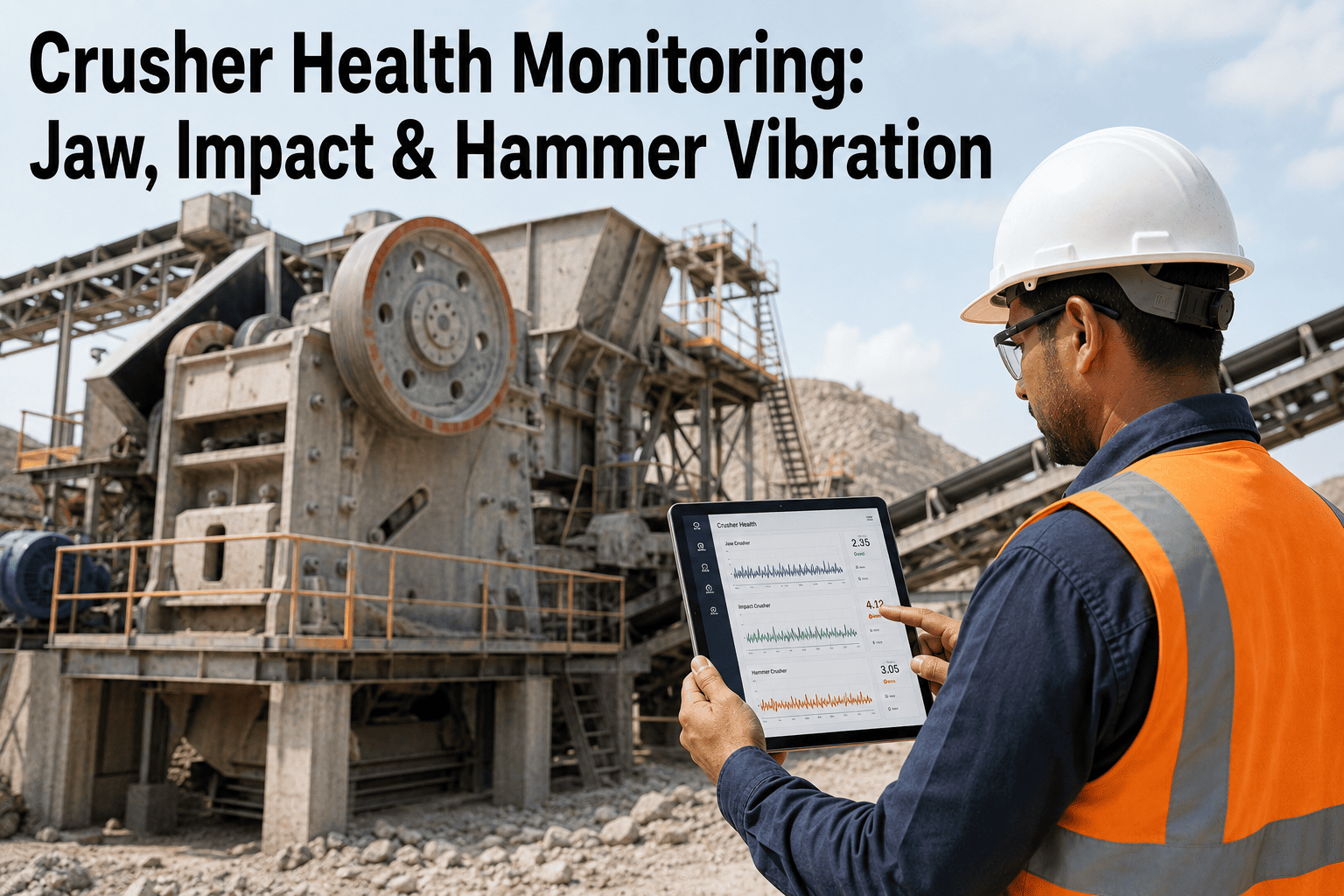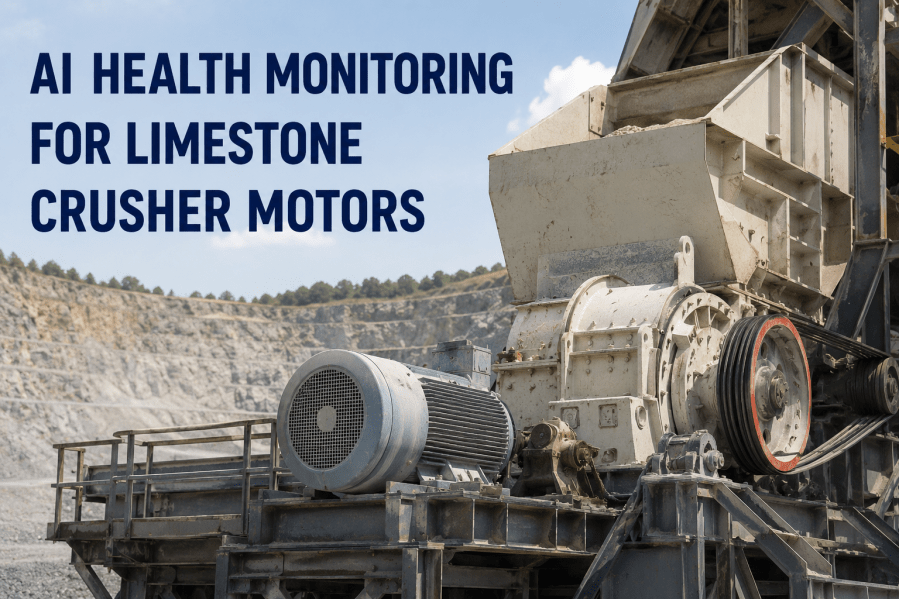
Limestone crusher motors do not fail at scheduled inspection intervals. They fail at 2 AM on a Tuesday, inside a bearing that was running 11°C above baseline three weeks earlier — a signal that was present in the data, unread. In cement plant raw material circuits, the primary and secondary crusher motor system is the upstream constraint that determines everything downstream: kiln feed consistency, raw mill throughput, and ultimately clinker production rate. A single unplanned crusher motor failure — bearing seizure, gearbox gear mesh collapse, coupling misalignment progressing to winding fault — costs between $180,000 and $650,000 in emergency parts, expedited labor, and lost raw material throughput. Every cent of that cost was preventable. The crusher motor's condition was broadcasting its deterioration through current draw signaturesvibration spectra, and thermal profiles for weeks before the failure event.AI health monitoring for limestone crusher motors is the discipline of reading those signals continuously interpreting them correctly and triggering the right maintenance action at the right time — before a wear event becomes a production stoppage.
Book a demo to see edge AI analytics for crusher motorsWhy Limestone Crusher Motor Health Determines Your Entire Production Chain
The limestone crusher sits at the head of every cement plant's raw material circuit — and its motor is the single point of failure with the highest downstream consequence of any rotating asset in the plant. When the crusher motor stops, raw material feed to the raw mill stops. When raw material feed stops, kiln feed consistency degrades within hours. When kiln feed degrades, clinker quality becomes unpredictable, free lime spikes, and LSF control becomes reactive rather than proactive. A four-hour crusher motor failure does not cost four hours of production — it costs four hours of crusher downtime plus the kiln stabilization period afterward, the quality correction window, and the throughput ramp-back time. In documented cement plant outage cost analyses, crusher motor failures consistently generate 2.5 to 4× the direct repair cost in total production impact.
The root cause of most crusher motor failures is not sudden — it is progressive. Bearing wear accumulates over weeks. Gearbox gear mesh deteriorates through stages. Coupling misalignment develops gradually as thermal cycles accumulate. Motor winding insulation degrades predictably with thermal stress history. Every one of these degradation modes generates observable signals — in motor current spectrum, in vibration frequency content, in bearing housing temperature, in winding resistance trends — that precede failure by 7 to 28 days. iFactory's edge AI platform monitors all of these channels simultaneously, interprets their combined state, and delivers prioritized maintenance alerts with specific fault classifications and recommended intervention windows. The maintenance team acts on prediction, not on failure.
The Crusher Motor Failure Chain: Five Degradation Modes and How AI Detects Each
Crusher motor failures do not arrive without warning — they arrive without the right monitoring infrastructure to read the warning. Each primary degradation mode in a heavy-duty limestone crusher motor system produces a distinct signal pattern that, interpreted correctly with multi-variable AI correlation, is detectable weeks before failure. The following table documents the five primary fault modes, their signal indicators, and iFactory's specific detection approach for each.
| Fault Mode | Primary Signal Indicator | Typical Detection Window | Failure Risk if Undetected | iFactory Detection Method |
|---|---|---|---|---|
| Roller / Journal Bearing Wear | Vibration: BPFO/BPFI sidebands; acoustic emission rise; bearing housing temp >9°C above baseline | 14–21 days pre-failure | Bearing seizure → motor trip → full crusher stoppage; secondary shaft damage | Multi-band spectral AI + thermal trend correlation model |
| Gearbox Gear Mesh Degradation | Vibration: gear mesh frequency sidebands; oil temperature rise; acoustic emission spike at mesh frequency | 21–28 days pre-failure | Tooth fracture → emergency gearbox replacement; $280K–$650K total failure cost | Edge FFT at gear mesh frequency + oil temp AI trending |
| Motor Winding Insulation Degradation | Motor current: harmonic distortion increase; winding resistance drift; partial discharge acoustic signature | 10–18 days pre-failure | Winding short → motor burnout → 3–6 week replacement lead time | Motor Current Signature Analysis (MCSA) AI + thermal imaging correlation |
| Coupling Misalignment | Vibration: 1× and 2× running speed amplitude increase; axial vibration rise; seal wear acceleration | 7–14 days pre-failure | Coupling failure → unplanned stoppage; accelerated bearing and seal wear | Multi-axis vibration AI + load asymmetry tracking model |
| Rotor Bar Cracking | Motor current: rotor bar pass frequency sidebands; slip frequency amplitude increase at 2× line frequency | 10–21 days pre-failure | Rotor bar fracture → motor vibration escalation → winding damage; full motor replacement | MCSA sideband AI + load-normalized current spectrum analysis |
Motor Current Signature Analysis: The Underutilized Diagnostic Channel in Crusher Monitoring
Most cement plants monitor their limestone crusher motors with temperature sensors and periodic manual vibration checks. Both are necessary — neither is sufficient. Temperature sensors detect thermal anomalies only after the fault has already generated measurable heat load, which in bearing and winding fault progressions typically occurs within 48 to 72 hours of failure. Manual vibration checks, performed every shift at best, provide condition snapshots separated by 8 to 12 hours — an eternity when a bearing is in the rapid-progression phase of its failure curve. The diagnostic channel that most crusher monitoring programs leave completely unused is Motor Current Signature Analysis (MCSA): the continuous, non-intrusive analysis of the motor's current waveform to detect mechanical and electrical fault signatures embedded in the power draw signal.
iFactory's MCSA module connects to existing current transformers on the crusher motor's power supply — no new sensors required in most installations — and runs continuous spectral analysis of the current signal at the edge. Rotor bar cracks generate characteristic sideband patterns at twice the line frequency ± slip frequency. Bearing defects create modulation patterns in the current spectrum at bearing defect frequencies. Gear mesh anomalies produce current harmonics at gear mesh frequency multiples. Air gap eccentricity creates low-frequency sidebands that distinguish mechanical from electrical fault origins. iFactory's AI correlates MCSA findings with simultaneous vibration and thermal data, eliminating false positives and providing fault classification that specifies not just that an anomaly exists — but which component is degrading, at what rate, and when intervention is required. Schedule a crusher motor MCSA assessment to evaluate your current monitoring gaps.
Edge AI Architecture: How iFactory Monitors Crusher Motors On-Premise
Crusher motor health monitoring in cement plants faces a specific infrastructure challenge that cloud-connected monitoring systems cannot solve reliably: network connectivity in the raw material crushing zone is frequently intermittent, and latency between a fault signal and a maintenance alert cannot be measured in seconds when the crusher is the upstream constraint for 3,000 tons per day of clinker production. iFactory's crusher motor AI runs entirely at the edge — on ruggedized compute hardware installed in the motor control center or crusher control room — processing vibration, current, and thermal data locally with sub-second inference latency, independent of internet connectivity. Alerts reach maintenance teams in real time, from the MCC to the control room display to the maintenance supervisor's mobile device, without a round trip to any cloud service.
The edge architecture also means that iFactory's models run on the crusher's actual operating data — not on a generalized model tuned for a representative average asset. Within 4 to 8 weeks of connected operation, iFactory's AI has established a plant-specific baseline for the crusher motor's current signature, vibration response at every operating load point, and thermal profile under seasonal ambient variation. Fault detection is relative to this specific baseline, not to a manufacturer specification that may not reflect the crusher's actual installation conditions, feed material characteristics, or operating cycle. This specificity is what drives the 94% fault detection accuracy figure in documented deployments — the AI knows this motor, at this plant, on this feed material. Visit iFactory's Support Center for edge AI deployment specifications by crusher type and motor rating.
Data Acquisition
iFactory connects to existing current transformers, accelerometers, RTDs, and thermocouples via iFactory's edge data acquisition hardware. For crusher motors without vibration instrumentation, iFactory's implementation team provides a sensor placement audit and supplies compatible accelerometers. Integration with existing DCS process data — crusher load, feed rate, motor speed — completes the data layer. Typical hardware installation: 2 to 3 days on-site.
Edge Inference Engine
iFactory's edge compute runs 32 fault signature models in parallel — MCSA spectral analysis, multi-band vibration FFT, thermal trend AI, and process correlation models — updating condition scores every second. The inference engine uses iFactory's pre-trained crusher fault signature library alongside plant-specific model weights that develop over the first 4 to 8 weeks of operation. All computation runs on-premise; no data leaves the plant network for inference.
Fault Classification and Alert
When iFactory's AI detects a developing fault condition, it classifies the fault type (bearing, gearbox, winding, coupling, rotor), estimates severity and progression rate, calculates the recommended intervention window, and triggers a prioritized alert. Alerts reach the control room display, maintenance supervisor mobile device, and CMMS work order system simultaneously — ensuring that a fault detected at 3 AM becomes a scheduled maintenance action before the day shift arrives.
CMMS Integration and Work Order Generation
iFactory integrates directly with SAP PM, IBM Maximo, and other enterprise maintenance systems — automatically generating work orders with fault classification, recommended scope, required parts, and intervention deadline. The alert-to-work-order chain requires no human intervention, meaning that maintenance planners arrive each morning with the day's crusher motor condition status already translated into actionable work orders, not raw alarm histories to be interpreted manually.
Traditional Monitoring vs. AI Edge Inference: The Crusher Motor Comparison
Cement plants that rely on scheduled manual inspections and fixed-threshold vibration alarms for crusher motor health management are not operating a predictive maintenance program — they are operating a reactive maintenance program with extra steps. The distinction matters because the cost difference between planned and unplanned crusher motor maintenance is not marginal. It is structural: planned bearing replacement costs $8,000 to $25,000 in parts and planned labor. Emergency bearing replacement after seizure — with secondary shaft damage, expedited parts freight, weekend labor rates, and lost raw material throughput — costs $120,000 to $340,000. The gap between these outcomes is not luck. It is detection lead time.
iFactory Crusher Motor Intelligence: What the Platform Delivers
The following capabilities represent iFactory's integrated approach to limestone crusher motor health — combining edge AI inference, multi-channel condition monitoring, and maintenance workflow automation into a system that treats crusher motor health as a continuous, quantified, actionable asset metric rather than a periodic inspection event.
Continuous Motor Current Signature Analysis (MCSA)
iFactory's MCSA module connects to existing current transformers — no new sensors required in most crusher motor installations — and runs continuous spectral analysis at the edge. The AI evaluates rotor bar condition, stator winding insulation health, air gap eccentricity, and mechanical fault signatures embedded in the current spectrum simultaneously, updated every second. For plants without current transformer access at the crusher MCC, iFactory's implementation team provides non-intrusive Rogowski coil installations. MCSA integration is typically completed in 1 to 2 days on-site.
Gearbox Health AI and Oil Condition Monitoring
iFactory's gearbox AI monitors gear mesh frequency sidebands, oil temperature and pressure trends, and acoustic emission patterns from gear contact simultaneously. The model distinguishes normal gear mesh variation from developing tooth surface fatigue, identifies oil film breakdown signatures before they accelerate gear wear, and detects coupling misalignment from the characteristic 2× running speed vibration signature. For crusher gearboxes with oil analysis programs, iFactory integrates laboratory oil analysis results as additional conditioning variables in the gearbox health model. Gearbox replacement on a primary limestone crusher costs $280,000 to $650,000; iFactory's 21 to 28-day early warning converts this to a planned gear inspection and seal replacement at under $40,000.
Bearing Health Progression Modeling and Replacement Planning
iFactory's bearing health AI does not issue a single alarm when a threshold is crossed — it continuously estimates the bearing's position on its wear progression curve and projects the time-to-failure trajectory based on current wear rate. Maintenance teams see a bearing health score updated every minute, a projected intervention deadline, and a recommended maintenance scope (inspection, lubrication intervention, or replacement). This allows planned bearing replacements to be scheduled during the next available maintenance window rather than forcing emergency replacement at the worst possible time. iFactory customers report bearing replacement cost reductions of 60 to 75% per event compared to pre-deployment emergency replacement averages.
Root Cause Analysis and Recurrence Prevention
When a crusher motor fault event occurs — whether detected by iFactory and intervened upon, or reaching failure before detection — iFactory's root cause analysis engine reconstructs the full fault progression timeline from the condition monitoring data chain. The analysis identifies the earliest detectable precursor signal, traces the degradation pathway back to its origin, and provides specific evidence for whether the fault originated in a lubrication anomaly, an operating condition excursion (overloading on hard limestone feed), a maintenance interval stretch, or an equipment installation issue. This root cause report gives reliability engineers the specific, time-stamped evidence needed to prevent recurrence through maintenance interval adjustment, operating condition limits, or equipment specification changes. Schedule a crusher motor reliability demo.
Expert Perspective: What Changes When You Monitor Crusher Motors with AI
We had accepted crusher motor bearing failures as a cost of doing business — we budgeted for two to three unplanned stoppages per year and kept emergency bearing stock on the shelf. After deploying iFactory's edge AI on our primary limestone crusher, the first thing that changed was not the number of failures — it was when we found out about them. The AI detected a developing bearing fault 19 days before it would have failed. We scheduled the replacement during a planned kiln shutdown two weeks later, completed it in 6 hours, and returned to full crushing rate at a parts and labor cost of $22,000. The bearing we replaced showed clear early-stage spalling — another week and we would have had a seizure and shaft damage. That one event paid for the system. We have not had an unplanned crusher motor stoppage in 16 months, and our maintenance planning has completely changed — we are scheduling interventions based on actual condition, not on calendar intervals that bear no relationship to actual wear state.
Frequently Asked Questions: AI Health Monitoring for Limestone Crusher Motors
Does iFactory require new sensors to monitor crusher motor bearing health?
In most installations, no. iFactory's MCSA module connects to existing current transformers at the crusher motor control center, extracting bearing fault signatures from the current spectrum without any new hardware on the motor itself. For bearing health monitoring via vibration, iFactory connects to existing accelerometers if present; for motors without vibration instrumentation, iFactory recommends a minimum sensor placement of two accelerometers per bearing housing — typically four to six accelerometers per crusher motor assembly — at a hardware cost that represents less than 15% of the first avoided failure event. Thermal monitoring uses existing RTDs or adds surface-mount temperature sensors to bearing housings. Most crusher motor installations reach full monitoring coverage with 2 to 3 days of on-site integration work.
How does iFactory's AI distinguish between a genuine mechanical fault and a process-induced vibration spike from hard limestone feed?
This distinction is the most critical capability in crusher motor AI monitoring — and the one most commonly missing from simpler threshold-based systems. iFactory's fault classification AI explicitly conditions its vibration analysis on simultaneous process state: crusher feed rate, motor load current, material feed grindability (estimated from power draw response), and rotor speed. A vibration spike that occurs during a hard limestone feed event at elevated motor load is correctly classified as a process-induced event — generating a process alert about feed condition but not a mechanical fault alert. A vibration anomaly at stable feed conditions with a characteristic BPFO or gear mesh frequency pattern is correctly classified as a mechanical fault requiring maintenance attention, regardless of whether its amplitude has crossed a fixed threshold. iFactory's deployed crusher motor systems maintain false positive rates below 3% of total alerts generated, which is the benchmark that determines whether maintenance teams trust and act on alerts versus ignoring them.
What crusher types and motor ratings does iFactory support for limestone applications?
iFactory's crusher motor health platform has been deployed on jaw crushers, impact crushers, cone crushers, and hammer crushers from all major OEMs — Metso, Sandvik, Thyssenkrupp, FLSmidth, Hazemag, and others — across motor ratings from 200 kW to 2,500 kW. The AI fault signature library includes crusher-type-specific models that account for each machine's characteristic vibration response, load cycle profile, and known failure mode distribution. For crusher types not yet in iFactory's deployment base, the implementation uses the closest analogous crusher model as the starting point, with plant-specific model specialization during the first 60 to 90 days of connected operation. Motor brand is not a constraint: iFactory's MCSA and vibration AI are motor-brand agnostic and have been validated on Siemens, ABB, WEG, Nidec, and other major industrial motor manufacturers.
How long does it take for iFactory's crusher motor models to reach reliable fault detection accuracy?
iFactory's pre-trained crusher fault signature library provides meaningful condition monitoring from the first week of connection — known fault signatures such as BPFO bearing patterns and gear mesh anomalies are detectable against the baseline the AI establishes in the first 72 hours of operation. Motor-specific model maturity — where the AI has characterized the crusher motor's current and vibration response across its full operating load range, feed material variety, and ambient temperature cycle — typically requires 4 to 8 weeks of connected operation. For plants with structured historical vibration or current data in their historian, the training period is substantially compressed by pre-loading 6 to 12 months of historical data before live deployment begins. Fault detection accuracy improves continuously as the model accumulates plant-specific training examples from the crusher's actual operating history.
What is the typical ROI calculation for crusher motor AI health monitoring, and how quickly does it pay back?
The ROI calculation for crusher motor AI monitoring centers on two primary value streams. The first and largest is avoided unplanned failure cost: a single emergency bearing seizure with secondary shaft damage costs $120,000 to $340,000 in parts, labor, and lost raw material throughput; iFactory's planned intervention equivalent costs $8,000 to $35,000. For a plant with two unplanned crusher motor events per year, the avoided failure savings alone generate $200,000 to $600,000 annually. The second value stream is maintenance interval optimization: AI-driven bearing replacement timing eliminates both early replacements (replacing healthy components that had remaining life) and late replacements (allowing wear to progress to secondary damage). iFactory customers across documented deployments report first-year ROI of 3.5× to 4.8× the platform cost, with the fastest paybacks — typically 3 to 5 months — occurring at plants that experience their first avoided catastrophic failure event within the initial monitoring period.
Conclusion: Crusher Motor Health Is a Data Problem, Not a Luck Problem
Every unplanned limestone crusher motor failure that has occurred at a cement plant in the past five years occurred in a motor that was broadcasting its deterioration through current signatures, vibration spectra, and thermal profiles for weeks before the failure. The data was there. The monitoring infrastructure to interpret it was not. iFactory's edge AI platform closes that gap — converting the sensor data already present on your crusher motor into continuous, prioritized, actionable health intelligence that gives maintenance teams 14 to 28 days of warning before bearing and gearbox failures reach the point of unplanned stoppage.
The financial case is not complex: one avoided emergency crusher motor failure pays for multiple years of AI monitoring subscription. The operational case is equally direct: a maintenance team that acts on 21-day AI warnings schedules interventions, controls costs, and maintains crushing availability. A maintenance team acting on 48-hour threshold alarms manages emergencies, absorbs premium costs, and explains production shortfalls. iFactory's platform is the difference between those two operating modes — and it runs on the sensor infrastructure most cement plants already have installed.