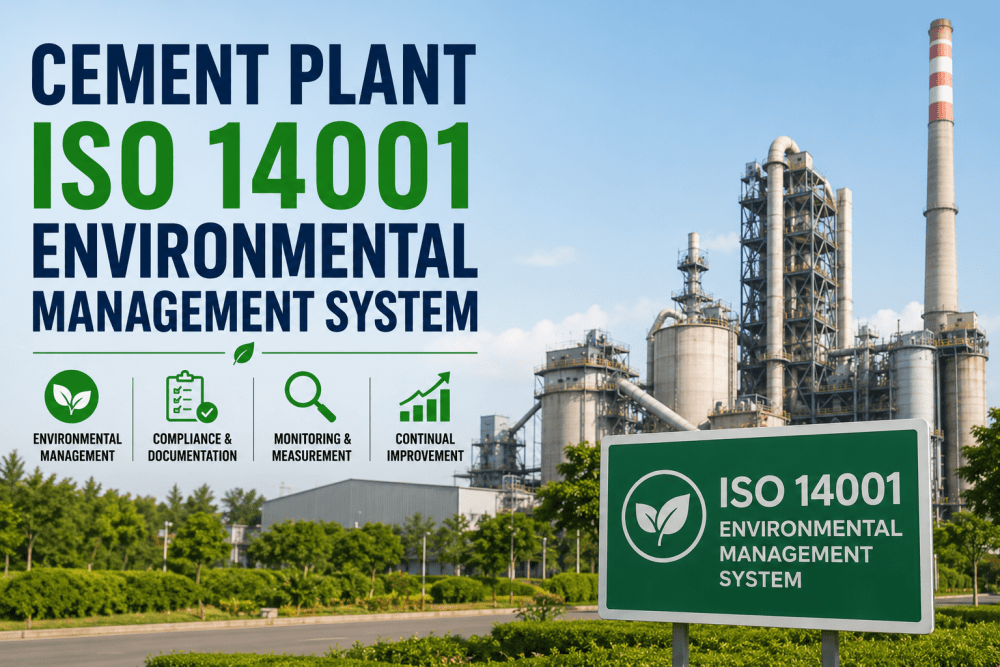
Cement plants pursuing or maintaining ISO 14001 and ISO 50001 certification face a dual compliance burden that most manufacturing facilities never encounter. The two standards share overlapping requirements for policy, planning, operational control, emergency preparedness, and management review, but they diverge in their technical focus — ISO 14001 demands comprehensive environmental aspect management across emissions, water, waste, and raw material consumption, while ISO 50001 requires rigorous energy baseline establishment, performance indicator tracking, and energy reduction project documentation. The manual approach to dual-certification compliance — spreadsheet-based KPI tracking, folder-based document control, email-based audit trail management — consumes an estimated 800 to 1,200 staff hours per year across the environmental and energy management functions, with audit preparation alone requiring 4 to 6 weeks of concentrated effort before each surveillance visit. AI-driven compliance automation changes this by connecting process data from the plant's control systems directly to the compliance management framework, generating real-time compliance status, automating non-conformance detection, and producing audit-ready documentation that reduces certification overhead by 60 to 75 percent. Book a Demo to see how iFactory's ISO Compliance Tracking and Audit Scheduling modules automate your cement plant's dual-certification management.
The Four Pillars of Dual ISO Compliance in Cement Manufacturing
Effective compliance management for ISO 14001 and ISO 50001 in a cement plant depends on four interlocking management system components. Each pillar addresses a distinct set of standard requirements while sharing common processes for documentation, training, audit, and corrective action. Cement plants that digitize all four pillars achieve certification audit cycles that take 3 to 5 days instead of 8 to 12, with non-conformances reduced by 50 to 70 percent between surveillance visits.
Environmental Aspect & Impact Management
ISO 14001 Clause 6.1.2 requires cement plants to identify environmental aspects — emissions to air (NOx, SOx, CO2, particulate matter), water discharge, waste generation, and raw material consumption — and evaluate their significance. AI connects continuous emissions monitoring systems, water flow meters, and waste tracking data to the aspect register, updating significance scores automatically as operating conditions change.
Energy Baseline & Performance Indicators
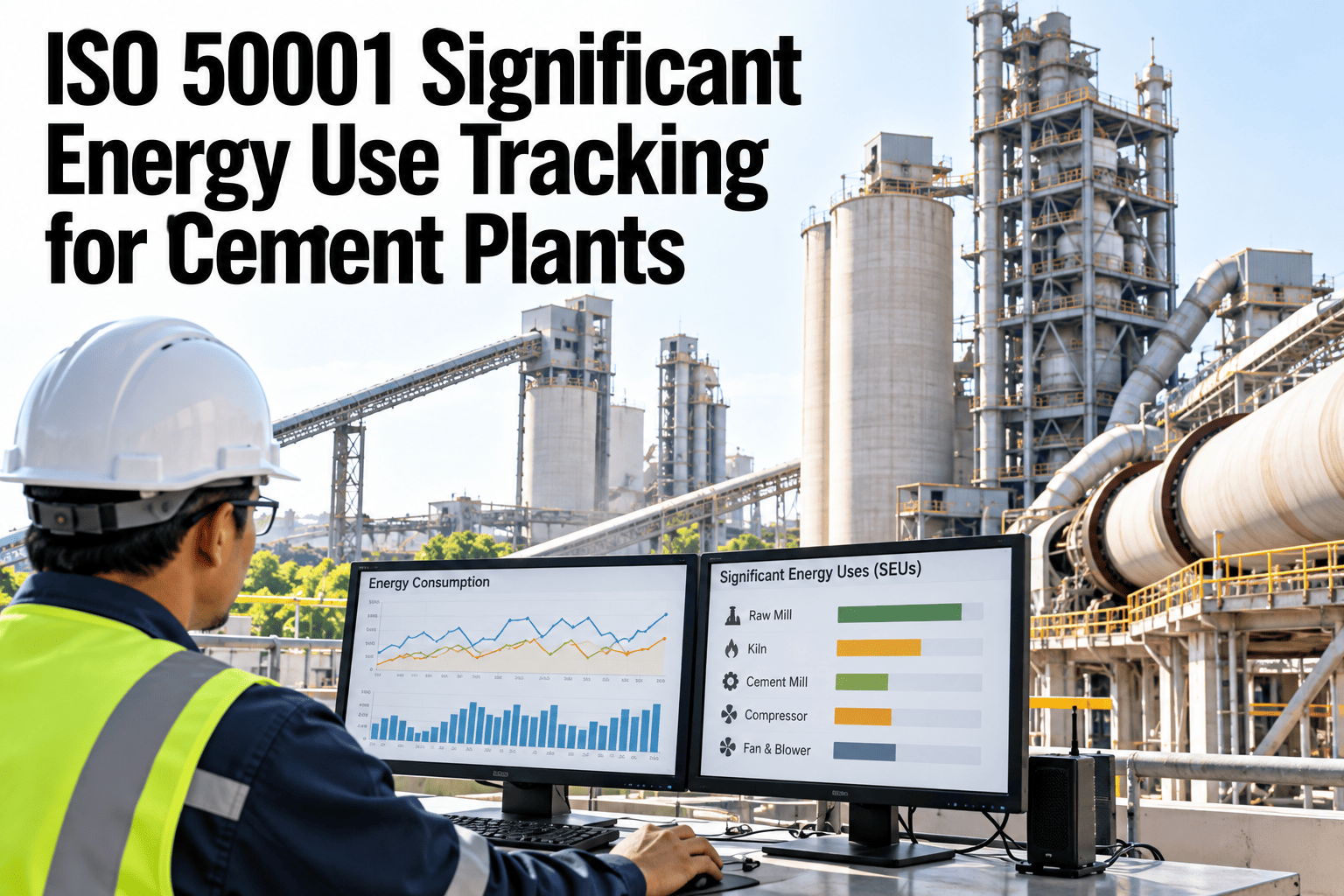
ISO 50001 Clause 6.3 and 6.5 require energy baselines (EnB), energy performance indicators (EnPI), and energy objectives. Cement plants typically track electrical energy intensity (kWh/ton cement) and thermal energy intensity (kcal/kg clinker) as primary EnPIs. AI establishes dynamic baselines from historical operating data and detects EnPI deviation in real time, triggering energy reduction project initiation when performance drifts outside the expected band.
Operational Planning & Control Integration
ISO 14001 Clause 8.1 and ISO 50001 Clause 8.1 both require operational planning and control — but the operational parameters differ. ISO 14001 focuses on emission control equipment operation, wastewater treatment, and waste segregation procedures. ISO 50001 focuses on kiln combustion optimization, mill grinding efficiency, and compressed air system management. AI integrates both control frameworks into a single operational dashboard.
Audit, CAPA & Management Review
ISO 14001 Clause 9 and ISO 50001 Clause 9 require internal audit programs, corrective and preventive action (CAPA) systems, and management review processes. The shared requirement for audit schedules, non-conformance tracking, and evidence-based management review creates the largest documentation burden in dual certification — and the highest-value automation opportunity through AI-generated audit trails and real-time CAPA status dashboards.
ISO 14001 and ISO 50001 Requirements Mapped to Cement Plant Processes
The matrix below maps the key ISO 14001 and ISO 50001 clauses to the specific cement plant processes, data sources, and documentation requirements that plants must manage for each clause. Understanding this mapping is the foundation of an effective AI-driven compliance platform, because the automation logic must ingest the correct process data for each clause and generate the appropriate evidence documentation. Book a Demo to see iFactory's compliance module configured for your plant's specific certification scope and process configuration.
| ISO Clause | Standard | Cement Plant Process | Primary Data Source | Documentation Required |
|---|---|---|---|---|
| 6.1.2 / 6.1.3 | 14001 | Emissions, water, waste, raw materials | CEMS, water meters, waste logs | Aspect register, significance criteria |
| 6.3 / 6.5 | 50001 | Kiln, mill, cooler, fans, compressors | PLC / DCS, power meters, fuel flow | EnB, EnPI, energy objectives |
| 8.1 | 14001 | Pollution control equipment operation | Baghouse DP, scrubber pH, temp | Operational control procedures |
| 8.1 | 50001 | Combustion, grinding, conveying systems | O2, CO, kW, tph, specific power | Energy control procedures |
| 9.1 | 14001 / 50001 | All monitored processes | All sensor and meter data | Monitoring reports, calibration records |
| 9.2 | 14001 / 50001 | All departments | Audit management system | Audit schedule, findings, responses |
| 10.1 / 10.2 | 14001 / 50001 | All non-conformances | CAPA workflow system | NC records, root cause, corrective actions |
| 9.3 | 14001 / 50001 | Plant management | Compliance dashboard | Management review meeting records |
AI-Driven Compliance Workflow — From Process Data to Audit Report
The gap between process data generated every second in a cement plant and the audit-ready compliance documentation required by ISO 14001 and ISO 50001 is bridged by a structured AI-driven workflow that ingests, analyzes, and documents compliance evidence continuously rather than retrospectively. iFactory's compliance platform executes this workflow across five stages, each producing the evidence records required for certification and surveillance audits.
Automated Data Integration from Process Control Systems
Continuous data ingestion from the plant's PLC, DCS, and stand-alone monitoring systems — continuous emissions monitoring system (CEMS) data, power meters on every major drive train, kiln fuel flow and temperature profiles, raw mill and cement mill specific power consumption, cooler air flow and pressure, compressed air system power and flow, and water supply and discharge flow rates. Data is time-stamped, validated for sensor health, and stored in the compliance data repository with full audit trail capture.
Real-Time Compliance Status and KPI Dashboard
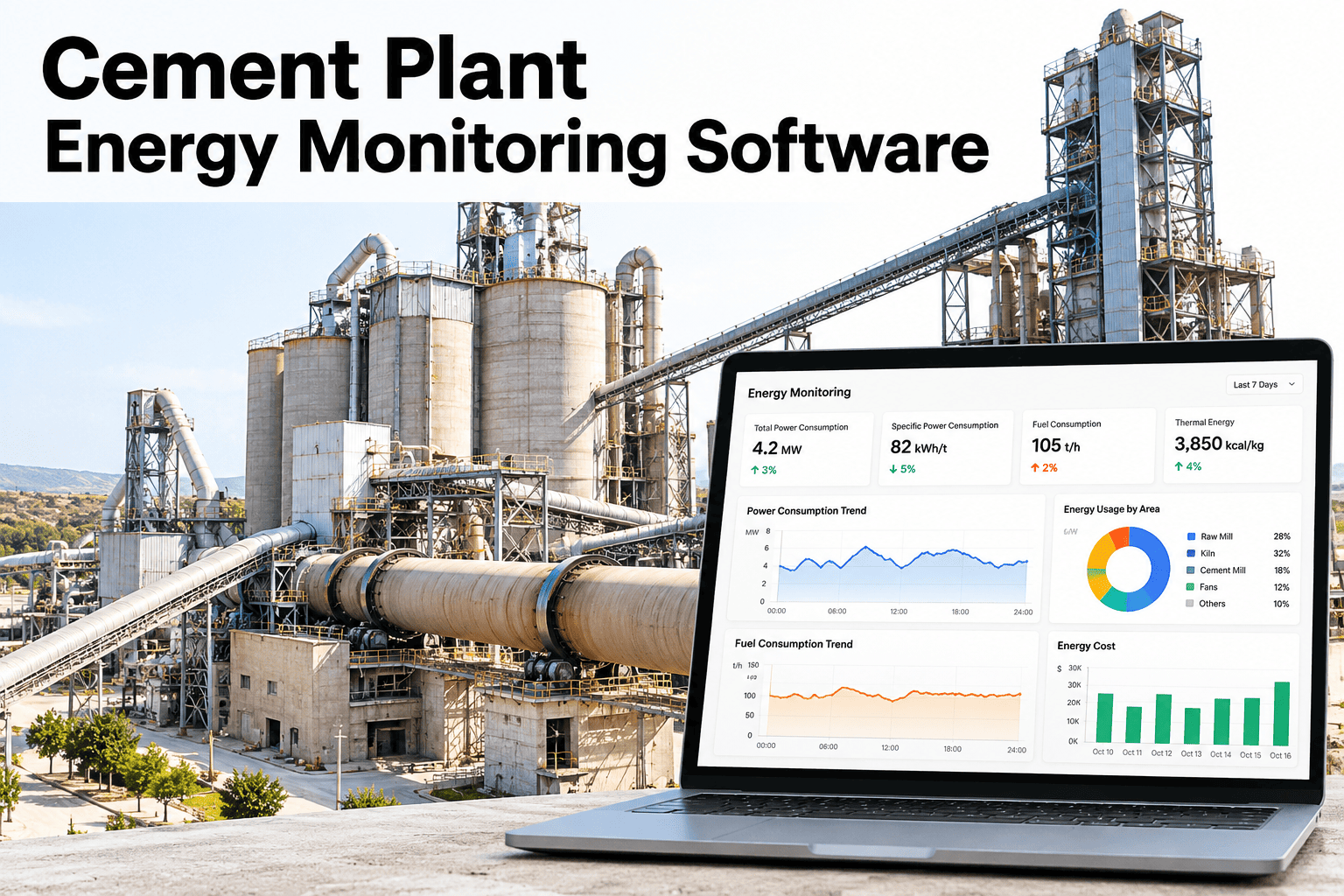
Ingested process data flows into the compliance KPI dashboard, which displays real-time status for every monitored environmental and energy parameter against its target, baseline, and regulatory limit. ISO 14001 aspects are color-coded green (within limit), amber (approaching limit), or red (exceeded). ISO 50001 EnPIs are shown against their dynamic baseline with deviation trend lines. The dashboard is the primary tool for management review preparation, capturing a continuous compliance record between formal review meetings.
Automated Non-Conformance Detection and Notification
When any monitored parameter exceeds its target, limit, or baseline deviation threshold, the platform automatically creates a non-conformance record with the timestamp, parameter value, duration of exceedance, and a snapshot of related process conditions at the time of the event. The non-conformance is routed to the responsible department head with a recommended corrective action timeline based on the severity classification configured in the compliance management module.
Corrective and Preventive Action (CAPA) Workflow
Each non-conformance flows into the CAPA workflow module, where root cause analysis is documented, corrective actions are assigned with due dates and evidence requirements, and effectiveness verification is scheduled. Preventive actions can be initiated proactively based on AI trend analysis — for example, a gradual EnPI drift that has not yet exceeded the threshold but is trending toward a non-conformance within the forecast window. The complete CAPA history is maintained as audit evidence for ISO 14001 Clause 10.1 and ISO 50001 Clause 10.1.
Audit-Ready Documentation and Report Generation
All compliance records — monitoring data, non-conformance records, CAPA history, training records, calibration certificates, and management review meeting minutes — are stored in the compliance documentation repository with version control, access logging, and retention scheduling. When an audit is scheduled, the platform generates an audit-ready evidence package organized by ISO clause, including the compliance status summary, supporting process data graphs, and the complete CAPA log for the audit period.
Replace Manual Audit Prep With Real-Time Compliance Intelligence
iFactory's ISO Compliance Tracking module connects your process data to ISO 14001 and ISO 50001 clause requirements — automating non-conformance detection, CAPA workflows, and audit-ready documentation in a single platform built for cement plant compliance teams.
What Compliance Leaders Say About AI-Driven ISO Management in Cement
Platform Capabilities for Integrated ISO 14001 and ISO 50001 Compliance
The financial and operational impact of moving from manual, document-based compliance management to an AI-driven, data-connected platform extends across every compliance activity. The capability grid below maps iFactory's compliance platform features to the measurable outcomes that matter to environmental managers, energy managers, and plant leadership.
Automated Audit Management
- Audit schedule generation with clause-based scope and department assignment
- Real-time audit finding capture with severity classification and photo evidence
- Automated evidence package generation organized by ISO clause for each audit event
- Audit finding closure tracking with root cause verification and effectiveness check
- Multi-site audit consolidation with cross-plant finding trend analysis
Energy & Environmental KPI Tracking
- Real-time EnPI dashboard with dynamic baseline against rolling 12-month average
- Emissions monitoring with aspect register auto-population from CEMS data feed
- Automated non-conformance record creation for any parameter exceeding target limit
- Energy reduction project tracking with verified savings documentation for ISO 50001
- Environmental compliance calendar with permit renewal, reporting, and audit deadlines
Document Control & Version Management
- Centralized document repository with ISO clause tagging and full-text search
- Version control with automated retention scheduling per document type and ISO clause
- Approval workflows for procedure updates, training records, and policy revisions
- Access control with role-based permissions for internal and external auditor access
- Automated document review reminders aligned with ISO-required review intervals
Integrated Compliance Management Is the New Standard for Cement Plants
The case for AI-driven ISO compliance management in cement manufacturing rests on a foundation every plant manager already understands: the standards are not going to get simpler, the audit scrutiny is not going to decrease, and the manual approach of spreadsheet trackers, folder-based document storage, and email-based CAPA workflows is consuming resources that should be directed toward environmental and energy performance improvement. The technology to connect process data to compliance evidence exists today, is proven across multiple cement plant deployments, and delivers measurable ROI in reduced audit cycle time, fewer non-conformances, and lower staff hour consumption — before accounting for the environmental and energy performance improvements that better data visibility enables.
iFactory's ISO Compliance Tracking and Audit Scheduling modules provide the integrated platform that connects your plant's CEMS, power monitoring, PLC data historian, and document repository to the structured compliance framework required by ISO 14001 and ISO 50001 — eliminating manual data compilation, automating non-conformance detection, streamlining CAPA workflows, and producing audit-ready documentation on demand. The platform deploys in 10 to 14 weeks, connects to existing process control and monitoring infrastructure without requiring sensor additions, and generates measurable compliance cost reduction from the first surveillance audit cycle. Book a Demo with iFactory's cement compliance team to build a site-specific compliance automation assessment for your cement plant.
Deploy AI-Driven ISO Compliance Management for Your Cement Plant
iFactory gives cement plant compliance teams a structured, automated ISO management platform — from real-time KPI tracking and non-conformance detection to CAPA workflows and audit-ready documentation — in a single system built for dual-certification operations.
ISO 14001 and ISO 50001 Compliance — Frequently Asked Questions
What process data does iFactory's compliance platform ingest for ISO 14001 and ISO 50001 monitoring?
The platform ingests data from continuous emissions monitoring systems (NOx, SOx, CO2, CO, O2, particulate matter), power meters on major drive trains (kiln ID fan, cooler fan, raw mill, cement mill, compressor), fuel flow meters (coal, pet coke, alternative fuels), kiln and calciner temperature profiles, water supply and discharge flow meters, waste generation and disposal records, and compressed air system power and flow data. The data ingestion layer connects to common cement plant control platforms including ABB 800xA, Siemens PCS7, Rockwell PlantPAx, and Schneider Foxboro via OPC-UA, Modbus TCP, or direct PLC database integration. Historical data for 12 to 24 months is imported during deployment to establish baselines and populate the environmental aspect register.
How does the platform handle the overlapping and distinct requirements of ISO 14001 and ISO 50001?
The compliance management module implements a dual-standard framework that maps each ISO 14001 and ISO 50001 clause to the specific cement plant processes, data sources, and documentation requirements identified during the initial compliance scope assessment. Overlapping clauses — such as Clause 9.2 (internal audit) and Clause 10.1 (non-conformance and corrective action) — are managed through shared workflows that satisfy both standards simultaneously. Standard-specific clauses — such as ISO 14001 Clause 6.1.2 (environmental aspects) and ISO 50001 Clause 6.3 (energy baseline) — have dedicated data ingestion and KAI dashboards that feed into the common documentation repository. The platform generates compliance reports filtered by standard, clause, or combined scope to support either individual or integrated audit scenarios.
How does the compliance platform integrate with existing cement plant CEMS and power monitoring systems?
The platform includes pre-built data connectors for the most common cement plant CEMS platforms (Thermo Fisher, Sick, Teledyne, Horiba) and power monitoring systems (Schneider PowerLogic, Siemens SENTRON, ABB Ability, Eaton Power Xpert). Data is ingested via OPC-UA, Modbus TCP, or direct database connection with configurable polling intervals from 10 seconds to 1 hour depending on the parameter's compliance significance. The data validation layer checks for sensor health status, out-of-range values, and communication continuity, flagging any data quality issues as potential non-conformances in the compliance dashboard. All ingested data is time-stamped and stored in the compliance data repository with full audit trail capture for ISO 14001 Clause 7.5 and ISO 50001 Clause 7.5 documentation requirements.