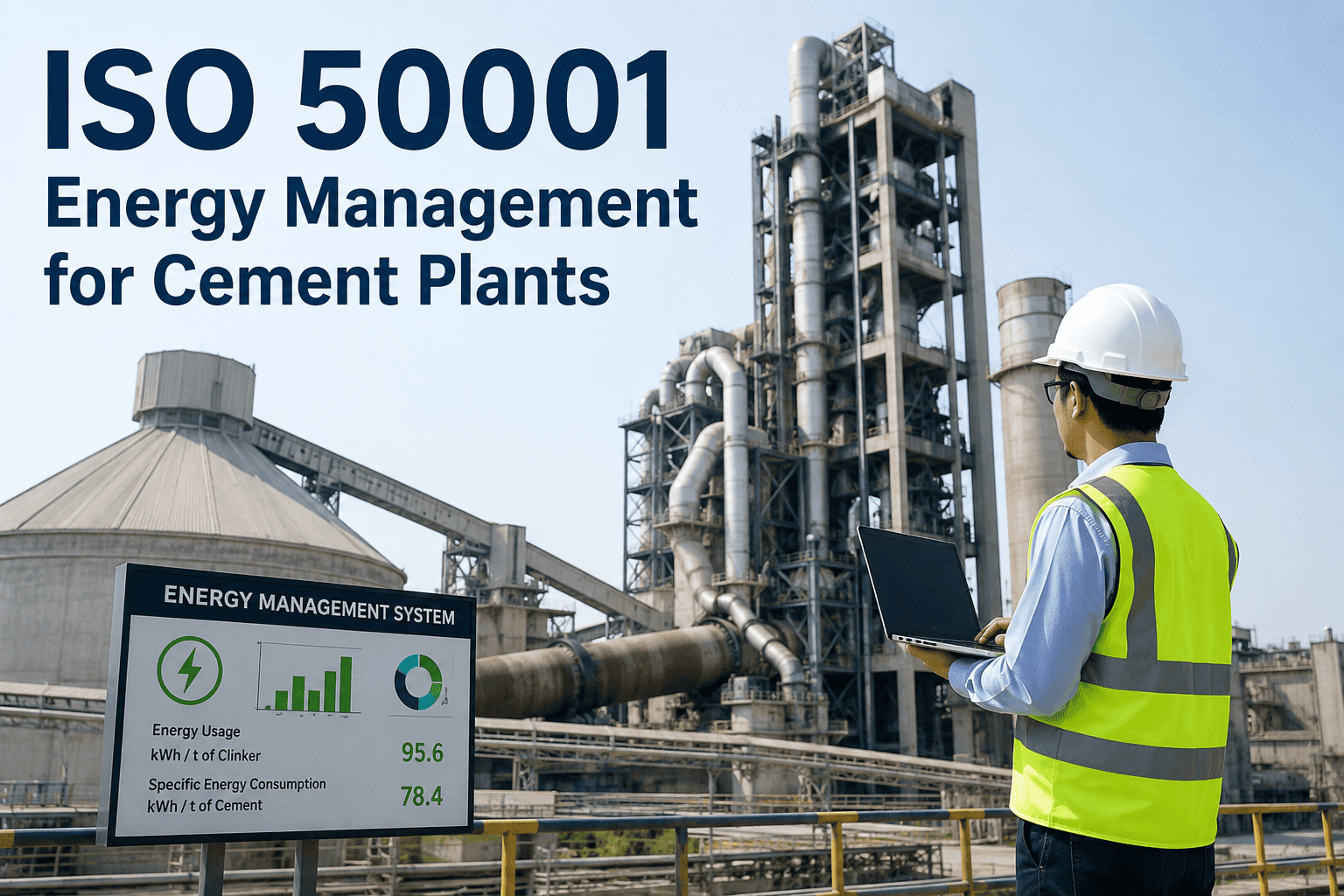
Energy already accounts for somewhere between 30 and 40 percent of total production cost at most cement plants, split between fuel for the kiln and electricity for grinding, so it is one of the few line items where a structured management system pays for itself almost immediately once it is running. ISO 50001 gives that structure a name and an audit trail: a Plan-Do-Check-Act cycle built around energy baselines and performance indicators tied to the specific equipment that actually consumes the energy, rather than a single plant-wide number that hides where the waste is happening. Talk to support about mapping your significant energy uses before the certification clock starts.
Cement Energy Optimization
ISO 50001 Energy Management for Cement Plants
A structured, auditable path to lower fuel and electricity costs across pyroprocessing and grinding
30-40%
Share of total production cost tied to energy
12-18 mo
Typical certification timeline
80%
Of consumption usually traced to 5-10 significant energy uses
The PDCA Cycle Applied to a Cement Plant
ISO 50001 is built around the same Plan-Do-Check-Act structure used in quality and environmental management systems, which makes it straightforward to integrate alongside an existing ISO 9001 or ISO 14001 program rather than running as a separate, competing initiative.
P
Plan
Conduct the energy review, identify significant energy uses across kiln, mills, and fans, and set the energy baseline and performance indicators for each.
D
Do
Implement the action plan: process changes, equipment upgrades, and operating procedure adjustments targeted at the significant energy uses identified in the plan phase.
C
Check
Monitor energy performance indicators against the baseline continuously, and verify that improvement actions are producing the measured, normalized gains expected.
A
Act
Adjust targets, correct underperforming actions, and feed lessons learned back into the next planning cycle as part of continual improvement.
Where Significant Energy Use Concentrates in Cement
ISO 50001 requires identifying the equipment responsible for the majority of consumption, called significant energy uses, and building specific management controls around each one rather than treating the plant as a single undifferentiated load.
01
Kiln and Pyroprocessing System
The largest single energy use in the plant by a wide margin, covering fuel consumption for clinker burning along with the ID fans and drives that support it.
02
Raw Mill and Grinding Circuit
A major electrical load that varies with raw material hardness and moisture, making it a natural candidate for its own dedicated energy performance indicator.
03
Cement Mill and Separator
Final grinding accounts for a significant share of electrical consumption and responds well to targeted separator and mill optimization actions tracked under its own baseline.
04
Fan Systems Across the Plant
Preheater, cooler, and mill fans collectively represent a large enough share of electrical draw that they typically warrant their own significant energy use category under the standard.
05
Compressed Air and Support Utilities
Smaller individually than the process areas above, but frequently mismanaged enough that it still earns a place among the top energy uses once properly measured.
Most plants find their significant energy uses account for roughly 80 percent of total consumption once properly mapped. Book a demo to see how that mapping applies to your specific line.
Energy Baseline and EnPI, Explained Simply
Two concepts sit at the center of every ISO 50001 program, and confusion between them is the most common reason certification stalls. The energy baseline is a fixed reference point captured during a defined period before improvement actions begin, and it is normalized to account for changes in production volume so that a busier month never gets mistaken for worse energy performance. The energy performance indicator is the ongoing measurement, usually expressed as energy consumed per tonne of clinker or cement produced, tracked continuously against that baseline to prove whether improvement actions are actually working.
Spreadsheets vs. a Platform-Based Approach
Early-stage single-site certification can sometimes run on spreadsheets, but most cement plants outgrow that approach quickly once submetering depth and multi-site reporting enter the picture.
Where Certification Programs Typically Stall
Most cement plants that struggle with ISO 50001 do not fail because the standard is conceptually difficult — they stall on the same handful of practical gaps every time.
A
Insufficient Submetering
Without dedicated meters at the kiln, raw mill, cement mill, and major fans, it becomes impossible to build a defensible, equipment-specific energy baseline rather than a single plant-wide estimate.
B
Baselines Never Normalized for Production
A baseline that ignores clinker or cement output volume makes a busy month look like a regression and a slow month look like an improvement, undermining every claim built on top of it.
C
EnPIs Tracked Sporadically Rather Than Continuously
Monthly spreadsheet snapshots satisfy the letter of the standard but leave auditors unable to verify that improvement actions are actually holding between review periods.
What a Well-Run EnMS Delivers
15-25%
Potential cost savings often left unquantified without a structured EnMS
60-80%
Reduction in certification effort with platform-based EnPI tracking
3 Years
Certification validity with annual surveillance audits
5-10
Significant energy uses typically identified per plant
Get Your Significant Energy Uses Mapped
Most certification delays trace back to weak baselines and undefined EnPIs. See how automated data collection removes that bottleneck before your Stage 1 audit is scheduled.
Frequently Asked Questions
How long does ISO 50001 certification typically take for a cement plant?
Most cement plants move from initial energy review through Stage 1 and Stage 2 audits within 12 to 18 months, though the timeline depends heavily on how much submetering infrastructure already exists. Plants starting with limited metering spend more of that window building the data foundation, while plants with existing DCS-level energy data can move through baseline and EnPI establishment considerably faster. A
demo call can help estimate a realistic timeline against your current instrumentation.
What is the difference between an energy baseline and an energy performance indicator?
The energy baseline is a fixed historical reference point, normalized for production volume, that represents how the plant performed before improvement actions started. The energy performance indicator is the ongoing, ideally continuous, measurement of current energy use against that same normalized basis. Every improvement claim under ISO 50001 is expressed as a change in the EnPI relative to the baseline, which is why both must be defined clearly and consistently before certification can proceed.
Do we need separate energy baselines for the kiln, raw mill, and cement mill?
Yes, in most cases. Each significant energy use identified during the energy review should have at least one associated energy performance indicator and baseline, since combining the kiln, raw mill, and cement mill into a single plant-wide number would hide which area is actually driving an improvement or a regression. Separate baselines make it possible to target investment at the equipment producing the clearest return.
Can ISO 50001 be integrated with our existing ISO 9001 or ISO 14001 systems?
Yes. ISO 50001 follows the same Plan-Do-Check-Act structure used by ISO 9001 for quality and ISO 14001 for environmental management, which was intentionally designed to make integration straightforward. Many cement plants fold energy management reviews into existing management review meetings and audit schedules rather than running a fully separate program, which reduces both administrative overhead and audit fatigue.
Is a spreadsheet enough to maintain ISO 50001 certification long term?
Spreadsheets can work for an initial single-site certification with a small number of significant energy uses, but most plants transition to a platform-based approach within 12 to 24 months as submetering depth and audit expectations increase. Auditors increasingly expect a traceable audit trail behind every baseline and EnPI calculation, which spreadsheets struggle to maintain reliably at scale.
Reach out to support to see how automated EnPI tracking fits into an existing certification program.
Turn Energy Data Into a Certified Management System
Every month without a documented baseline and tracked EnPIs is a month of unquantified savings sitting inside your kiln, mill, and fan circuits. See how the mapping and monitoring comes together.