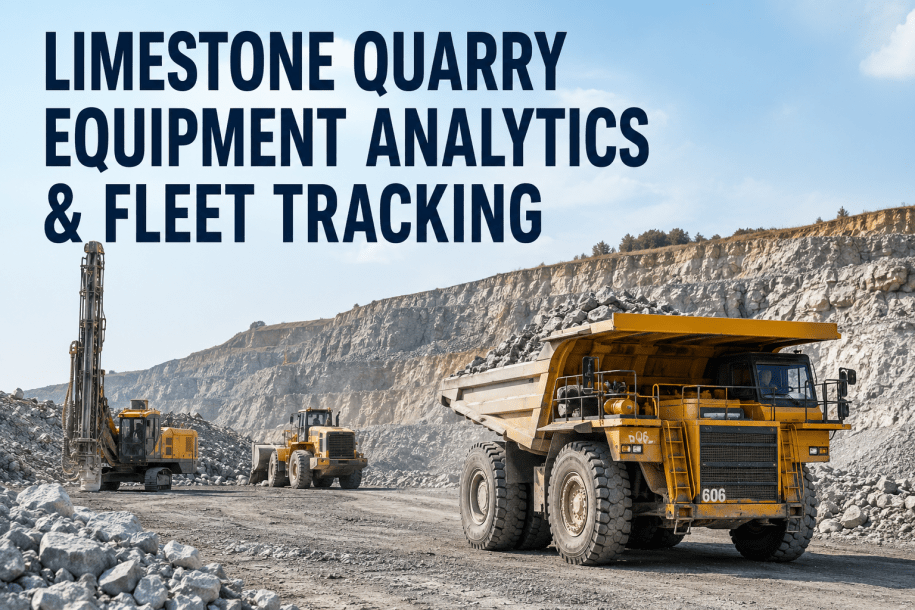
Every limestone quarry operation runs on mobile equipment — blast hole drills, front-end loaders, haul trucks, excavators, and support vehicles — and every dollar of operating cost flows through those assets. A typical 2 million ton per year limestone quarry operates 18 to 25 mobile assets across a pit that spans 200 to 500 acres, with haul cycles that average 3 to 5 miles from the active face to the primary crusher. The challenge is not managing individual equipment condition in isolation — it is understanding how every asset's location, utilization, fuel consumption, operator behavior, and maintenance status interact across the fleet in real time. GPS fleet tracking with AI-driven analytics closes this gap by transforming raw telemetry data — position, speed, engine hours, fuel rate, payload, and fault codes — into actionable intelligence that the quarry manager uses to improve utilization by 40 percent, reduce fuel cost by 25 percent and eliminate unplanned breakdowns across the entire mobile fleet. Book a Demo to see how iFactory AI's Fleet Management and GPS Tracking modules deliver quarry equipment analytics for your limestone operations.
The Cost of Blind Fleet Management in Limestone Quarries
Every quarry manager knows the pain of the equipment blind spot: a haul truck that has been idling at the crusher dump pocket for 35 minutes while the loader at the face waits for a return; a drill rig that has been operating with a worn hydraulic pump for three shifts because the engine hour-based PM schedule has not triggered the service interval yet; a fuel consumption pattern across the haul truck fleet that is 18 percent higher than last quarter but no one can pinpoint whether the increase is from longer haul routes, operator behavior, or a slow-rolling mechanical issue that has not yet triggered a fault code. The blind spot is not a failure of people — it is a failure of data integration. GPS location data lives in the telematics provider's portal, engine diagnostics live in the OEM's system, fuel transactions live in the fuel card provider's database, and work orders live in the CMMS. None of these systems talk to each other. iFactory AI connects them all in a single fleet analytics platform that turns the blind spot into a live operations dashboard.
Three Equipment Categories That Define Quarry Fleet Performance
A limestone quarry mobile fleet breaks into three distinct equipment categories — each with a different operating profile, failure mode, and analytics requirement. The AI fleet analytics platform must address each category's specific monitoring and optimization needs because a generic approach that treats all mobile assets the same misses the most valuable insights for each equipment type.
Drilling and Blasting Equipment
Blast hole drill rigs operating 24 hours per day during development and production drilling cycles, consuming 30 to 60 gallons of diesel per hour, and generating pull-down force, rotation speed, and torque data that indicates bit wear, ground condition changes, and drill string health. GPS tracking of drill pattern progress plus analytics on drill metrics improves blast fragmentation and reduces drilling cost per ton by 8 to 15 percent.
Hauling and Loading Equipment
Haul trucks (rigid or articulated), front-end wheel loaders, and excavators form the highest-cost asset group in the quarry — representing 50 to 65 percent of total mobile fleet operating expense. Haul cycle time, load-pass count, payload weight, fuel consumption per ton, and idle-to-work ratio are the KPIs that directly control quarry productivity and unit cost. AI analytics on haul route optimization delivers 15 to 25 percent cycle-time reduction.
Crushing and Screening Equipment
Primary jaw or gyratory crushers, secondary cone crushers, triple-deck screens, and overland conveyors are typically semi-stationary but experience the most severe wear and mechanical stress in the quarry. Crusher mantle and liner wear, screen deck tension, and conveyor belt tracking and bearing temperatures generate failure modes that can be predicted from motor power draw, vibration, and operating hours data integrated with the mobile fleet GPS feed.
Five AI Capabilities for Quarry Fleet Analytics and GPS Tracking
AI applied to quarry fleet management transforms five distinct activities across the equipment lifecycle — from real-time GPS location tracking and utilization analysis to predictive maintenance scheduling and fuel optimization. Each capability addresses a specific gap that conventional fleet management methods cannot close because the necessary data — GPS location, engine diagnostics, fuel consumption, and work order history — exists in disconnected systems that never share information. iFactory's Fleet Management and GPS Tracking modules integrate all five capabilities into a single platform that the quarry manager uses to monitor, analyze, and optimize every mobile asset from a single dashboard.
Real-Time GPS Fleet Tracking and Equipment Utilization Analytics
Every mobile asset in the quarry fleet is equipped with a GPS telematics unit that transmits position, speed, heading, engine hours, and diagnostic fault codes at intervals ranging from 10 seconds to 5 minutes depending on connectivity. iFactory's platform ingests this data and computes real-time utilization metrics — operating hours vs. available hours, idle time percentage, travel time percentage, and cycle count for haul trucks. The utilization dashboard displays every asset on a live quarry map with color-coded status indicators: green for productive operating, amber for idling, red for down for repair, and gray for scheduled maintenance.
- Live GPS tracking displayed on quarry map with asset type, status, and operator identification
- Hour-by-hour utilization report showing operating, idle, travel, and down time for each asset
- Automatic cycle detection for haul trucks: load, haul, dump, return with segment time breakdown
- Geofence-based arrival and departure alerts for key zones: loading face, crusher, fuel station, shop
AI-Driven Predictive PM Scheduling from Engine Hours and Operating Data
Conventional PM scheduling in limestone quarries is based on engine-hour intervals or calendar cycles — every 250 hours for oil change, every 500 hours for filter replacement, every 1,000 hours for major service. This rigid approach either over-services equipment that operates in benign conditions or under-services equipment that operates in severe dust, heat, or load conditions. AI predictive PM scheduling ingests real-time engine data — operating hours at load factor, ambient temperature, coolant temperature, hydraulic oil temperature, and fault code frequency — and adjusts the PM interval dynamically based on actual equipment usage severity.
- PM interval dynamically adjusted based on engine load factor, operating severity, and ambient conditions
- Predictive failure models trained on historical fault codes and engine parameter trends for each asset class
- AI-generated work orders flow directly to the iFactory CMMS with recommended parts and labor estimate
- PM schedule optimized to coincide with planned downtime windows rather than interrupting production
Fuel Consumption Analytics and Energy Optimization
Fuel is the single largest variable operating cost in a limestone quarry mobile fleet — typically 30 to 40 percent of total equipment operating expense. AI fuel analytics ingests GPS position data, engine ECM fuel rate, payload weight, and haul route profile to calculate fuel consumption per ton hauled for every asset and every operator. The platform identifies assets and operators with above-average fuel consumption, correlates high consumption with specific operating conditions (steep grades, excessive idle time, overloading), and generates recommendations for route changes, operator coaching, or mechanical investigation.
- Gallons-per-ton fuel efficiency calculated per asset per shift with driver attribution
- Idle fuel consumption tracked and reported as actionable waste metric for each operator and shift
- Fuel consumption anomaly detection — sudden increase triggers mechanical inspection recommendation
- Fuel card transaction data integrated with GPS location data for tank-level fuel reconciliation
Operator Performance and Equipment Abuse Monitoring
Operator behavior is the most variable and least measured factor in quarry equipment operating cost. Harsh acceleration, hard braking, excessive engine speed, and rapid hydraulic cycling accelerate component wear by 20 to 40 percent and increase fuel consumption by 10 to 20 percent. iFactory's platform tracks operator performance indicators — average engine speed, max acceleration events, overspeed duration, and hydraulic cycle frequency — and scores each operator against the fleet benchmark. Operator dashboards display individual performance metrics with coaching recommendations for improvement.
- Operator scorecard per shift showing fuel efficiency, idle time, harsh events, and productivity metrics
- Harsh event recording — hard braking, rapid acceleration, overspeed — with GPS location and severity rating
- Equipment abuse alerts sent to quarry supervisor when operator metrics exceed threshold for 3 consecutive shifts
- Operator training module linked to specific performance gaps identified by AI analysis of driving data
AI-Optimized Haul Route Planning and Cycle Time Reduction
Haul truck cycle time — load, haul, dump, return — is the single biggest determinant of quarry productivity and unit cost. Conventional haul route planning relies on static road assignments that do not account for changing conditions: active face location moving daily, crusher dump pocket availability, road surface deterioration after rain, or traffic congestion at intersection points. AI haul route optimization takes real-time GPS position data from every haul truck, crusher dump status, road condition data from operator reports, and active face coordinates to calculate the optimal route for each truck at each cycle.
- Real-time route optimization — shortest time path calculated for each truck considering current conditions
- Haul road condition tracking from GPS-based roughness analysis and operator-reported road issues
- Cycle time KPI dashboard by route, shift, operator, and truck model for targeted improvement initiatives
- Queue management at crusher dump pocket — GPS-based arrival time prediction and alternate route recommendation
Conventional Fleet Management vs. AI-Driven Fleet Analytics
The difference between conventional quarry fleet management and AI-driven fleet analytics is the difference between looking at last week's utilization spreadsheet and watching today's operations on a live map with predictive alerts that tell you which asset will need service next Tuesday. The comparison below maps the conventional approach against iFactory's AI-driven method across every dimension of quarry fleet management.
- GPS tracking limited to basic location in telematics portal; no correlation with maintenance or fuel data
- Equipment utilization calculated manually from operator shift reports and fuel tickets at end of month
- PM scheduling based on fixed engine-hour intervals; equipment over-serviced or under-serviced based on severity
- Fuel consumption tracked by total gallons purchased per month; no per-asset or per-operator visibility
- Operator performance assessed subjectively by supervisor observation; no objective data on driving behavior
- Haul routes determined by operator experience; no data-driven route optimization for changing pit conditions
- Maintenance work orders created after breakdown occurs; no predictive warning of impending failure
- GPS position, engine data, fuel rate, and fault codes integrated on single live map with status indicators
- Real-time utilization computed from GPS telemetry for every asset; operating, idle, travel, down time by shift
- AI-driven PM scheduling dynamically adjusted by engine load, ambient conditions, and fault code frequency
- Per-asset and per-operator fuel efficiency tracked in gallons per ton; anomaly detection for mechanical issues
- Operator scorecards generated automatically from engine and GPS data; targeted coaching for improvement
- AI route optimization recalculated per cycle based on active face location, crusher status, and road conditions
- Predictive failure alerts generated from engine parameter trends and historical fault code patterns
Deployment Architecture — From Fleet Telemetry to Operations Dashboard
Deploying AI fleet analytics in a limestone quarry requires connecting three data domains: GPS telematics from mobile assets, engine diagnostics from OEM telematics or aftermarket ECM readers, and operational data from the fuel management system and CMMS. iFactory's platform is designed for this multi-source integration, with pre-built connectors for leading telematics providers and a structured deployment pathway that delivers value at each phase.
GPS Telematics and Equipment Data Ingestion
GPS telematics data ingested from OEM telematics portals (Caterpillar VisionLink, Komatsu KOMTRAX, Volvo CareTrack) or aftermarket GPS devices (Samsara, Geotab, CalAmp). Engine ECM data — RPM, coolant temp, hydraulic oil temp, fuel rate, fault codes — pulled via J1939 CAN bus or OEM API. Fuel transaction data from fuel card providers or on-site tank management system. iFactory's pre-built connectors for 25+ telematics and fuel platforms accelerate integration to 2 to 3 weeks.
AI Analytics and Fleet Health Model Training
Machine learning models trained on historical telematics and maintenance data to predict equipment health, fuel consumption patterns, and optimal PM intervals. Utilization baseline computed from GPS data for each asset class. Operator behavior models trained on engine RPM, speed, and braking data. Haul route optimization model trained on historical GPS tracks to identify optimal paths. Model accuracy validated against at least 3 months of historical operational data before deployment.
Fleet Operations Dashboard and Alert Configuration
Live quarry map with asset positions, status indicators, and zone-based geofences configured with the quarry operations team. Utilization, fuel, and productivity dashboards built to show current shift performance against daily and weekly targets. Alert rules configured for key events: asset entering low-fuel threshold, utilization below target for 2 consecutive hours, fault code trigger requiring immediate inspection, PM interval approaching within 50 hours.
CMMS Integration and Continuous Learning
AI-generated PM work orders flow directly into the iFactory CMMS, creating scheduled maintenance tasks with recommended parts, labor estimate, and required skill level. Predictive failure alerts generate inspection work orders with specific guidance on what to inspect based on the anomaly indicators. All telematics, fuel, and inspection data linked to each asset's equipment history record. Predictive models retrain continuously on new telematics data and inspection outcomes, improving prediction accuracy with every operating month.
Deploy AI Fleet Analytics Across Your Limestone Quarry Operations
From GPS tracking and utilization analytics to predictive PM scheduling and fuel optimization — iFactory's Fleet Management and GPS Tracking modules deliver the full quarry equipment analytics platform in one system built for mining and aggregates operations.
What Quarry Fleet Leaders Say About AI-Driven Analytics
I have managed mobile equipment fleets in limestone and aggregate operations for eighteen years — across five quarries ranging from 500,000-ton-per-year agricultural lime operations to 4 million-ton-per-year cement-grade limestone operations. Fleet management in this industry has always been a reactive exercise. You put GPS units on the trucks to track location, you use the OEM telematics portal to pull engine hours for PM scheduling, and you look at fuel tickets at the end of the month to see if consumption is in the expected range. But none of those data sources talk to each other, and more importantly, none of them tell you what is going to happen next week — which truck is going to break down, which operator is burning excess fuel, or which haul route is costing you 20 percent more per ton than the alternative route that the operator is not using. iFactory's platform pulled GPS position data from our Samsara telematics, engine ECM data from our Caterpillar and Komatsu portals, and fuel transaction data from our fuel card provider into a single dashboard within three weeks of the project start date. The first insight that changed our operations came from the utilization analytics tab: we discovered that one of our five 50-ton haul trucks was operating at 38 percent utilization while the fleet average was 62 percent. The telematics data showed the truck was spending 2.5 hours per shift parked at the crusher dump pocket waiting for the previous truck to clear, while two other trucks were queued behind it for an average of 12 minutes per cycle. We had been looking at monthly utilization spreadsheets that averaged all five trucks together and showed a comfortable 60 percent fleet average — the individual truck problem was completely invisible until the AI platform broke utilization down by asset, by shift, and by hour. The fuel analytics module identified a second opportunity within the first month: operator C on the day shift was consuming 18 percent more fuel per ton than the next-highest operator on the same truck model on the same haul route. The operator scorecard showed excessive idle time — 37 minutes per shift above the fleet average — and a pattern of hard acceleration events at the crusher dump pocket that indicated aggressive positioning behavior. The shift supervisor reviewed the data with the operator, implemented a coaching plan focused on idle reduction and smooth approach speed, and the operator's fuel consumption dropped 14 percent over the next three weeks.
The AI predictive PM scheduling module paid for the entire platform investment within the first six months by preventing a catastrophic engine failure on a 100-ton haul truck. The engine ECM data showed a gradual increase in coolant temperature deviation — 4 degrees above the normal operating band — over a 10-day period. The AI model identified this as a predictive indicator of coolant pump degradation and generated an inspection work order. The shop found that the coolant pump impeller had lost three vanes from cavitation erosion, and the pump was replaced during a scheduled PM window at a cost of $1,400 rather than failing during operation and causing an engine overheating event that would have required a $45,000 engine rebuild.
AI Fleet Analytics in Limestone Quarries Is an Operational Necessity
The case for AI-driven fleet analytics in limestone quarry operations is built on a foundation every quarry manager already understands: mobile equipment is the most expensive input in any quarry, and the gap between the data available in disconnected telematics portals and the insight needed to drive real-time decisions is costing the operation 20 to 35 percent of its potential productivity. The technology is not speculative. GPS telematics is already installed on most quarry mobile assets. OEM engine ECMs are generating data on every operating parameter. Fuel card systems are recording every transaction. The problem has never been a lack of data — it has been the absence of an analytical layer that connects these data sources, correlates them with equipment performance and cost, and delivers actionable intelligence to the quarry manager in time to make a decision that matters.
iFactory AI's Fleet Management and GPS Tracking modules provide that analytical layer — integrating GPS telematics, engine diagnostics, fuel transactions, and maintenance history into a single platform that delivers real-time fleet visibility, predictive PM scheduling, fuel optimization, operator performance management, and haul route optimization for every mobile asset in the quarry. The platform connects to existing telematics and CMMS infrastructure, deploys in 8 to 12 weeks, and generates measurable ROI within the first quarter of operation. Book a Demo with iFactory's quarry operations team to build a site-specific fleet analytics assessment for your limestone quarry.
Deploy AI Fleet Analytics for Your Limestone Quarry with iFactory
iFactory registers every mobile asset, tracks GPS location and utilization in real time, predicts maintenance needs from engine data, optimizes fuel consumption per ton, and generates operator scorecards — in one platform built for quarry and mining operations.
Limestone Quarry Equipment Analytics and Fleet Tracking — Frequently Asked Questions
What GPS telematics data is needed for AI fleet analytics in a limestone quarry?
The minimum data requirement is GPS position (latitude, longitude, heading, speed) updated at least once per minute per asset, engine hours and cumulative fuel consumption from the ECM or telematics gateway, and odometer reading for mobile assets. High-value additional data includes instantaneous fuel rate (gallons per hour), engine RPM and load factor, coolant and hydraulic oil temperature, and OEM diagnostic fault codes. iFactory's platform ingests data from OEM telematics portals such as Caterpillar VisionLink, Komatsu KOMTRAX, Volvo CareTrack, and Hitachi Global E-Service, as well as aftermarket GPS devices from Samsara, Geotab, CalAmp, and other telematics providers. The platform also integrates fuel card transaction data and on-site tank management system data for end-to-end fuel reconciliation.
How does AI predict equipment failures from telematics data in quarry operations?
The AI failure prediction models are trained on historical telematics data — engine parameter trends, fault code occurrences, and operating conditions — correlated with actual maintenance events and failure records from the CMMS. The models learn the precursor patterns that precede specific failure modes: coolant temperature drift before water pump failure, hydraulic oil temperature rise before pump degradation, vibration pattern changes before bearing failure, and fuel rate increase before injector or turbocharger issues. Once deployed, the models monitor incoming telematics data continuously and generate predictive alerts when parameter trends match the precursor patterns learned during training. The prediction lead time varies by failure mode — coolant system issues typically show 7 to 14 days of advance warning, while hydraulic and powertrain failures show 3 to 7 days of detectable precursor patterns.
How does AI optimize haul truck routes in real time across changing pit conditions?
The AI haul route optimization model takes real-time GPS position data from every haul truck, the active loading face coordinates provided by the quarry dispatcher, the crusher dump pocket availability status (open, queued, or down), and road condition data derived from GPS-based roughness analysis and operator-reported issues. The model calculates the shortest time path for each truck at each cycle dispatch, accounting for road surface quality, grade severity, intersection traffic, and dump pocket queue length. When a haul road becomes impassable due to weather, blasting, or maintenance, the model recalculates routes for all active trucks within seconds. The route recommendation is displayed to the haul truck operator through the in-cab display or mobile app, and actual route adherence is tracked and reported as a compliance metric.
What is the typical ROI timeline for AI fleet analytics in a limestone quarry operation?
Quarry operations deploying iFactory's AI fleet analytics platform typically recover the investment within 6 to 12 months through a combination of utilization improvement (35 to 50 percent gain on underperforming assets), fuel cost reduction (25 to 35 percent through optimized routes and operator behavior improvement), reduced unplanned maintenance (30 to 45 percent fewer breakdown events, each avoiding $8,000 to $25,000 in emergency repair cost and production delay), and extended equipment life through better PM scheduling. On a typical 20-asset quarry fleet with $3 million to $5 million in annual mobile equipment operating cost, a 15 to 20 percent total cost reduction represents $450,000 to $1,000,000 in annual savings that directly offsets the platform investment within the first year.
Does the platform integrate with existing quarry GPS telematics and OEM portals?
Yes. iFactory's Fleet Management module includes pre-built connectors for the leading OEM telematics portals — Caterpillar VisionLink, Komatsu KOMTRAX, Volvo CareTrack, Hitachi Global E-Service, and John Deere JDLink — as well as aftermarket GPS platforms including Samsara, Geotab, CalAmp, Verizon Connect, and Teletrac Navman. The platform also connects to fuel card providers (WEX, FleetCor, Shell Card), on-site tank management systems, and CMMS platforms (IBM Maximo, SAP EAM, Infor EAM, and iFactory's native CMMS). New connector development for proprietary or legacy telematics systems is typically completed within 2 to 4 weeks. The integration architecture is data-source agnostic: the quarry manager does not need to replace any existing telematics infrastructure.