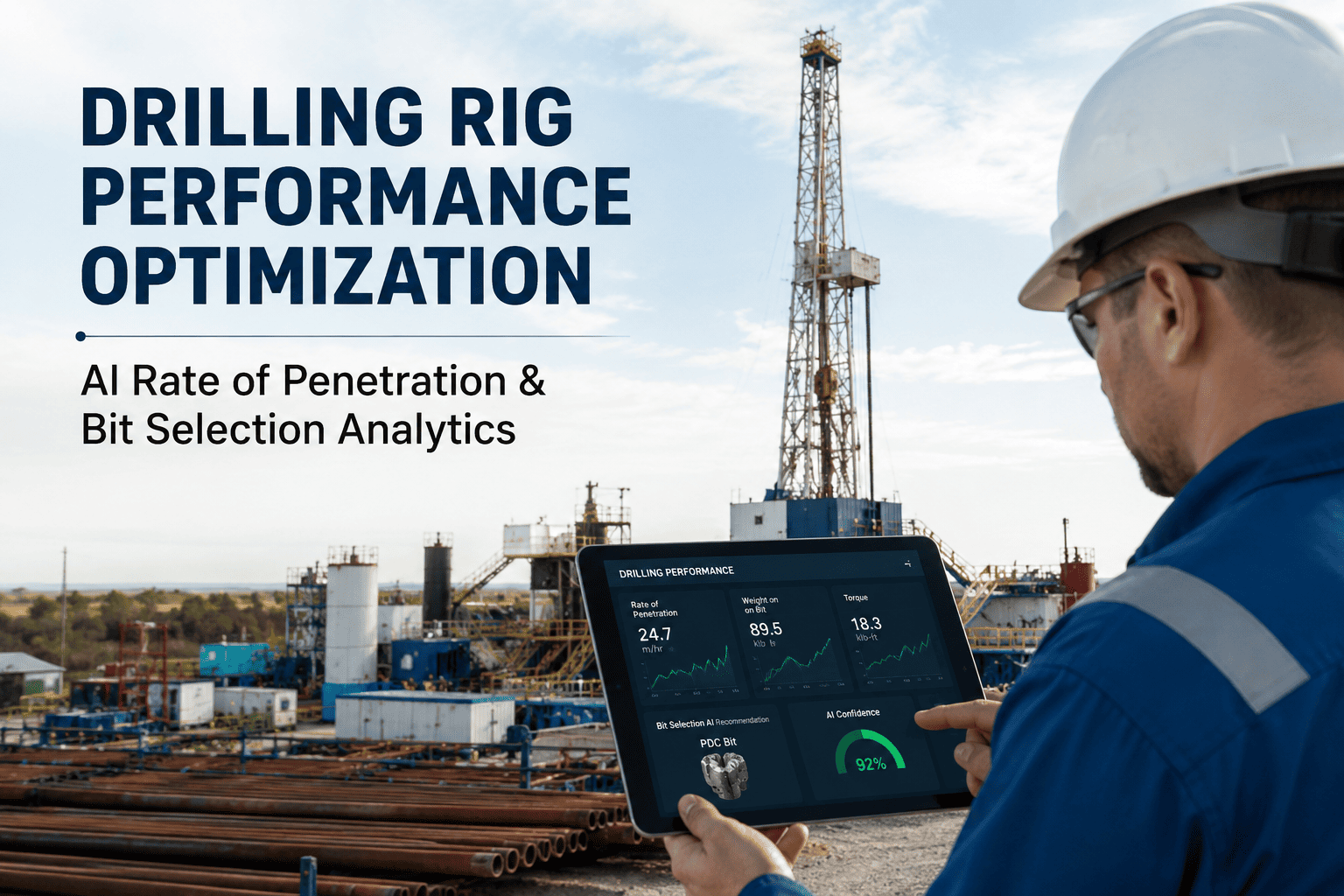
Every foot of hole that takes longer than it should is money spent without progress. On a mid-size land rig, a single day of non-productive time can run past $30,000, and offshore spreads push that number into six figures before the crew changes shift. Drillers have long relied on experience, fixed drill-off tests, and after-the-well reviews to catch inefficiency — usually long after the non-productive time is already on the AFE. AI-driven rate of penetration prediction and bit selection analytics flip that timeline, recommending the optimal weight-on-bit, rotary speed, and flow rate combination while the bit is still in the hole, and operators comparing notes on the approach are booking a demo of the platform before their next well program spuds.
The Driller's Dilemma: Push the Bit Harder, or Protect It?
Rate of penetration decisions get made every few minutes on every well, and each one carries a trade-off between speed and bit life, vibration, and formation damage. Static drill-off charts and driller intuition worked when formations were predictable. In unconventional plays, deepwater sections, and geothermal wells, they leave real ROP on the table.
17–33%
Average ROP improvement reported in field-validated machine learning trials
40–60%
Typical non-productive time reduction after AI parameter optimization goes live
13%
Average reduction in mechanical specific energy from real-time WOB and RPM tuning
Where Drilling Programs Actually Lose Time
Non-productive time rarely shows up as one dramatic event. It accumulates across dozens of small, avoidable decisions spread across every bit run, every formation change, and every parameter adjustment made without full visibility into what the rock is actually doing downhole.
Conservative Parameter Envelopes
Drillers often stay well inside safe WOB and RPM limits to avoid twist-offs or vibration damage, sacrificing achievable ROP because the real-time downhole condition isn't visible at surface.
Reactive Bit Selection
Bit type is frequently chosen from offset-well history rather than the specific lithology being drilled in that interval, leading to premature wear or under-utilized cutting structures.
Undetected Stick-Slip and Whirl
Torsional vibration and bit whirl degrade ROP and shorten bit life long before surface torque readings show an obvious problem, and by the time it's visible the damage is already done.
Delayed Drill-Off Test Cycles
Manual drill-off tests are run infrequently because they take rig time to execute, so the parameter model driving the well often lags the actual formation being drilled by hours or days.
How AI-Driven ROP Prediction Works on a Live Well
Modern ROP optimization platforms combine physics-based drilling models with machine learning trained on offset and real-time data, continuously recommending parameter adjustments instead of waiting for the next scheduled review.
01
Real-Time Surface and Downhole Data Ingestion
WOB, RPM, torque, standpipe pressure, flow rate, and available MWD vibration data stream continuously from the rig floor into the analytics engine, typically at one-second to five-second intervals.
02
Formation-Aware ROP Modeling
Neural network and gradient-boosted models trained on offset well logs and lithology data build a formation-specific ROP response curve, replacing the fixed Bourgoyne-Young style constants used in older empirical models.
03
Constrained Parameter Search
The model tests small, safe deviations in WOB and RPM against the live response, building a continuously updated map of which parameter combination is producing the best ROP for the current formation and bit condition.
04
Dysfunction Detection and Guardrails
Stick-slip, bit whirl, and excessive vibration are flagged from torque and RPM fluctuation patterns, and the recommended parameter envelope automatically tightens before damage accumulates on the bit or BHA.
05
Driller-Facing Recommendation and Logging
Recommended setpoints are pushed to the driller's display in plain terms, and every adjustment plus its resulting ROP is logged automatically for the end-of-well performance review and the next offset model.
Drilling programs running AI parameter optimization are cutting non-productive time by 40 to 60 percent per well section.
iFactory's rig performance platform layers ROP prediction, bit selection analytics, and dysfunction detection on top of your existing surface data acquisition system, with no changes to your drill string.
Bit Selection Analytics: Matching the Cutting Structure to the Rock
Bit selection has historically leaned on offset-well precedent and vendor recommendations. AI models trained on lithology, mechanical specific energy, and historical bit dull grades now recommend cutter density, blade count, and gauge design specific to the interval ahead, not the well that was drilled last year.
| Formation Type |
Common Failure Mode |
AI-Recommended Adjustment |
Typical Bit Life Gain |
| Interbedded shale and sandstone |
Uneven wear from lithology transitions |
Variable cutter density across blade profile |
20–35% |
| Hard abrasive carbonate |
Premature cutter wear and gauge rounding |
Higher-grade PDC with reinforced gauge pads |
15–25% |
| Unconsolidated sand |
Bit balling and reduced cleaning efficiency |
Adjusted junk slot area and flow distribution |
10–20% |
| Deep hot geothermal rock |
Thermal degradation of cutters |
Thermally stable diamond cutter selection |
25–40% |
| Interbedded chert stringers |
Impact damage and chipped cutters |
Impact-resistant cutter grade with backup bevel |
15–30% |
Parameter Optimization Gains, Side by Side
Isolated parameter tuning helps, but the combined effect of ROP-aware WOB, RPM, and flow rate management is where most of the non-productive time reduction actually comes from.
Weight-on-bit optimization
Up to 22%
Rotary speed tuning
Up to 17%
Flow rate and hydraulics tuning
Up to 14%
Combined AI parameter optimization
Up to 33%
Manual Drilling Practice vs. AI-Optimized Drilling
The comparison below reflects typical outcomes reported across onshore and offshore programs after AI-based ROP and bit selection analytics were introduced mid-campaign, measured against the same formation drilled under manual parameter control.
Manual Parameter Control
Offset-based bit selection, periodic drill-off tests
Average ROPBaseline
Non-productive time per sectionHigh
Bit trips per wellMore frequent
Vibration-related NPTDetected late
AI-Optimized Drilling
Real-time ROP prediction, dysfunction guardrails
Average ROP17–33% higher
Non-productive time per section40–60% lower
Bit trips per wellReduced
Vibration-related NPTFlagged in real time
What Separates a Successful Rollout From a Stalled One
What consistently works
Feeding the model with clean offset-well data before spud, so the ROP prediction starts closer to formation reality on the first bit run instead of learning from scratch.
Pushing recommendations directly to the driller's console in plain operational terms rather than a separate engineering dashboard that nobody checks during tour.
Setting dysfunction guardrails before chasing maximum ROP, so early wins don't come at the cost of an unplanned bit trip.
Where rollouts stall
Treating the platform as a one-time software install instead of a continuous model that improves with every additional bit run and offset well added.
Letting drillers override every recommendation without feedback, which prevents the model from ever calibrating to actual rig behavior.
Rolling out across the full rig fleet before validating the model on one or two wells, which makes it harder to isolate what's actually driving performance gains.
The Bottom Line for Drilling Engineers
Rate of penetration and bit selection have always been engineering decisions made under uncertainty. What AI-driven analytics change is how much of that uncertainty gets resolved before the parameter change is made rather than after the fact in a post-well report. A drilling program that closes even a portion of the 17 to 33 percent ROP gap documented across recent field trials pays for the analytics platform many times over across a multi-well campaign, and the non-productive time avoided compounds with every additional well drilled on the same model.
Frequently Asked Questions
The next well on your program is the cheapest place to start closing the ROP gap.
iFactory's drilling performance specialists will walk through your current rig data setup, show what a formation-specific ROP model looks like for your basin, and outline a pilot well plan before you commit to fleet-wide rollout.