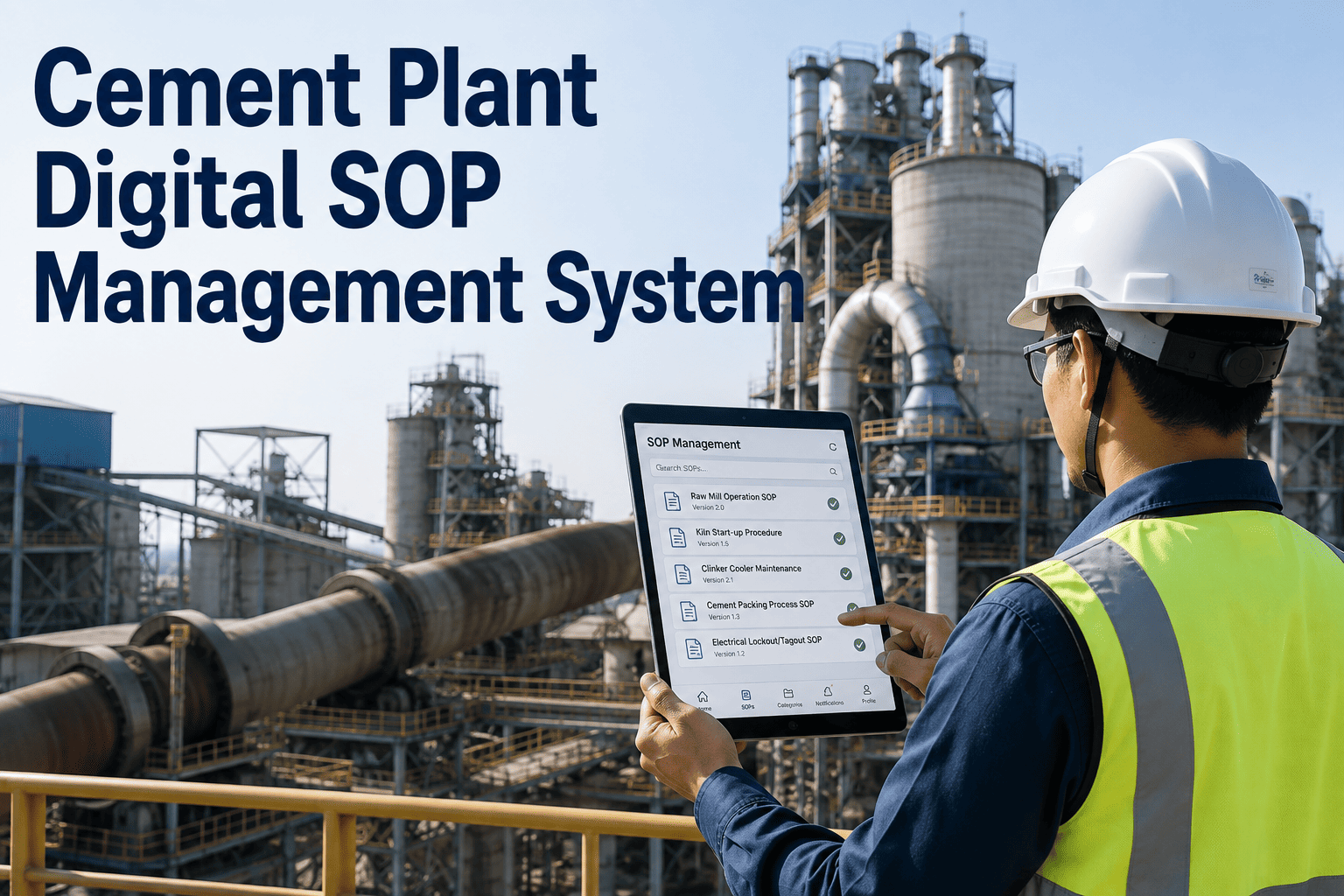
Ask a shift supervisor whether every operator on every crew ran last week's kiln startup exactly per procedure, and the honest answer at most cement plants is that nobody actually knows. Laminated binders get outdated the moment a process changes, checkmarks get signed off from memory rather than at the moment the step happened, and the one operator who actually understands the tribal-knowledge workaround for a tricky changeover retires without ever writing it down. A digital SOP system does not just move paper onto a screen, it closes the gap between what a procedure says and what actually happens on the floor. Book a demo to see how iFactory turns your existing procedures into guided, trackable digital work instructions.
Your SOPs Only Work If You Can Prove They Were Actually Followed
Paper and PDF-based procedures create version drift, invisible non-compliance, and audit gaps that only surface after something has already gone wrong. iFactory's Document Management turns static SOPs into guided digital procedures with built-in version control, evidence capture, and AI-powered compliance tracking, so what happened on the floor matches what the procedure required.
The Real Cost of Paper SOPs Nobody Puts in the Budget
Paper and loosely managed digital procedures feel manageable right up until a second shift, a third production line, or a new operator joins the mix, at which point version drift, inconsistent execution, and unverifiable compliance start compounding quietly in the background. The problem rarely shows up as a single dramatic failure, it shows up as a slow accumulation of small deviations that only becomes visible during an audit, an incident investigation, or a quality complaint.
What Actually Changes When SOPs Move Off Paper
- Latest revision may not be the one on the floor
- Sign-off happens from memory, sometimes after the fact
- No photo or reading evidence tied to a specific step
- Tribal knowledge lives in one operator's head
- Audit prep means physically hunting down binders
- Every operator sees the current approved version automatically
- Steps are confirmed with a photo, reading, or signature in real time
- Evidence is captured and timestamped at the moment work happens
- Procedure knowledge is written once and reused across every shift
- A complete audit trail is available in seconds, not hours
Stop Finding Out About Procedure Gaps During an Audit
iFactory's Document Management gives every operator guided, version-controlled procedures with built-in evidence capture, so compliance is verified continuously instead of reconstructed after the fact.
What a Real Digital SOP System Actually Captures
The difference between a simple PDF viewer and a genuine digital SOP system comes down to what gets recorded while the procedure is being followed, not just how the document is displayed.
| Tracked Element | Why It Matters |
|---|---|
| Version and revision history | Proves which procedure version was active on any given date, for any given line |
| Step-level completion evidence | Photo, reading, or signature captured at the moment each step is performed, not after the fact |
| Operator and shift attribution | Ties every completed step to a specific person, shift, and timestamp for accountability |
| Deviation and exception flags | Automatically highlights out-of-spec readings or skipped steps for supervisor review |
| Approval and sign-off workflow | Routes new or revised procedures through required review before they go live on the floor |
From Written Procedure to Verified Execution
What Plants Moving Off Paper Actually See
Why Starting With One Process Beats a Full Rollout
Plants that try to digitize every procedure across every line on day one tend to stall under the sheer volume of content to convert and approve. A more effective starting point is the single process that causes the most repeated questions, corrections, or audit findings, since that is where digitization delivers visible value fastest and builds the internal case for expanding further.
Once a first process is live, the expansion pattern that works best is usually sequential rather than a big-bang switch across every line at once. Rolling out to a second shift on the same line first tests whether the procedure and evidence requirements hold up across different crews and habits before adding the complexity of a different line entirely. This staged approach also gives supervisors a manageable volume of new digital workflow to learn and coach on at any given time, rather than retraining an entire plant's worth of procedures and expectations in a single week.
Common Questions About Digital SOP Management
Is a digital SOP system really necessary for a mid-size cement plant, or is that overkill?
Mid-market plants, generally those in the range of a few dozen to a few hundred employees, often see the clearest benefit because they typically have enough procedure volume across multiple lines and shifts to make paper genuinely unmanageable, while lacking the dedicated IT staff larger enterprises rely on to build a custom solution. A purpose-built digital SOP platform with fast setup and simple authoring closes that gap without requiring a large internal implementation team. Book a demo to see how quickly a plant your size can get a first process live.
How does a digital system actually prevent the pencil-whipping problem where steps get signed off without being done?
Pencil-whipping happens on paper because a checkmark carries no proof that the underlying action actually occurred, it only proves someone wrote a mark on a form, often after the fact from memory. A digital system closes that gap by requiring actual evidence at each critical step, such as a photo of a completed task, a measured reading entered directly, or a timestamped signature captured in the moment, which makes it considerably harder to sign off on work that was not actually performed and creates a verifiable record when it was.
Do operators actually adopt digital procedures, or does this just create resistance on the floor?
Adoption tends to go smoothly when the rollout starts small, keeps the interface simple, and genuinely makes the operator's job easier rather than adding extra reporting burden, which is why starting with a single high-value process rather than a full plant-wide switch matters so much for early buy-in. Operators who have struggled with an outdated binder or an illegible predecessor's handwriting often become the strongest advocates once they see step-by-step guidance with photos and videos actually reduce the number of times they get pulled aside to ask a supervisor a question. Contact support for guidance on a rollout approach that minimizes floor disruption.
Can a digital SOP system integrate with our existing CMMS and quality systems, or does it operate separately?
A well-built digital SOP platform is designed to connect with existing maintenance, quality, and production systems rather than becoming another disconnected island of data, so a flagged deviation during a procedure can automatically generate a work order, or a quality reading captured mid-procedure can flow directly into existing quality management records without manual re-entry. This integration is what separates a genuine operational tool from a simple document viewer, and it is worth confirming explicitly during evaluation rather than assuming it by default. Book a demo to see how this connects with the systems you already run.
What happens to institutional knowledge when an experienced operator retires, if it was never written down?
Without a structured system to capture it, that knowledge typically leaves with the person, and the plant relearns the same lessons through trial and error over months or years until a new operator rebuilds a comparable level of expertise, often the hard way through repeated small mistakes. A digital SOP system gives experienced operators a practical way to document the tacit adjustments, workarounds, and judgment calls that never made it into the original written procedure, turning individual expertise into a shared, searchable resource the entire plant can draw on immediately rather than losing it at the moment it is needed most.
Turn Your Procedures Into Proof, Not Just Paperwork
iFactory's Document Management gives every operator the current procedure, captures evidence as the work happens, and keeps your audit trail ready before anyone asks for it.