Fans are the quiet giants of a cement plant's electric bill. Between the preheater induced-draft fan, the raw mill fan, the cooler fans, and the baghouse fans, a typical plant routes somewhere between a fifth and a third of its entire electrical consumption through fan motors — most of it wasted on dampers throttling air that a variable speed drive could simply slow down instead. The fans keep running at full speed regardless of what the process actually needs, and the difference between required airflow and delivered airflow gets burned off as heat at the damper blade. Talk to support about auditing your fan fleet before your next energy review.
Cement Energy Optimization
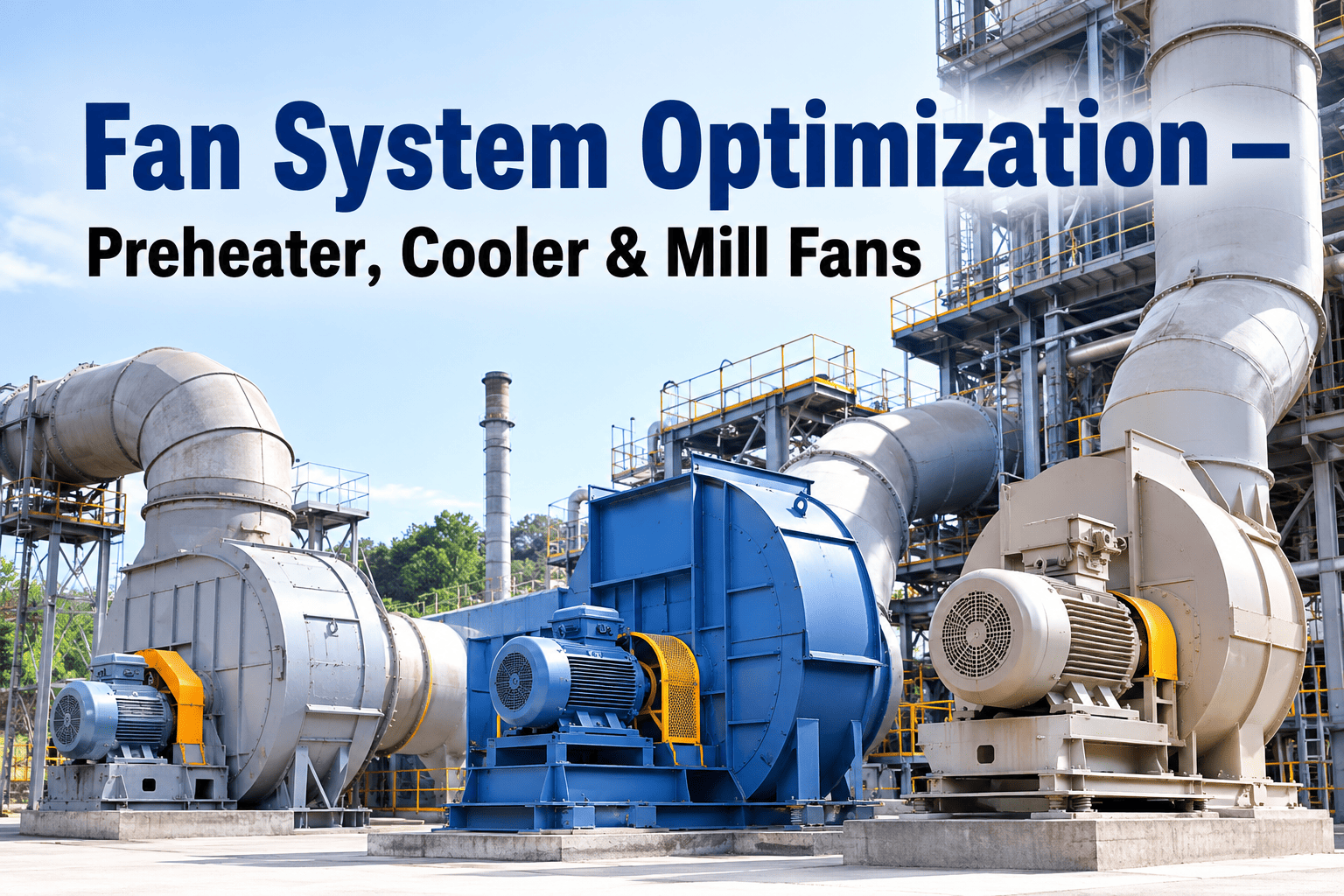
Fan System Optimization — Preheater, Cooler & Mill Fans
The single largest untapped electrical savings opportunity in most cement plants sits inside fan motors already installed on your line
20-30%
Share of plant power consumed by fans
15-45%
Typical energy savings after VFD retrofit
8-18 mo
Payback period on fan and blower applications
Where Fan Power Actually Goes
Not every fan on a cement line carries the same weight. A handful of large induced-draft and mill fans account for most of the electrical draw, which is exactly why a fan optimization program should start with the biggest motors rather than spreading thin across every fan in the plant.
Preheater / Kiln ID Fan
Highest single draw
Raw Mill Fan
Major continuous load
Cement Mill / Separator Fan
Large but variable draw
Clinker Cooler Fans
Multiple smaller units, high cumulative draw
Baghouse / Coal Mill Fans
Smaller individually, easy early win
Damper Throttling vs. Variable Speed Control
Almost every fan energy loss in a cement plant traces back to the same root cause: fans built to run at one constant speed being forced to match a process demand that changes constantly through the shift.
Damper Throttling
The fan runs at full rated speed continuously, and a damper blade physically restricts airflow to hit the target pressure. The motor still consumes power to spin at full speed while the excess energy is dissipated as turbulence and heat across the damper itself.
VFD Speed Control
The fan slows down to match actual demand instead of fighting a damper. Because fan power follows a cubic relationship with speed, even a modest 10% speed reduction can cut power draw by roughly a quarter, which is why fan applications post some of the highest VFD payback of any equipment class in the plant.
Fan affinity laws mean small speed reductions compound into large savings fast. Book a demo to see the projected savings on your specific fan fleet.
Typical Savings and Payback by Fan Type
Energy savings and payback vary widely depending on how much the fan's load actually swings during normal operation. Fans serving processes with the most variable demand, like kiln draft and coal mill exhaust, tend to deliver the fastest returns.
How a Fan Optimization Rollout Actually Works
A fan optimization program does not require shutting down the line or replacing equipment wholesale. Most plants move through a short, repeatable sequence on each fan before moving to the next one.
01
Baseline the Current Load Profile
Motor current, damper position, and process demand are logged across a full production cycle to quantify exactly how much airflow is being wasted at each operating point.
02
Model the Fan Affinity Curve Against Process Demand
The relationship between fan speed and required draft, pressure, or airflow is modeled so the control system knows exactly how far it can safely reduce speed at any given production rate.
03
Install and Commission the Drive
The VFD is installed upstream of the existing motor and integrated with the control logic, then tuned against live process feedback rather than a generic default profile.
04
Monitor and Refine Continuously
Diagnostic data from the drive feeds back into the control model so speed setpoints keep tightening around actual demand as seasonal and production variations show up over time.
The Fan Failures That Erase Savings Overnight
A VFD retrofit protects the energy bill, but a poorly maintained fan can undo those gains in a single unplanned shutdown. Preheater and cooler fans run in some of the harshest conditions in the plant, and the same handful of failure modes account for most of the downtime.
Bearing Failures
Inconsistent lubrication intervals are the leading cause of premature bearing wear on large ID and cooler fans, and this single failure mode accounts for a large share of all fan breakdowns across the industry.
Blade Buildup and Corrosion
Moisture combined with cement dust and alkali condensation gradually coats and corrodes fan blades, throwing the rotor out of balance and driving vibration well past acceptable limits.
Vibration From Imbalance
Vibration exceeding recognized industry thresholds signals an unacceptable condition that typically points back to blade wear, coupling misalignment, or a bearing nearing end of life.
Signs Your Fan Fleet Is Losing Money Today
Most plants running throttled, constant-speed fans do not realize how much is being lost until someone looks specifically for it. A few operational signals tend to show up consistently across plants that turn out to have significant fan energy waste.
Dampers Running Mostly Closed
If inlet or outlet dampers sit at 40-60% closed during normal operation to hold pressure, the fan is working far harder than the process actually requires, and that gap is pure wasted energy.
Fan Motors Running Flat Out Around the Clock
A fan motor drawing near-nameplate current continuously, even during lower-output shifts or planned slowdowns, is a strong indicator that speed control rather than damper control would recover meaningful savings.
High Ambient Noise and Vibration Near Fan Housings
Turbulence created by throttled dampers often shows up as elevated noise and vibration at the fan housing and ductwork, which also accelerates mechanical wear well beyond what a properly matched airflow would cause.
What a Fan Optimization Program Delivers
15-20%
Total plant electrical consumption reduction from a full VFD program
40%
Fewer bearing-related breakdowns with automated lubrication scheduling
±2 mmH2O
Draft control precision achievable with modeled affinity-law control
6-14 mo
Fastest payback class: coal mill and baghouse fans
Find Your Fastest-Payback Fan First
A short fan audit ranks every motor on your line by savings potential and payback speed, so the retrofit budget goes to the fan that pays for itself fastest.
Frequently Asked Questions
Which fan should we retrofit with a VFD first?
Start with the fan carrying both a high motor rating and the most variable demand profile, since those two factors together determine how much energy the damper is currently wasting. On most cement lines, that is either the preheater induced-draft fan or the coal mill exhaust fan, both of which typically deliver payback inside 18 months. A short audit during a
demo call can rank every fan on your line by projected payback speed.
Does slowing down a fan with a VFD affect kiln draft or product quality?
No, when the control system is modeled correctly. Modern VFD control uses fan affinity laws matched against actual draft demand, so speed reductions track process requirements closely enough to hold draft pressure within a tight tolerance rather than letting it drift. The goal is matching airflow to demand precisely, not simply running the fan slower and hoping the process tolerates it.
How much does a typical fan VFD retrofit cost compared to the energy savings?
Cost varies significantly with motor size, since kiln ID fans in the higher horsepower range require larger drives than a baghouse fan, but the payback period is what matters most for budgeting purposes. Fan and blower applications generally return their investment within 8 to 18 months because of the cubic relationship between fan speed and power draw, making them one of the fastest-paying retrofit categories in the entire plant.
Can VFDs be added to fans that are still mechanically sound, or only during a fan replacement?
VFDs can generally be added to existing, mechanically sound motors without replacing the fan itself, which is one of the reasons this retrofit is so common. The drive and control system are installed upstream of the motor, and in most cases the existing motor windings and bearings handle variable speed operation without modification, provided the motor was originally designed for inverter duty or is confirmed suitable during the assessment.
What maintenance changes once a fan is running on a VFD instead of a damper?
Maintenance shifts from damper actuator upkeep toward monitoring drive diagnostics, since modern VFDs report motor current, speed, torque, and heat sink temperature continuously. That data stream makes it possible to catch a developing bearing or alignment issue well before it becomes an unplanned shutdown.
Reach out to support to see how that diagnostic data feeds into predictive maintenance scheduling.
Your Fans Are Already Paid For — Stop Overpaying to Run Them
Every shift your ID, mill, and cooler fans run against a throttled damper instead of a matched drive, the same energy keeps getting burned off as waste heat. See which fan on your line pays back fastest.