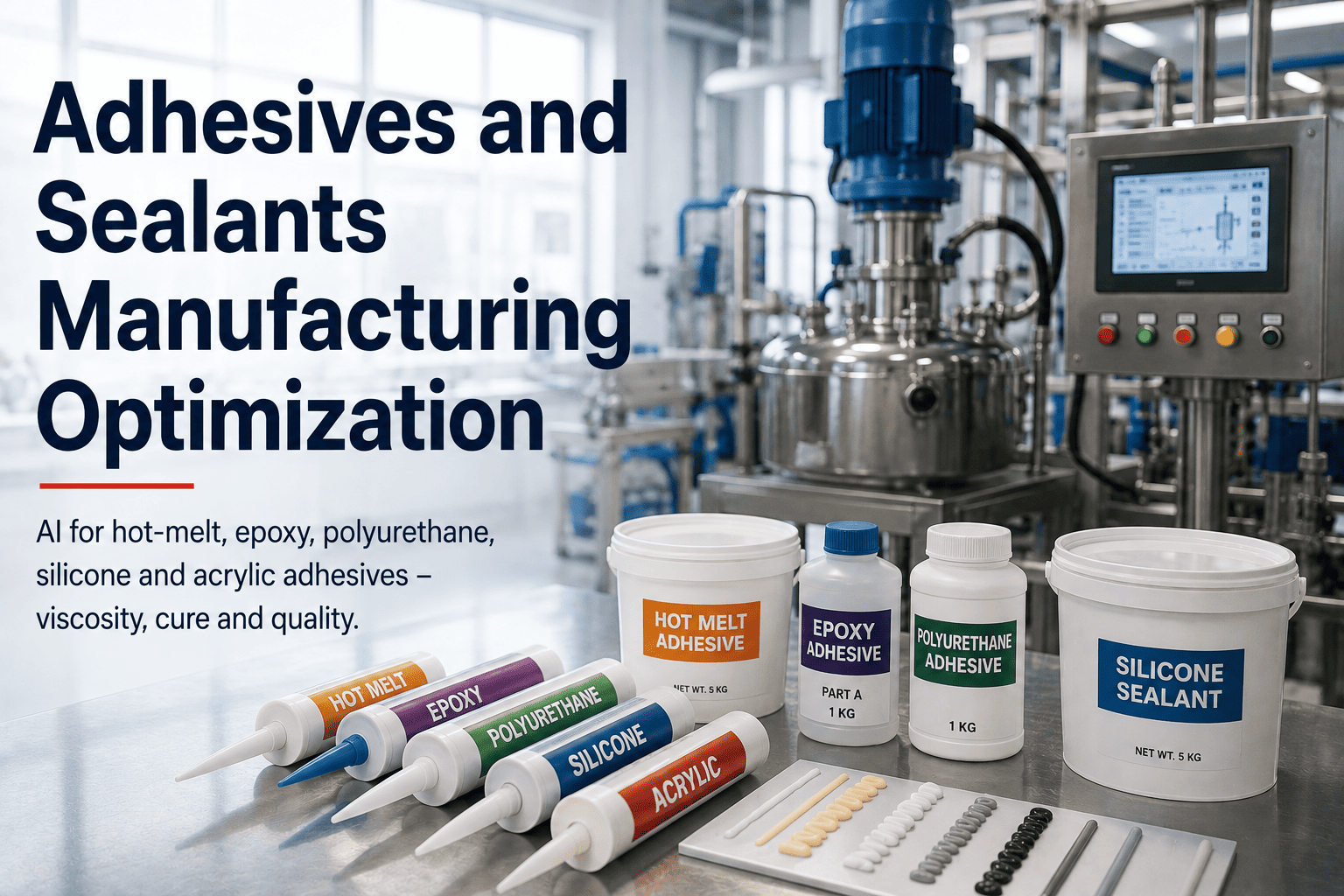
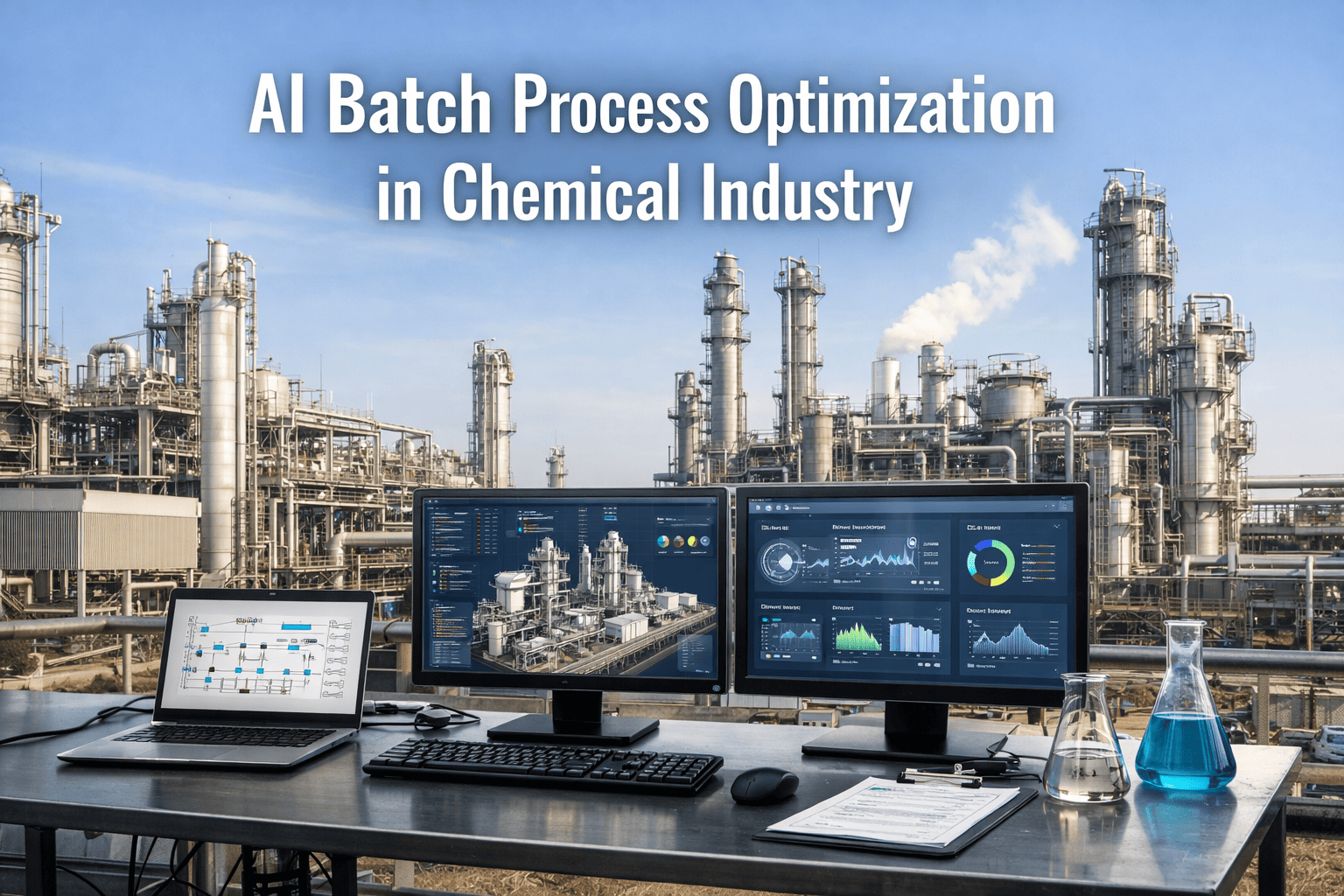
Running an adhesives and sealants plant means managing chemistry that fights back. A hot-melt's viscosity has to land in a narrow window or it won't extrude right; a moisture-cure polyurethane can be ruined by water content above a fraction of a percent; a two-part epoxy lives or dies on mix ratio and cure profile; a silicone sealant destined for an EV battery pack has to hold spec across humidity swings the plant can't control. And underneath every chemistry sits the same operational reality: batch reactors and mixers where viscosity can swing from a hundred to fifty thousand centipoise between products, where a subtle feed or thermal drift becomes an off-spec batch, and where the lab result that confirms it arrives hours after the material is already made. Off-spec rework in specialty chemical batches commonly runs tens of thousands of dollars per batch. The plants pulling ahead are the ones replacing after-the-fact lab confirmation with real-time, on-premise AI that reads the batch as it runs — predicting viscosity and cure quality before the batch is lost. To see it configured for your chemistries, book a demo.
SPECIALTY · ADHESIVES & SEALANTS MANUFACTURING
Read the Batch as It Runs — Not Hours Later in the Lab.
Hot-melt, epoxy, polyurethane, silicone, acrylic — each chemistry has its own viscosity window, cure behavior, and failure mode. iFactory's on-premise AI monitors reactors and mixers in real time, predicting viscosity, composition, and cure quality hours before lab testing would catch a deviation, so an off-spec batch becomes an intervention instead of a write-off.
8–14 hrs
Earlier deviation detection than traditional lab testing
4.5–7.8%
Batch consistency improvement seen in pilot validation
$18K–52K
Typical rework cost of a single off-spec specialty batch
100%
On-premise — your formulations never leave your network
Why Adhesive and Sealant Batches Are Hard to Control
Adhesives manufacturing sits at an awkward intersection: the chemistry is sensitive and non-linear, the process is batch-based with wide product-to-product swings, and the quality confirmation is slow. A reactor or mixer generates hundreds of correlated variables — temperature, pressure, flow, viscosity, moisture, torque — that interact in ways no operator watching a wall of SCADA screens can fully track. By the time a lab sample confirms the viscosity drifted or the emulsion didn't form, the batch is finished and the raw material, energy, and reactor time are already spent. That lag between production and quality knowledge is where the money leaks.
Viscosity Swings Product to Product
The same reactor might run a thin acrylic at a hundred centipoise and a stiff hot-melt at fifty thousand, and every product has its own narrow acceptance window. A static reference band tuned for one recipe is meaningless for the next, so a batch can drift off-spec while the control screen still shows green — because the green band describes a process that isn't running.
Moisture and Feed Purity Are Unforgiving
Moisture-cure polyurethanes need water content held to a fraction of a percent, and feed-composition variability quietly drives molecular-weight drift that a fixed recipe control never sees. A small change upstream — a raw-material lot, a humidity shift, an incomplete dry — becomes a batch that cures wrong, and the cause is invisible until the symptom is a failed test.
Cure and Mix Are Tightly Coupled
Two-part epoxies and reactive systems depend on mix ratio, degassing, and thermal profile all landing together; a small error in any one shifts green strength, open time, or final bond. These are coupled variables, not independent knobs, and controlling them by single-parameter setpoints misses the interactions that actually determine whether the batch cures to spec.
The Lab Confirms, It Doesn't Prevent
Traditional QC relies on periodic lab samples and post-batch analysis — accurate, but always after the fact. By the time off-spec material is detected through manual sampling, the whole batch has already deviated, turning what could have been a mid-batch correction into rework averaging tens of thousands of dollars and a customer complaint waiting to happen.
The core problem isn't that operators lack skill — it's that they're asked to detect subtle, multi-variable drift across dozens of interacting signals in real time, using tools built to describe a machine and a recipe that no longer match the batch in the vessel. That's exactly the gap a dynamic AI model closes.
The Chemistries, and What Each One Demands
A plant running multiple adhesive families is really running several different control problems on shared equipment. An optimization platform has to understand what each chemistry is sensitive to, because the parameter that makes or breaks a hot-melt isn't the one that governs a silicone. These are the five families most specialty plants juggle, and the control priority for each.
HOT-MELT
Viscosity & thermal window
Thermoplastic systems applied molten and bonded as they cool, prized for high green strength and solvent-free handling. Control centers on holding viscosity within an application window that can span roughly 5,000 to 70,000 cP depending on grade, and on tight thermal management — too hot degrades the polymer, too cool and it won't wet the substrate. Reactive hot-melt PU adds a moisture-cure stage on top of the thermoplastic set.
POLYURETHANE
NCO:OH ratio & moisture
Prepolymer systems built by reacting polyisocyanate with polyol, where the isocyanate-to-hydroxyl ratio and prepolymer viscosity define the product. Water is the enemy during synthesis — feedstock often has to be dried below a fraction of a percent moisture — while moisture-cure grades then rely on ambient humidity to crosslink. Getting both the exclusion and the later cure right is the central challenge.
EPOXY
Mix ratio & cure profile
Two-part structural systems where resin and hardener must meet in precise ratio and cure on a controlled thermal profile. Deviations in mix ratio, degassing, or exotherm management shift final strength and pot life, and because the reaction is coupled and exothermic, the parameters have to be controlled together. Structural epoxies serving automotive and aerospace carry the tightest consistency demands of all.
SILICONE
Cure stability across humidity
Moisture-cure and two-part systems valued for temperature and environmental resistance, increasingly critical in EV battery sealing. The demand is controlled viscosity and stable curing that holds bond integrity across variable humidity and temperature — including formulations engineered to cure uniformly in non-climate-controlled plants. Consistent performance under swinging ambient conditions is the defining production challenge.
ACRYLIC
Emulsion & particle consistency
Water-based and reactive acrylic systems used across construction sealants and pressure-sensitive applications, where emulsion stability, particle-size distribution, and viscosity define quality. An incomplete emulsion or inconsistent particle size is a classic mixing-driven failure — the kind that a load-profile shift can reveal mid-batch before the finished-product test ever runs.
See AI Batch Monitoring on Your Chemistries
Bring a product that gives you trouble — the hot-melt that drifts, the PU that's moisture-sensitive, the epoxy with tight consistency limits. iFactory engineers will show how real-time monitoring reads that batch as it runs and flags the deviation while there's still time to correct it.
What Real-Time AI Actually Does on the Line
The shift from lab-confirmed to AI-predicted quality isn't about adding another dashboard — it's about replacing static reference bands and periodic sampling with a live model that reads the batch continuously and understands what it's seeing. Here's what that looks like on an adhesives line, mapped to the failure modes above.
01
Predict Viscosity Before the Lab Does
Machine-learning models read hundreds of process and analytical tags at intervals of seconds to minutes and predict product attributes — viscosity, composition, particle-size distribution — in real time, surfacing an emerging deviation well ahead of when a manual lab sample would catch it. The batch that's drifting off-spec announces itself while you can still act on it.
02
Model Each Recipe, Not One Static Band
The system builds a baseline per product recipe, because acceptable behavior varies by viscosity, batch size, and mixing speed. Each batch's live profile is compared against the right historical baseline for that exact product — so a stiff hot-melt and a thin acrylic on the same mixer are each judged against their own normal, not a single misleading reference.
03
Read Mixing Through Motor Load
Motor-load profiles across the mixing cycle reveal batch consistency directly: a load-curve shape change — a plateau where there used to be a smooth curve — triggers a viscosity or consistency investigation before the batch completes, while a steady-state load decline or start-up spike flags blade wear or a seal issue that would otherwise corrupt the next batch.
04
Classify the Cause, Not Just the Symptom
Rather than flagging "something's wrong," the models classify the anomaly — feed-composition drift, mixing inefficiency, thermal-profile deviation — and deliver contextual diagnostics with recommended adjustments. The operator gets a direction to act, not just an alarm, which turns a detection into a mid-batch correction.
Multi-source signals — temperature arrays, pressure, flow, moisture and composition analyzers, torque telemetry — are fused into a single batch-health score per vessel, updated continuously. The model detects the precursors to variability rather than the failures themselves, which is the whole difference between catching a batch and mourning one.
From Reactor Health to Bead Traceability
Optimization doesn't stop at the batch. The same platform that reads the reactor also protects the equipment that runs it and follows the product downstream to the point of application — so quality is managed as one connected chain rather than a set of disconnected checkpoints.
UPSTREAM
Reactor & Mixer Reliability
Agitators, mixers, and reactors endure batch-to-batch viscosity swings from roughly 100 to 50,000 cP, thermal cycling, and corrosive media that wear seals, bearings, and impellers. Fusing vibration, motor-current signature, temperature, and torque data, the platform forecasts mechanical seal failure, impeller wear, and gearbox degradation months ahead — so a mechanical failure never becomes a catastrophic mid-batch loss.
DOWNSTREAM
Application & Traceability
Where the product is dispensed — an automotive sealant bead, a structural adhesive line — vision and laser systems inspect every application against spec, and a tamper-proof record links each one to material batch, application temperature, and process conditions. For automotive supply that traceability supports IATF 16949 and customer-specific audit readiness, closing the loop from reactor to bond.
When a customer complaint does arrive, the connected record traces back to the exact batch, reactor, and operating conditions in seconds — turning what used to be a multi-day investigation into a query. The material batch that made the off-spec bead, the reactor conditions that made the batch, and the equipment state at the time are all one linked history.
Why On-Premise Matters for a Formulation Business
For an adhesives and sealants maker, the formulation is the business — the exact recipes, ratios, and process conditions are the intellectual property that competitors would love to have. That's why the deployment architecture isn't a detail; it's a strategic requirement. iFactory runs fully on-premise, with all AI, analytics, and data inside your own network.
Your Formulations Never Leave
All AI, analytics, and process data run inside your network — recipes, ratios, and batch conditions stay on-site rather than being shipped to a vendor cloud. For a business whose competitive edge is its chemistry, keeping the data that describes that chemistry sovereign isn't a preference, it's protection of the core asset.
Built for Plant-Floor Reality
A chemical-environment architecture is engineered for continuous operation, corrosive conditions, and the integration realities of real reactors and mixers — connecting to existing sensors and control systems rather than demanding a rip-and-replace. The platform meets the plant where it is instead of requiring the plant to reshape around it.
Turnkey AI: Racked, Ready, and Live in Weeks
Adopting plant AI shouldn't mean an open-ended IT project. iFactory ships as a turnkey system — a pre-configured on-premise AI server that arrives racked and ready, so the path from decision to running model is measured in weeks, not quarters.
1
Ships Racked and Ready
The pre-configured NVIDIA AI server arrives as a bundled hardware-and-software system. You rack it, connect power and Ethernet, and the AI is live — no procurement of separate components, no months of infrastructure buildout before the first model runs.
2
Full-Scope Integration Included
Cabling, network setup, and integration with your reactors, mixers, PLC/SCADA, and analyzers are part of the deployment, along with operator training — so the system connects to the plant you already run rather than requiring you to build around it.
3
Live in 6–12 Weeks, ROI Early
A fixed-scope program brings full batch monitoring live in a matter of weeks, with batch-consistency improvements typically visible in early pilot validation and avoided-rework savings accumulating within the first weeks of full production monitoring — no open timeline, no scope creep.
4
Backed by Remote Monitoring & Support
The deployment includes ongoing remote monitoring and support, so the models stay tuned as recipes and conditions evolve. Trust signals bear it out — a large installed base and high platform uptime — meaning the system keeps performing long after go-live, not just at launch.
What Changes for the Plant Manager
For the person accountable for yield, quality, and on-time delivery, real-time batch intelligence changes the fundamental economics of the plant — moving quality decisions upstream of the loss instead of after it.
01
Fewer Batches Written Off
Catching a deviation hours before the lab would means a drifting batch gets corrected mid-run instead of scrapped, and each avoided off-spec batch saves the tens of thousands of dollars in rework, wasted raw material, and reactor time that a write-off costs. The savings compound across every product family the plant runs.
02
Consistency the Customer Notices
Tighter batch-to-batch consistency shows up directly in the product a customer receives, reducing complaints and the reputation damage an off-spec shipment causes. For structural and automotive customers with strict acceptance criteria, provable consistency is what protects and grows the account.
03
Equipment Failures Stop Surprising You
With seal, bearing, and impeller degradation forecast months ahead, a reactor or mixer failure becomes a scheduled maintenance window rather than a catastrophic loss mid-batch. The plant's unplanned-downtime exposure drops, and the mechanical surprises that used to take out a batch largely disappear.
04
Complaints Resolve in Seconds
When a quality question comes in, the connected record traces from the finished complaint back to the batch, reactor, and conditions immediately, so root-cause investigation is a query rather than a week of cross-referencing logs. The plant answers customers fast and defends its process with data.
Frequently Asked Questions
The questions adhesives and sealants plant managers ask most often when evaluating AI-driven process optimization.
How can AI predict viscosity before a lab sample confirms it?
By reading the process signals that determine viscosity in real time rather than waiting to measure the outcome. Machine-learning models trained on your batch data analyze hundreds of process and analytical tags — temperature profiles, pressure, flow, moisture, torque, composition — at intervals of seconds to minutes, and learn the relationship between those conditions and the final product attributes. Because the model sees the precursors as they develop, it predicts where viscosity, composition, and particle size are heading and flags a deviation hours before a manual sample would reach the lab and come back. It doesn't replace lab testing; it gives you an early-warning layer on top of it. To see it on your products,
book a demo.
We run several chemistries on shared equipment. Does one model handle that?
Yes — that's exactly the problem it's built for. The system establishes a separate baseline for every product recipe, because acceptable behavior varies by viscosity, batch size, and mixing speed, so a stiff hot-melt and a thin acrylic on the same mixer are each judged against their own normal rather than a single static band that fits neither. Each new batch is compared against the correct historical profile for that specific product, and the anomaly classification is tuned to the chemistry running. This recipe-aware approach is what makes the platform useful in a multi-product specialty plant, where the whole challenge is that the "normal" changes every time the product changes.
Our formulations are our crown jewels. Is our data safe?
This is precisely why the platform runs fully on-premise. All AI, analytics, and process data stay inside your own network — your recipes, ratios, and batch conditions are never shipped to a vendor cloud or exposed outside your walls. For an adhesives and sealants business, the formulation is the core asset, so a sovereign, on-site architecture isn't a nice-to-have; it's the only responsible way to apply AI to the data that describes your chemistry. You get the analytical power of modern machine learning without handing the thing that makes you competitive to anyone else. The models are trained and run on your infrastructure, under your control.
How disruptive is deployment to a running plant?
It's designed to be minimally disruptive and time-boxed. The system ships as a turnkey, pre-configured on-premise AI server that arrives racked and ready — you provide power and network, and the deployment includes cabling, integration with your existing reactors, mixers, PLC/SCADA, and analyzers, plus operator training. Because it connects to the sensors and control systems you already have rather than requiring a rip-and-replace, full batch monitoring typically goes live in a matter of weeks on a fixed scope, with early results visible in pilot validation. There's no open-ended professional-services engagement before you see value, and the plant keeps running throughout the integration rather than shutting down for it.
What kind of return should we expect, and how fast?
The primary return comes from avoided rework, because a single off-spec specialty batch commonly costs tens of thousands of dollars in wasted material, energy, and reactor time, and preventing even a handful pays for the program. Plants completing a fixed-scope deployment have reported six-figure avoided rework and quality losses within the first weeks of full production monitoring, with batch-consistency improvements detectable in early pilot validation. Beyond direct rework savings, the equipment-reliability side reduces unplanned downtime, and the traceability side shrinks complaint-investigation time from days to seconds. The exact numbers depend on your product mix and current scrap rate, which is what a scoped assessment quantifies. Contact
iFactory support to size the opportunity for your plant.
CATCH THE BATCH · PROTECT THE FORMULATION · PROVE THE QUALITY
Optimize Every Adhesive and Sealant Batch With On-Premise AI.
Real-time viscosity and cure prediction across hot-melt, epoxy, polyurethane, silicone, and acrylic — recipe-aware baselines, reactor and mixer reliability, and end-to-end traceability, all running inside your own network. Turn off-spec write-offs into mid-batch corrections, and walk customers through provable consistency batch after batch.