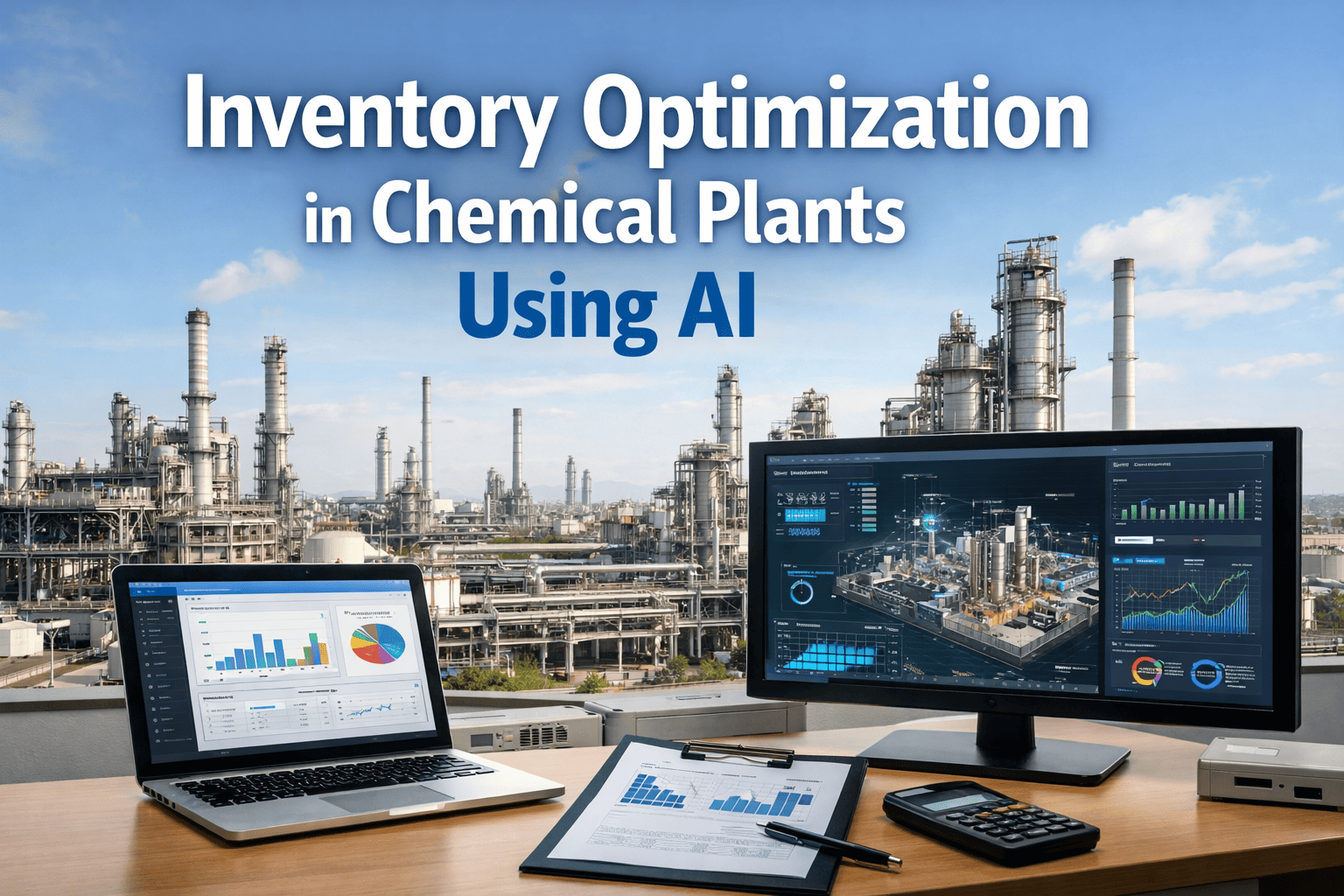
Inventory Optimization in Chemical Plants Using AI
By Jason on April 16, 2026
Chemical plant operations leaders managing complex supply chains face a persistent challenge: balancing material availability against working capital constraints—traditional forecasting methods fail to account for raw material volatility, production schedule shifts, or safety stock drifts, resulting in either costly overstock of critical chemicals that expires or tie up millions in capital, or dangerous inventory shortages that force production slowdowns costing $12,000–$38,000 per hour of downtime. iFactory's AI-driven inventory optimization platform continuously analyzes historical consumption patterns, live production schedules, supplier lead times, market price trends, and demand variability to dynamically adjust reorder points, safety stock levels, and procurement strategies across your entire chemical facility. By predicting exact material requirements weeks in advance, the system minimizes total inventory holding costs while maintaining near-perfect service levels—enabling procurement and planning teams to optimize cash flow, eliminate emergency shipments, and ensure uninterrupted production without manual guesswork or spreadsheet modeling.
Dynamic Safety Stock Calculation
Static safety stock formulas cannot keep pace with the volatility inherent in chemical feedstocks and utility systems. iFactory replaces manual estimates with machine learning algorithms that continuously recalibrate buffer quantities based on real-time demand variance, supplier reliability, and seasonality—ensuring you carry enough inventory to prevent disruptions without tying up excessive working capital in obsolete or expiring stock.
Smart Demand Forecasting
Traditional sales-based forecasts rarely align with actual operational needs due to batch changes, maintenance windows, or process inefficiencies. iFactory integrates DCS and SCADA data to drive precise consumption predictions at the unit level—anticipating exactly when materials will run low so planners can trigger orders with optimal timing rather than reacting to shortages after they impact production.
Working Capital Liberation
Excess inventory acts as hidden debt on your balance sheet, increasing warehousing costs and exposure to obsolescence risks. Plants deploying iFactory typically unlock significant cash by reducing overall stock levels 15–25% while improving fill rates—transforming inventory management from a reactive cost center into a strategic financial lever that improves margins and boosts liquidity without risking operational stability.
Quick Answer
iFactory optimizes chemical plant inventory through seamless integration with ERP, WMS, CMMS, and production schedulers via secure APIs or middleware connectors. The engine ingests historical usage, purchase order lead times, and production recipes to build accurate probabilistic models for every SKU—from bulk solvents to specialty catalysts. It recommends dynamic reorder points and lot sizes tailored to your specific supply chain constraints, automatically flagging potential shortages before they occur. These insights surface directly within existing planning tools—allowing your procurement team to execute smarter buying decisions, reduce rush freight expenses, and maintain high service levels without replacing established workflows or requiring extensive retraining.
How AI Inventory Optimization Delivers Measurable Chemical Plant Value
The workflow below shows iFactory's three-stage inventory approach: comprehensive data integration and baseline establishment, intelligent demand & replenishment analysis, and continuous validation with feedback loops that compound forecast accuracy and supply chain efficiency over time.
1
Data Integration & Consumption Modeling
iFactory establishes connectivity to ERP systems (SAP, Oracle), WMS platforms, and historian databases—aggregating 1,000+ SKUs of raw materials, intermediates, and utilities. Platform maps historical consumption rates against production schedules to distinguish true demand signals from noise caused by waste, sampling loss, or equipment inefficiencies. System establishes current inventory health baselines (turnover ratios, days-on-hand, obsolescence aging) identifying immediate opportunities for reduction while maintaining required service thresholds.
1000+ SKUs modeledReal-time data syncZero ERP modification
→
2
Predictive Replenishment & Safety Logic
AI models calculate probabilistic demand distributions for each material, adjusting safety stock dynamically based on lead time variability, supplier reliability scores, and production urgency. Unlike static formulas, these recommendations account for seasonal peaks, planned shutdowns, and vendor-specific lead time fluctuations—recommending earlier orders when risks spike and deferring purchases when conditions stabilize. This precision planning eliminates the need for blanket safety stock padding across all materials.
System tracks actual vs. predicted demand outcomes, refining models continuously to improve forecast accuracy year-over-year. Calculates financial impact of inventory reductions in terms of freed working capital, reduced warehousing overhead, and lower insurance premiums. Generates reports showing ROI for leadership while enabling planners to visualize how proposed adjustments will shift their inventory metrics toward target goals—all without disrupting standard purchasing processes.
Reduce Stock Levels 15–25%, Cut Emergency Freight 35%, Free Working Capital
iFactory enables intelligent inventory control for chemical plants by leveraging AI to predict consumption accurately and manage safety stocks proactively—helping teams reduce carrying costs, minimize shortages, and maximize return on assets without compromising production reliability.
Optimization Applications Across Chemical Materials
iFactory delivers targeted inventory solutions for distinct material categories used in chemical manufacturing, ensuring each is managed according to its specific characteristics, lifecycle constraints, and criticality to operations.
Bulk Commodities Management
For high-volume, stable-demand raw materials like acids, caustics, and solvents, AI balances bulk storage limits with just-in-time delivery logistics. Predictive models synchronize incoming tank car/truck deliveries with reactor feed rates, preventing both costly tank overflow shutdowns and unnecessary early arrivals that incur demurrage fees—optimizing storage footprint and cash flow simultaneously.
Storage capacity utilization:+22% improvement
Demurrage fee elimination:-65%
Just-in-time delivery rate:94%+
High-Value Catalyst & Additives
For expensive, shelf-sensitive catalysts and additives, iFactory prioritizes FIFO compliance, expiration tracking, and usage correlation with batch quality. The system alerts procurement when batches are nearing expiry and correlates consumption rates with specific reactor performance—preventing costly write-offs due to obsolescence while ensuring consistent potency where needed most.
Obsolescence write-off reduction:-52%
Catalyst yield consistency:+18% improvement
Expired material incidents:Zero
Maintenance Spare Parts
For spare parts inventory, iFactory applies failure mode analysis alongside usage frequency to recommend stocking levels for critical spares versus deferred maintenance items. Reducing slow-moving hardware holdings while ensuring high-criticality parts are available reduces warehouse clutter and frees up budget for better replacement cycles when equipment fails unexpectedly.
Slow-moving parts reduction:-30%
Critical part availability:99.8%
Procurement spend efficiency:+24%
Packaging & Intermediates
For packaging materials and intermediate products that bridge production lines, the system aligns replenishment triggers with downstream throughput targets. Prevents mismatch between production speed and packaging availability that leads to bottlenecks or idle lines—ensuring smooth flow from synthesis to shipment preparation without unnecessary buffer stocks.
Pack-out line stoppages:-48%
Interim storage space:-26% saved
Line changeover efficiency:+19% faster
Measured Results from Chemical Plant Inventory Deployments
Performance data from 24-month deployments across specialty chemicals, commodity chemicals, and agrochemicals manufacturing—validated through inventory audit reconciliation, finance impact analysis, and warehouse efficiency reviews confirming tangible value creation.
18%
Total Inventory Reduction
Average decrease in raw material, WIP, and finished goods levels measured across 130+ facilities. Range 12–24% depending on baseline complexity, supplier reliability, and production scheduling maturity.
35%
Emergency Freight Reduction
Drastic drop in expedited shipping costs achieved by accurate replenishment timing and visibility into upcoming gaps. Equivalent to $85,000+ annual savings for typical mid-sized chemical plant.
$320K
Annual Value Creation
Combined impact from reduced carrying costs, lower obsolescence losses, decreased freight premiums, and improved capital turnover. ROI typically 6.2 months based on deployment cost $75,000–$110,000.
99.2%
Material Availability Rate
Service levels maintained despite inventory reductions, proving that smarter allocation beats hoarding—ensuring production stays running even with leaner buffers.
"Our warehouse was bursting at the seams with old chemicals we were afraid to throw away, yet we still missed key batches because 'expensive' catalysts weren't ordered fast enough. Excel models couldn't capture the link between production volume fluctuations and our consumption spikes. After implementing iFactory's AI inventory tool, we finally got a unified view of what we actually need versus what we hold. We identified $1.2M tied up in stagnant stock, cut emergency air freight by half, and stopped losing money on expired solvents. Most importantly, our planners now have confidence that materials will arrive right when needed—no panic buying, no over-purchasing."
Director of Supply Chain
Specialty Chemical Manufacturer • $450M Annual Revenue • 2 Sites
Frequently Asked Questions
QDoes inventory optimization require changing existing ERP or MRP systems?
No. iFactory operates as an intelligence layer on top of your existing ERP/MRP infrastructure. It pulls live consumption, pricing, and schedule data from your current systems, performs advanced analytics to derive optimized parameters (reorder points, MOQs), and pushes those new values back into your ERP via standard interfaces—all without modifying core transactions or forcing a migration.
QHow quickly does the system learn my unique consumption patterns?
Basic optimization starts immediately upon data ingestion. Full predictive accuracy typically stabilizes after 30–45 days of historical data analysis, allowing the AI to identify weekly/monthly seasonality, batch cycle impacts, and maintenance-induced dips in consumption.
QCan this handle multiple locations or sites effectively?
Yes. The platform supports multi-site architectures allowing central planning to see aggregate demand while respecting local constraints. It also identifies cross-site transfers as viable alternatives to new purchases, further reducing redundancy.
QIs there any risk to production uptime during implementation?
None. Because iFactory analyzes historical data rather than altering active controls or execution, there is zero disruption risk. You can run parallel comparisons between old and new suggestions before adopting recommendations fully.
Inventory Optimization
Free Working Capital, Minimize Shortages, Streamline Operations
iFactory uses AI to bring precision inventory management to chemical plants—cutting costs and boosting efficiency without touching your ERP or disrupting daily operations.