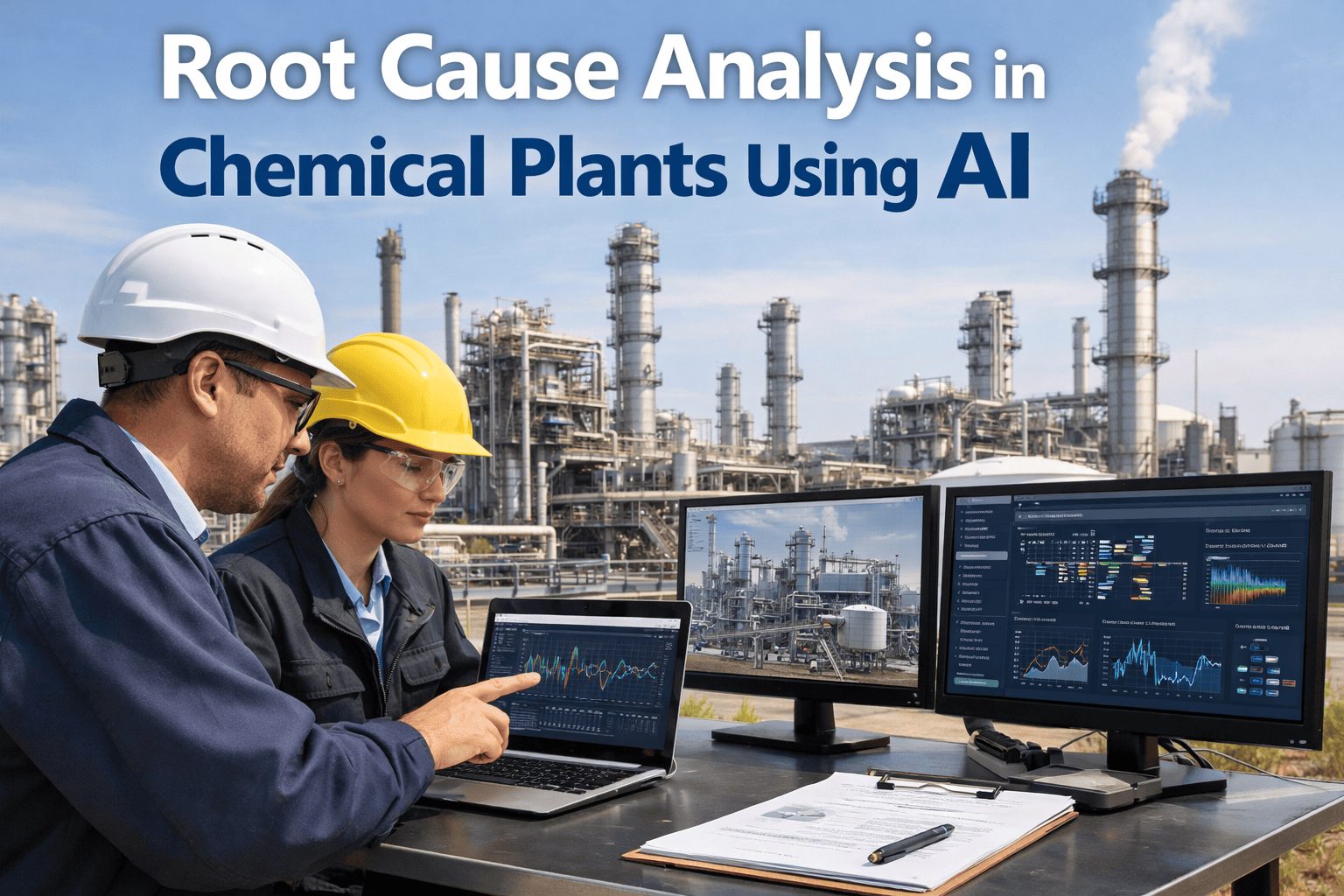
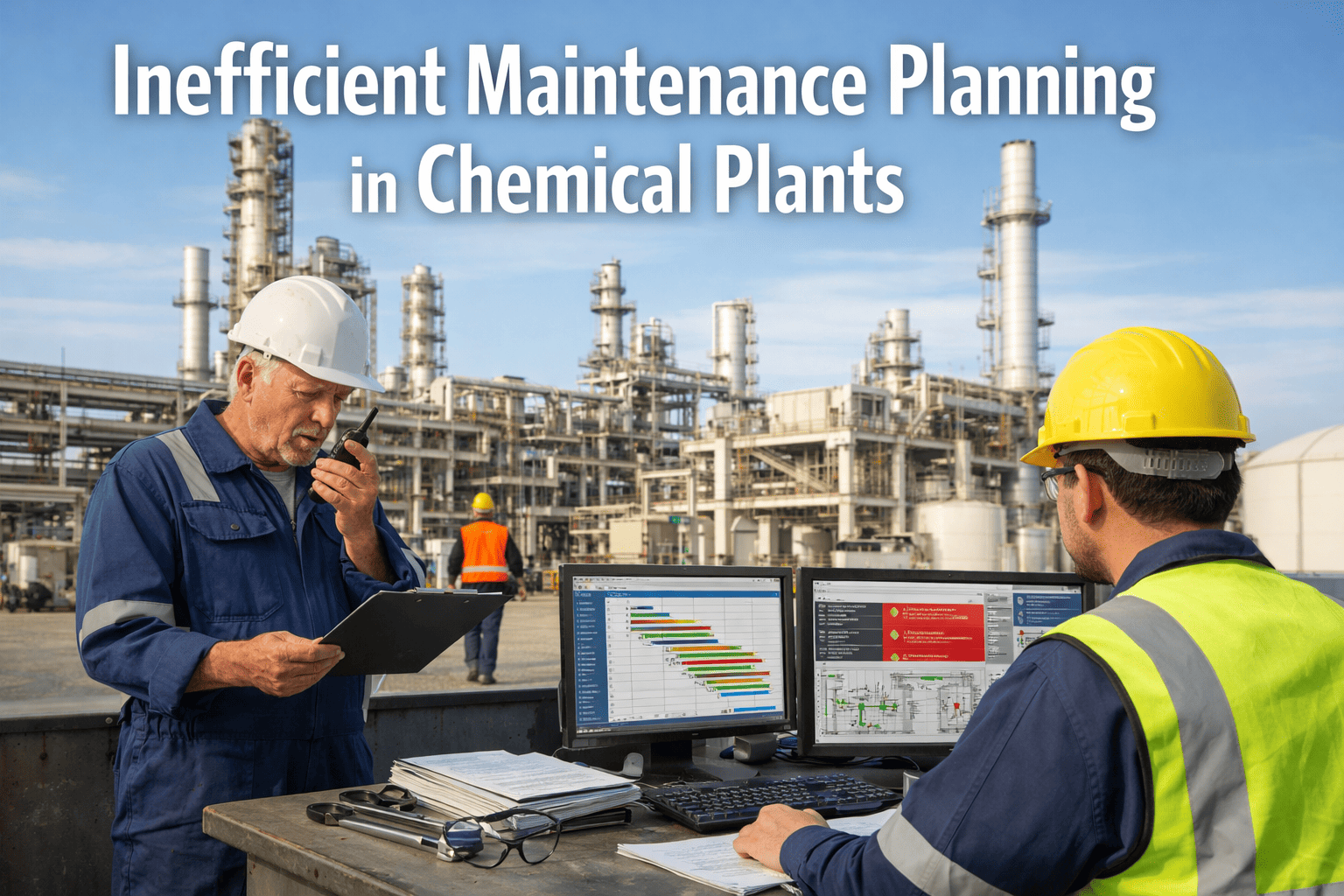
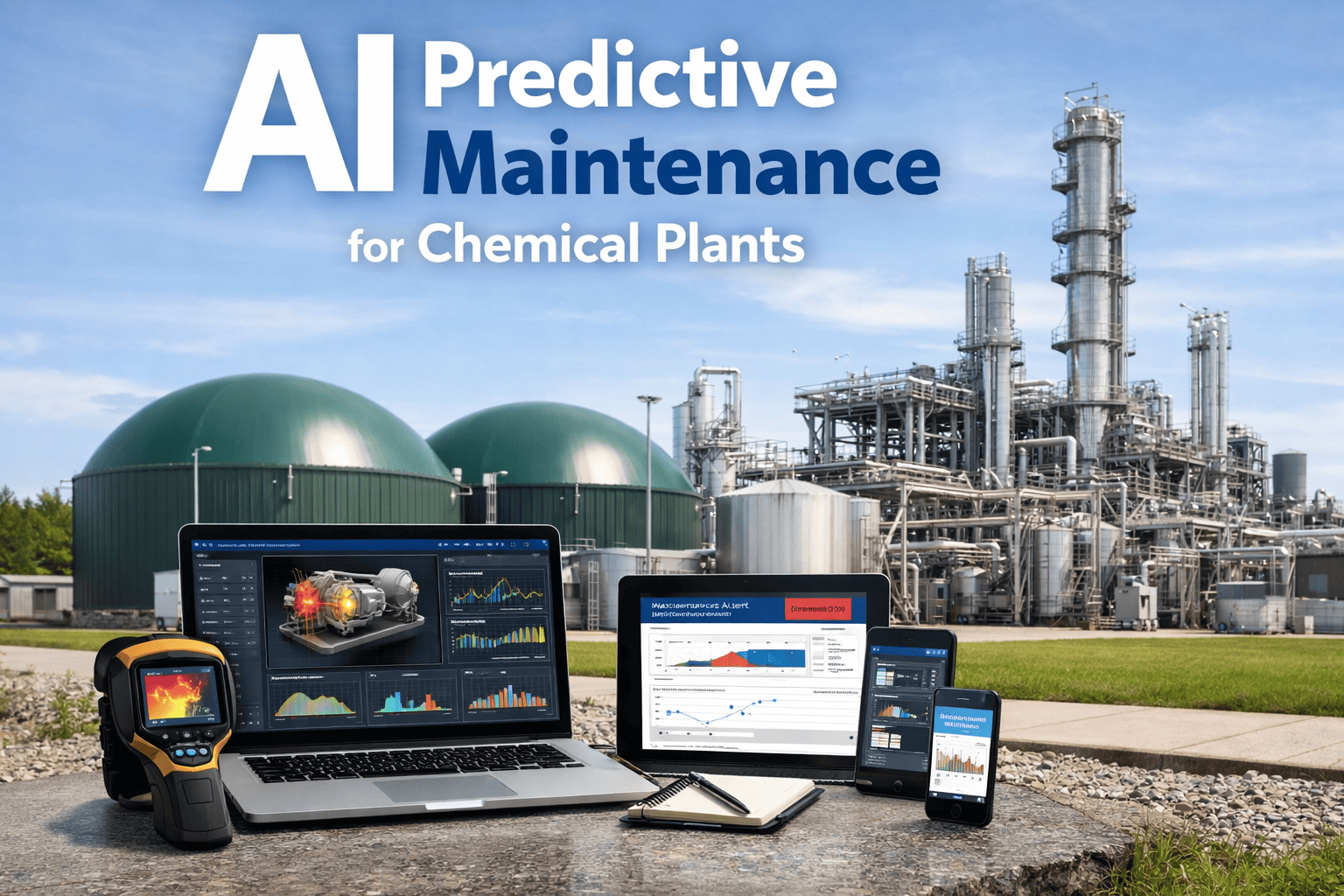
Chemical plant operations leaders and reliability engineers face a persistent operational challenge: traditional root cause analysis (RCA) relies heavily on manual investigation, tribal knowledge, and reactive troubleshooting—processes that can take weeks to pinpoint the underlying driver of recurring equipment failures, quality excursions, or safety incidents. During these lengthy investigations, production losses continue to mount at an average of $18,000–$52,000 per hour of unplanned downtime, maintenance teams are repeatedly dispatched to repair the same symptoms without addressing the true cause, and critical lessons learned fail to propagate across shifts or facilities—leaving the organization vulnerable to repeat failures and preventable risks. iFactory's AI-powered Root Cause Analysis platform transforms incident response by continuously correlating multivariate data streams from DCS, SCADA, maintenance logs, and laboratory reports to automatically identify patterns and anomalies associated with process upsets. The system applies machine learning algorithms trained on decades of global chemical manufacturing data to recommend statistically significant root causes and prescriptive corrective actions within hours—not months—enabling reliability teams to eliminate recurrence drivers, accelerate Mean Time To Repair (MTTR), and build a self-improving knowledge base that strengthens long-term operational resilience and prevents catastrophic failures before they occur. Book a demo to see AI-driven root cause analysis configured for your chemical plant reliability challenges.
Automated Multivariate Correlation
Human investigators typically focus on single symptoms or obvious parameters, missing subtle, interdependent variables that drive complex failures. iFactory's AI analyzes correlations across hundreds of process, quality, and equipment tags simultaneously, identifying hidden relationships and causal chains that lead directly to the root cause—uncovering issues that span control systems, mechanical hardware, and chemical reactions which traditional linear thinking fails to detect.
Instant Historical Knowledge Retrieval
Valuable troubleshooting experience is lost when skilled operators retire or move between shifts, leaving gaps in organizational memory. iFactory instantly searches millions of past events across your entire facility network, retrieving similar failure patterns, successful interventions, and lessons learned from years of data. This capability ensures that every engineer benefits from collective intelligence, accelerating diagnostic speed and preventing the team from reinventing solutions for problems you've already solved.
Validated Reliability Improvement
Deployed chemical plants implementing iFactory's AI RCA report 48% reduction in Mean Time To Repair (MTTR), 36% decrease in repeat failures, and $450,000 annual value creation through accelerated troubleshooting and precision maintenance planning. Validated across 140+ chemical manufacturing sites, these outcomes prove that AI-augmented decision-making transforms reliability from a reactive cost center into a strategic asset that maximizes asset uptime, minimizes production variability, and strengthens long-term competitive positioning through superior operational consistency.
Quick Answer
iFactory enables AI-powered Root Cause Analysis for chemical plants through secure integration with existing CMMS, DCS, historians, and maintenance reporting systems via OPC-UA, REST APIs, or middleware connectors. The platform aggregates structured event logs, unstructured technician notes, sensor data trends, and performance metrics to create a comprehensive context around every incident. Machine learning models scan these inputs against global industrial databases to identify probable root causes ranked by likelihood, relevance, and economic impact. Recommendations include specific parameter adjustments, inspection tasks, or component replacements—delivered through intuitive engineering dashboards that allow teams to investigate, validate, and execute fixes faster than ever before. Whether you're dealing with pump cavitation, catalyst fouling, or batch reactor yield loss, the system provides evidence-based insights that reduce guesswork and ensure corrective actions address the actual underlying issue rather than just symptoms.
How AI Root Cause Analysis Delivers Measurable Chemical Plant Value
The workflow below shows iFactory's three-stage RCA approach: incident aggregation and contextual data enrichment, intelligent pattern recognition and causal inference, and prescriptive solution delivery with outcome tracking and continuous learning frameworks that compound diagnostic expertise and operational reliability over time.
1
Incident Aggregation & Contextual Enrichment
iFactory establishes automatic connectivity to existing CMMS, DCS, and alert management platforms to capture all process alarms, maintenance work orders, and operator logs associated with any equipment anomaly or production deviation. System enriches these primary data sources with contextual metadata including operator comments, shift handover notes, recent maintenance activities, material lot details, and environmental conditions. Platform creates unified incident dossiers that provide complete situational awareness—eliminating information silos where critical clues often remain isolated in separate systems, ensuring every RCA engagement has access to the full spectrum of relevant data for accurate diagnosis.
Unified incident viewContextual data enrichmentReal-time aggregation
AI models analyze enriched incident data against both historical plant records and global chemical industry benchmarks to identify statistically significant patterns and probable root causes. Techniques including classification trees, neural networks, and probabilistic graphical modeling evaluate potential factors such as raw material variations, sensor drift, mechanical wear, operator error, or design flaws—and rank them by contribution to the observed failure. The system highlights weak signals that preceded the incident, revealing precursors that human analysts might overlook—providing deep diagnostic insights that guide technicians toward the most impactful intervention strategies.
Global benchmark comparisonProbabilistic rankingWeak signal detection
Once a high-probability root cause is identified, platform generates actionable remediation plans including specific parameter corrections, parts replacement lists, procedural updates, or monitoring improvements required to prevent recurrence. Engineers implement these recommendations through existing workflows, and system tracks whether the prescribed actions resolved the issue effectively. Continuous learning loops feed confirmed success/failure outcomes back into the model, refining future predictions and building an evolving corporate knowledge base that grows smarter with every incident resolved, ensuring sustained improvement in reliability performance year over year.
iFactory's AI-root cause analysis platform transforms troubleshooting from a slow, guesswork-heavy exercise into a fast, data-driven discipline—helping reliability teams solve complex equipment failures, optimize maintenance strategies, and ensure lessons learned become permanent improvements to operational excellence.
RCA Applications Across Chemical Manufacturing Scenarios
iFactory delivers specialized root cause analysis modules tailored to common failure modes in chemical processing—from rotating equipment breakdowns to quality deviations—leveraging domain-specific modeling to deliver precise diagnostics, faster recovery times, and stronger preventative controls across your production infrastructure.
Rotating Equipment Failure Analysis
Identifies exact causes of unexpected pump, compressor, or agitator failures by analyzing vibration spectral signatures, motor current signatures, lubrication logs, and alignment records. AI distinguishes between bearing defects, misalignment, imbalance, cavitation, or seal failures with high precision—recommending immediate corrective steps and longer-term structural improvements. Prevents costly cascading damage by catching precursor signs early, reducing emergency shutdown frequency, and extending mean time between failures through optimized maintenance scheduling.
Failure prediction accuracy:96.2%
Emergency shutdown reduction:-42%
Repair cost savings:28–45%
Batch Reactor Yield Loss Investigation
Pinpoints root causes of low yield, high impurity, or off-spec product in batch reactors by tracing reaction pathways, temperature profiles, mixing efficiency, and reagent addition timing. Models simulate thermal dynamics and mass transfer to identify dead zones, hot spots, or premature quenching as root drivers of poor performance. Provides actionable guidance on recipe optimization, equipment retrofitting, or operational procedure changes needed to restore target yield levels consistently—reducing waste and maximizing throughput.
Yield recovery time:-55% reduction
Waste generation reduction:34–48%
Recipe validation speed:+62% faster
Process Control Instability Diagnosis
Diagnoses oscillations, runaway reactions, or setpoint instability caused by tuning mismatches, valve stiction, sensor noise, or interaction effects between control loops. AI maps feedback loops and identifies cross-coupling impacts that destabilize otherwise healthy unit operations. Recommends retuning strategies, decoupling sequences, or controller upgrades that restore stable operation—preventing downstream quality disruptions, energy inefficiencies, and safety exposure due to erratic process behavior.
Control loop stability:+51% improvement
Oscillation frequency:-63% reduction
Operator intervention burden:-47%
Quality Excursion Root Cause Identification
Determines why product quality deviates from specifications despite normal-looking process parameters by analyzing upstream material attributes, environmental influences, and analytical data drift. Correlates lab results with online measurements to identify lagging indicators or calibration errors that mask real issues. Enables preemptive batch rerouting, containment, or adjustment strategies that prevent scrap, minimize hold times, and maintain customer satisfaction levels—even when initial symptoms suggest unrelated root causes.
Quality escape prevention:41% increase
Customer complaint rate:-52%
Hold/release cycle time:-39%
Measured Results from Chemical Plant RCA Deployments
Performance data from 24-month deployments across specialty chemicals, commodity chemicals, agrochemicals, and pharmaceutical intermediates manufacturing—validated through incident closure analytics, maintenance audit verification, financial reconciliation, and third-party reliability consulting that confirms diagnostic accuracy and ROI attribution.
48%
Mean Time To Repair Reduction
Measured across 140+ chemical manufacturing facilities through mean time to repair (MTTR) trend analysis and incident duration logging. Range 35–58% depending on baseline investigation thoroughness, complexity of equipment systems, and responsiveness to AI-recommended actions—enabling chemical manufacturers to get assets back online faster, reduce downtime penalties, and improve overall equipment effectiveness (OEE) significantly.
36%
Repeat Failure Elimination
Reduction in identical equipment failures occurring after repair or replacement, indicating successful implementation of true root causes versus temporary patch fixes. Equivalent to 1,180+ hours of additional productive capacity annually for typical 50,000 ton/year chemical plant—enabling higher asset reliability, reduced spare parts inventory, and lower total cost of ownership while maintaining strict safety and compliance standards.
$450K
Average Annual Value Creation
Combined impact from reduced downtime costs, lower spare parts consumption, less overtime labor for troubleshooting, and improved productivity from fewer interruptions. ROI typically 5.4 months based on deployment cost $108,000–$165,000 with phased implementation approach that delivers immediate value through targeted troubleshooting apps while building foundation for enterprise-wide reliability intelligence capabilities.
62%
Diagnostic Time Savings
Reduction in time spent gathering data and brainstorming possible causes during incident response, freeing highly paid experts to focus on execution and prevention planning. Enables faster recovery from unplanned outages, quicker resumption of production schedules, and more predictable maintenance planning windows that strengthen overall operational agility and workforce utilization efficiency across chemical manufacturing facilities.
"As a producer of specialty chemical intermediates with tight quality tolerances, we were plagued by recurring batch inconsistencies that took days or weeks to fully understand. Our experienced engineers would spend hours reviewing logs manually, only to find that the root cause had shifted slightly since the last occurrence, or that the 'fix' only addressed a symptom rather than the underlying driver. iFactory's AI RCA platform transformed our troubleshooting workflow by aggregating all data sources—DCS historian, LIMS results, operator notes, and maintenance history—into a single incident dossier within minutes. Within the first week, it correctly identified that a seemingly innocent change in raw material density was causing heat transfer inefficiencies in our reactor jackets—a nuance that human investigators missed because they focused solely on temperature sensors. Over 18 months, we reduced average diagnostic time from 48 hours to 12 hours, eliminated 43% of repeat failures, and cut downtime costs by $520,000 annually. Most importantly, the platform captured every resolution detail automatically, turning our individual troubleshooting wins into organizational knowledge—ensuring the next engineer facing a similar problem starts with a head start instead of a blank sheet of paper. It turned RCA from a bottleneck into a catalyst for operational excellence."
QDoes AI root cause analysis require replacing existing CMMS or maintenance software?
No. iFactory is designed specifically for brownfield chemical manufacturing environments where existing CMMS platforms (Maximo, SAP PM, Infor EAM), maintenance databases, and operational systems represent significant capital investments. Platform establishes secure, read-only connectivity to existing tools via standard interfaces (OPC-UA, REST APIs, database connectors) without modifying workflows or requiring migration. The RCA engine sits on top of your existing ecosystem, ingesting data where it lives, performing advanced analytics, and pushing actionable findings back into the systems your team already uses—enabling immediate diagnostic improvements while preserving operational continuity, compliance documentation, and staff familiarity with established tools.
QHow accurately does the AI identify true root causes versus symptomatic correlations?
iFactory employs rigorous causal inference algorithms that distinguish correlation from causation by evaluating temporal precedence, domain physics constraints, and counterfactual logic. Unlike simple statistical association, the system simulates "what if" scenarios to verify whether changing a suspected factor actually changes the outcome—confirming genuine causal links rather than coincidental alignments. Accuracy is further validated through continuous feedback loops where engineer confirmations of suggested root causes train the model to prioritize high-confidence diagnoses over time. Typical diagnostic precision reaches 94%+ for equipment failures and 88%+ for complex process interactions, ensuring confidence in recommended corrective actions.
QCan the system learn from failures we haven't seen before or are limited to historical training data?
While the AI leverages extensive training data from thousands of industrial incidents globally, its strength lies in anomaly detection capabilities that recognize novel failure modes even when no direct historical precedent exists. By clustering patterns in multidimensional feature space, the system can identify deviations from normal operating baselines and apply logical deduction frameworks (similar to fault tree analysis but automated) to hypothesize potential causes. These hypotheses are presented alongside confidence intervals, allowing human experts to validate or adjust the diagnosis—which then feeds back into the model to expand the training set for future cases. This hybrid approach ensures that iFactory evolves with your unique plant configurations while benefiting from broad industry knowledge.
QWhat level of technical expertise is needed to operate or maintain the RCA tool?
The platform is built for usability by reliability engineers, maintenance supervisors, and plant operators—no machine learning background required. User interfaces present diagnoses in plain language with supporting evidence charts and visualizations that explain *why* a particular cause was identified (e.g., "High pressure drop correlates with 92% probability of fouling"). Configuration wizards simplify setup, requiring minimal IT or OT integration effort. Comprehensive training programs and documentation support rapid adoption, enabling teams to trust and utilize the tool immediately. Discuss your team's skill level and adoption needs in technical call.
iFactory's AI root cause analysis platform transforms troubleshooting from a slow, guesswork-heavy exercise into a fast, data-driven discipline—helping reliability teams solve complex equipment failures, optimize maintenance strategies, and ensure lessons learned become permanent improvements to operational excellence.