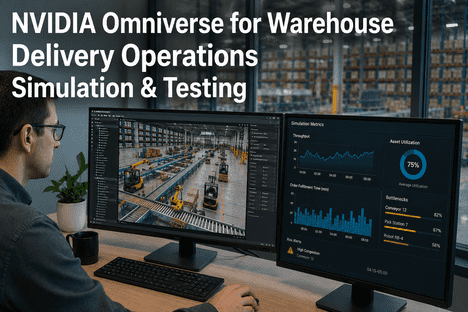
Every warehouse change carries operational risk. A new conveyor configuration that looks correct on a 2D layout drawing produces unexpected bottlenecks at peak throughput. A robot fleet rebalancing that simulated cleanly in spreadsheets generates collision risks at intersections the planner never modeled. An AI-driven maintenance schedule that should optimize uptime instead concentrates technician load on the same shift that handles peak SLA-critical fulfillment. The traditional answer pilot small, scale carefully costs months of opportunity and rarely catches the cascading interactions between equipment, robots, people, and software that determine whether the change actually works. NVIDIA Omniverse changes the economics completely. By building physically accurate, photorealistic digital twins of warehouse delivery hubs, operators can simulate thousands of virtual operating hours in day validating analytics schedules, robot deployments, conveyor configurations, and labor rotations against peak-volume scenarios, edge-case events, and worst-case failure modes before any physical change touches live operations. KION uses this approach to train autonomous forklift fleets for GXO; Amazon Robotics builds full warehouse twins to validate fulfillment systems; FANUC, ABB, KUKA, and Yaskawa with 2 million+ industrial robots installed globally validate robot applications through Omniverse physically-accurate twins. Book a Demo to see how iFactory AI integrates with NVIDIA Omniverse simulation across warehouse delivery operations in 6 to 8 weeks.
1,000s
Virtual warehouse operating hours simulated in days, not months of physical pilot
2M+
Industrial robots from ABB, FANUC, KUKA, Yaskawa validated via Omniverse twins
Zero
Live operational risk during analytics schedule and robot deployment validation
6-8 wks
Deployment timeline from baseline audit to live Omniverse-integrated analytics
What NVIDIA Omniverse Brings to Warehouse Delivery Operations Simulation
NVIDIA Omniverse is a development platform for building physically accurate digital twins — virtual environments that obey real-world physics, lighting, sensor behavior, and machine kinematics with sufficient fidelity that AI policies, robot controllers, and operational schedules trained in simulation transfer reliably to physical operations. Isaac Sim, the robotics-focused application built on Omniverse, provides specific tools for warehouse logistics simulation: conveyor belt generation, animated workers, NVIDIA cuOpt routing optimization, ROS 2 robot integration, and synthetic data generation for training AI vision systems. The combination delivers what no spreadsheet model, 2D layout tool, or discrete-event simulator can: a full-physics rehearsal environment where every warehouse change can be tested against thousands of virtual operating hours before physical implementation.
iFactory's platform integrates directly with NVIDIA Omniverse to close the loop between simulation and live operations. Analytics schedules, predictive maintenance plans, robot fleet routing, and conveyor configurations developed in iFactory can be tested in the Omniverse twin against historical peak-volume data, weather scenarios, equipment failure modes, and labor availability profiles. When simulation validates the change, the same configuration deploys to live operations with confidence — and continuous bidirectional data flow keeps the twin synchronized with real facility state so future simulations remain accurate.
Physically Accurate Warehouse Digital Twins
Photorealistic, physics-accurate twins of dock bays, pick zones, AS/RS lanes, sortation lines, and refrigeration areas — modeling actual conveyor speeds, robot kinematics, sensor behavior, and labor flow patterns with high enough fidelity for transfer to live operations.
Analytics Schedule Validation Before Deployment
Predictive maintenance schedules, AI work order routing, and inspection cadences validated against thousands of virtual operating hours — catching schedule conflicts, technician overload, and SLA exposure issues before they impact live operations.
Robot Fleet Deployment Testing
AMR, AGV, quadruped, and conveyor robot fleet routing validated against ABB, FANUC, KUKA, Yaskawa, Boston Dynamics, and KION platforms within physics-accurate Omniverse twins — eliminating collision risk and throughput surprises in physical rollout.
Conveyor Configuration and Layout Optimization
Isaac Sim conveyor belt generation, NVIDIA cuOpt routing optimization, and animated worker simulation — testing layout changes, induction line rebalances, and sortation re-rates against peak-volume virtual operating data before physical work begins.
Synthetic Data for AI Vision Training
Omniverse Replicator generates synthetic data (2D/3D imagery, sensor feeds, ground-truth labels) for training warehouse AI vision systems — eliminating the data-collection burden that delays vision system deployment by 6 to 18 months.
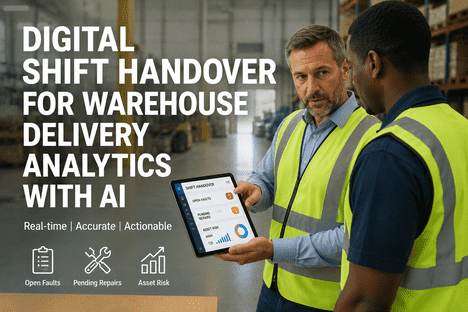
AI-Powered Shift Logbook for Simulation Continuity
iFactory's Shift Logbook captures every simulation event, validation outcome, and pre-deployment finding with AI summaries — ensuring operations teams inherit full simulation context when changes move from Omniverse twin to physical execution.
Why Spreadsheet Models and Pilot Programs Cannot Match Omniverse Simulation Fidelity
Traditional warehouse change validation relies on three methods: spreadsheet throughput models that ignore physics, discrete-event simulators that ignore robot kinematics, and small-scale physical pilots that rarely catch peak-load cascade failures. Omniverse simulation eliminates the limitations of all three. The following comparison shows where conventional methods fall short versus what NVIDIA-integrated simulation delivers.
| Validation Parameter |
Spreadsheet Models + Physical Pilots |
iFactory + NVIDIA Omniverse Twin |
| Physics Accuracy |
Conveyor speeds, robot kinematics, sensor behavior all approximated. Real-world collision risks, throughput cascades, and timing dependencies invisible until physical rollout. |
Full Omniverse physics engine — conveyor friction, robot dynamics, sensor latency, lighting effects modeled with sufficient fidelity for direct sim-to-real transfer. |
| Simulation Speed vs Live Time |
Physical pilots run at 1:1 with live time. A 90-day test takes 90 days. Peak-season scenarios cannot be tested off-season; weather variations cannot be replayed. |
Virtual simulation runs faster than real time. Thousands of operating hours compress into days; peak scenarios, weather events, and failure modes replayed on demand. |
| Robot Fleet Validation |
Robot vendors run isolated trajectory tests. Multi-vendor fleet interactions (AMRs + quadrupeds + AS/RS) only emerge during expensive pilot deployments. |
Full multi-vendor fleet simulation in single Omniverse twin — ABB, FANUC, KUKA, Yaskawa, Boston Dynamics, KION platforms interacting in physics-accurate environment. |
| Peak-Load Scenario Testing |
Pilots cannot replicate Black Friday or holiday peak load. Cascade failures discovered when they happen for real — at the worst possible time. |
Historical peak-volume data replayed against any proposed change. Cascade failures discovered in simulation; mitigations validated before live exposure. |
| AI Training Data Generation |
Computer vision and robot AI policies require real-world training data — 6 to 18 months of collection effort before models reach production readiness. |
Omniverse Replicator generates synthetic training data at scale. Production-ready AI vision and robot policies trained in weeks, not quarters. |
| Change Cost and Reversibility |
Layout, conveyor, and robot changes incur capital cost and downtime even when wrong. Reversal requires another physical change cycle. |
Simulation changes are free and instant. Iterate dozens of configurations virtually; deploy the validated optimum to physical operations. |
Every Warehouse Change Should Be Validated in Simulation Before It Touches Live Operations.
iFactory AI integrates with NVIDIA Omniverse and Isaac Sim to validate analytics schedules, robot deployments, and conveyor configurations against thousands of virtual operating hours — eliminating the operational risk of unproven changes in live delivery hubs.
Book a Demo to see Omniverse-integrated simulation applied to your operation.
How iFactory AI Deploys Omniverse-Integrated Simulation Across Warehouse Delivery Hubs
iFactory follows a structured deployment process that delivers a working Omniverse twin and first validation cycle within the first four weeks and full bidirectional simulation-to-operations integration by week eight. Each stage has defined deliverables so operations teams see measurable simulation impact — not multi-quarter consulting projects that produce demos no one deploys.
Weeks 1–2
Facility 3D Capture and OpenUSD Twin Construction
Existing CAD layouts, BIM models, and LiDAR scans converted to OpenUSD format and loaded into Omniverse. Conveyor lines, AS/RS, dock equipment, and key assets modeled with physics-accurate properties. CMMS, WMS, and ERP data flows established for bidirectional twin synchronization. Digital Shift Logbook deployed.
Weeks 3–4
Isaac Sim Robot Fleet Integration and First Simulation Runs
Robot fleet models (ABB, FANUC, KUKA, Yaskawa, Boston Dynamics, KION) loaded via URDF/Onshape connectors. ROS 2 bridges established. First simulation runs replay historical peak-volume data — surfacing first batch of bottleneck and collision findings within two weeks.
Weeks 5–6
Analytics Schedule Validation and Synthetic Data Generation
Predictive maintenance schedules, AI work order routing, and inspection cadences tested in simulation against multiple scenarios. Omniverse Replicator activated for synthetic data generation supporting AI vision and robot policy training. First validated change deployed to live operations.
Weeks 7–8
Bidirectional Sync, NVIDIA cuOpt, and Multi-Site Rollout
Continuous bidirectional sync between Omniverse twin and live operations active — twin stays synchronized with real facility state. NVIDIA cuOpt routing optimization integrated. Multi-site rollout templates configured for additional fulfillment hubs and distribution centers.
MEASURABLE OUTCOMES FROM WEEK 4: SIMULATION VALIDATION BEGINS IMMEDIATELY
Warehouse operators completing iFactory's 6 to 8 week deployment report 60–80% reduction in failed change rollouts, 70%+ faster AI vision model training via synthetic data, and operational risk on physical changes measurably reduced through pre-validation. By month 6, deployments report 4–7x faster change velocity as the team gains confidence iterating in simulation rather than live operations.
60-80%
Reduction in failed change rollouts via pre-deployment simulation
4-7x
Change velocity increase through simulation-validated iteration
70%+
Faster AI vision training via Omniverse synthetic data
NVIDIA Omniverse Warehouse Simulation: Use Cases from Live Deployments
The following outcomes reflect iFactory + NVIDIA Omniverse integrations at operating distribution centers and fulfillment hubs across e-commerce, 3PL, and contract logistics operations. Each use case reflects 9 to 12 month post-deployment performance.
A contract logistics operator deploying 24 autonomous forklifts across a 380,000 sq ft fulfillment hub faced 4 to 6 months of physical pilot exposure before fleet rollout — with significant collision risk in narrow aisles, blocked-dock recovery edge cases, and uncertain throughput during peak shifts. iFactory built an Omniverse twin of the facility integrating KION-style Jetson-based forklift models with ROS 2 control. Simulation ran the equivalent of 8 months of operating hours in 11 days, surfacing 47 collision edge cases, 12 blocked-dock scenarios requiring re-routing logic, and a throughput cliff at 92% capacity utilization. All issues resolved in simulation before physical rollout. Live deployment completed in 14 days with zero collision incidents and throughput targets exceeded by 11%.
Book a Demo to see fleet validation applied to your operation.
8 mo → 11 days
Pilot validation time reduction via Omniverse simulation
47
Collision edge cases identified and resolved in simulation
0
Collision incidents during 14-day live rollout
A national e-commerce hub planning a $4.2M conveyor and sortation rebalance had no way to validate the design against actual peak-volume operating data — vendor simulations were limited to throughput models that ignored physical interactions. iFactory built an Omniverse twin loading 6 months of historical WMS dispatch data, real label-quality patterns, and actual operator behavior. Simulation ran the proposed configuration against the full 6-month dataset in 19 days, revealing a 14% throughput shortfall during Sunday-Monday turnover and three induction-line bottlenecks not visible in the vendor model. Configuration adjusted in simulation before physical implementation; final design achieved 108% of target throughput post-deployment.
Book a Demo to see conveyor validation applied to your operation.
$4.2M
Capital project validated in simulation before physical work began
19 days
Time to validate 6-month historical scenario in Omniverse twin
108%
Post-deployment throughput vs original design target
A 3PL operator deploying AI vision for damage detection, label verification, and dimensional analysis faced a 14-month real-world data collection cycle before models could reach production accuracy. iFactory deployed Omniverse Replicator-based synthetic data generation — producing photorealistic carton, label, damage, and lighting variations at scale across all required scenarios. Vision models trained on synthetic data achieved production accuracy in 8 weeks (vs 14 months projected), reaching 99.4% damage detection accuracy on real-world test sets. Annual cost of delayed AI vision deployment recovered: $1.7M in damage exception cost and labor recovery.
Book a Demo to see synthetic data acceleration applied to your AI vision program.
14 mo → 8 wks
AI vision training time reduction via synthetic data
99.4%
Production damage detection accuracy on real-world test sets
$1.7M
Annual cost recovered through accelerated AI vision deployment
Expert Perspective: Why Simulation Has Become the Default for Serious Warehouse Change
Industry Review — Warehouse Operations Simulation Perspective
"The companies still treating warehouse change as a physical-pilot problem are five years behind. Amazon Robotics, KION, FANUC, ABB — every operator running serious automation at scale has moved validation into Omniverse twins. The reason is simple: physical pilots cost months and miss edge cases; simulation costs days and catches them. The mindset shift is recognizing that the twin is not a separate project — it is the validation environment for every change you would ever consider making to the warehouse. Operators who build the twin once and reuse it for every change get faster, cheaper, and more reliable than competitors stuck in pilot-cycle economics."
Warehouse Automation Architect — Multi-Site Logistics Operator (provided via iFactory deployment reference)
This perspective aligns with what automation leaders consistently report across iFactory deployments: the highest-ROI gains come from treating the Omniverse twin as a permanent validation environment, not a one-off project. Every analytics schedule, robot deployment, conveyor change, and AI policy goes through simulation first. The twin pays for itself in the first prevented bad rollout. Book a Demo to speak with iFactory's Omniverse integration specialists about your operation.
Physics-Accurate Simulation. Sim-to-Real Confidence. Live in 6 to 8 Weeks.
iFactory integrates with NVIDIA Omniverse and Isaac Sim — building photorealistic warehouse twins that validate analytics schedules, robot fleets, conveyor configurations, and AI vision systems against historical peak data before any change touches live operations.
Conclusion: NVIDIA Omniverse Is Now the Standard for Warehouse Delivery Simulation
The case for NVIDIA Omniverse-based simulation in warehouse delivery operations has moved beyond evaluation. With Amazon Robotics building warehouse twins for fulfillment validation, KION deploying Jetson-based autonomous forklifts validated through Omniverse for GXO, ABB/FANUC/KUKA/Yaskawa validating 2M+ installed industrial robots through physically accurate digital twins, and synthetic data generation cutting AI vision deployment time from 14 months to 8 weeks, operators continuing to validate warehouse change through spreadsheet models and physical pilots are accepting cost, time, and operational risk that simulation eliminates.
iFactory's platform delivers the specific capabilities warehouse delivery operations require: Omniverse-integrated digital twins built from CAD, BIM, and LiDAR data; Isaac Sim robot fleet validation across multi-vendor platforms; analytics schedule and predictive maintenance plan testing against historical peak scenarios; conveyor and layout optimization via NVIDIA cuOpt; synthetic data generation via Omniverse Replicator for AI vision training; AI-powered Shift Logbook continuity from simulation through physical deployment; and bidirectional sync that keeps the twin synchronized with live operations. The 6 to 8 week deployment program means simulation-validated change begins within weeks. Book a Demo to receive an Omniverse simulation assessment specific to your warehouse delivery operation.
Frequently Asked Questions About NVIDIA Omniverse Warehouse Simulation
What NVIDIA Omniverse and Isaac Sim capabilities does iFactory integrate with?
iFactory integrates with Omniverse OpenUSD twin construction, Isaac Sim robotics simulation, Omniverse Replicator synthetic data generation, NVIDIA cuOpt routing optimization, and ROS 2 robot integration. Multi-vendor robot fleet models from ABB, FANUC, KUKA, Yaskawa, KION, and Boston Dynamics import via URDF and Onshape connectors.
How does the Omniverse twin stay synchronized with the live warehouse?
iFactory establishes bidirectional data flow between the twin and live operations through CMMS, WMS, and ERP integrations via OPC-UA, MQTT, BACnet, Modbus, and REST APIs. Equipment state, asset health readings, fulfillment dispatch data, and labor patterns continuously update the twin — keeping simulations accurate against current facility state.
How quickly can the Omniverse twin be built from existing facility data?
Initial twin construction completes in the first 2 weeks of deployment from existing CAD layouts, BIM models, and LiDAR scans converted to OpenUSD format. First simulation runs begin in weeks 3–4. Full bidirectional sync and multi-vendor robot fleet integration completes by week 8.
Can simulation data train AI vision and robot policies for production deployment?
Yes. Omniverse Replicator generates photorealistic synthetic data (2D/3D imagery, sensor feeds, ground-truth labels) at scale, supporting AI vision models for damage detection, label verification, dimensional analysis, and robot policy training. Documented deployments have reduced AI vision training time from 14 months to 8 weeks while achieving 99%+ production accuracy.
How does the AI-powered Shift Logbook support simulation-to-operations continuity?
The Shift Logbook captures every simulation run, validation outcome, edge case identified, and resolution applied with AI-generated summaries. When changes move from twin to live operations, the operations team inherits full simulation context — eliminating the knowledge gap between simulation engineers and shift teams executing the change.
Deploy NVIDIA Omniverse-Integrated Warehouse Simulation in 6 to 8 Weeks.
iFactory builds physically accurate digital twins that validate analytics schedules, robot fleets, and conveyor configurations before any change touches live operations.
60–80% reduction in failed change rollouts
4–7x faster change velocity through simulation
8 wks AI vision training via synthetic data