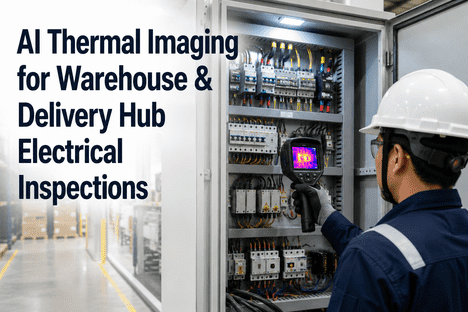
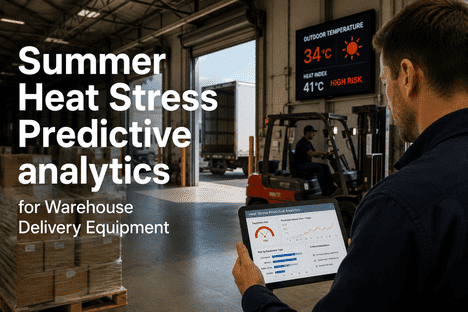
Electrical failure is one of the top three causes of unplanned downtime, fire risk, and equipment damage in industrial warehouse and delivery hub facilities and the regulatory environment around it has changed structurally. The 2023 revision of NFPA 70B moved infrared thermography from a recommended practice to an enforceable standard, with mandatory thermal inspection of all electrical equipment at minimum every 12 months and every 6 months for equipment classified at Equipment Physical Condition 3. At the same time, the operational cost asymmetry remains extreme: a loose connection inside a motor junction box discovered during thermal inspection is tightened under an hour at under $500 in total cost the same loose connection missed by visual inspection trips the motor mid-shift, drives $25,000+ in downtime and emergency repair, and on automated warehouse equipment cascades into outbound dispatch failure. AI thermal imaging closes the gap between annual NFPA 70B compliance scans and the continuous monitoring that modern automated warehouses and delivery hubs structurally require detecting electrical hotspots, motor overheating, and bearing faults invisible to visual inspection, then auto-generating CMMS work orders against the specific failing component before peak operations are disrupted. Book a Demo to see how iFactory AI deploys thermal imaging analytics within 6 weeks.
NFPA 70B
2023 standard makes annual infrared thermography of electrical equipment mandatory
$25K+
Cost of one missed motor junction-box overheat that trips a critical asset mid-shift
30%
Reduction in maintenance cost documented across thermography-driven programmes
4–6 wks
Deployment timeline from electrical asset audit to live AI thermal analytics
What AI Thermal Imaging Analytics Actually Monitors in a Warehouse or Delivery Hub
The electrical and mechanical estate of a modern automated warehouse or delivery hub is the structural backbone of every operational SLA. Main switchgear, motor control centres (MCCs), busways, transformers, UPS systems, stationary batteries, panelboards, distribution boards, sortation conveyor drive motors, AMR and AGV charging infrastructure, dock door motors, ATLS drive units, refrigeration compressors in cold-storage zones, and the dozens of motors and bearings running 24/7 across pick-and-pack lines. Every single failure point on that estate shows a thermal signature long before it shows operational symptoms. Loose connections, overloaded circuits, motor winding imbalance, bearing degradation, harmonic distortion, capacitor failure — each one runs measurably hot against either its own baseline or the temperature of adjacent identical components under similar load.
iFactory AI's thermal imaging analytics layer integrates fixed thermal cameras for continuous monitoring of critical electrical and mechanical assets, plus structured handheld thermal scan workflows for the broader estate that satisfies NFPA 70B's mandatory cadence. Per-asset thermal baselines are established under representative load. NETA-aligned severity classifications based on Delta-T (the difference between component temperature and either its baseline signature or adjacent identical components) drive automated alert routing into the CMMS. Compliance documentation for NFPA 70B inspections is generated continuously rather than reconstructed annually. Book a Demo to see live thermal imaging analytics mapped to your specific electrical estate.
Electrical Hotspot Detection on Switchgear and MCCs
Continuous thermal monitoring of main switchgear, motor control centres, busways, transformers, panelboards, and distribution boards. Loose connections, overloaded circuits, and developing arc-flash precursors detected at sub-degree Delta-T resolution — addressing the failure class that drives the documented $25,000+ single-event cost asymmetry.
Motor Overheating and Winding Analytics
Per-motor thermal signature tracked against baseline and against identical adjacent motors under similar load. Winding imbalance, amp overload, cooling-fan degradation, and harmonic distortion identified via thermal pattern before functional failure. Particularly critical on sortation conveyor drives, dock-door motors, and ATLS drive units carrying peak outbound load.
Bearing Fault and Mechanical Degradation Identification
Bearing-temperature signatures aligned with ISO 18434-1 actionable-fault thresholds (typically 20°C above baseline). Bearing degradation surfaced 2 to 8 weeks ahead of functional failure across motors, conveyor drives, refrigeration compressors, and ATLS drivetrains — replacement scheduled at $2,500 planned cost rather than $25,000+ emergency replacement.
NETA Severity Classification and Delta-T Thresholding
Thermal events automatically classified against NETA-aligned severity bands: Delta-T over 40°C = imminent failure, shutdown and repair within 24 hours; 15 to 40°C = significant degradation, repair within 1 to 2 weeks; 4 to 15°C = early-stage degradation, add to next PM window; under 4°C = normal variation. Each band drives a distinct CMMS routing and intervention urgency.
Auto-Generated CMMS Work Orders
Thermal events above threshold push structured work orders into IBM Maximo, SAP PM, ServiceMax, Infor EAM, or eMaint with asset ID, thermal image, Delta-T reading, NETA severity classification, recommended intervention, and predicted failure window. Replaces reactive "wait for the asset to fail" maintenance with intervention against the specific component running hot.
NFPA 70B Compliance and Shift Logbook Integration
Continuous thermal records, calibrated camera certifications, certified-thermographer logs, and corrective-action evidence captured against NFPA 70B 2023 mandatory annual cadence (semi-annual for Condition 3 equipment). Audit packs exported on demand. Shift Logbook captures every thermal alert, intervention, and recheck across operations, maintenance, and electrical-engineering handovers — backed by WMS, TMS, and CMMS integration via OPC-UA, MQTT, and REST.
Why Annual Handheld IR Scans Are No Longer Enough for Automated Warehouses
NFPA 70B's 2023 mandatory annual cadence (and 6-month cadence for Condition 3 equipment) sets the compliance floor — but automated warehouses, delivery hubs, and cold-storage operations running 24/7 cannot rely on an annual snapshot to catch electrical and mechanical faults that develop in days. The table maps where the conventional model breaks against what continuous AI thermal analytics delivers.
| Thermal Inspection Parameter |
Annual Handheld IR Scan Only |
iFactory AI Thermal Imaging Analytics |
| Coverage Frequency |
One annual scan satisfies NFPA 70B floor (semi-annual for Condition 3). Between scans, hotspots, motor overheats, and bearing faults develop unmonitored for 6 to 12 months. |
Fixed thermal cameras continuously monitor critical electrical and mechanical assets. Handheld scans on broader estate scheduled by AI based on equipment criticality and historical failure patterns — not calendar. |
| Delta-T Trend Visibility |
Single thermal reading per inspection cycle. Trend direction unknown until next scan. A component at 14°C Delta-T this year vs 6°C last year — the most actionable signal — is visible only if both scans use identical methodology. |
Live Delta-T trend per asset across hours, days, and weeks. Acceleration toward NETA significant or imminent thresholds detected the moment the trend changes, not 6 to 12 months later. |
| Severity Classification |
Severity assigned manually by certified thermographer on day of scan. Subjective variation between thermographers and between inspection cycles common. |
NETA severity bands applied automatically per asset against established baseline — imminent (over 40°C), significant (15–40°C), early-stage (4–15°C), normal (under 4°C). Consistent classification across every event. |
| Maintenance Workflow Integration |
Inspection report delivered as PDF days or weeks after the scan. Manual translation into CMMS work orders. Lag between detection and intervention measured in days. |
Thermal events push structured work orders directly into the CMMS with image, Delta-T, severity, recommended action, and asset ID. Detection-to-intervention lag measured in minutes. |
| Compliance Documentation |
Annual report assembled by the inspection vendor. Audit trail reconstructed retrospectively. Corrective-action evidence often disconnected from the original finding. |
Continuous tamper-evident NFPA 70B 2023 audit records linking each thermal finding to its corrective action, technician, completion timestamp, and post-intervention recheck. Audit pack exported on demand. |
| Insurance and Risk Posture |
Annual inspection completion satisfies the minimum carrier expectation. Continuous-monitoring premium discounts (typically 5–15%) unavailable. |
Documented continuous thermal monitoring supports insurance carrier negotiation. Arc-flash risk reduction, fire-risk reduction, and equipment-damage reduction structurally evidenced. |
Every Hotspot Building Under a Closed Panel Door Is a Trip Already Programmed.
iFactory AI delivers warehouse and delivery hub operations continuous fixed-camera thermal monitoring, NETA severity classification, auto-generated CMMS work orders, NFPA 70B 2023 audit documentation, and Shift Logbook continuity — integrated with your WMS, TMS, and CMMS in 4 to 6 weeks.
Book a Demo to see live thermal analytics against your current electrical estate.
How iFactory AI Deploys Thermal Imaging Analytics
iFactory follows a structured deployment process that delivers live thermal telemetry on the highest-criticality electrical assets within the first two weeks and full NFPA 70B compliance integration by week six. Each phase produces a measurable deliverable to maintenance, operations, electrical-engineering, and compliance leadership.
Weeks 1–2
Electrical Asset Audit and Camera Deployment Planning
Electrical and mechanical estate inventoried — main switchgear, MCCs, busways, transformers, UPS, stationary batteries, panelboards, conveyor drive motors, AMR charging infrastructure, dock door motors, ATLS drive units, refrigeration compressors. NFPA 70B Equipment Physical Condition classification reviewed. Tier 1 critical assets identified for fixed-camera continuous monitoring; broader estate scheduled for AI-routed handheld thermal scans. Integration initiated with WMS (Manhattan, Blue Yonder, SAP EWM, Infor), TMS (Oracle, BluJay, Descartes), and CMMS (Maximo, SAP PM, ServiceMax, Infor EAM, eMaint).
Weeks 2–4
Baseline Thermal Calibration and NETA Threshold Activation
Per-asset thermal baselines established under representative operating load. Fixed cameras commissioned on Tier 1 assets with field-of-view, focal distance, and emissivity calibration validated by a certified thermographer. NETA severity thresholds activated — imminent (over 40°C), significant (15–40°C), early-stage (4–15°C), normal (under 4°C). First thermal anomalies on switchgear connections, motor windings, and bearing temperatures surface within the first 3 weeks, typically including latent issues that the most recent NFPA 70B annual scan had missed or under-classified.
Weeks 4–6
Auto Work Orders, Compliance Documentation and Shift Logbook
Auto-generated CMMS work orders activated with thermal image, Delta-T reading, NETA severity, recommended intervention, and predicted failure window pushed directly to the maintenance queue. NFPA 70B 2023 compliance documentation enabled with continuous audit-ready records, certified-thermographer logs, and corrective-action evidence. Shift Logbook integrated so every thermal alert, intervention, and post-intervention recheck is captured across operations, maintenance, and electrical-engineering handovers with full audit chain.
DEPLOYMENT OUTCOME: LATENT HOTSPOTS AND BEARING FAULTS SURFACE WITHIN 3 WEEKS
Warehouses completing iFactory's 4–6 week thermal imaging analytics deployment consistently surface latent electrical and mechanical issues within the first 3 weeks of camera commissioning — switchgear connections developing Delta-T trends, motor windings running hot against adjacent identical motors, bearings approaching the ISO 18434-1 20°C threshold. Programmes typically deliver the documented 30% reduction in overall maintenance cost, drive the documented over-60% reduction in unplanned breakdowns, and unlock 5–15% insurance premium reduction tied to documented continuous monitoring.
30%
Maintenance cost reduction documented across thermography-driven programmes
60%+
Reduction in unplanned electrical and mechanical breakdowns
5–15%
Insurance premium reduction unlocked through documented continuous monitoring
Thermal Imaging Analytics: Use Cases from Live Deployments
The following outcomes are drawn from iFactory thermal imaging analytics deployments at operating warehouse delivery hubs across e-commerce fulfilment, cold-storage 3PL, and parcel sortation networks. Each use case reflects 9–14 month post-deployment performance against the specific electrical or mechanical risk the analytics layer was deployed to address.
An e-commerce delivery hub operating 6 motor control centres feeding sortation, pick-and-pack, and dock door equipment had absorbed 3 unplanned MCC trip events over a 14-month window — each carrying 4 to 7 hours of outbound disruption and averaging $42,000 in direct cost. Annual NFPA 70B handheld thermal scans had passed all three failing connections within the prior 12 months. iFactory deployed fixed thermal cameras on all 6 MCCs with continuous Delta-T monitoring against baseline and adjacent-component comparisons. Within 5 weeks the model flagged 4 connections trending toward the NETA significant band (15 to 40°C Delta-T) and 1 already at the imminent threshold — all corrected during planned overnight maintenance windows at total cost under $4,800. Zero unplanned MCC trips across the following 12 months.
Book a Demo to see how this applies to your electrical estate.
0 trips
Unplanned MCC trip events in 12 months post-deployment vs 3 in prior 14 months
$126K
Direct unplanned-event cost eliminated through predictive thermal intervention
5 conn.
Connections at NETA significant or imminent severity caught in first 5 weeks
A parcel sortation operator running 84 conveyor drive motors across cross-belt and tilt-tray sortation lines had been managing motor and bearing replacement on a fixed-hour PM schedule. Eight unplanned bearing failures over 11 months had driven $310,000 in emergency replacement, downtime, and missed carrier cut-offs. iFactory deployed continuous thermal monitoring on the full motor fleet, aligned to ISO 18434-1 actionable-fault thresholds (typically 20°C above baseline). Within 7 weeks the model identified 12 motors with bearing temperatures trending above baseline and 3 motors with winding imbalance signatures. All 15 were addressed during planned overnight windows at planned replacement cost. Unplanned bearing failures dropped to zero across the following 12 months, recovering the full $310,000 annual exposure.
0 failures
Unplanned bearing failures in 12 months post-deployment vs 8 in prior 11
$310K
Annual emergency-replacement and disruption cost recovered
15 motors
Bearings and windings caught at ISO 18434-1 actionable threshold
A cold-storage 3PL operating 3 facilities had received its first post-NFPA 70B 2023 insurance renewal cycle. The carrier had flagged the operator's annual-only handheld thermal inspection cadence as below the continuous-monitoring posture the 2023 standard rewards, with premium increases of approximately 12% under consideration. iFactory deployed fixed thermal cameras on switchgear, MCCs, transformers, and refrigeration compressor electrical infrastructure across all 3 facilities, plus AI-routed handheld scan scheduling for the broader estate. NFPA 70B 2023 audit documentation activated with tamper-evident continuous records, certified-thermographer logs, and full corrective-action evidence. Insurance renewal completed with a 9% premium reduction based on documented continuous monitoring posture. The follow-up NFPA 70B compliance audit closed without observation.
3 sites
Cold-storage facilities brought under unified continuous thermal monitoring
9%
Insurance premium reduction unlocked vs the 12% increase originally proposed
0 obs.
NFPA 70B 2023 audit observations on the follow-up compliance review
Expert Perspective: What the Industry Gets Wrong About Electrical Inspection
Industry Review — Warehouse Reliability and Electrical Engineering Perspective
"The shift in NFPA 70B 2023 from a recommended practice to an enforceable standard has not landed yet across most warehouse and delivery hub operations. Most operators still treat their annual handheld thermal scan as a compliance check rather than what it actually is — a single sample of a continuous physical process. A loose connection on a busway, a winding imbalance on a sortation conveyor motor, a bearing approaching the ISO 18434-1 threshold on a refrigeration compressor — these are not annual events. They are daily-trend events. The operations that have moved to continuous fixed-camera monitoring on Tier 1 electrical assets and AI-routed handheld scans on the broader estate are running 30% lower maintenance cost, 60%+ fewer unplanned breakdowns, and earning insurance premium reductions that previous-generation programmes simply could not unlock. The economics of one $25,000 motor trip prevented every quarter pays for the whole programme."
Reliability Engineering Lead — Major North American Warehouse and Delivery Network Operator (provided via iFactory deployment reference)
The supporting data confirms it. NFPA 70B 2023 is now enforceable with mandatory annual cadence (semi-annual for Condition 3 equipment). NETA Delta-T severity classification provides objective, repeatable severity routing rather than thermographer-dependent judgement. ISO 18434-1 establishes bearing-temperature actionable thresholds across rotating equipment. The documented 30% maintenance cost reduction, over 60% breakdown reduction, and 5–15% insurance premium reductions across thermography-driven programmes are not aspirational — they are the established benchmarks. Book a Demo to speak with iFactory's thermal imaging specialists about your current operation.
Continuous Thermal Intelligence. NFPA 70B Compliant. Live in 4–6 Weeks.
iFactory gives warehouse and delivery hub operations continuous fixed-camera thermal monitoring, NETA severity classification, ISO 18434-1 bearing analytics, auto-generated CMMS work orders, NFPA 70B 2023 audit documentation, and Shift Logbook continuity. Results measurable within 30 days of camera commissioning.
Conclusion: Continuous Thermal Imaging Is the New Compliance and Reliability Standard
The case for AI thermal imaging analytics in warehouse and delivery hub operations has moved past pilot programmes. NFPA 70B 2023 has made annual infrared thermography enforceable, with semi-annual cadence on Condition 3 equipment. The cost asymmetry between $500 planned intervention on a loose connection caught early and $25,000+ on a tripped motor caught late, the documented 30% reduction in overall maintenance cost, the over-60% reduction in unplanned breakdowns, the 5–15% insurance premium reductions tied to documented continuous monitoring, and the structural reality that an annual snapshot cannot catch developing faults on 24/7 automated estates have made continuous monitoring the new operating standard.
iFactory's platform delivers the specific capabilities warehouse and delivery hub operations require: electrical hotspot detection on switchgear and MCCs, motor overheating and winding analytics, bearing fault and mechanical degradation identification, NETA severity classification with Delta-T thresholding, auto-generated CMMS work orders, NFPA 70B 2023 compliance documentation, and a digital Shift Logbook carrying every thermal alert and intervention across handovers — integrated with Manhattan, Blue Yonder, SAP EWM, Infor WMS, Oracle TMS, BluJay, Descartes, IBM Maximo, SAP PM, ServiceMax, Infor EAM, and eMaint via OPC-UA, MQTT, and REST. The 4–6 week deployment timeline means measurable thermal intelligence begins within weeks. Book a Demo to receive a thermal imaging analytics assessment specific to your electrical estate and compliance profile.
Frequently Asked Questions About AI Thermal Imaging Analytics
Which electrical and mechanical asset classes does iFactory's thermal analytics cover?
iFactory covers main switchgear, motor control centres, busways, transformers, UPS systems, stationary batteries, panelboards, distribution boards, sortation conveyor drive motors, dock door motors, ATLS drive units, AMR and AGV charging infrastructure, refrigeration compressors in cold-storage zones, and the broader motor and bearing population across pick-and-pack lines. Tier 1 critical assets are typically deployed with fixed cameras for continuous monitoring; the broader estate is covered with AI-routed handheld thermal scan scheduling that satisfies NFPA 70B's mandatory cadence.
How does iFactory support NFPA 70B 2023 compliance specifically?
NFPA 70B 2023 mandates infrared thermography inspection of all electrical equipment at minimum every 12 months, and every 6 months for equipment classified at Equipment Physical Condition 3. iFactory satisfies the cadence requirement through a combination of fixed continuous cameras on critical assets and AI-routed handheld scan scheduling on the broader estate. Tamper-evident continuous records, certified-thermographer logs, corrective-action evidence linked to each finding, and audit-ready PDF export on demand provide the documentation auditors and insurers expect under the 2023 standard.
How does the platform classify thermal severity?
Every thermal event is classified automatically against NETA-aligned severity bands using Delta-T (the difference between component temperature and either its baseline or adjacent identical components under similar load): over 40°C = imminent failure, shutdown and repair within 24 hours; 15 to 40°C = significant degradation, repair within 1 to 2 weeks; 4 to 15°C = early-stage degradation, add to next PM window; under 4°C = normal operating variation. Bearing analytics align with ISO 18434-1 thresholds (typically 20°C above baseline as the actionable fault marker).
Do we need to replace our existing handheld thermal cameras?
No. iFactory works with existing handheld thermal cameras and certified-thermographer workflows for the broader estate. Fixed thermal cameras are deployed only on the Tier 1 critical assets identified during the week 1–2 audit — typically main switchgear, primary MCCs, critical sortation drive motors, and cold-storage refrigeration compressor electrical infrastructure. The combination delivers continuous monitoring where it matters most without replacing the existing handheld inspection capability.
How does the platform connect thermal findings to maintenance action?
Every thermal event above threshold pushes a structured work order directly into the operator's CMMS (IBM Maximo, SAP PM, ServiceMax, Infor EAM, eMaint) with the thermal image, Delta-T reading, NETA severity classification, asset ID and location, recommended intervention, required parts, and predicted failure window. Maintenance receives an actionable work order — not a PDF report to be manually translated days later. Detection-to-intervention lag drops from days under annual-scan workflows to minutes under continuous AI monitoring.
How does the Shift Logbook fit into the thermal imaging workflow?
Every thermal alert, technician response, recheck reading, calibration event, certified-thermographer scan, and corrective-action close-out is captured in iFactory's digital Shift Logbook against the affected asset. Incoming operations, maintenance, and electrical-engineering shifts inherit a complete view of which assets are healthy, which are flagged, which interventions are pending, and which corrective actions remain open. Floor observations from operators — unusual motor noise, burning smell, panel-door warmth — are correlated with thermal telemetry so qualitative observation enriches the analytics record used for NFPA 70B 2023 audit posture.
Stop Running Electrical Inspection on Annual Snapshots. Deploy AI Thermal Imaging in 4–6 Weeks.
iFactory gives warehouse and delivery hub operations continuous fixed-camera thermal monitoring, NETA severity classification, ISO 18434-1 bearing analytics, auto-generated CMMS work orders, NFPA 70B 2023 audit documentation, and Shift Logbook continuity across operations, maintenance, and electrical-engineering handovers.
NFPA 70B 2023 mandatory cadence satisfied through continuous and AI-routed coverage
30% reduction in maintenance cost and 60%+ reduction in unplanned breakdowns
NETA severity bands and ISO 18434-1 bearing thresholds applied automatically
5–15% insurance premium reduction unlocked through continuous monitoring posture