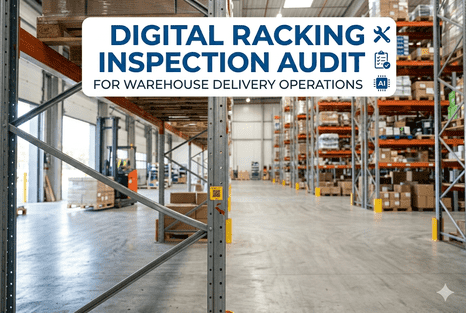
Digital Racking Inspection Audits for Warehouse Delivery Operations
By Arel Dixon on June 4, 2026
Warehouse racking systems support thousands of pallets weighing up to 2,000 lbs each yet the structural integrity of every beam, upright, and connector relies on inspection records that are often handwritten, filed in binders, and never analysed for trends. A single unnoticed fork truck impact to an upright can reduce load capacity by 40–60%, creating a collapse risk that endangers workers and halts operations for weeks. iFactory AI digitises racking inspection with mobile photo documentation, damage trending across inspection cycles, automated compliance checklists aligned to SEMA, RMI, and OSHA standards, and AI-based classification of damage severity converting a paper-based compliance chore into a structural risk management system that protects warehouse personnel and extends racking asset life. Book a Demo to see how iFactory digitises racking inspections for your warehouse. Book a Demo to see how iFactory digitises racking inspections for your warehouse.
Digital Racking Inspection for Warehouses 2026
Digital Racking Inspection Audits for Warehouse Safety & Compliance
Most warehouses conduct weekly or monthly racking inspections using paper checklists — a supervisor walks each aisle, ticks boxes for damage types, and notes an approximate location. These paper records are filed in binders and rarely reviewed longitudinally. A fork truck impact that bends a beam flange by 15mm on week three may go unrepaired until the next scheduled inspection cycle, during which the damaged beam continues to support dynamic loads. By the time it is flagged, adjacent uprights may have shifted, creating a cumulative structural weakness that a single-point inspection cannot detect. Digital racking inspection with the iFactory platform replaces paper with structured mobile data capture each damage observation includes geo-tagged aisle coordinates, high-resolution photographs, a severity classification (green/yellow/red per SEMA guidelines), and a timestamped repair workflow. Inspection data accumulates across cycles, building a structural health trend for every racking component enabling warehouse managers to see not just today's damage, but how damage progresses over time.
Three Operational Problems iFactory Solves for Warehouse Racking Safety
01
PROBLEM
Undocumented Impact Damage That Escalates Silently
A fork truck operator clips an upright while back-palletising a delivery bay. The impact bends the flange by 10mm — within SEMA's amber threshold but below red. No one reports it. Over the next six weeks, the same upright absorbs three more impacts, each bending the column further until the flange is 25mm out of vertical — a red-condition that now requires immediate offloading and upright replacement, costing $1,200–$2,800 per upright plus 40 pallet positions of lost storage for 8–12 hours. iFactory's digital racking inspection platform enables operators and supervisors to log damage in under 30 seconds via the mobile app — snap a photo, select severity, and tag the aisle location. The platform auto-generates a repair work order with the racking component part number and sends a notification to the warehouse manager and maintenance team. Damage trends across inspection cycles are plotted on a racking health dashboard, showing which aisles have recurring impact patterns so root causes — tight turning radii, poor aisle width, inadequate operator training can be addressed before more uprights are damaged.
30-sec mobile damage logAuto repair work ordersDamage trend dashboard
02
PROBLEM
Compliance Audit Fatigue with Paper Records
Warehouses subject to SEMA, RMI, OSHA, or internal insurer audits must produce inspection records for every racking bay across every inspection cycle — often thousands of data points. With paper records, pulling a complete audit trail requires a supervisor to dig through binders, photocopy checklists, and manually compile evidence that all bays were inspected within the required frequency. Gaps in the paper trail can result in non-compliance findings, increased insurance premiums, or regulatory citations. iFactory's digital inspection module auto-generates compliance reports by warehouse zone, inspection cycle, and date range — with photographic evidence linked to each damage observation. The platform tracks inspection completion rates in real time, alerting supervisors when a bay or aisle is overdue for its scheduled inspection. Audit reports are exportable as PDF with a single click, including photo thumbnails, severity summaries, and repair status — eliminating the binder-digging that consumes 4–8 hours per quarterly compliance audit.
Auto compliance reportsPhoto-linked evidence trailReal-time inspection tracking
03
PROBLEM
Reactive Repair Budgeting That Invites Emergency Spend
When racking damage is discovered only during annual or bi-annual thorough inspections, the repair backlog can include 50–200 damaged components — each requiring offloading, replacement, and re-racking. The warehouse manager must then decide which repairs are urgent and which can wait, often without severity data or trend history to guide the decision. Emergency upright replacement costs 2–3× planned replacement due to premium contractor rates, expedited parts shipping, and last-minute storage shuffling. iFactory's continuous inspection model weekly operator walk-throughs logged via mobile app combined with monthly supervisor audits — catches damage at the green and amber stage, when repairs can be scheduled during planned maintenance windows at standard labour rates. The platform's budget forecasting module estimates the cost of each repair tier based on component type and severity, enabling the warehouse manager to allocate monthly racking maintenance budget accurately rather than waiting for a catastrophic failure that forces unplanned capital spend.
Green/amber interventionCost forecasting per severity2–3× emergency cost avoidance
How Digital Racking Inspection Maps to Warehouse Racking Types
Structural bolted connections loosen under vibration; progressive loosening leads to beam dislodgement
Warehouse Inspection Use Cases: What iFactory Delivers on the Floor
Selective Racking
Weekly Upright & Beam Inspection with Photo Severity Classification
Inspection: Weekly
A 30,000-pallet-position warehouse in a food distribution hub runs 60 fork trucks across two shifts. Racking uprights on receiving and shipping aisles absorb an average of 120 impacts per month from pallet misalignment and turn-radius clipping. With paper inspection, only 12–15% of impacts are documented. iFactory's mobile inspection workflow enables each shift supervisor to scan aisle barcodes and snap photos of every upright and beam connector using a tablet or smartphone. The AI severity classifier applies SEMA colour-coding: green (minor scuff — monitor), amber (flange damage 10–20mm — schedule within 7 days), red (flange damage >20mm or structural deformation — offload immediately). Each red observation triggers an automatic work order to the maintenance team and a push notification to the warehouse manager. Over 12 weeks, the trend dashboard reveals that 60% of red damage occurs on receiving bay uprights — driving a layout change that widens the turning radius and reduces impacts by 80%.
Damage capture rate85–90% with digital workflow vs. 12–15% paper
Repair responseRed damage repaired within 48 hours vs. 2–6 weeks on paper system
Flow Track & Brake Function Inspection for Pallet Runaway Prevention
Inspection: Monthly
Pallet live-storage systems use gravity to feed pallets to the picking face through roller tracks with speed controllers or brakes. A single failed brake can release a pallet at uncontrolled speed into the picking aisle, striking an operator or colliding with another pallet — causing product damage and serious injury. In a 10,000-pallet cold storage facility, iFactory's monthly brake function inspection workflow guides the technician lane-by-lane, recording pass/fail for each brake unit with a photo of the brake condition. Failed brakes are flagged for replacement within 72 hours, and the platform tracks brake failure rates by manufacturer and lane position — identifying whether failures cluster on the highest-usage lanes or correlate with a specific brake model. This data enables the warehouse to switch to a higher-durability brake for high-throughput lanes, reducing brake-related pallet runaways by 70% over six months.
Brake failure rateReduced 70% over six months with data-driven brake model selection
Inspection cycle30 minutes per 100 lanes with mobile app vs. 3 hours paper
Drive-In Racking
Guided Rail & Upright Alignment Audit for Deep-Lane Safety
Inspection: Monthly
In drive-in racking, the fork truck enters the rack structure to deposit or retrieve pallets, guided by floor rails and upright-mounted guides. Rail misalignment of 10mm or more can cause a fork truck to scrape an upright, destabilise the load, or tip — particularly in deep-lane configurations where the operator cannot see the far end of the lane. iFactory's drive-in racking inspection module includes a guided rail alignment measurement workflow: the inspector uses a laser distance measurer paired with the mobile app to record rail spacing at the entry, mid-point, and deep end of each lane. Measurements outside tolerance trigger a rail realignment work order with the specific rail section identified. The platform tracks alignment drift trends lane-by-lane, flagging lanes where misalignment is progressive — indicating a floor settlement or anchor base issue that requires structural engineering review before a catastrophic failure occurs.
Rail alignment tolerance10mm threshold with lane-by-lane trend tracking
Structural riskProgressive misalignment flagged for engineering review
What iFactory Delivers for Warehouse Racking Operations
85–90%
Damage capture rate with mobile digital inspection vs. 12–15% paper
Photo-documented observations with AI severity classification in under 30 seconds per bay
70%
Fewer unrepaired damage incidents through auto work order generation
Red-tagged components repaired within 48 hours via automated notification and parts integration
4–8 Hr
Saved per quarterly compliance audit with one-click PDF evidence reports
Photo-linked audit trail replaces binder digging and manual compilation
1–2 Wk
Platform deployment with pre-built racking inspection templates
iFactory's racking inspection module runs on standard smartphones and tablets (iOS and Android) — no specialised hardware purchase required. The mobile app uses the device's camera for photo documentation, GPS for aisle location tagging, and optional barcode/QR scanner for bay-level identification. For laser measurement of rail alignment or beam deflection, iFactory integrates with Bluetooth laser distance measurers (Leica, Bosch, Hilti) that pair directly with the app — the measurement reading auto-populates the inspection form. Pre-built racking inspection templates for selective pallet racking, drive-in, push-back, flow-through, cantilever, and mezzanine systems are included in the platform. The complete deployment — app installation, template configuration, user training, go-live — typically takes 1–2 weeks for a single-site warehouse.
Every inspection observation is stored in the iFactory cloud platform with immutable timestamps, user authentication, and photo file hashes that prevent tampering. Inspection records are versioned — if a damaged upright is repaired and the subsequent inspection shows the repair, the platform retains both the damage photo and the repair photo with separate timestamps and user credentials. Data is synchronised in real time when the device is connected to WiFi or cellular; offline mode caches up to 500 inspection observations locally on the device and syncs automatically when connectivity is restored. Audit exports include a full data provenance trail — who inspected which bay at what time, with the original photographs and any subsequent repair records. This chain of custody meets SEMA and RMI audit documentation requirements and satisfies insurer evidence standards for racking safety compliance.
Yes. iFactory integrates with leading WMS platforms (Manhattan, Blue Yonder, SAP EWM, Oracle WMS, HighJump) and CMMS systems (Maximo, Maintenance Connection, UpKeep, Fiix) via REST API, flat file, or database connector. When a racking inspection observation is classified as red (immediate repair), the platform can auto-create a work order in your existing CMMS with the racking component part number, aisle location, repair priority, and linked damage photo. The WMS integration enables the platform to flag pallet positions in red-tagged bays as blocked — preventing the WMS from directing put-away or pick operations into affected storage locations until the repair is completed and the bay is re-inspected. No rip-and-replace of existing systems is required; standard integration is completed during the first week of deployment.
iFactory's inspection scheduling module supports the three-tier frequency model recommended by SEMA and RMI: daily operator visual checks (30 seconds per bay — logged via mobile app with a green/amber/red tap), weekly supervisor inspections (full aisle walk-through with photo documentation of amber and red observations), and quarterly or annual thorough inspections (detailed bay-by-bay inspection with measurement and structural assessment). The platform auto-generates inspection schedules based on your warehouse layout and racking type, and tracks completion rates with automated reminders to supervisors when inspections are due or overdue. Inspection frequency can be customised per warehouse zone — for example, shipping and receiving bays can be inspected weekly while deep storage bays follow monthly cycles. All inspection records are retained for the full SEMA-mandated 7-year record-keeping period.
iFactory's digital racking inspection platform typically achieves positive ROI within 3 months of deployment. The savings drivers are three-fold: elimination of emergency upright replacement costs (2–3× premium vs. planned replacement), reduction in compliance audit labour (4–8 hours saved per quarterly audit), and lower insurance premiums through verifiable inspection programmes (5–15% annual premium reduction for warehouses with digital inspection evidence). The platform deployment including mobile app installation, template configuration, user training, and go-live takes 1–2 weeks. Most warehouses see a complete return on the first-year investment within the first 4–6 months from avoided emergency repairs and audit labour savings alone, before factoring in insurance premium reductions and improved operator safety.
Digitise Your Racking Inspection Programme Today
iFactory AI replaces paper-based racking inspection with mobile photo documentation, AI severity classification, auto work order generation, and one-click compliance reporting. Pre-built templates for selective, drive-in, push-back, flow-through, cantilever, and mezzanine racking systems. 1–2 week deployment with full user training. Positive ROI within 3 months.