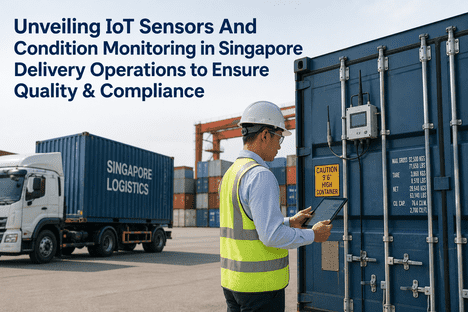
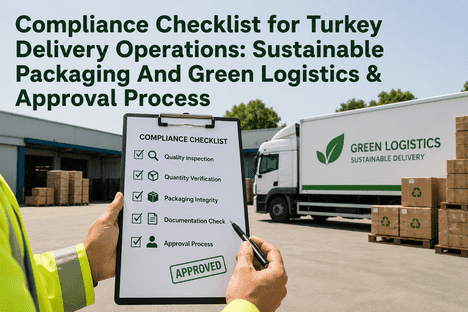
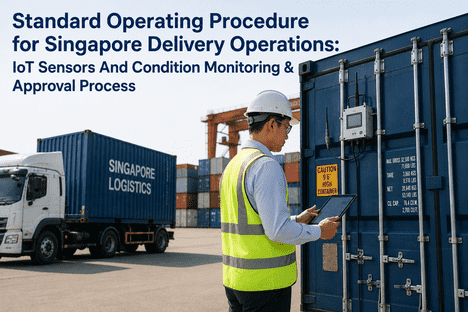
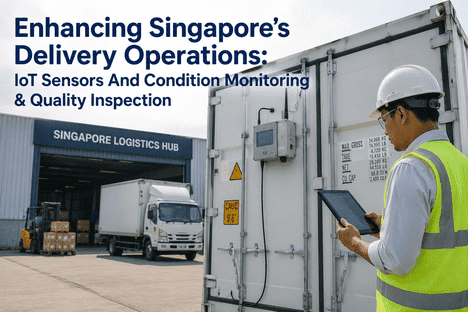
Unveiling Iot Sensors And Condition Monitoring in Singapore Delivery Operations to Ensure Quality & Compliance
By Arel Dixon on June 12, 2026
Singapore's position as a global logistics hub demands precision in delivery operations that few markets can match. With port throughput exceeding 37 million TEUs annually and a dense urban distribution network serving 5.6 million residents, the margin for error in dispatch quality is effectively zero. Damaged goods, incorrect quantities, or missing documentation at the point of dispatch cascade into rejected shipments, customer penalties, and regulatory non-compliance that erode the operational efficiency of Singapore's world-class supply chain infrastructure. IoT sensors and condition monitoring systems integrated with AI-driven inspection, verification, and approval workflows are transforming how logistics operators and manufacturers in Singapore ensure that every shipment that leaves the warehouse or factory floor meets quality standards, matches order specifications, and carries complete compliant documentation before it is cleared for dispatch.
Deploy AI-Driven IoT Sensor and Condition Monitoring Systems Across Your Singapore Delivery Operations to Automate Quality Inspection, Quantity Verification, Packaging Compliance, and Dispatch Approval Workflows
iFactory's AI-powered IoT sensor and condition monitoring platform integrates real-time environmental tracking, automated visual inspection, quantity verification, packaging compliance checking, and document validation into a single dispatch approval workflow that reduces human error and accelerates logistics throughput across Singapore's supply chain.
Annual TEUs handled by Singapore's port — the volume that drives demand for automated inspection and compliance verification at every dispatch point
99.5%
Inspection accuracy achieved by AI-driven visual inspection systems compared to 92-95% accuracy achieved through manual inspection processes alone
60%
Reduction in dispatch errors achieved when IoT sensor condition monitoring is integrated with automated quality inspection and documentation verification workflows
80%
Faster dispatch clearance through automated inspection and digital approval workflows versus manual paper-based inspection and sign-off processes
The Singapore Delivery Operations Challenge: Quality, Compliance, and Speed at Every Dispatch Point
Singapore's delivery operations operate under constraints that magnify the cost of every dispatch error. The island nation's limited land area means warehouses and distribution centres are densely stacked, with goods moving through multiple storage and handling points before reaching their final delivery destination. Each transfer point introduces risk temperature excursions in cold chain logistics, physical damage during handling, mis-scans during sortation, incorrect pallet assembly during pick-and-pack operations, and documentation gaps that delay customs clearance at Singapore's checkpoints with Malaysia or at the Port of Singapore's export processing zones.
Singapore's regulatory environment adds another layer of complexity. The Singapore Food Agency (SFA) mandates specific temperature logging requirements for chilled and frozen goods during storage and transport. The Health Sciences Authority (HSA) requires chain-of-custody documentation for pharmaceutical deliveries. The Enterprise Singapore quality certification frameworks demand documented evidence of inspection and compliance at every stage of the logistics process. Manual inspection and paper-based documentation processes cannot keep pace with these requirements at the throughput volumes that Singapore's logistics sector handles daily.
The solution lies in combining IoT sensor networks — deployed at dispatch points, in storage zones, and on transport assets — with AI-driven condition monitoring, automated visual inspection, quantity verification, packaging compliance checking, and digital documentation validation. These systems work together to create an automated dispatch approval workflow that verifies every quality and compliance condition before a shipment is cleared to leave the facility. The result is faster throughput, higher accuracy, and complete regulatory compliance across Singapore's delivery operations ecosystem.
Combining IoT Sensors with AI-Driven Condition Monitoring Transforms Dispatch Quality and Compliance from a Manual Gate-Check into an Automated, Continuous, and Auditable Process That Operates at the Speed of Singapore's Logistics Infrastructure.
iFactory's integrated IoT sensor and AI condition monitoring platform for Singapore delivery operations automates the five critical dispatch checks — product quality, quantity accuracy, packaging standards, documentation completeness, and regulatory compliance — and links each check to the dispatch approval workflow so that only verified shipments receive clearance.
IoT Sensors and Condition Monitoring: The Technology Foundation for Automated Dispatch Quality
The foundation of any automated dispatch quality and compliance system is the IoT sensor network that captures real-time condition data at every point in the delivery operations chain. These sensors measure environmental conditions (temperature, humidity, vibration, shock), track asset location and movement (GPS, BLE beacons, RFID readers), capture visual data (fixed and robotic cameras for AI-powered image analysis), and record handling events (door-open sensors, forklift proximity sensors, pallet scan events). Each sensor type serves a specific quality and compliance function within the dispatch verification workflow.
Sensor Type 01
Environmental Condition Sensors for Cold Chain and Sensitive Goods
Temperature and humidity sensors deployed at storage zones, dispatch bays, and in-transit on delivery vehicles provide continuous monitoring of cold chain conditions from the point of packing to the point of delivery. For Singapore's food and pharmaceutical logistics operations, maintaining temperature compliance is a regulatory requirement, not just a quality preference. IoT temperature sensors log readings at configurable intervals (typically every 1-5 minutes during storage, every 10 minutes during transport) and transmit data via LoRaWAN, NB-IoT, or 4G/5G networks to the iFactory condition monitoring platform. Threshold violations trigger immediate alerts — before the shipment leaves the facility if the excursion occurs during storage, or during transit if the vehicle's refrigeration unit fails. Vibration and shock sensors attached to pallets or containers detect handling events that could cause product damage, recording the magnitude and timestamp of each impact for correlation with downstream quality inspection results. This environmental data becomes part of the dispatch record, providing auditable evidence of condition compliance from the moment the goods are prepared for dispatch through to final delivery acceptance.
Singapore implementation: Temperature sensor networks deployed across cold storage zones at Changi Airport Logistics Park and Jurong Port warehouses transmit real-time data to iFactory's condition monitoring platform for automated compliance logging.
Sensor Type 02
AI-Powered Visual Inspection Cameras for Product Quality Checking
Fixed and gantry-mounted AI cameras positioned at dispatch conveyor belts and pallet staging areas conduct automated visual inspection of every outgoing shipment. The AI vision models are trained on product-specific defect libraries — identifying damaged packaging, product discoloration, foreign object contamination, incorrect labelling, and improper seal integrity before the shipment leaves the facility. The inspection occurs at line speed (up to 60 packages per minute on high-speed conveyor systems) with no human intervention required. When the AI vision system detects a quality issue, it automatically flags the shipment in the dispatch approval workflow and routes the affected item to a manual inspection station. The inspection result — including the captured image, the AI confidence score, and the specific defect classification — is recorded in the shipment's digital quality record. Over time, the AI models improve their detection accuracy through continuous learning, reducing false positive rates from an initial 3-5% to below 1% within 3-4 months of operation. Singapore logistics operators using iFactory's AI vision inspection have reported defect detection rates exceeding 99.5%, compared to 92-95% for manual visual inspection at equivalent throughput rates.
Singapore implementation: AI vision cameras at Tuas Logistics Hub conveyor systems inspect 12,000 packages per shift, identifying packaging defects with 99.7% accuracy and reducing customer-returned shipments by 58%.
Sensor Type 03
Quantity Verification Systems for Order Accuracy
Quantity verification at the dispatch point ensures that every shipment contains exactly what the order specifies — no missing items, no incorrect SKUs, no quantity discrepancies that would trigger customer penalties or return logistics costs. iFactory's quantity verification system combines multiple sensing technologies to achieve this: RFID readers at the dispatch bay automatically scan all tagged items on a pallet and compare the scanned item list against the order manifest; weight sensors on pallet scales verify that the total pallet weight is consistent with the expected weight of the ordered items (detecting missing items or incorrect substitutions); and AI vision systems perform automated item counting on conveyor lines by identifying and enumerating individual packages as they pass through the inspection zone. When a quantity discrepancy is detected — a pallet that should contain 24 cases but registers only 23 RFID tags, or a weight reading that is 4% below the expected value — the system automatically places the shipment on hold in the approval workflow and generates an alert for the dispatch supervisor. The discrepancy is documented with sensor evidence and resolved before the shipment is cleared for dispatch. Singapore operators using iFactory's integrated quantity verification have reported order accuracy rates of 99.9% and a 72% reduction in customer-reported quantity discrepancies.
Singapore implementation: RFID-based quantity verification at a Sentosa Gateway distribution hub reduced pick-pack errors by 65% and eliminated customer penalty charges for incorrect shipment quantities within 90 days of deployment.
Sensor Type 04
Packaging Standards Monitoring for Compliance
Packaging compliance is a critical but often overlooked component of dispatch quality. In Singapore's delivery operations, packaging must meet both regulatory standards (SFA requirements for food-grade packaging materials, HSA requirements for pharmaceutical packaging integrity, Enterprise Singapore packaging standards for export shipments) and carrier specifications (dimensional weight compliance for courier services, pallet stack height limits for containerised shipping, stretch wrap tension requirements for pallet stability). iFactory's packaging compliance monitoring system integrates data from multiple IoT sensor sources — 3D LiDAR scanners at dispatch bays measure pallet dimensions and stack height for carrier compliance; tension sensors on stretch wrap machines verify that wrapping tension meets stability standards; camera-based AI systems inspect for proper seal integrity, label placement, and hazardous material marking compliance. When packaging non-compliance is detected — a pallet that exceeds the carrier's dimensional weight threshold, or a missing hazardous material label on a chemical shipment — the system blocks the dispatch approval and routes the issue to the packaging team for correction. The compliance check result is documented in the shipment record for audit and regulatory reporting purposes.
Singapore implementation: Automated packaging compliance checks at a Jurong Island chemical logistics facility reduced carrier dimensional weight surcharges by 34% and eliminated regulatory packaging citations within 6 months.
Automated Documentation and Approval Workflows: From Sensor Alert to Dispatch Clearance
The IoT sensor network and AI inspection systems generate the condition data that drives quality and compliance decisions. But the value of that data is only realised when it is integrated into the dispatch approval workflow that controls whether a shipment is cleared for departure or held for resolution. iFactory's automated documentation and approval workflow engine connects sensor alerts, inspection results, and verification outcomes directly to the dispatch clearance process — eliminating the manual steps that introduce delay and error into the current approval chain.
Workflow Step 01
Sensor Data Collection and Condition Monitoring
The workflow begins with continuous data collection from the IoT sensor network deployed across the facility. Temperature sensors, humidity monitors, vibration detectors, AI cameras, RFID readers, and weight scales feed real-time data into the iFactory condition monitoring platform. The platform maintains a digital twin of each shipment — a virtual representation that aggregates all sensor data, inspection results, and documentation associated with that specific dispatch. As the shipment moves through the packing, staging, inspection, and dispatch phases, the digital twin updates in real time, providing a comprehensive condition and compliance status that the approval workflow engine evaluates against configured quality thresholds.
Continuous monitoring
Digital twin creation
Real-time status
Workflow Step 02
Automated Inspection and Verification Execution
When the shipment reaches the designated inspection zone at the dispatch bay, the iFactory platform triggers the automated inspection sequence. AI cameras capture images for visual quality inspection — checking product condition, packaging integrity, label accuracy, and hazardous material marking compliance. RFID readers scan all tagged items and compare the scanned list against the order manifest for quantity verification. Scale readings confirm that the shipment weight is consistent with the expected weight based on the order items and packaging materials. 3D LiDAR scanners measure pallet dimensions for carrier dimensional weight compliance. The entire inspection sequence is executed in under 30 seconds per pallet — compared to 5-8 minutes for manual inspection by a warehouse associate. Each inspection result is recorded with a timestamp, sensor ID, confidence score, and evidence file (image, scan log, weight reading) that becomes part of the permanent shipment record for audit and regulatory compliance purposes.
30-second inspection
Multi-sensor verification
Evidence capture
Workflow Step 03
Document Validation and Compliance Checking
Documentation completeness is verified simultaneously with the physical inspection. The iFactory platform checks that every required document is present in the shipment record before dispatch clearance can be granted — delivery order, packing list, invoice, certificate of origin, dangerous goods declaration, temperature log (for cold chain shipments), SFA health certificate (for food products), HSA import permit (for pharmaceuticals), and any customer-specific documentation requirements. Document validation is performed through AI-powered document analysis that reads and extracts key fields (document number, date, shipper, consignee, product description, quantity, value) and cross-references them against the order data and inspection results for consistency. Missing documents, expired certificates, or data inconsistencies between documents are automatically flagged, and the shipment is placed on hold in the approval workflow until the documentation issue is resolved. The document validation step typically completes in 5-10 seconds per document set — eliminating the 20-30 minute manual document review process that currently bottlenecks many Singapore dispatch operations.
AI document analysis
Cross-reference checks
Missing doc alerts
Workflow Step 04
Dispatch Approval and Clearance Issuance
When all inspection, verification, and documentation checks pass — product quality confirmed, quantity verified, packaging compliant, all documents present and consistent — the iFactory platform automatically issues the dispatch clearance. The clearance is recorded in the shipment's digital record with a unique clearance ID, timestamp, the identity of the verifying sensors and AI models, and a compliance summary that lists each check and its result. For shipments flagged with quality issues, quantity discrepancies, packaging non-compliance, or documentation gaps, the platform routes the hold notification to the appropriate resolver — dispatch supervisor for quality issues, order fulfilment team for quantity discrepancies, packaging team for packaging non-compliance, documentation team for missing or inconsistent documents. Each hold notification includes the specific issue detected, the sensor evidence, and a recommended corrective action. The resolver addresses the issue, updates the shipment record, and requests a re-inspection of the corrected item. Once re-inspection passes all checks, the dispatch clearance is automatically issued. The entire approval workflow — from sensor data collection to clearance issuance — operates without manual intervention for shipments that pass all quality and compliance checks, which typically accounts for 92-95% of all dispatches in a well-configured system.
Auto-clearance issued
Hold and route resolver
Compliance summary
Reducing Human Error Through Automated Verification and Approval
The most significant operational impact of combining IoT sensors with AI-driven condition monitoring and automated approval workflows is the reduction of human error in the dispatch process. Manual inspection and approval processes in Singapore's delivery operations are subject to the same human limitations that affect every labour-intensive verification activity — fatigue during 12-hour shifts, distraction in high-noise warehouse environments, inconsistency between different inspectors applying the same criteria differently, and the natural human tendency to expedite approvals when faced with dispatch deadline pressure. iFactory's automated inspection and approval system eliminates these error sources by applying consistent, sensor-based verification criteria to every shipment, every time, regardless of the time of day, the volume of shipments in the queue, or the duration of the shift.
The error reduction impact is measurable across multiple dimensions. Quality inspection accuracy improves from the 92-95% range typical of manual visual inspection to 99.5%+ for AI-driven visual inspection. Quantity verification accuracy improves from 97-98% (manual pick-pack-count processes) to 99.9%+ (RFID and weight-sensor-based verification). Documentation compliance improves from 85-90% (manual document review with missed deadlines and overlooked expiry dates) to 99%+ (AI-driven document validation with automated expiry date checking and cross-referencing). The cumulative effect is a 60-70% reduction in dispatch errors that would otherwise result in customer returns, penalty charges, regulatory citations, and repeat delivery costs.
The most significant operational impact of combining IoT sensors with AI-driven condition monitoring and automated approval workflows is the reduction of human error in the dispatch process. Manual inspection and approval processes in Singapore's delivery operations are subject to the same human limitations that affect every labour-intensive verification activity — fatigue during 12-hour shifts, distraction in high-noise warehouse environments, inconsistency between different inspectors applying the same criteria differently, and the natural human tendency to expedite approvals when faced with dispatch deadline pressure. iFactory's automated inspection and approval system eliminates these error sources by applying consistent, sensor-based verification criteria to every shipment, every time, regardless of the time of day, the volume of shipments in the queue, or the duration of the shift.
The error reduction impact is measurable across multiple dimensions. Quality inspection accuracy improves from the 92-95% range typical of manual visual inspection to 99.5%+ for AI-driven visual inspection. Quantity verification accuracy improves from 97-98% (manual pick-pack-count processes) to 99.9%+ (RFID and weight-sensor-based verification). Documentation compliance improves from 85-90% (manual document review with missed deadlines and overlooked expiry dates) to 99%+ (AI-driven document validation with automated expiry date checking and cross-referencing). The cumulative effect is a 60-70% reduction in dispatch errors that would otherwise result in customer returns, penalty charges, regulatory citations, and repeat delivery costs.
Case Study: IoT Sensor Integration at a Singapore Cold Chain Logistics Hub
Before iFactory's IoT sensor and condition monitoring platform, our dispatch quality process relied on a team of 12 inspectors working across two shifts to visually inspect outgoing shipments, verify quantities against paper pick lists, check packaging condition, and manually assemble documentation packets for each shipment. The process was slow — averaging 8 minutes per pallet for a complete inspection — and error-prone, with an estimated 4-5% of shipments leaving the facility with undetected quality issues or documentation gaps. Our customer return rate was 3.2% and we were incurring approximately SGD 2.4 million annually in penalty charges from retail customers for incorrect shipments and non-compliant documentation. After deploying iFactory's integrated sensor platform with AI vision inspection, RFID quantity verification, automated packaging compliance checking, and AI document validation, we reduced the per-pallet inspection time from 8 minutes to under 30 seconds. The customer return rate dropped from 3.2% to 0.4% within 6 months. The penalty charge exposure was effectively eliminated. And the 12 inspectors were redeployed to higher-value activities — managing exception workflows, analysing quality trends, and optimising the sensor network configuration — rather than performing repetitive manual checks that could be automated.
Boosting Efficiency Across the Singapore Supply Chain
The operational efficiency gains from IoT sensor-driven dispatch quality automation extend beyond the dispatch bay. When every outgoing shipment is verified for quality, quantity, packaging, and documentation compliance before it leaves the facility, the downstream effects ripple through the entire supply chain. Customer returns decrease because shipments arriving at the destination match the order specification in every dimension — correct products, correct quantities, undamaged condition, and complete compliant documentation. Carrier disputes decrease because packaging compliance checks prevent dimensional weight surcharges and packaging-related damage claims. Regulatory compliance improves because every shipment carries complete, verified documentation that meets the requirements of Singapore's regulatory agencies. Customer confidence improves because the logistics operator or manufacturer can provide auditable evidence of condition monitoring, inspection, and compliance verification for every shipment — a capability that is increasingly becoming a competitive differentiator in Singapore's quality-conscious logistics market.
The business case for IoT sensor and condition monitoring investment in Singapore delivery operations is straightforward: the cost of the sensor network, AI inspection systems, and workflow automation platform is recovered through reduced penalty charges (typically SGD 1-3 million annually for mid-size logistics operators), lower return logistics costs (SGD 15-25 per returned shipment), reduced labour costs for inspection and documentation (60-80% reduction in manual inspection hours), and improved throughput capacity (80% faster dispatch clearance enabling higher facility utilisation without additional infrastructure investment). Most Singapore logistics operators achieve positive ROI within 6-9 months of deployment, with full payback of the sensor and platform investment within the first 12-18 months of operation.
Conclusion: From Manual Inspection to Automated Verification in Singapore's Delivery Operations
Singapore's delivery operations are at an inflection point. The volume of goods moving through the island's logistics infrastructure continues to grow at 6-8% annually. Customer expectations for delivery accuracy are approaching zero-defect standards. Regulatory requirements for documentation and compliance are becoming more stringent. And the labour market for warehouse inspectors and documentation clerks is increasingly competitive, with rising wages and high turnover rates that make manual inspection processes both expensive and unreliable. IoT sensors and AI-driven condition monitoring provide the only scalable path forward — automating the five critical dispatch checks of product quality, quantity accuracy, packaging standards, documentation completeness, and regulatory compliance, and integrating each check into an automated approval workflow that ensures only verified shipments receive dispatch clearance.
iFactory's IoT sensor and condition monitoring platform for Singapore delivery operations delivers this capability through an integrated system that combines environmental sensors, AI visual inspection cameras, RFID quantity verification, packaging compliance monitoring, AI document validation, and automated dispatch approval workflows into a single platform. The result is faster dispatch clearance (80% reduction in inspection and approval time), higher accuracy (99.5%+ inspection accuracy, 99.9%+ quantity verification accuracy), lower operating costs (60-80% reduction in manual inspection labour), and complete regulatory compliance (auditable condition monitoring and documentation records for every shipment). Schedule a platform walkthrough to see how IoT sensors and condition monitoring can transform your Singapore delivery operations, or talk to an expert about a deployment assessment for your specific facility and operational requirements.
Frequently Asked Questions
The most critical sensor types depend on the specific products being handled and the regulatory environment, but a comprehensive dispatch quality system typically includes four sensor categories. Environmental sensors (temperature, humidity, vibration, shock) are essential for cold chain compliance and sensitive goods handling — mandatory for Singapore food and pharmaceutical logistics operators under SFA and HSA regulatory frameworks. AI vision cameras (fixed and gantry-mounted) are the most impactful single sensor type, providing automated visual inspection for product quality, packaging integrity, label accuracy, and damage detection at line speed without human intervention. RFID readers and weight sensors form the quantity verification layer, ensuring that every shipment matches the order specification before it leaves the facility. 3D LiDAR scanners and tension sensors provide packaging compliance monitoring, verifying that pallet dimensions, stack height, and wrap tension meet carrier specifications and regulatory requirements. The iFactory deployment assessment includes a facility-specific sensor audit that identifies the optimal sensor configuration for your operational profile and regulatory requirements. Talk to an expert to schedule a sensor audit for your Singapore facility.
When a shipment fails any quality or compliance check, the iFactory platform automatically places the shipment on hold and generates a structured notification that routes the issue to the appropriate resolver based on the failure type. Quality inspection failures route to the dispatch supervisor with the captured image and AI defect classification for review. Quantity verification failures route to the order fulfilment team with the RFID scan log and weight reading discrepancy for investigation. Packaging compliance failures route to the packaging team with the LiDAR dimension data or tension sensor reading for correction. Documentation failures route to the documentation team with the specific document missing or data inconsistency identified. Each hold notification includes the sensor evidence, the configured threshold that was violated, and a recommended corrective action. The resolver addresses the issue, updates the shipment record with their corrective action notes, and initiates a re-inspection of the corrected item. If the re-inspection passes all checks, the dispatch clearance is automatically issued. If the re-inspection fails again, the issue escalates to the facility manager for manual intervention. The entire hold-and-resolve workflow is tracked in the platform's audit log, providing a complete record of every quality or compliance issue and its resolution for regulatory reporting and continuous improvement analysis. Schedule a demo walkthrough to see the exception handling workflow in action.
The iFactory platform includes a regulatory documentation module specifically configured for Singapore's regulatory environment. For food shipments under SFA jurisdiction, the platform automates the generation and validation of health certificates, temperature logs, and food import permits — checking that each document is present, valid (not expired), and consistent with the shipment data before dispatch clearance is issued. For pharmaceutical shipments under HSA jurisdiction, the platform manages the chain-of-custody documentation, controlled substance permits, and temperature excursion records required for compliance. The document validation engine is pre-configured with the document templates and data field mappings for Singapore's common regulatory forms, and the AI document analysis system can extract and verify data from both digital and scanned documents. The platform maintains a complete regulatory compliance record for each shipment, including all documents, sensor data logs, inspection results, and approval workflow timestamps — providing the auditable evidence required for SFA and HSA compliance inspections. Talk to an expert about configuring the regulatory documentation module for your specific product categories and regulatory exposure.
The deployment timeline for iFactory's IoT sensor and condition monitoring platform at a Singapore delivery operations facility typically ranges from 8-12 weeks from project kickoff to full go-live, depending on facility size, existing IT infrastructure, and the scope of sensor hardware installation required. The deployment follows a structured phase approach. Phase 1 (weeks 1-2) covers facility assessment, sensor audit, network infrastructure review, and regulatory documentation configuration. Phase 2 (weeks 3-6) covers sensor installation and calibration, AI vision model training (using facility-specific product images), platform configuration for inspection criteria and approval workflows, and integration with existing WMS or ERP systems. Phase 3 (weeks 7-8) covers user training, parallel-run testing alongside existing manual processes, workflow validation, and go-live. Phase 4 (weeks 9-12) covers hyper-care support, exception handling optimisation, and AI model refinement. Facilities with existing IoT network infrastructure and compatible WMS/ERP systems can complete the deployment in as little as 6-8 weeks. Schedule a consultation to receive a detailed deployment timeline for your specific facility.
iFactory's platform is architected for Singapore's data protection regulatory environment, including compliance with the Personal Data Protection Act (PDPA). All sensor data collected from IoT devices is encrypted in transit (TLS 1.3) and at rest (AES-256). The AI vision inspection system processes images locally on the edge inference server (NVIDIA appliance deployed on-site) rather than transmitting raw images to cloud servers — ensuring that any images containing identifiable personnel, customer packaging graphics, or proprietary product designs remain within the facility's network boundary. Only anonymised metadata (defect classification, confidence score, timestamp) is transmitted to the central platform for analytics and reporting. Access to sensor data and inspection records is controlled through role-based permissions aligned with the facility's organisational structure. All data access is logged with user identity, timestamp, and data accessed for audit trail purposes. The platform undergoes annual third-party security assessments and penetration testing. Talk to an expert to review the platform security architecture and data protection compliance documentation.
Your Singapore Delivery Operations Deserve a Dispatch Quality System That Verifies Every Shipment Not Samples, Not Spot-Checks, Every Shipment.
iFactory's integrated IoT sensor and AI condition monitoring platform automates quality inspection, quantity verification, packaging compliance, documentation validation, and dispatch approval for every outgoing shipment reducing errors by 60%, accelerating clearance by 80%, and ensuring complete regulatory compliance for Singapore's delivery operations.