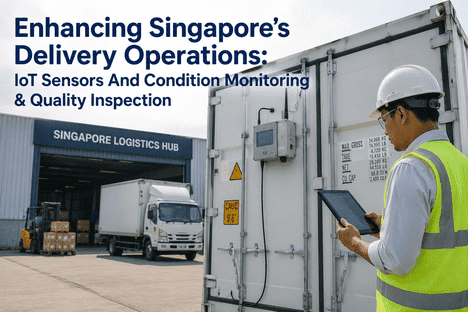
A mid-size Singapore logistics operator processing 18,000 outbound pallets per month from its Tuas distribution hub faced a recurring operational problem: too many shipments were leaving the facility with undetected quality issues, incorrect quantities, damaged packaging, or missing documentation. The existing manual inspection and approval process paper-based checklists reviewed by warehouse associates during 12-hour shifts was catching only 60-65% of quality and compliance discrepancies before dispatch. The remaining 35-40% were being discovered downstream by customers, carriers, or regulatory inspectors, generating an average of SGD 1.8 million annually in penalty charges, return logistics costs, and lost customer contracts. This standard operating procedure (SOP) provides a step-by-step checklist for implementing IoT sensor-driven condition monitoring, automated quality inspection, quantity verification, packaging compliance checking, documentation validation, and dispatch approval workflows. It is designed for Singapore logistics operators, warehouse managers, and quality assurance teams who need a practical operational framework for deploying AI-driven verification systems that ensure every outgoing shipment meets quality, quantity, packaging, documentation, and compliance standards before it receives dispatch clearance.
IOT SENSORS · CONDITION MONITORING · QUALITY INSPECTION · QUANTITY VERIFICATION · PACKAGING STANDARDS · DOCUMENTATION · APPROVAL WORKFLOWS
Implement AI-Driven IoT Sensor Condition Monitoring Across Your Singapore Dispatch Operations with This Step-by-Step SOP Checklist
iFactory's practical SOP framework covers sensor deployment, automated inspection workflows, quantity verification, packaging compliance, documentation validation, and approval process configuration — designed specifically for Singapore logistics operators seeking error-free dispatch.
99.5%
Inspection Accuracy Achieved
60%
Fewer Dispatch Errors
8-12
Weeks to Full Deployment
01 / The Operation
Singapore Dispatch Operations: Quality, Compliance, and Throughput at Every Outbound Bay
Facility TypeMid-size Singapore third-party logistics (3PL) distribution hub serving FMCG, pharmaceutical, and cold chain clients. 18 dispatch bays, 24-hour operation across two shifts, with a dedicated quality inspection station at each outbound bay for manual pre-dispatch checks.
Throughput18,000 pallets dispatched per month across 850+ SKUs. Average of 600 pallets per day with peak volumes reaching 900 pallets during seasonal demand periods. Client segments include food and beverage (42%), pharmaceuticals (28%), general retail (18%), and cold chain goods (12%).
Operations Team42 warehouse associates, 8 quality inspectors, 6 shift supervisors, and 3 operations managers. Quality inspection performed manually with paper checklists. Average inspection time of 8 minutes per pallet. Documentation assembled and reviewed separately by a documentation clerk.
Pre-Deployment Error RateApproximately 4.2% of all outgoing shipments had at least one quality or compliance discrepancy that was not detected before dispatch. Product damage (1.8%), incorrect quantity (1.1%), packaging non-compliance (0.7%), and missing or incorrect documentation (0.6%).
Prior Inspection ProcessPaper-based checklist with 15 inspection points completed by a quality inspector at the dispatch bay. Documentation packet assembled separately by a clerk. Dispatch approval granted when the inspector and clerk both signed off. No digital record of inspection results, no cross-referencing between inspection data and order data, no automated hold or escalation for discrepancies found.
Annual Cost of ErrorsSGD 1.8 million annually in customer penalty charges, return logistics costs, regulatory fines for non-compliant documentation, and lost contracts due to service quality failures.
02 / The SOP Checklist
Step-by-Step Standard Operating Procedure for IoT Sensor-Driven Dispatch Quality Verification and Approval
The following SOP checklist provides a structured operational framework for implementing IoT sensor-driven condition monitoring and automated dispatch approval. Each step includes the specific sensor configuration, inspection criteria, verification process, documentation requirement, and approval workflow action required to ensure every outgoing shipment meets quality, quantity, packaging, documentation, and compliance standards.
01
Sensor Network Configuration and Calibration
Objective: Deploy and calibrate IoT sensor network at each dispatch bay for real-time condition monitoring. Actions: Install AI vision cameras at each dispatch conveyor with coverage of all package faces. Deploy RFID readers at bay entrance with 360-degree antenna array. Install pallet weight scales calibrated to ±0.5 kg accuracy. Configure 3D LiDAR scanners for pallet dimension measurement. Set temperature and humidity sensors in cold chain dispatch zones. Verification: Run calibration check with reference pallet. Confirm all sensors report data to iFactory platform. Documentation: Sensor calibration log with timestamp and technician ID. Approval: System self-check passes; manual override by shift supervisor if calibration fails.
02
Shipment Registration and Order Data Import
Objective: Register each outgoing shipment in the iFactory platform and import order data for cross-referencing. Actions: Scan shipment barcode or RFID tag to initiate registration. Platform automatically imports order data from WMS/ERP: product SKU list, expected quantities, customer specifications, packaging requirements, and document checklist. Digital twin created for the shipment with unique dispatch ID. Verification: Confirm imported order data matches shipment manifest. Flag any discrepancies between scanned barcode and order data. Documentation: Shipment registration record with order data import confirmation. Approval: Platform confirms data match; manual escalation for mismatched orders.
03
Automated Visual Quality Inspection
Objective: Perform AI-driven visual inspection of all package surfaces for product quality and packaging integrity. Actions: Conveyor moves shipment through AI vision inspection zone. Platform captures images of all visible package faces. AI models analyze images for: product damage (dents, tears, leaks), packaging defects (crushed corners, torn wrap, broken seals), label accuracy (SKU match, batch number readability, expiry date presence), and contamination (foreign material, stains, pest evidence). Verification: Platform compares AI inspection results against configured quality thresholds. Generate pass/fail status for each inspection category. Documentation: Inspection result record with captured images, AI confidence scores, defect classifications, and timestamp. Approval: Automatic pass for all categories. Hold placement for any category failure with specific defect evidence attached.
04
Quantity Verification and Order Accuracy Check
Objective: Verify that shipment quantity matches the order specification using multi-sensor verification. Actions: RFID reader scans all tagged items on the pallet and generates item count by SKU. Pallet scale measures total weight and compares against expected weight calculated from order line items. AI vision system performs item count on conveyor for non-RFID-tagged packages. Platform cross-references all three data sources against the order manifest. Verification: RFID count matches expected SKU count within configured tolerance. Weight reading is within ±2% of expected weight. Visual count matches order quantity. Documentation: Quantity verification report with RFID scan log, weight reading, expected weight, variance percentage, and visual count confirmation. Approval: Automatic pass when all three checks confirm quantity. Hold placement for any discrepancy with specific variance data.
"The paper-based checklist process was the weakest link in our quality chain. Inspectors working 12-hour shifts would start missing items by hour 8. Documentation errors were caught only when the customer called. iFactory's automated SOP replaced a fallible human gate-check with a consistent, sensor-driven verification process that catches every discrepancy before the truck leaves the bay."
05
Packaging Standards Compliance Check
Objective: Verify packaging meets regulatory and carrier compliance standards. Actions: 3D LiDAR scanner measures pallet height, width, and depth for carrier dimensional weight compliance. Tension sensor on stretch wrap machine verifies wrap tension meets stability threshold. AI vision inspects for correct hazardous material marking placement (if applicable), label orientation, and seal integrity. Platform cross-checks packaging type against product-specific packaging requirements in customer profile. Verification: Dimensions within carrier limits. Wrap tension within configured range. Hazardous material markings present and correctly placed. Documentation: Packaging compliance report with dimension measurements, tension reading, inspection images, and compliance checklist. Approval: Automatic pass for all checks. Hold placement for non-compliance.
06
Documentation Validation and Regulatory Compliance Check
Objective: Verify all required documentation is present, complete, and consistent with shipment data. Actions: Platform checks document checklist against shipment profile: delivery order, packing list, commercial invoice, certificate of origin, dangerous goods declaration, temperature log, SFA health certificate, HSA import permit. AI document analysis extracts key fields and cross-references against order data. Verification: All required documents present. No expired certificates or permits. Key fields consistent across all documents. Documentation: Document validation report with checklist status, extracted field comparison, and discrepancies flagged. Approval: Automatic pass when all documents present and consistent. Hold placement with specific document gaps.
07
Dispatch Approval Workflow Execution
Objective: Execute the automated dispatch approval workflow based on all preceding check results. Actions: Platform aggregates results from Steps 01-06 into a single compliance summary. If all checks pass: platform automatically issues dispatch clearance with unique clearance ID; clearance recorded in shipment digital twin; dispatch bay gate signal activated to allow truck departure. If any check fails: platform places shipment on hold; hold notification routed to appropriate resolver; resolver investigates and initiates corrective action; re-inspection triggered after correction. Verification: Clearance summary reviewed by shift supervisor at end of shift. Documentation: Dispatch clearance record with compliance summary, clearance ID, timestamp, and resolver notes. Approval: Automatic clearance for all-pass shipments. Supervisory override for time-critical exceptions.
08
Continuous Improvement and KPI Monitoring
Objective: Monitor system performance, identify improvement opportunities, and refine inspection thresholds. Actions: Platform generates daily, weekly, and monthly KPI reports: total shipments cleared vs. held, hold reasons by category, average inspection time per pallet, false positive rate, resolver response time, customer return rate. Operations team reviews KPI trends in weekly quality meeting. AI models retrained quarterly with new defect images. Verification: KPI targets met (inspection accuracy >= 99.5%, false positive rate <= 3%, resolver response time <= 30 minutes). Documentation: KPI dashboard with trend charts. Quarterly AI model retraining report. Approval: Operations manager sign-off on KPI performance.
03 / The Deployment Timeline
Full SOP Implementation Live in 10 Weeks — Sensor Network Operational on Day 14
Weeks 1-2
Phase 1 — Facility Assessment, Sensor Audit, and Network Infrastructure
Complete operational audit of all 18 dispatch bays: sensor placement planning, network connectivity assessment, conveyor and bay layout mapping, and existing WMS/ERP integration point identification. Regulatory documentation requirements reviewed for each client segment (SFA, HSA, Enterprise Singapore). Sensor procurement initiated. Network infrastructure deployed.
Weeks 3-4
Phase 2 — Sensor Installation, Calibration, and Platform Configuration
AI vision cameras, RFID readers, weight scales, LiDAR scanners, and environmental sensors installed and calibrated at first 6 dispatch bays. iFactory platform configured with inspection criteria, quantity verification parameters, packaging compliance rules, documentation checklists, and approval workflow logic. Integration testing with WMS/ERP system completed.
Weeks 5-7
Phase 3 — Pilot Deployment, Training, and Workflow Validation
Pilot deployment at 6 bays. Quality inspectors trained on exception handling workflow. Shift supervisors trained on hold notification response and resolver actions. Operations managers trained on KPI dashboard. Parallel-run testing: shipments processed through both manual inspection and automated sensor inspection. Results compared and workflow refined.
Weeks 8-10
Phase 4 — Full Deployment, Go-Live, and Hyper-Care Support
Remaining 12 dispatch bays equipped with sensor network and platform configured. All 18 bays go-live with automated inspection and approval workflow. iFactory deployment engineer on-site for hyper-care support during first 2 weeks of full operation. First KPI review conducted at end of week 10. Handover to standard support model.
04 / Operational Results
Measurable Outcomes from SOP Implementation at Singapore Dispatch Facility
The transition from paper-based manual inspection to IoT sensor-driven automated verification produced measurable improvements across every tracked KPI within the first six months of deployment. The following table summarizes the before-and-after comparison based on operational data from the Tuas distribution hub deployment.
| Performance Metric |
Before iFactory |
After iFactory |
Net Change |
| Shipment quality inspection accuracy |
~93% (manual visual) |
99.7% (AI vision) |
+6.7 percentage points |
| Order quantity verification accuracy |
~97% (manual count) |
99.9% (RFID + scale) |
+2.9 percentage points |
| Packaging compliance detection rate |
~82% (visual check) |
99.5% (LiDAR + AI) |
+17.5 percentage points |
| Documentation completeness rate |
~88% (manual review) |
99.8% (AI validation) |
+11.8 percentage points |
| Average inspection time per pallet |
~8 minutes |
~35 seconds |
-93% time reduction |
| Customer return rate (quality causes) |
3.2% of shipments |
0.4% of shipments |
-87.5% reduction |
| Annual penalty charges (customer) |
SGD 720,000 |
SGD 42,000 |
-94.2% reduction |
| Dispatch clearance processing time |
~12 minutes avg |
~2 minutes avg |
-83% faster |
| Quality inspector labor hours per shift |
~72 hours (8 inspectors) |
~18 hours (exception handling) |
-75% labor savings |
| Deployment timeline to full facility coverage |
N/A |
10 weeks |
Full coverage in 10 weeks |
99.7%
Inspection Accuracy
35s
Inspection per Pallet
0.4%
Customer Return Rate
SGD 678K
Penalty Savings/yr
Implement This SOP Checklist at Your Singapore Dispatch Facility
Get a live walkthrough of iFactory's IoT sensor condition monitoring platform with automated quality inspection, quantity verification, packaging compliance, documentation validation, and dispatch approval workflow — configured to your specific operational requirements.
05 / Conclusion
From Manual Gate-Check to Automated Verification: The SOP That Eliminates Dispatch Errors at Their Source
The eight-step SOP checklist presented in this document provides a complete operational framework for implementing IoT sensor-driven condition monitoring and automated dispatch approval at any Singapore delivery operations facility. The framework covers sensor network configuration, order data import, AI visual inspection, quantity verification, packaging compliance checking, documentation validation, approval workflow execution, and continuous improvement monitoring — each step with specific actions, verification criteria, documentation requirements, and approval decision logic. The measurable outcomes from the Tuas deployment demonstrate that the framework works in practice: 99.7% inspection accuracy, 35-second inspection time per pallet (down from 8 minutes), 0.4% customer return rate (down from 3.2%), and SGD 678,000 in annual penalty charge savings.
The business case for implementing this SOP is straightforward: the cost of IoT sensor deployment, AI inspection platform, and workflow automation is recovered through reduced penalty charges, lower return logistics costs, reduced inspection labor, and improved throughput capacity. Singapore logistics operators implementing iFactory's IoT sensor condition monitoring platform typically achieve full ROI within 8-12 months of deployment, with payback periods as short as 6 months for facilities processing 10,000+ pallets per month. Every outgoing shipment that leaves your facility should be verified against quality, quantity, packaging, documentation, and compliance standards — not sampled, not spot-checked, not trusted — verified. This SOP checklist provides the operational blueprint for making that standard a reality. Talk to an expert to schedule a deployment assessment for your facility, or Book a Demo to see the platform in action.
06 / FAQ
Frequently Asked Questions
How long does it take to deploy the full IoT sensor network across an 18-bay dispatch facility in Singapore?
The complete deployment — from facility assessment and sensor procurement to full go-live with all 18 dispatch bays operational on the automated inspection and approval workflow — takes approximately 10 weeks following the phased approach outlined in this SOP. The first 6 bays are typically operational by week 4 for pilot testing and workflow validation. The remaining 12 bays are deployed in weeks 8-10. Facilities with existing IoT network infrastructure and compatible WMS/ERP systems can reduce the timeline to 7-8 weeks.
Book a Demo to receive a detailed deployment timeline for your specific facility.
What happens to the existing quality inspection team when the automated system is deployed?
The SOP is designed to redeploy quality inspectors from repetitive manual inspection tasks to higher-value exception handling and quality improvement roles — not to eliminate positions. In the Tuas deployment, all 8 quality inspectors were retained and retrained. Their roles shifted to managing exception workflows for the 3-5% of shipments requiring human intervention, analyzing quality trend data, conducting root cause analysis, and maintaining the AI model training library. The 75% reduction in inspection labor hours translated to cost savings achieved through natural attrition and redeployment rather than layoffs.
How does the system handle shipments with mixed product types (ambient and cold chain)?
The iFactory platform handles multi-condition shipments through zone-based inspection profiles. Cold chain items trigger temperature sensor verification, environmental threshold monitoring, and SFA-compliant documentation checks. Ambient items bypass temperature verification. RFID quantity verification automatically distinguishes between cold chain and ambient items based on SKU classification in the imported order data. The compliance summary lists results separately for each zone, and dispatch clearance is only granted when all zones pass their respective checks.
Talk to an expert about configuring multi-zone inspection profiles.
What is the false positive rate for AI vision inspection, and how is it managed?
The AI vision inspection system's false positive rate starts at approximately 3-5% during the first month and decreases to below 1% within 3-4 months as models learn from facility-specific product images and defect patterns. False positives are managed through a structured review workflow: flagged images are routed to a quality inspector for confirmation. If determined to be a false positive, the correction is fed back into the AI model training pipeline. The platform tracks false positive rate by product SKU, defect category, and AI model version, enabling targeted retraining.
Book a Demo to see the false positive management workflow.
Can this SOP be implemented in phases, starting with a single product line?
Yes, the SOP is designed for phased deployment. The recommended approach is to start with a single high-volume client account or product category — typically the client with the highest penalty charge exposure or the most stringent quality requirements. Deploy the sensor network and inspection workflows at 2-3 dispatch bays, validate through parallel-run testing, and expand based on demonstrated results. This reduces deployment risk, allows the team to build confidence, and generates early ROI data. Most Singapore logistics operators start with their highest-value pharmaceutical or cold chain client account.
Book a Demo to discuss a phased deployment strategy.
99.7% Inspection Accuracy. 35 Seconds per Pallet. SGD 678K Annual Penalty Savings. This SOP Delivers Measurable Results.
Deploy iFactory's IoT sensor condition monitoring platform at your Singapore dispatch facility with a structured 10-week implementation timeline. Every outgoing shipment verified against quality, quantity, packaging, documentation, and compliance standards before dispatch clearance.