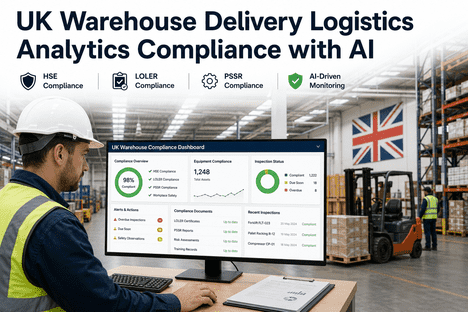
European warehouse delivery operations are facing the tightest sustainability and traceability compliance environment in their history. The EU Green Deal framework — CSRD, EU Taxonomy, CountEmissionsEU, ETS2 for road transport, and the simplified ESRS standards moving through the Omnibus I package — has converted what used to be voluntary sustainability reporting into a hard regulatory layer with audit obligations, scope thresholds, and material penalties for non-compliance. For warehouse delivery operators, the operational impact is concrete: every asset, every shift, every kWh of energy, and every kilometre of inbound and outbound transport now needs to be defensibly traceable. Manual compliance documentation cannot scale to that load. AI-driven maintenance and operations documentation can — and iFactory AI is the platform European operators are deploying to make it work. Book a Demo to see how iFactory AI turns EU Green Deal compliance into a continuous, auditable data layer rather than a quarterly reporting fire-drill.
€450M
Net turnover threshold for CSRD scope under Omnibus I
61%
Reduction in ESRS mandatory datapoints under simplified standards
2027
First reporting year under fully simplified ESRS framework
24/7
Audit-ready compliance documentation with continuous AI traceability
EU Warehouse Logistics — Green Deal Compliance
EU Warehouse Logistics Compliance: AI Maintenance Documentation for the Green Deal Era
How AI-driven asset traceability, automated maintenance documentation, and continuous compliance evidence keep European warehouse delivery operations CSRD-, EU Taxonomy-, and CountEmissionsEU-ready — without converting your operations team into a full-time reporting function.
The EU Compliance Layer European Warehouse Operations Now Operate Inside
The Green Deal is not a single regulation. It is a stacked set of reporting frameworks that each warehouse delivery operator must understand individually and then reconcile into a single defensible data trail. After the Omnibus I simplification package was approved by the European Parliament in December 2025 and finalised through Council adoption in February 2026, the scope was narrowed but the operational obligations remain real for any operation above the €450M turnover and 1,000-employee threshold — and for the supply-chain partners those operators report on.
CSRD
Corporate Sustainability Reporting Directive
Mandatory disclosure of environmental and social performance under ESRS standards. Wave 2 reporting timelines shifted to FY 2027 under Omnibus, but data infrastructure must be in place now to capture an auditable year of evidence.
EU Taxonomy
Sustainable Activity Classification
Determines whether warehouse upgrades, electrified fleets, energy-efficient equipment, and other capex qualify as "sustainable" investment. Required disclosure for CSRD-in-scope operators and a competitive financing factor for everyone else.
CountEmissionsEU
Transport GHG Emissions Standard
Harmonised EU methodology for calculating transport greenhouse gas emissions across inbound and outbound logistics. Requires consistent emissions data at the shipment and asset level — exactly where manual spreadsheets fail.
ETS2
Emissions Trading for Road Transport
Carbon pricing on road transport fuels now active across EU member states. Drives cost structures for warehouse inbound and outbound flows and forces operators to track fuel consumption with the same rigor as financial data.
The common thread across all four frameworks is that they expect continuous, granular, auditable data from warehouse operations — energy consumption per asset, fuel consumption per route, maintenance interventions with full traceability, and equipment lifecycle data. iFactory AI was built to capture exactly this evidence as a by-product of normal operations rather than a quarterly compliance project.
Worried whether your current data infrastructure can survive a CSRD assurance review? Book a Demo with iFactory's EU compliance team and we will walk you through a compliance evidence audit against your existing systems.
Why Spreadsheets and ERP Reports Will Not Survive an EU Assurance Review
The defining shift introduced by CSRD is that sustainability data must now meet the same standard and rigor as financial data. That includes audit trails, immutable records, defensible methodology, and traceability from the dashboard number back to the original sensor reading or work order entry. Spreadsheets, manual logbooks, and shallow ERP sustainability modules cannot produce that audit trail — and assurance providers know it.
Layer 1 — Asset & Sensor Data
Continuous Equipment Traceability
Energy consumption, runtime hours, maintenance interventions, and lifecycle events captured per asset from PLCs, IoT sensors, and the iFactory mobile app. Every datapoint timestamped, attributed, and immutable — the foundation of any defensible CSRD or Taxonomy disclosure.
Per-asset energy tracking
Immutable audit logs
Attribution to named users
Layer 2 — Operations Documentation
AI Maintenance & Shift Logbook
Every work order, PM intervention, shift handover, energy reading, and parts consumption captured in a single structured ledger. AI tags entries against ESRS categories automatically, so the compliance evidence is already classified at the point of capture — not retrofitted at year-end.
ESRS category tagging
e-signed shift handovers
Linked parts and energy records
Layer 3 — Compliance Reporting
Automated EU Disclosure Outputs
Direct export to CSRD/ESRS-aligned templates, EU Taxonomy alignment reports, CountEmissionsEU transport calculations, and ETS2 fuel reconciliation. Auditor-ready packages generated on demand with full drill-down from disclosure line to source record.
ESRS-aligned exports
Taxonomy alignment view
Full drill-down for assurance
Where AI Compliance Documentation Delivers the Highest ROI in EU Warehouse Operations
Continuous AI documentation only matters if it solves the specific compliance pain points European warehouse operators are running into right now. The use cases below are where iFactory deployments across EU warehouse delivery operations have shown the strongest evidence-capture impact — and each one maps directly to a Green Deal framework.
CSRD · ESRS E1
Per-Asset Energy & Emissions Tracking
iFactory ingests energy meter data, runtime hours, and asset cycle counts to compute per-asset Scope 1 and Scope 2 emissions automatically. Warehouse operators report the granular energy disclosures ESRS E1 requires without the spreadsheet aggregation work that breaks at assurance time.
100%
Asset-level energy traceability for ESRS E1 disclosures
EU Taxonomy
Sustainable Capex Evidence Capture
Asset register entries automatically capture the data points needed to evaluate Taxonomy alignment — energy efficiency class, lifecycle assessment data, end-of-life management. Warehouse capex decisions can be defended as "sustainable" with traceable evidence rather than narrative claims.
3x
Faster Taxonomy alignment review with structured asset data
CountEmissionsEU
Transport & Yard Emissions Calculation
Inbound and outbound transport activity logged at the asset and shipment level. Fuel card, telematics, and GPS data ingested into the iFactory model and converted into CountEmissionsEU-aligned per-shipment GHG calculations — ready for both customer disclosure and internal benchmarking.
95%+
Shipment-level emissions coverage from integrated telematics
ETS2
Fuel Consumption Reconciliation
Fleet fuel consumption captured from fuel cards, OEM telematics, and yard refuelling logs reconciled against ETS2 carbon pricing exposure. Operations leaders see the real-time financial impact of fuel choices and route changes — informing both compliance and cost decisions.
Daily
Reconciliation cadence for ETS2 fuel and carbon cost exposure
Manual EU Compliance Reporting vs. AI-Driven Continuous Documentation
The choice European warehouse operators face is not "do we comply" — that question is settled by regulation. The choice is whether to comply by stacking spreadsheets, consultants, and quarterly fire-drills on top of operations, or by capturing the evidence continuously from the systems that already run the warehouse. The comparison below shows what the two approaches look like in practice.
| Compliance Dimension |
Manual / Spreadsheet Reporting |
iFactory AI Continuous Documentation |
| Evidence Capture Cadence |
Quarterly or annual data collection sprints |
Continuous, captured at point of work |
| Audit Trail Defensibility |
Reconstructed retrospectively from emails and logs |
Timestamped, attributed, immutable from day one |
| ESRS Category Mapping |
Manual remapping at year-end by consultants |
AI tags entries against ESRS categories at capture |
| Per-Asset Energy & Emissions |
Estimated from monthly utility bills |
Computed live from PLC and energy meter feeds |
| Transport Emissions Data |
Carrier-provided aggregates, often incomplete |
Per-shipment data from telematics, fuel card, OEM feeds |
| Assurance Review Effort |
Weeks of data reconciliation for auditors |
Auditors drill down from dashboard to source record |
| Cost of Each Reporting Cycle |
External consultant spend plus internal team time |
Reporting embedded in operations — no separate cycle |
| Time to Generate Disclosure Package |
4 to 8 weeks of cross-functional effort |
On-demand export with full drill-down |
| Readiness for Scope Expansion |
Each new regulation triggers a fresh project |
New requirements added as configuration, not rebuild |
Stop Treating EU Compliance as a Quarterly Fire-Drill
iFactory AI captures CSRD, EU Taxonomy, CountEmissionsEU, and ETS2 evidence continuously from your warehouse operations — so the disclosure package is already built when the auditor arrives.
Book a Demo to see the compliance ledger working against your operating model.
Expert Review: What Sustainability Officers Actually Need from Warehouse Operations in 2026
Many warehouse operations leaders read the Omnibus I simplification headlines and concluded that the EU pulled back from sustainability reporting. That is not what happened. The scope narrowed to operations above the €450M turnover and 1,000-employee threshold, and the ESRS mandatory datapoints dropped from roughly 1,100 to about 430 in the simplified draft. But the operations that remain in scope — which still includes the vast majority of large European warehouse delivery operators — now face more data discipline, not less. Auditors are focusing harder on fewer datapoints, which means each remaining datapoint needs a stronger evidence chain.
For warehouse delivery operations specifically, the practical compliance problem is that ESRS E1 (climate change), E5 (resources and circular economy), and S1 (own workforce) all depend on data that lives in the maintenance and operations layer — energy consumption per asset, lifecycle traceability, hours worked per shift, safety incidents, equipment turnover. If that data lives in a paper logbook, an Excel file on a shared drive, or a shallow ERP module that does not track per-asset detail, the disclosure will not survive assurance. The infrastructure investment that matters now is the continuous operational data layer, not the reporting tool that sits on top of it.
That is exactly where iFactory AI fits in the European compliance stack. The platform is not a sustainability reporting tool — it is the operational data layer that feeds whatever sustainability reporting tool the organisation has chosen. CSRD disclosures stop being a separate project and become a query against the warehouse's continuous operational ledger. EU Taxonomy alignment for capex stops being a narrative exercise and becomes a data lookup. CountEmissionsEU calculations stop being carrier-provided aggregates and become per-shipment computations from telematics data the platform already ingests.
The warehouse delivery operations that will navigate the Green Deal smoothly are not the ones that have hired the most consultants. They are the ones that have moved compliance from an annual project into a continuous data discipline embedded in normal operations. That shift requires the right operational data infrastructure — and 2026 is the year to put it in place, before Wave 2 CSRD reporting comes due in FY 2027.
What iFactory AI Delivers for EU Warehouse Delivery Compliance
The word "compliance platform" gets used loosely. iFactory AI is specifically the operational documentation layer European warehouse delivery operators need to keep CSRD, EU Taxonomy, CountEmissionsEU, and ETS2 evidence flowing continuously rather than collected retrospectively. Here is the complete scope of what the platform contributes to the EU compliance stack.
01
Per-Asset Energy and Emissions Ledger
Continuous energy consumption, runtime, and emissions calculation per warehouse asset from PLC, energy meter, and IoT feeds — the granular evidence ESRS E1 requires for defensible Scope 1 and Scope 2 disclosures.
02
AI Shift Logbook with ESRS Tagging
Every shift handover, work order, safety event, and operational entry tagged automatically against relevant ESRS categories at capture — eliminating year-end reclassification work and reducing assurance review effort.
03
EU Taxonomy Asset Classification
Warehouse asset register fields aligned to Taxonomy criteria — energy class, lifecycle data, end-of-life pathway — so capex decisions can be defended as Taxonomy-aligned with traceable evidence rather than retrospective narrative.
04
Transport Emissions Integration
Fuel card, OEM telematics, and GPS data ingested through pre-built iFactory connectors and converted into CountEmissionsEU-aligned per-shipment emissions — feeding both internal benchmarking and customer disclosure requests.
05
Immutable Audit Trail
Every entry timestamped, attributed to a named user, and immutable. Meets the data integrity expectations of CSRD assurance providers and the broader ALCOA+ data integrity principles inherited from regulated industries.
06
Sustainability Reporting Exports
Direct exports aligned to simplified ESRS templates, EU Taxonomy alignment outputs, and CountEmissionsEU calculation summaries. Auditor-ready packages generated on demand with drill-down from disclosure line to source record.
07
Multi-Site EU Network Visibility
Single platform across German, French, Italian, Dutch, Polish, and Spanish warehouse sites with localised language, shift patterns, and reporting hierarchies. Group sustainability officers see the entire EU footprint without merging spreadsheets.
08
ERP, MES, and WMS Integration
Bi-directional connectors with SAP, Oracle, Microsoft Dynamics, SAP EWM, Manhattan, and Blue Yonder. iFactory becomes the operational evidence layer feeding the systems of record, not a parallel silo.
Want a tailored compliance evidence scope for your European operations? Book a Demo and the iFactory EU team will walk you through what continuous documentation looks like for your specific warehouse footprint.
Frequently Asked Questions
After the Omnibus I simplification, is CSRD still relevant for our warehouse operation?
Yes — for any operation with more than 1,000 employees and over €450M net turnover, CSRD remains in scope with Wave 2 reporting now due for FY 2027 under the revised timeline. Even operations below the threshold are still asked for CSRD-aligned data by customers, banks, and value-chain partners that are in scope. The infrastructure decision is the same either way: build a continuous operational data layer now, not a retrospective reporting project later.
How does iFactory AI handle the simplified ESRS standards specifically?
The simplified ESRS draft published in December 2025 reduces mandatory datapoints from roughly 1,100 to about 430. iFactory's data model is structured around the operational evidence those simplified datapoints require — per-asset energy, lifecycle data, transport emissions, safety incidents, and workforce hours. As the simplified ESRS are finalised through the Commission delegated act process expected around summer 2026, the platform's tagging and export templates update accordingly without requiring customer-side rework.
Does iFactory replace our sustainability reporting platform like Normative or Coolset?
No — iFactory is the operational data layer that feeds those reporting platforms with defensible warehouse-level evidence. Sustainability reporting tools produce the final CSRD disclosure document; iFactory ensures the underlying warehouse operations data (energy, emissions, maintenance, lifecycle) is captured continuously, attributed, immutable, and auditable. The two layers work together rather than competing.
What does deployment across multiple EU sites typically look like?
Most EU multi-site rollouts complete within 6 to 10 weeks. The platform supports localised language, country-specific shift patterns, regional regulatory variations, and consolidated group-level reporting. Pilot sites typically go live first, followed by phased rollout to additional warehouses with a shared reference configuration. Each new site benefits from lessons learned across the existing fleet.
How does iFactory align with broader EU data integrity expectations?
Every entry is timestamped, attributed to a named user, e-signed where required, and immutable — meeting ALCOA+ data integrity principles (Attributable, Legible, Contemporaneous, Original, Accurate, plus Complete, Consistent, Enduring, Available) that European auditors apply across regulated and increasingly across non-regulated disclosures. This is the same data integrity standard pharmaceutical and food manufacturers have used for years, applied to warehouse delivery sustainability evidence.
iFactory AI — EU Warehouse Compliance
Build the Continuous Compliance Layer Before Wave 2 CSRD Reporting Comes Due.
CSRD, EU Taxonomy, CountEmissionsEU, and ETS2 evidence captured continuously from your European warehouse operations — auditor-ready when the assurance review arrives.