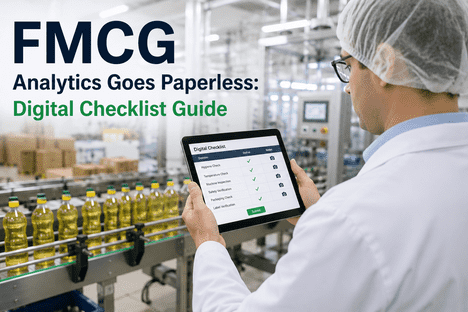
The FMCG quality and maintenance manager's clipboard contains the same forms it held five years ago. Daily startup checks printed from a Word template last updated when the plant was commissioned. Cleaning verification logs completed with a ballpoint pen and filed in a three-ring binder that has not been opened since the last audit. Temperature and pressure readings transcribed from digital displays onto paper forms and entered into a spreadsheet by the evening shift administrator. The waste generated by paper-based maintenance and quality documentation is measurable: 45 minutes per shift per technician spent locating, completing, and filing paper forms; 12-18% of inspection data lost or illegible before it reaches the digital record; 30-45 days between data collection and analysis for trend identification; and an average of 14 hours per audit spent locating paper records across the plant. FMCG analytics goes paperless by replacing every paper form, clipboard, and binder with mobile digital checklists that capture data at source, validate completeness in real time, attach photo evidence automatically, and feed every inspection result into a searchable digital record that is available for analysis within seconds of form completion not weeks after the fact.
FMCG Analytics Goes Paperless: The Digital Checklist Guide for Food Manufacturing
iFactory AI replaces every paper form, clipboard, and binder in your FMCG plant with mobile digital checklists, photo documentation, and automated compliance records cutting data collection time by 50% and audit preparation by 80%.
Why Paper-Based Checklists Are Costing FMCG Plants More Than They Realize
Paper checklists appear inexpensive a ream of paper costs a few dollars and a clipboard costs less than a replacement sensor. But the hidden costs of paper-based data collection in FMCG manufacturing compound across every shift, every line, and every audit. The following metrics are measured from documented FMCG plant transitions from paper to digital checklists using iFactory AI's paperless analytics platform.
The Paper-to-Digital Transition Challenges in FMCG Manufacturing
FMCG plants attempting to transition from paper to digital checklists face a set of operational challenges that do not exist in office environments. The production floor is wet, dusty, and subject to strict hygiene protocols. Technicians wear gloves that do not work with capacitive touchscreens. Network connectivity is unreliable in processing areas with stainless steel walls and refrigeration systems. Regulatory auditors require proof that every checklist was completed by an authorized person at the required time with no opportunity for back-dating. These constraints have kept many FMCG plants on paper despite knowing the waste it generates. iFactory AI's paperless analytics platform was designed specifically for these conditions.
Gloved-hand data entry on wet production floors
Standard touchscreens fail in FMCG environments where operators wear cut-resistant gloves, latex gloves, or thick rubber gloves for cleaning protocols. iFactory's mobile interface supports large-button layouts, voice-to-text input, barcode scanning, and photo capture all operable with gloved hands or via simple tap targets that accommodate wet or greasy fingers. The interface is designed for the production floor, not the office cubicle.
Offline operation in areas with limited connectivity
FMCG processing areas with stainless steel cladding, walk-in coolers, and freezer storage create dead zones where cellular and WiFi signals cannot reach. iFactory's mobile app operates fully offline, caching checklist responses, photo attachments, and timestamps locally on the device. When the technician returns to a connected area, all data syncs automatically with server-side validation that ensures no records are duplicated or lost even after extended offline periods.
Audit-proof digital records with tamper-evident timestamps
Regulatory auditors require documented proof that every inspection occurred at the required time. iFactory's digital checklists capture timestamps at the moment of form opening, each data entry, and final submission with SHA-256 hashing that detects any post-submission modification. The audit trail shows exactly who completed each item, when, on which device, and whether any data was entered after the initial submission. This level of documentation is not achievable with paper forms.
The iFactory AI Paperless Transition Framework: From Pilot to Plant-Wide Rollout
iFactory AI's paperless deployment model follows a structured four-phase approach that minimizes disruption to production operations while building momentum for plant-wide adoption. Each phase delivers measurable value before the next phase begins, ensuring that the business case compounds with every checklist digitized.
Checklist Audit & Digital Design
Audit every paper form used in the plant: startup checklists, cleaning logs, temperature records, inspection forms, and handover sheets. Digitize each form into iFactory's checklist builder with conditional logic, photo attachments, barcode scanning, and required fields. Deliverable: Digital checklist library covering all plant processes.
Pilot Line Deployment
Deploy digital checklists on one production line or department. Train operators and technicians on the mobile app. Run paper and digital in parallel for one week to validate data quality and identify workflow gaps. Measure time savings and data completeness against paper baseline. Timeline: 2 weeks.
Plant-Wide Rollout
Deploy across all production lines and departments in phased waves. Each wave includes standardized checklist templates, mobile device provisioning, operator training, and go-live support. Lessons from each wave feed into the next, continuously improving deployment efficiency. Timeline: 3-5 departments every 2 weeks.
Analytics Activation & Continuous Improvement
With all checklists digital, activate real-time analytics dashboards that show compliance rates, completion times, and trend data across all lines. Identify recurring issues, training gaps, and process improvement opportunities from the accumulated digital dataset. Establish ongoing checklist optimization cycle.
Book a Demo to review the paperless transition framework for your FMCG plant.
Digital Checklist Capabilities That Enable FMCG Paperless Operations
The following platform capabilities are designed specifically for FMCG manufacturing environments where hygiene protocols, regulatory compliance, and production continuity are non-negotiable.
Photo Documentation with Tamper-Evident Metadata
Every photo captured through iFactory's digital checklists is embedded with device ID, GPS coordinates, timestamp, and a SHA-256 hash that detects any post-capture modification. For FMCG plants documenting cleaning verification, equipment condition, or quality issues, photo evidence becomes audit-ready at the moment of capture — no separate camera, no file naming, no upload step.
Conditional Logic & Required Field Validation
Paper forms cannot enforce completeness. A technician can skip a temperature reading on a paper form and the omission is discovered only during audit — weeks or months later. iFactory's digital checklists enforce required fields, conditional logic that shows or hides sections based on previous answers, and range validation that flags out-of-spec readings at the moment of entry. Incomplete forms cannot be submitted.
Real-Time Compliance Dashboard & Automated Record Retention
Every completed digital checklist feeds into a real-time compliance dashboard that shows completion rates by line, shift, and checklist type. Overdue checklists generate automated alerts to supervisors. Completed records are retained in searchable digital storage with configurable retention policies that meet regulatory requirements — eliminating the physical storage space and retrieval time associated with paper archives.
You do not need to replace your entire operations system. You need a digital layer that replaces the clipboard. Book a Demo to see how iFactory AI digitizes your existing paper checklists in days, not months.
Industry Perspective On Paperless Analytics Transition in FMCG Manufacturing
"The FMCG industry has been paper-dependent for so long that most plant managers have stopped questioning whether the clipboard is the best tool for the job. But when you look at the data, it is clear that paper is not just inefficient — it is a compliance risk. I have been through SQF and BRC audits where 30% of the time was spent waiting for someone to locate paper records. With digital checklists, that time drops to zero. Every record is searchable, every timestamp is verifiable, and every photo is geo-tagged and hashed. The technology has been ready for years. What changed is that FMCG plants now have mobile devices that work with gloved hands, offline connectivity that syncs automatically, and analytics platforms that turn inspection data into actionable insights within seconds. The paperless transition is not a future initiative. It is a competitive necessity for any FMCG plant that wants to reduce waste, improve compliance, and free technician time for value-added work."
FMCG Paperless Analytics & Digital Checklists Frequently Asked Questions
The Paperless FMCG Plant Is Not a Future Vision. It Is a Decision You Can Execute This Quarter.
The technology stack for paperless FMCG analytics exists today: mobile devices that work with gloved hands in wet environments, offline-capable apps that sync automatically, tamper-evident digital records that satisfy regulatory auditors, and analytics dashboards that turn inspection data into actionable insights within seconds of form completion. Every paper form in your plant startup checklists, cleaning logs, temperature records, quality inspections, handover sheets can be digitized within weeks using iFactory AI's paperless analytics platform.
The question is not whether your FMCG plant will go paperless. The question is whether you will lead the transition or follow it. Book a Demo to see how iFactory AI digitizes your existing paper checklists and transforms your FMCG plant into a paperless analytics-driven operation.
Ready To Take Your FMCG Plant Paperless with Digital Checklists?
You have seen the data on paper waste and the framework for digital transition. Now see iFactory AI in action on your own plant's checklists. We will digitize one of your existing paper forms in under 30 minutes during a live walkthrough.